
Your compensation cycle opens in 14 countries, each with its own currency, statutory holdback, and approval workflow. Your spreadsheets link at the edges, but a single FX swing can distort budget visibility by thousands of dollars overnight. For organizations running multi-country allocations, the failure point is rarely the compensation decision itself. It is the budget control layer that cannot track live spend across currencies, reallocate mid-cycle without a vendor ticket, or produce an auditable trail from a posted pay range back to a documented budget amount.
Generic FP&A tools forecast total workforce cost for finance, but they do not enforce budget guardrails at the point of a manager's decision. That distinction is critical. A compensation management platform is software that enforces those guardrails, tracks spend in real time, and prevents overspending before approvals happen. In 2026, the rise of pay-range transparency laws in regulated markets makes the platform a compliance mechanism that carries legal weight.
CompUp starts at $3 per employee per year and keeps its multi-currency engine and compliance dashboards native. This article maps the four best platforms ranked for complex multi-country budget allocations, the features that separate leaders from laggards, and the integration risks you cannot afford.
This is what HR and rewards leaders need to know before evaluating a compensation platform for multi-country budget allocations:
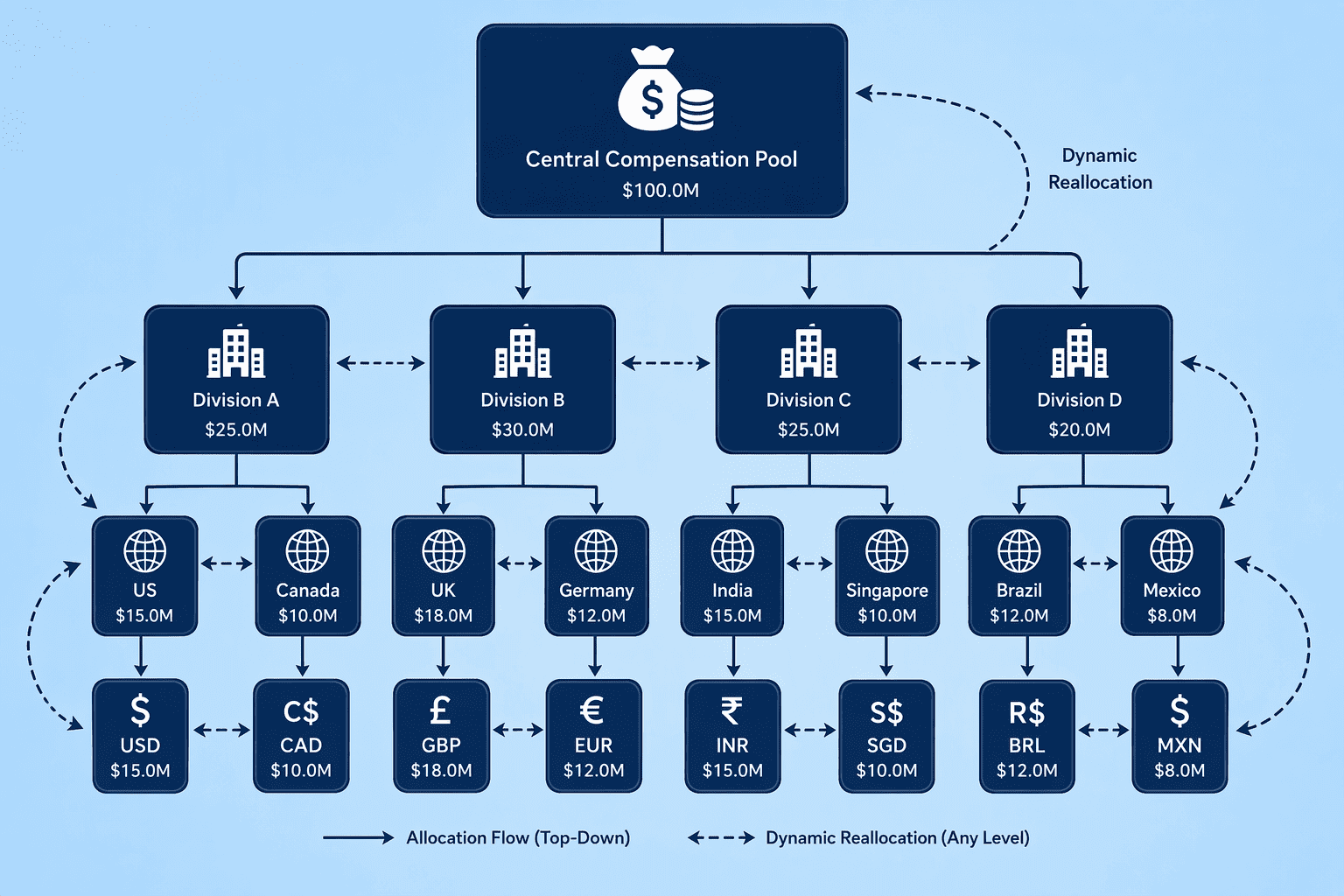
CompUp approaches multi-country compensation as an orchestration challenge. Its platform keeps a multi-currency engine, real-time budget simulation, and statutory change modeling native to the core product, so HR teams configure everything in one place. Starting at $3 per employee per year, it fits organizations that need to move fast across borders without a custom development cycle.
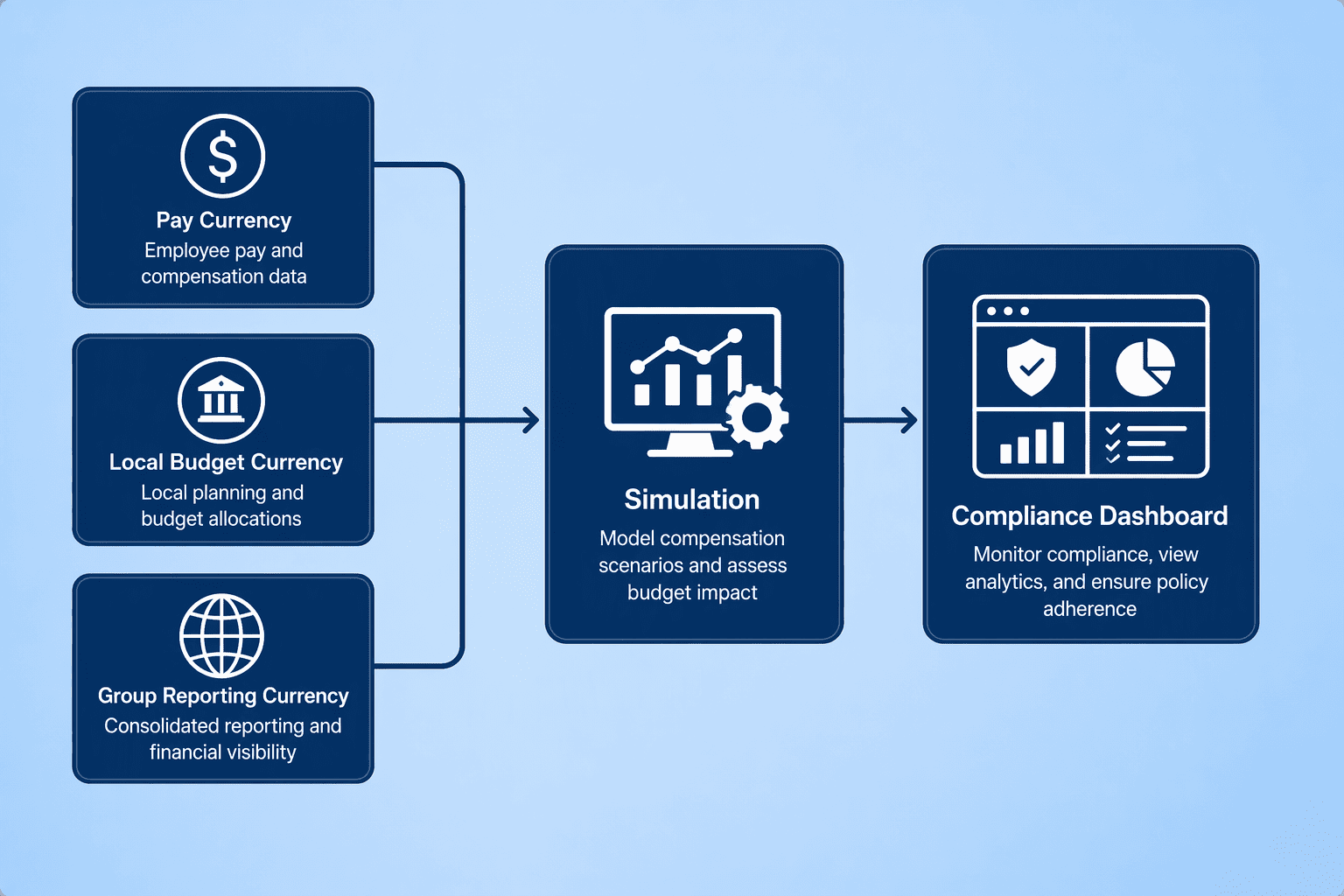
A key differentiator is how CompUp separates pay currency, local budget currency, and group reporting currency as distinct fields. A fictional £200,000 budget remains £200,000 even if the translated USD report changes from $250,000 to $260,000. Managers never misinterpret FX movement as new spending capacity. The platform surfaces this directly in its simulation layer.
Compliance dashboards lock in the new guardrails and generate an auditable trail. That matters when a posted pay range in a regulated market must trace back to a documented budget amount. The system also handles proration and holdback precision for mid-year hires across time zones, a feature that derails manual processes.
CompUp serves over 200 global companies and integrates with BambooHR, Lattice, Darwinbox, and Workable, making it a deployable choice for mid-market and growth-stage enterprises.
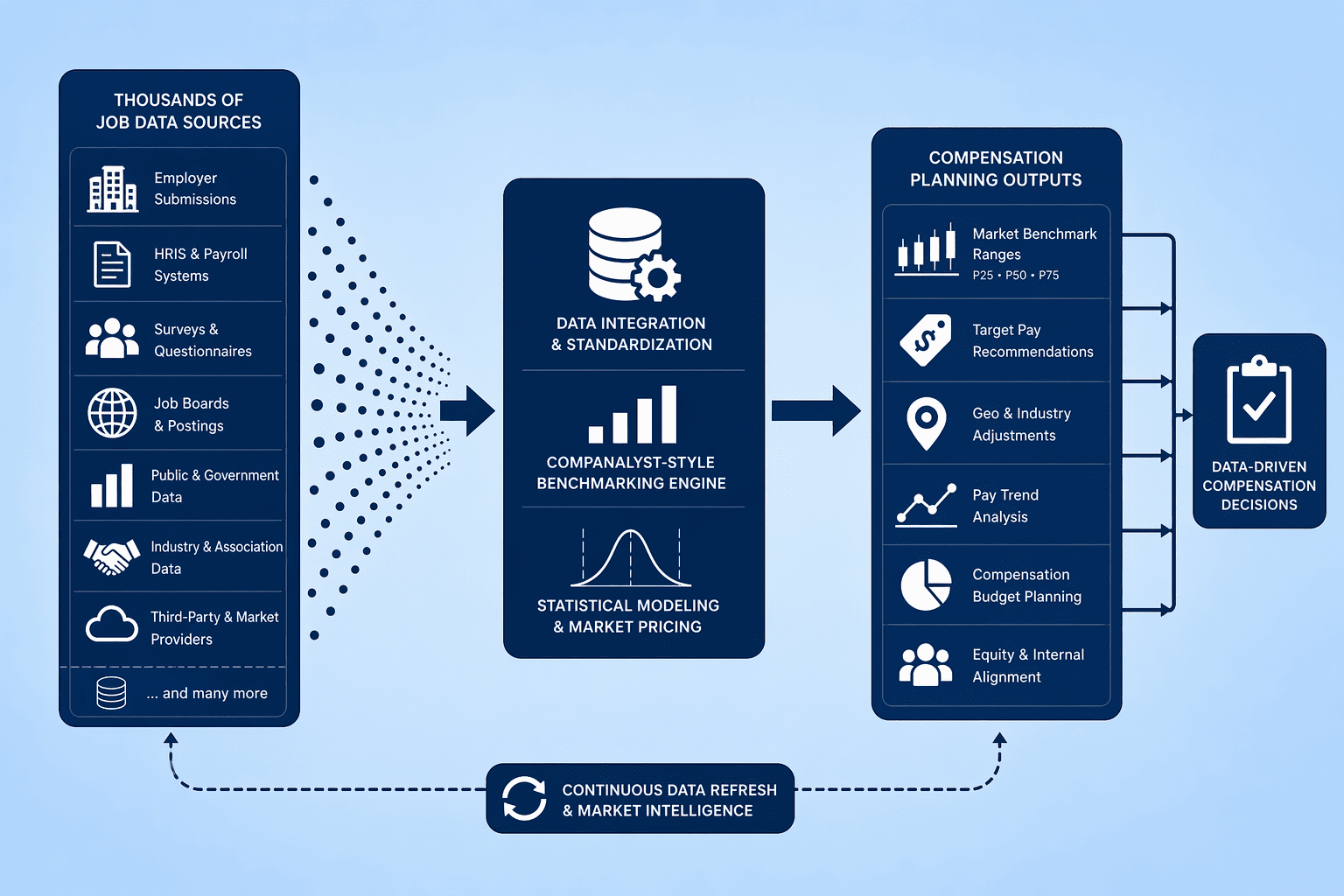
Payscale fits when the main problem is data depth, and you don't need to reallocate budget in real time. Through CompAnalyst, the platform brings together market data from 1.4M+ jobs across 225 industries. That gives you a broader benchmarking base than most budget-focused tools. If your company runs annual compensation reviews and anchors pay in external data, this setup handles it well.
AI-driven job matching and pricing speed up role-level decisions. That matters when a global expansion forces you to create salary bands in unfamiliar markets fast. Coverage includes the US and 26 countries worldwide. The multi-currency budget controls, however, are less flexible than those in Compport or CompUp.
Pick Payscale when market data integration matters more than live cross-currency reallocation or mid-cycle budget shifts without vendor support.
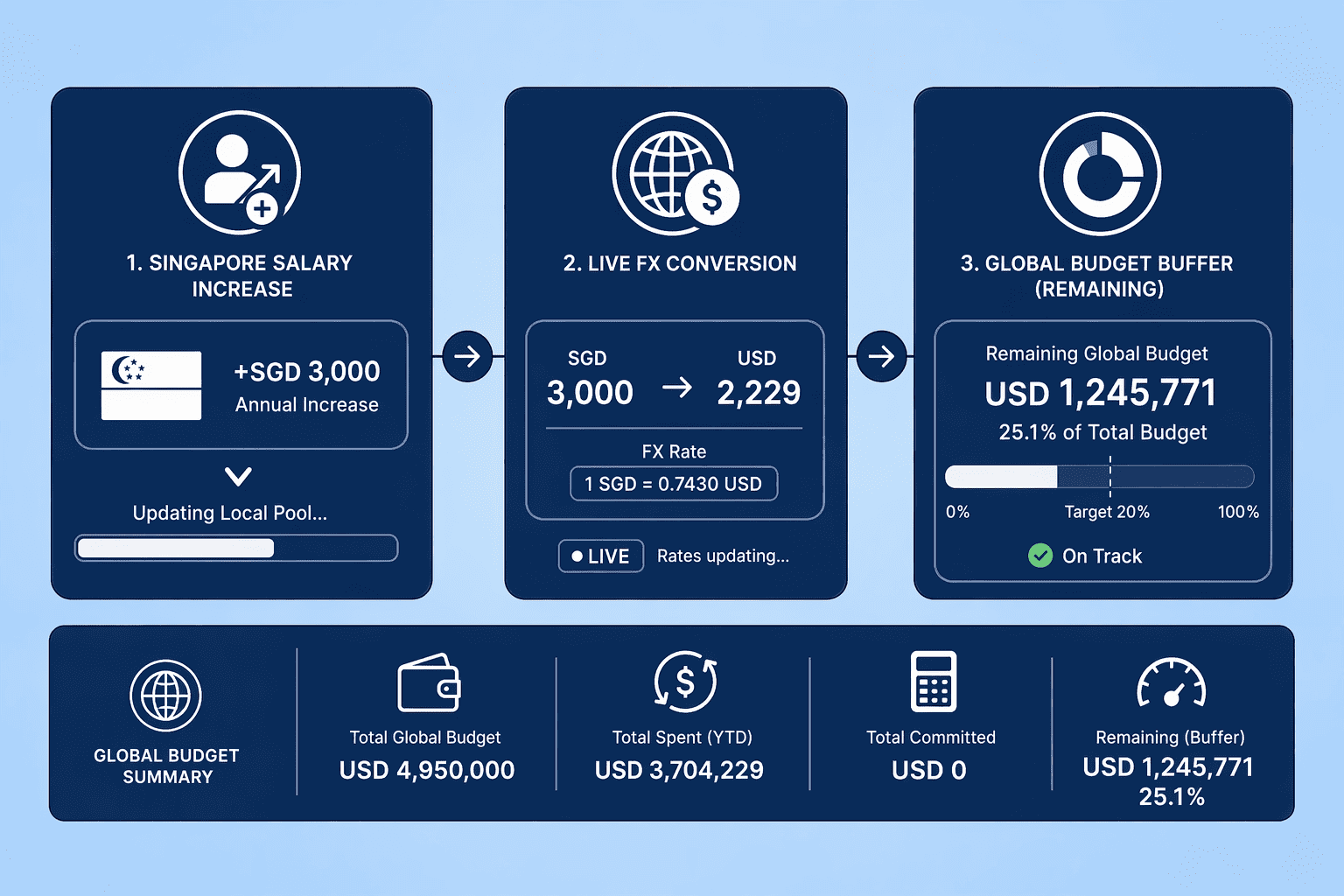
A multi-country compensation cycle moves fast. A manager in Singapore approves a 7 percent increase at 10 a.m., and by the time the CFO checks the dashboard at noon, that spend must be reflected against the Singapore pool, converted at the live FX rate, and measured against the remaining global buffer. Real-time budget-vs-actual tracking delivers that visibility. It makes compensation a live financial control, not a hindsight report.
Compensation budgeting software enforces pools at the point of decision and tracks spend in real time across currencies. Without it, overspend hides inside stale spreadsheets until the cycle closes. Weak budget controls, not bad compensation decisions, cause most failures. CompUp's simulation layer models the downstream impact before a manager hits submit.
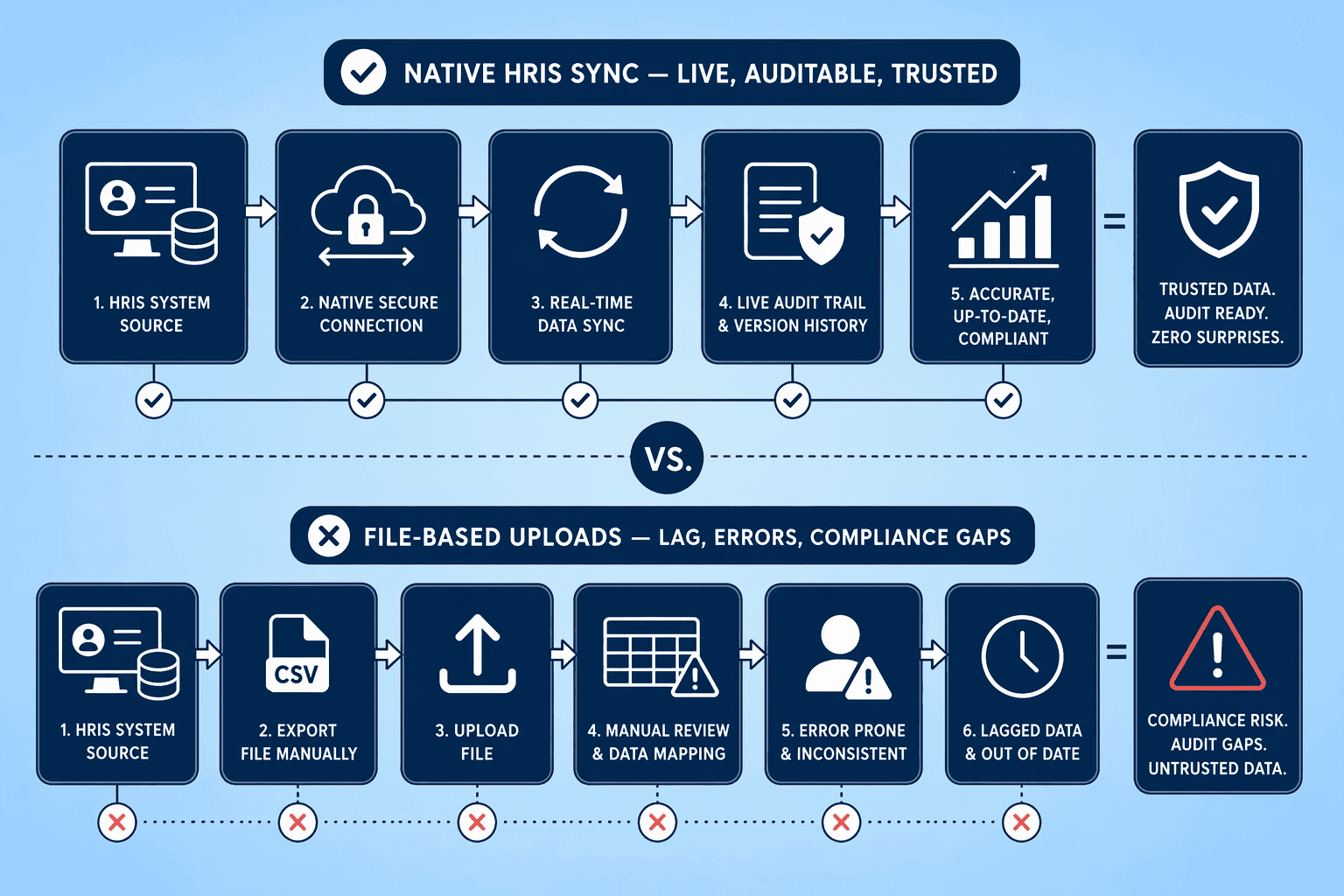
How your compensation platform connects to your HRIS determines whether your compliance trail is continuous or gap-filled. Native HRIS sync creates a live, auditable link between employee records and budget allocations. File-based uploads introduce lag and manual error risks that regulators may not accept.
| Integration Method | Data Flow | Compliance Trail Quality | Error Risk | Implementation Speed |
|---|---|---|---|---|
| Native HRIS sync | Real-time, bidirectional | Continuous, auditable at the record level | Low (machine-to-machine) | Slower initial setup, minimal ongoing overhead |
| File-based uploads | Batch, typically CSV or XLSX | Fragmented, dependent on manual version control | High (cut-paste errors, stale data) | Fast to start, high maintenance over time |
| Hybrid (API + flat file) | Varies by vendor | Depends on which ingestion path the record took | Moderate, with reconciliation burden | Medium, requires ongoing monitoring |
Native integration gives you a real-time, bidirectional feed. The moment HR updates a record, your comp platform reflects it. That continuous link builds an audit trail at the record level. Auditors can trace every dollar, every approval, every change to a specific employee record without hunting through email attachments. File-based processes break that chain. A spreadsheet exported Friday is stale by Monday morning. Someone copies a cell wrong, or sorts data out of sync, and the entire budget reconciliation drifts.
Salary planning software that connects directly to your HRIS avoids the manual cut and paste errors that come with spreadsheets. When data flows machine to machine, there is no opportunity for a mistyped digit or a filtered column that excludes a department. The compliance logic lives in the connection itself. Approval workflows, eligibility rules, and budget limits apply to live data rather than a frozen snapshot. That consistency matters during an audit, where one stale record can unravel months of careful documentation.
Implementation speed works differently than most teams expect. File uploads get you running in an afternoon, but the maintenance hours stack up fast. Every payroll cycle means a new export, a new validation pass, and a new set of reconciliation steps. Native sync takes longer to configure up front, requiring API credentials and field mapping. After that initial work, the ongoing lift nearly vanishes. The connection stays live and self-healing, with no weekly export duties and no version-control chaos.
Compliance risk concentrates in the gaps between manual steps. When compensation data sits in spreadsheets, it ages the second someone downloads it. A promotion entered in the HRIS on Wednesday morning does not reach the spreadsheet someone prepared Tuesday evening. That gap means compensation decisions happen on outdated data, sometimes for days. A live sync gives you a platform where the budget you approve is the budget you execute, with every change reflected immediately and every record traceable to its source.
Multi-country budget allocations demand a platform that enforces guardrails at the point of decision, tracks live spend across currencies, and produces an auditable trail from a posted pay range back to a documented budget. CompUp gives mid-market teams scaling across 15-plus countries frictionless global orchestration at an accessible price. Evaluate the rest through the lens of your dominant constraint: data richness for Payscale, complex rule engines for beqom, or SAP integration for SuccessFactors. A good next step is seeing how CompUp puts this into practice.
A compensation management platform is software that enforces budget guardrails, tracks spend in real time, and reallocates mid-cycle across entities and currencies. It differs from FP&A tools by operating at the point of manager decision, not just reporting, and supports multi-country allocations through live budget-vs-actual tracking, cross-currency reallocation, and auditable compliance trails.
CompUp is a strong choice for frictionless global orchestration, with native multi-currency simulation and compliance dashboards serving 200+ companies. Starting at $3 per employee per year, it keeps its multi-currency engine and budget simulation native to the core product.
CompUp separates pay, local budget, and reporting currencies to prevent FX misinterpretation, models statutory changes in real time, and generates auditable dashboards. Its starting price of $3 per employee per year makes it accessible for teams managing 15+ countries without custom development.
Look for real-time budget-vs-actual tracking across currencies, mid-cycle reallocation without vendor tickets, proration and holdback precision, native HRIS sync rather than file-based uploads, and an auditable trail linking pay ranges to documented budgets. These features separate purpose-built compensation platforms from generic FP&A tools.
Payscale excels at broad market data integration through CompAnalyst, beqom handles complex pay rules and total rewards for large enterprises, and SAP SuccessFactors Compensation offers deep integration for SAP-centric organizations. Each serves different priorities beyond budget allocation.
Multi-country budgeting requires managing multiple currencies, statutory holdbacks, and time zones while maintaining a single auditable compliance trail. A posted pay range in a regulated market must trace back to a documented budget amount, so the platform must handle proration, reallocation, and FX translation as compliance actions, not just calculations.
Community Manager (Marketing)
As a Community Manager, I’m passionate about fostering collaboration and knowledge sharing among professionals in compensation management and total rewards. I develop engaging content that simplifies complex topics, empowering others to excel and aim to drive collective growth through insight and connection.
Revolutionizing Pay Strategies: Don't Miss Our Latest Blogs on Compensation Benchmarking