
Your compensation review cycle is weeks late. Managers are emailing messy spreadsheets with errors, your CHRO has no visibility into budget drawdown, and an employee just forwarded a Glassdoor salary range that makes your bands look ten years old. The quiet cost is harder to see: 32% of employees cited unfair pay as their key reason to quit a role, according to Mercer's 2025 to 2026 report. Every year you delay fixing that inequity costs an organization an average of $439,000 more, Gartner research shows.
The category of software built to fix this has moved on. Compensation planning tools are no longer just spreadsheet replacements. They have split into two distinct work types: strategic compensation planning, which establishes your long-term philosophy and pay structures, and compensation review planning, which executes recurring merit cycles, promotions, and bonus allocations.
The 2026 vendor landscape is crowded. The ISG Buyers Guide evaluated 20 providers, naming Salary.com, Oracle, and Anaplan the top three overall, with ADP, Pave, Payscale, beqom, SAP, and Workday rated Exemplary. But rank tables do not tell you which tool solves your specific headache. This guide compares the top platforms by distinct operational strength so you can pull the right lever.
These tools solve different organizational problems, so picking the right one depends on whether your bottleneck is bad data, clumsy planning workflows, or a fragmented tech stack.
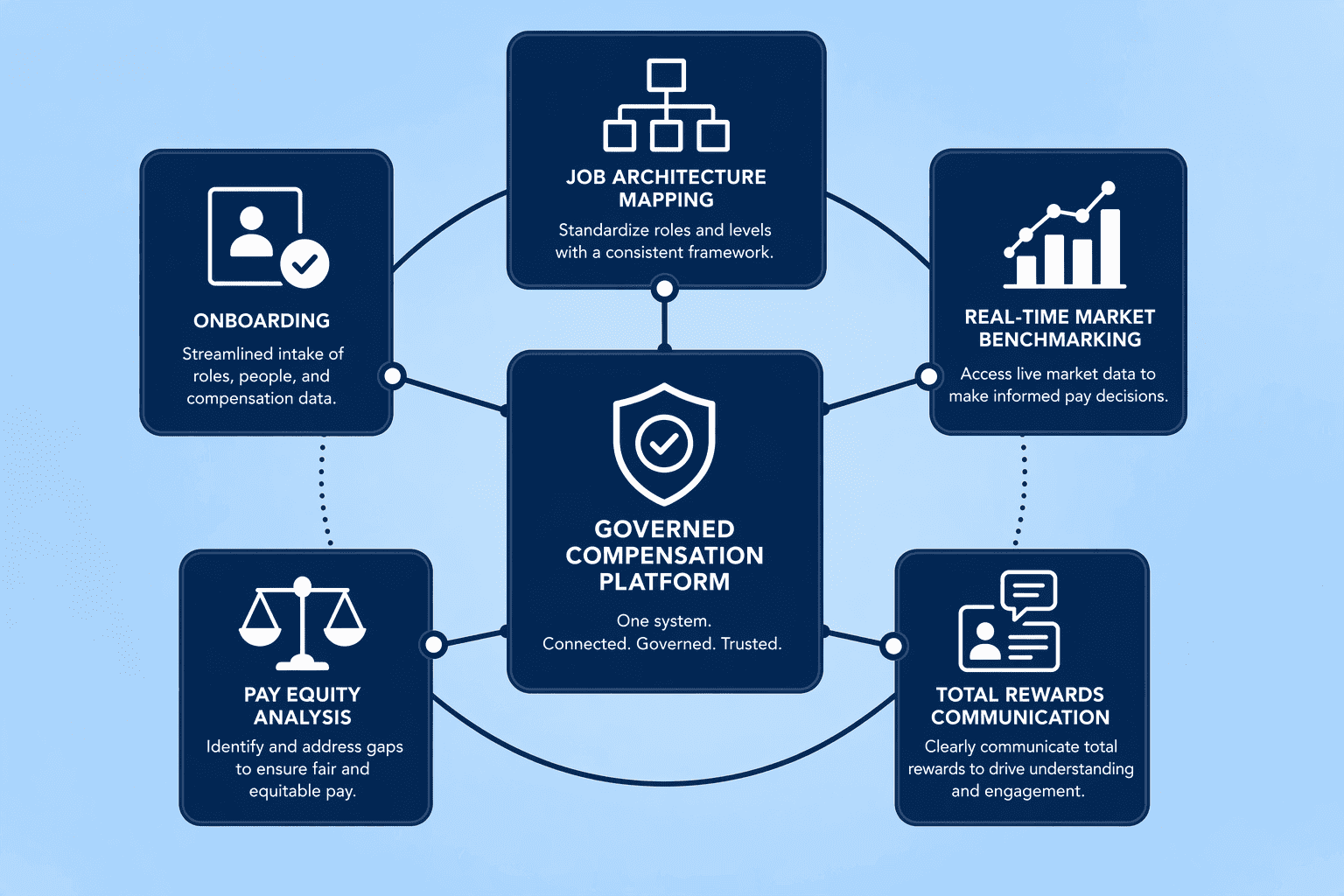
CompUp is a purpose-built compensation platform that collapses the gap between strategic planning and review execution. Its onboarding engine automates job architecture mapping and links roles to continuous market data instead of point-in-time survey snapshots. For a team that needs benchmarking, pay equity analysis, and total rewards communication inside one governed system, it is the most unified option available.
Traditional survey-based providers deliver a file once a quarter or once a year. CompUp pulls industry-specific compensation data in real time, which means your bands reflect what the market is doing today, not what it did six months ago. That shift matters operationally.
When a manager opens a merit recommendation, the benchmarking context is already current. The built-in pay equity analysis flags controlled and uncontrolled pay gaps during the review cycle itself, so remediation proposals happen at the point of decision rather than in a separate compliance sprint months later. At appraisal close, the platform generates personalized Total Rewards Statements automatically.
CompUp is a specialist platform priced starting at $3 per employee per year, with integrations to systems like BambooHR, Lattice, Darwinbox, and Workable. The ISG report notes that AI-assisted recommendations must remain explainable and reviewable with auditable controls. CompUp addresses that by keeping the compensation decision with the manager and HR team underpinned by a governed, auditable logic. For organizations prioritizing speed to a governed compensation posture over a 12-month platform migration, the CompUp model rewards decisiveness.
Salary.com owns the survey conversation. Its compensation management platform, CompAnalyst, draws on one of the largest proprietary survey libraries in the industry. If your compensation function lives and dies by deep, survey-sourced market data and methodological defensibility, Salary.com is the default starting point. The ISG Buyers Guide ranked it among the top three providers overall for 2026.
The core workflow is straightforward market pricing at scale. CompAnalyst's AI-powered job matching with confidence scoring maps your roles to benchmark jobs and flags where the match quality is weak. The methodology holds up when a comp team has to defend its ranges to a CFO or board.
Where Salary.com has stretched recently is in cycle management. CompXL Max, its newer module, connects the survey data directly to merit and bonus planning cycles with a potential flight risk indicator. When a base salary dips below the market minimum, the system flags it inside the review workflow. That tightens a loop that used to require a separate analytics step.
For organizations still running incentive compensation on spreadsheets ( roughly 47% still do), Salary.com's structured data foundation is a meaningful upgrade. The trade-off is that you are buying into a survey-centric model. Companies that want continuous, real-time data feeds instead of periodic survey publications will find the fit awkward.
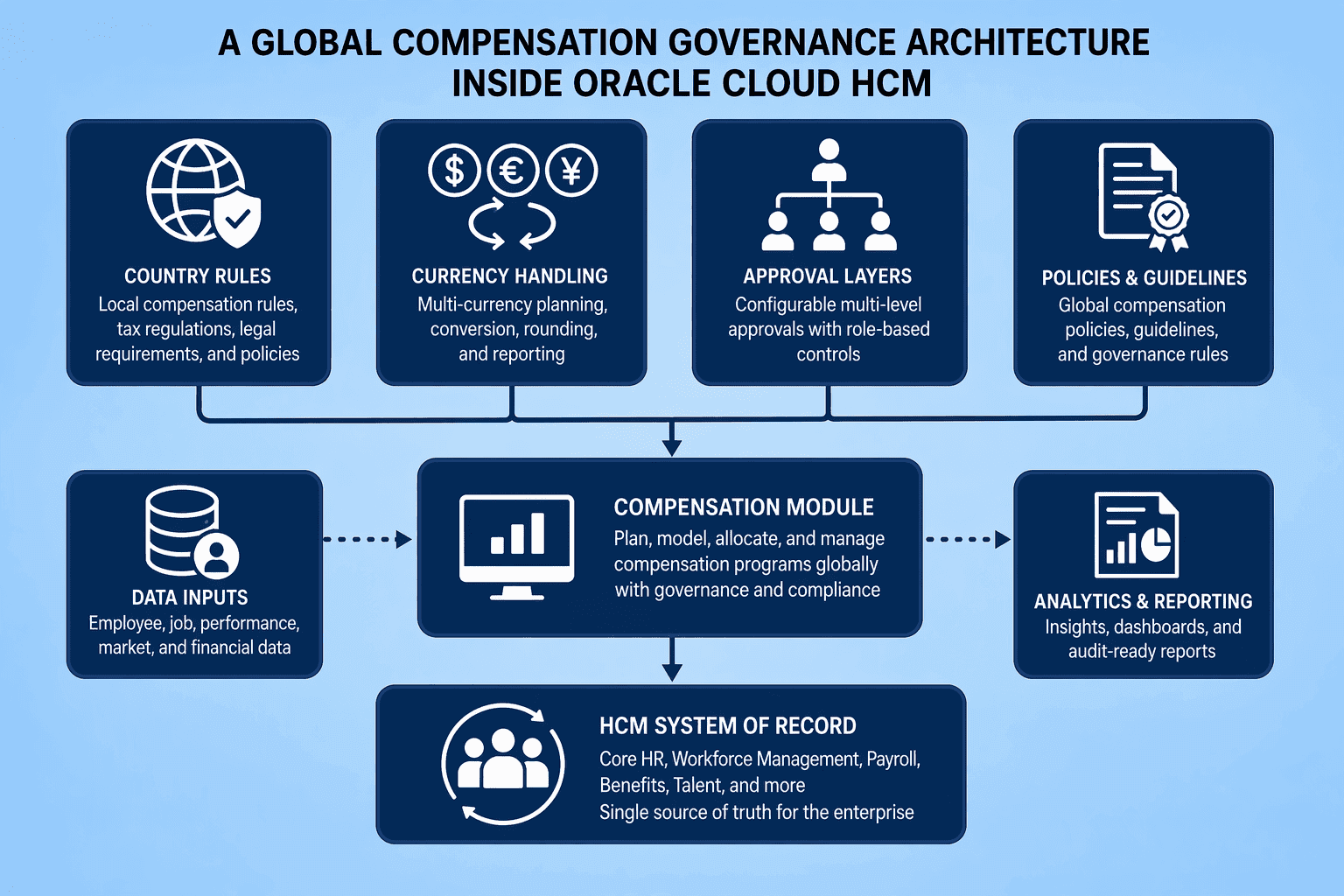
Oracle's Workforce Compensation module fits large enterprises already inside the Oracle Cloud HCM ecosystem that need multi-country governance rather than point-solution speed. The ISG Buyers Guide named Oracle a top-three provider alongside Salary.com and Anaplan.
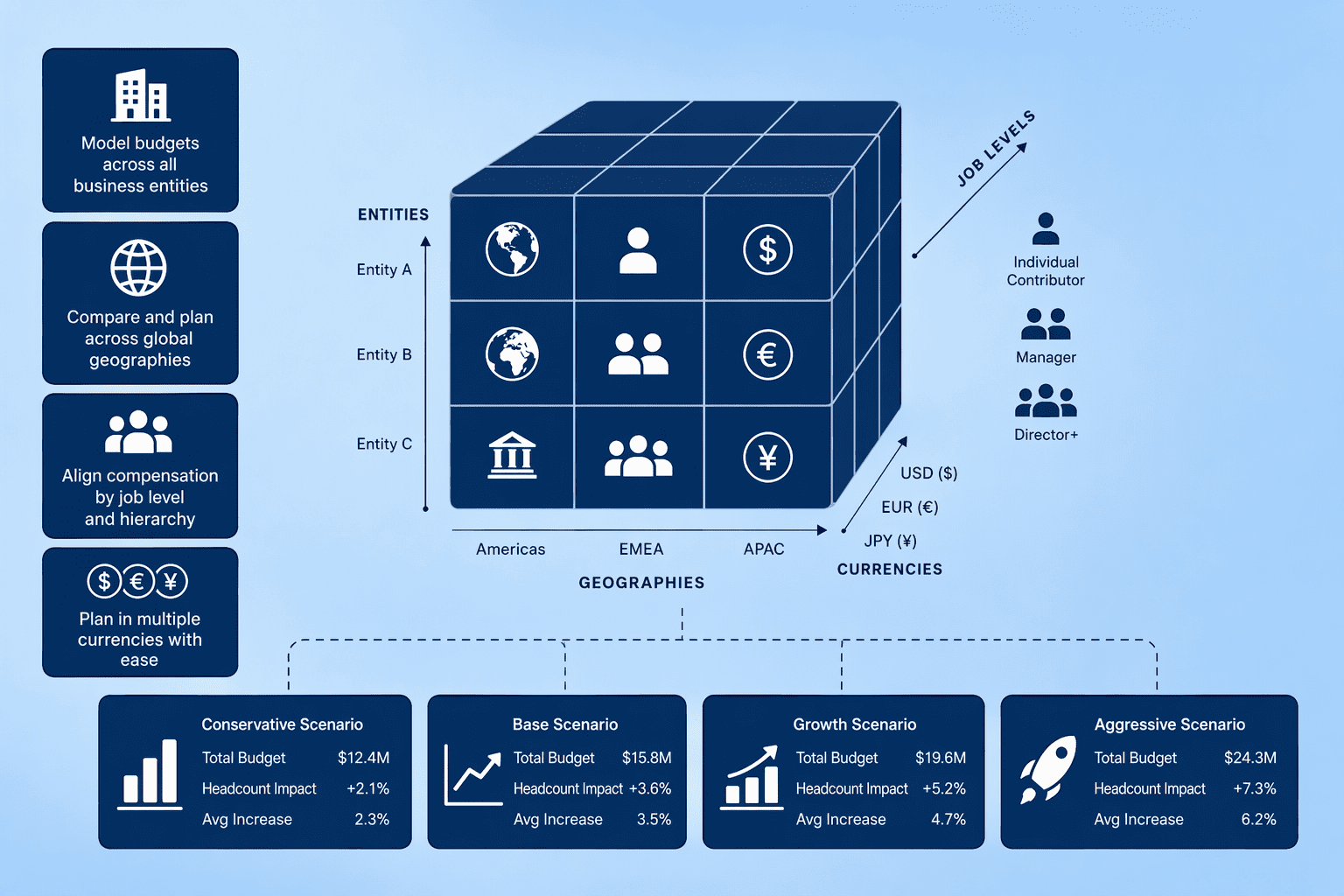
Anaplan treats the compensation budget as a connected financial model that sits at the intersection of Finance and HR. When a business runs scenarios across entities, geographies, job levels, and currencies simultaneously, Anaplan is the only credible choice. ISG named it a top-three provider overall, specifically citing its multidimensional modeling capability.
| Capability | Anaplan | Typical Planning Tools |
|---|---|---|
| Scenario dimensions | Financial, geographic, role-based, and currency-level simultaneously | Fixed in-product models, limited cross-dimension toggling |
| Calculation engine | In-memory, real-time recalculation across connected models | Batch or refresh-dependent recalculations |
| User profile | Finance and Total Rewards leaders modeling budget allocation | Primarily HR/Comp admins running review cycles |
| Implementation effort | High; requires dedicated model-building expertise | Low to moderate; configuration-led onboarding |
The modeling power is real, but the learning curve is steep. Anaplan is not a compensation tool you switch on in four to six weeks. It requires specialized model-building resources and disciplined governance. Organizations that make it work are typically those where the compensation function reports jointly into Finance and HR. The binding constraint in those orgs is budget modeling complexity. Benchmarking data freshness and cycle-execution speed are secondary concerns.
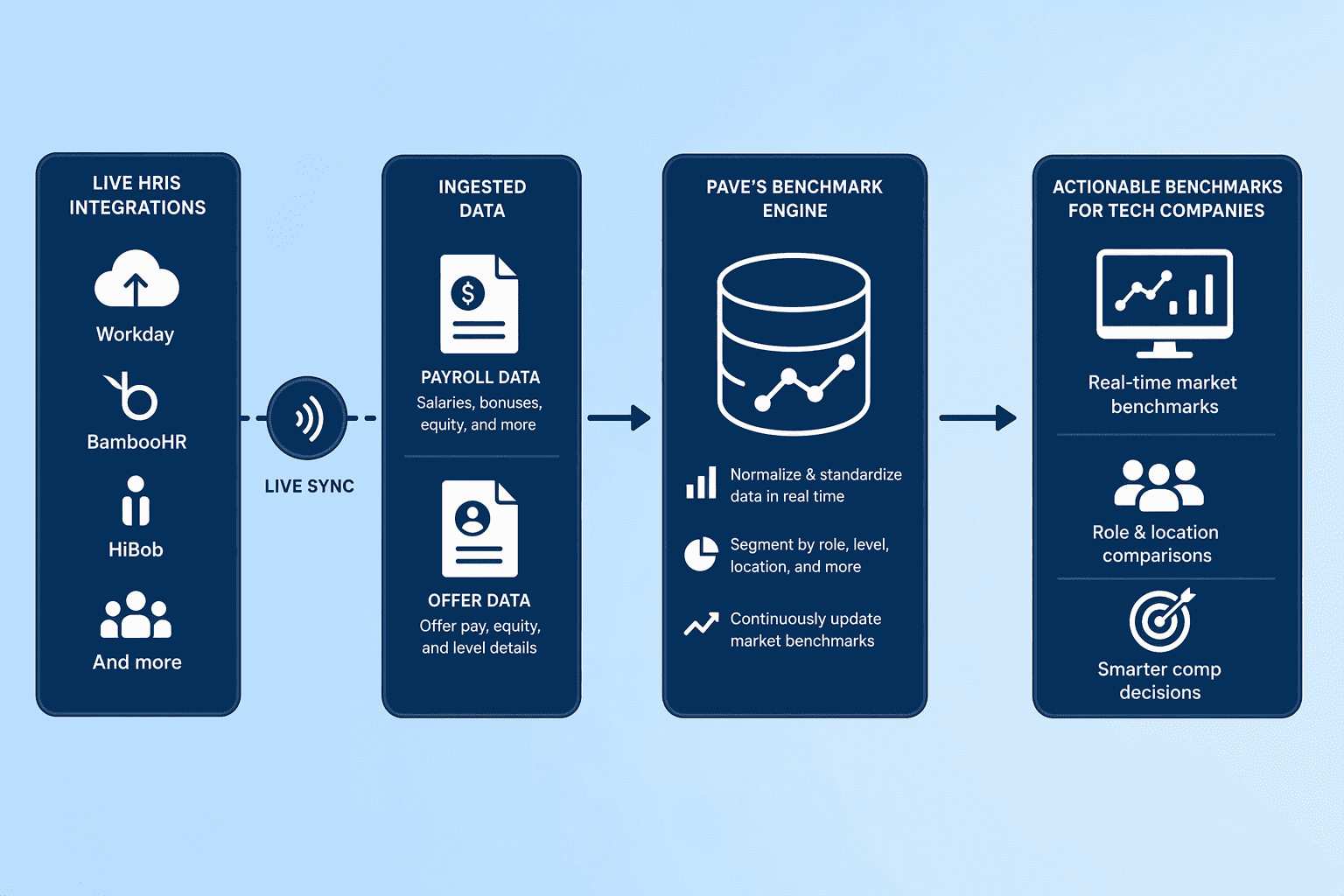
Pave negotiates compensation data differently than every other player on this list. It pools market data from more than 9,000 companies through live HRIS integrations, which means its benchmark engine reflects real offers and real payroll, not survey self-reports. For a Series C startup or a mid-cap tech firm competing on total cash, that data model matters.
ISG rated Pave Exemplary in the 2026 Buyers Guide, and its product focus confirms the specialization. The platform does not try to model budget scenarios across business units or manage global governance rules. It does three things tightly: real-time market data ingestion, compensation review workflows, and attrition risk signaling that ties comp decisions directly to retention. When a manager adjusts a base salary, Pave surfaces data on how employees at that compa-ratio have attrited in the past.
Pave's strength is sector-specific. It dominates in technology and high-growth environments where market data moves monthly, not annually. If you are running a manufacturing compensation plan or a government pay structure with fixed grade steps, Pave's data set is less relevant.
The ISG report emphasizes that AI-augmented recommendations must remain explainable with auditable controls. Pave meets this by surfacing data layers on the screen for comp reviewers, not hiding the logic behind a recommendation engine. It is built for operators who want to interrogate the data, not inherit a number.
For an organization running ADP Workforce Now or ADP RUN, the shortest path to a governed compensation cycle is to turn on ADP's compensation module and avoid a separate integration project. ISG rated ADP Exemplary, and the core value proposition is integration depth, not modeling sophistication.
Mid-market employers run lean comp teams. Merit cycles, bonus grids, and approval routing on the same platform that processes payroll eliminates the reconciliation step and reduces the time between a finalized recommendation and an accurate paycheck. The module handles straightforward cycle management with configurable eligibility rules, budget pools, and manager worksheets. It is functional, not transformational.
What ADP does not do is strategic compensation planning of the depth that Anaplan, Salary.com, or CompUp provide. There is limited multidimensional modeling, no automated job architecture mapping, and no real-time benchmarking data ingestion. That is the deliberate trade-off: simplicity and payroll adjacency over analytical range.
For a mid-market company still running merit cycles on exported spreadsheets, ADP removes the most dangerous operational risk first: spreadsheet errors becoming payroll errors. Some customers report dramatic error reduction: Braze and Hopper, for example, saw 90% fewer errors in compensation data after adopting a dedicated compensation platform.
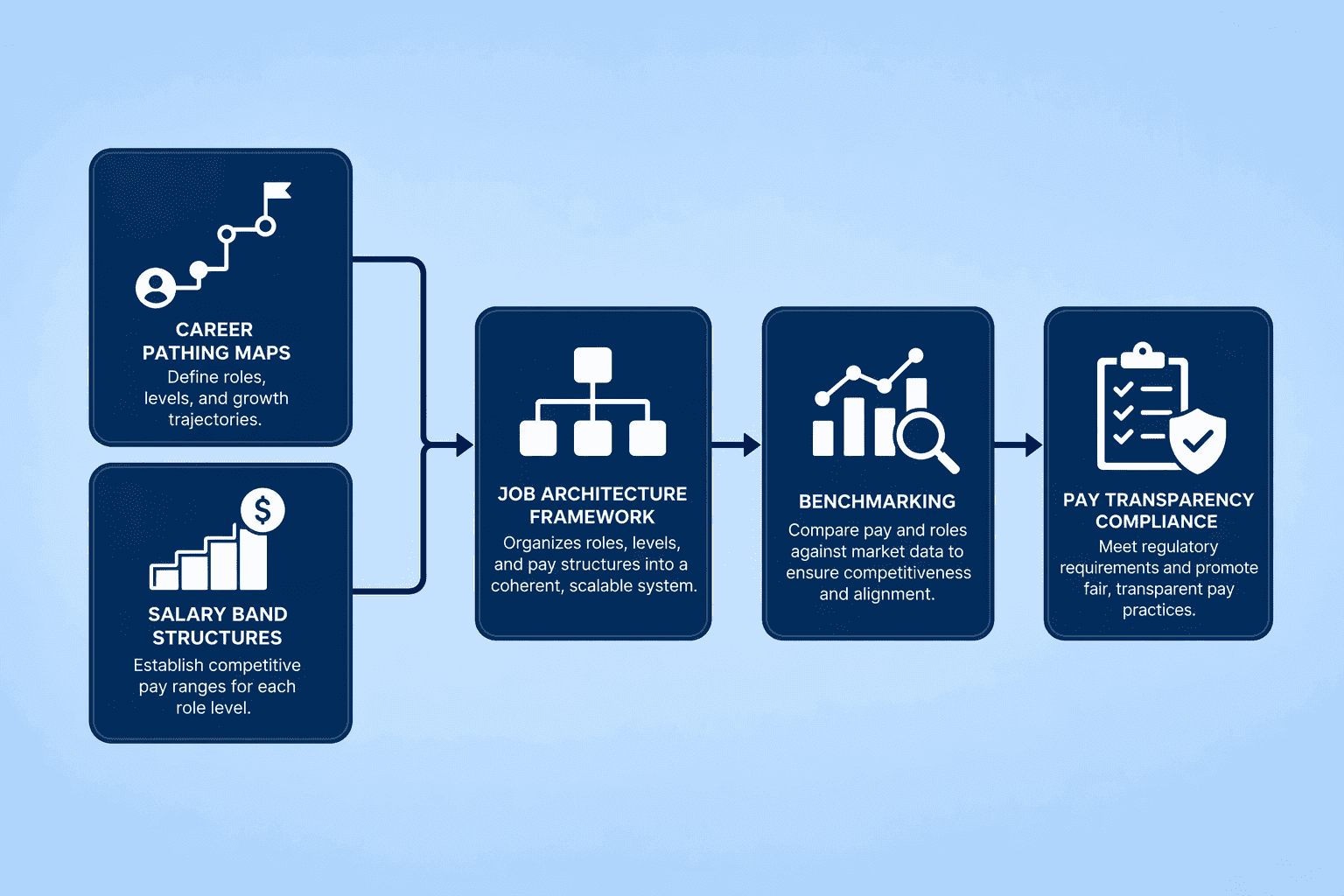
Payscale treats job architecture as the bedrock of compensation. The platform builds career pathing maps and salary band structures first; benchmarking and pay equity analysis flow from that architecture. ISG rated Payscale Exemplary, and the ranking reflects the platform's strength in structured, defensible compensation design.
Pay transparency legislation has become a structural compliance requirement. Colorado's law, California's mandate, and New York City's pay disclosure rules apply to employers with even a small presence in those jurisdictions, requiring posted salary ranges backed by defensible data. Payscale's pay equity module directly addresses this pressure. It models the cost of remediation at the employee level and monitors controlled and uncontrolled pay gaps on an ongoing basis.
The data methodology sits between Salary.com's deep survey library and CompUp's continuous streaming model. Payscale blends peer-sourced data with traditional surveys, accepting a slightly less real-time signal in exchange for broader methodological aggregation.
Where CompUp automates job architecture mapping algorithmically during onboarding and keeps market data continuously updated, Payscale provides a more deliberate, consultative architecture-building process. That difference in approach is the primary selection factor between the two. Organizations that want the architecture built quickly and benchmarked continuously tend to lean toward CompUp; those that prefer a manual, high-touch architecture design process favor Payscale.
The selection criterion is which platform solves the specific operational bottleneck holding your compensation function back. If stale benchmarking data is the problem, pick the provider whose data methodology matches the speed of your market. If enterprise budget modeling across borders is the choke point, buy Anaplan and staff it properly. If you have no unified system at all, a platform like CompUp or a payroll-integrated module like ADP's removes the biggest risk first.
The ISG report recommends testing realistic scenarios that exercise multidimensional budget modeling, configurable eligibility rules, and contextual manager guidance before committing. That advice applies regardless of vendor. Teams migrating from spreadsheets should follow a practical path: nail a consistent job architecture, roll out salary bands with market anchoring, then apply pay equity checks inside every review cycle. Tools exist to execute each step. The cost of continued inaction compounds and is countable. A good next step is seeing how CompUp puts this into practice.
Compensation planning tools are software platforms that centralize pay data, market benchmarks, and cycle workflows to help organizations design and execute salary, bonus, and equity decisions. They reduce spreadsheet errors and give HR and Finance leaders real-time budget visibility.
They analyze controlled and uncontrolled pay gaps by job, gender, and race using compensable factors. Most can model the cost of remediation at the employee level and monitor equity on an ongoing basis. This supports compliance with pay transparency laws in states like California, Colorado, and New York.
Look for market benchmarking methodology, budget scenario modeling, pay equity and pay compression analysis, configurable approval workflows, and HRIS or payroll integration. Consider whether you need strategic architecture-building features, cycle-execution features, or both in a unified platform.
CompUp automates job architecture mapping during onboarding and runs continuous, non-survey market data updates. It combines benchmarking, pay equity analysis, and total rewards statements in one platform, starting at $3 per employee per year. It is a specialist tool, not an enterprise HCM suite.
The ISG Buyers Guide evaluated 20 providers in 2026 and ranked Salary.com, Oracle, and Anaplan in the top three, with ADP, Pave, Payscale, beqom, SAP, and Workday rated Exemplary. The market splits between data-rich benchmarking specialists and workflow-centric planning platforms.
Build a consistent job architecture first. Then select a platform that supports a phased rollout of salary bands, followed by pay equity checks integrated into review cycles. Test the platform with real scenarios covering budget modeling, business rules, and manager guidance before committing.
Community Manager (Marketing)
As a Community Manager, I’m passionate about fostering collaboration and knowledge sharing among professionals in compensation management and total rewards. I develop engaging content that simplifies complex topics, empowering others to excel and aim to drive collective growth through insight and connection.
Revolutionizing Pay Strategies: Don't Miss Our Latest Blogs on Compensation Benchmarking