
Your compensation package is no longer a private negotiation. Across the US, from California to New York to Colorado, pay transparency legislation is turning the full value of what you pay into a public expectation and a compliance requirement. Static offer letters listing only base salary fail on both fronts: employee retention and regulatory readiness. This is a structural overhaul of how you communicate total compensation.
The right software automates the assembly of personalized total rewards statements, pulling live data from payroll, benefits, and HR systems to show every employee the complete investment you make in them. The business case is urgent. A well-executed statement transforms line items like health insurance premiums, retirement contributions, and tuition remission into a coherent retention narrative. Since the start of 2026, universities like UVM now deliver digital total rewards statements via PeopleSoft portals, a market shift toward always-accessible data that supports pay transparency compliance.
What this means for your total rewards strategy in 2026 comes down to a few critical operational shifts:
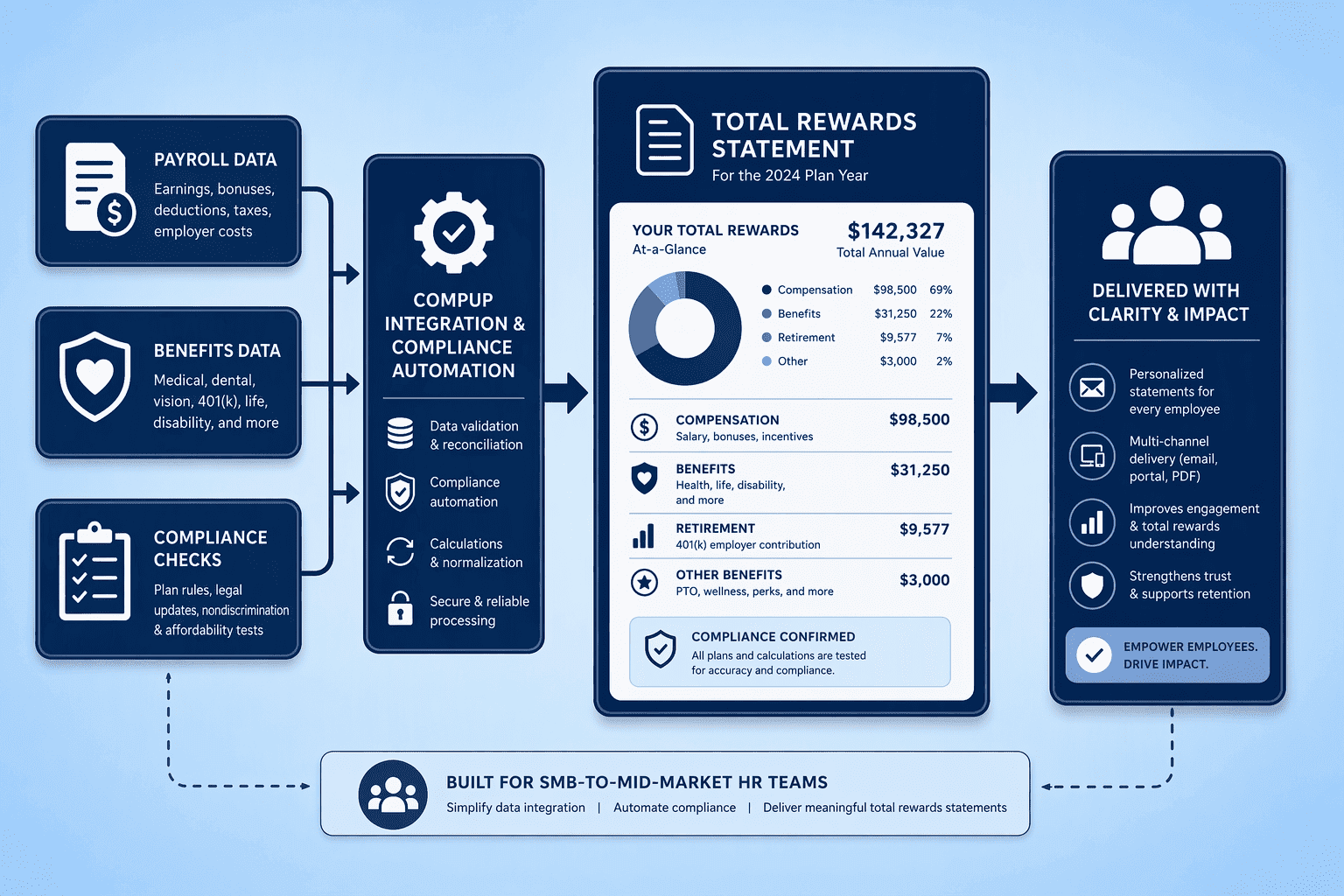
For SMB-to-mid-market HR teams that need high-automation total rewards statement generation without the overhead of an enterprise HCM, CompUp is a compensation-first platform purpose-built for the task. Here is how its data integration and compliance automation map against the core operational requirements:
| Requirement | CompUp Capability | Operational Impact |
|---|---|---|
| Best suited for | SMB-to-mid-market HR and Total Rewards teams scaling compensation communication | Reduces manual assembly effort and spreadsheet risk |
| Data integration | Payroll and HRIS connectors (including BambooHR, Lattice, Darwinbox, Workable) | Aggregates multi-source compensation data into a single statement |
| Custom branding | High, with a configurable total rewards statement builder supporting conditional logic | Produces personalized, on-brand statements segmented by employee group |
| Pay transparency compliance | Built-in, connecting compensation planning with pay equity analysis and compliance dashboards | Aligns statement distribution with state-level regulatory requirements |
CompUp ties rewards communication to performance outcomes by producing personalized Total Rewards Letters when the appraisal cycle closes. For organizations managing compensation across borders, the platform includes native multi-currency support and real-time budget simulation. Its $3 per employee per year starting price makes dedicated total rewards automation accessible to teams that have outgrown manual processes but do not need global compensation modeling.
Multinationals with operations in dozens of countries need a compensation platform that can model every vacation mandate, tax treatment, and pay equity requirement without breaking. beqom is an enterprise total compensation platform built for deep configurability, and it operates as a unified back end for the kind of complex, multi-country total rewards statements that a regional HRIS cannot produce.
This configurability extends directly to compliance. beqom added a dedicated pay equity capability by acquiring PayAnalytics in 2023. The result is a compensation engine that allows country-specific configurations for SLAs and anonymization, embedding pay equity and transparency interventions directly into compensation decisions. For a global enterprise, compliance becomes a feature of the workflow rather than a report run after the fact.
Its enterprise-grade nature extends to data integration. The platform handles multi-source, multi-country data pulls that would fracture a lesser system. That scale is reflected in its competitive positioning. As of July 2026, its G2 rating stands at 4.3 out of 5. While strong, this score sits in a competitive cluster with other analytical tools, a signal that depth of functionality is balanced against the implementation complexity inherent to any platform that can model compensation across 37-plus countries.
For the enterprise buyer, beqom is the answer when no two country payrolls run on the same logic and the statement itself must carry equal legal weight in California and Cologne.
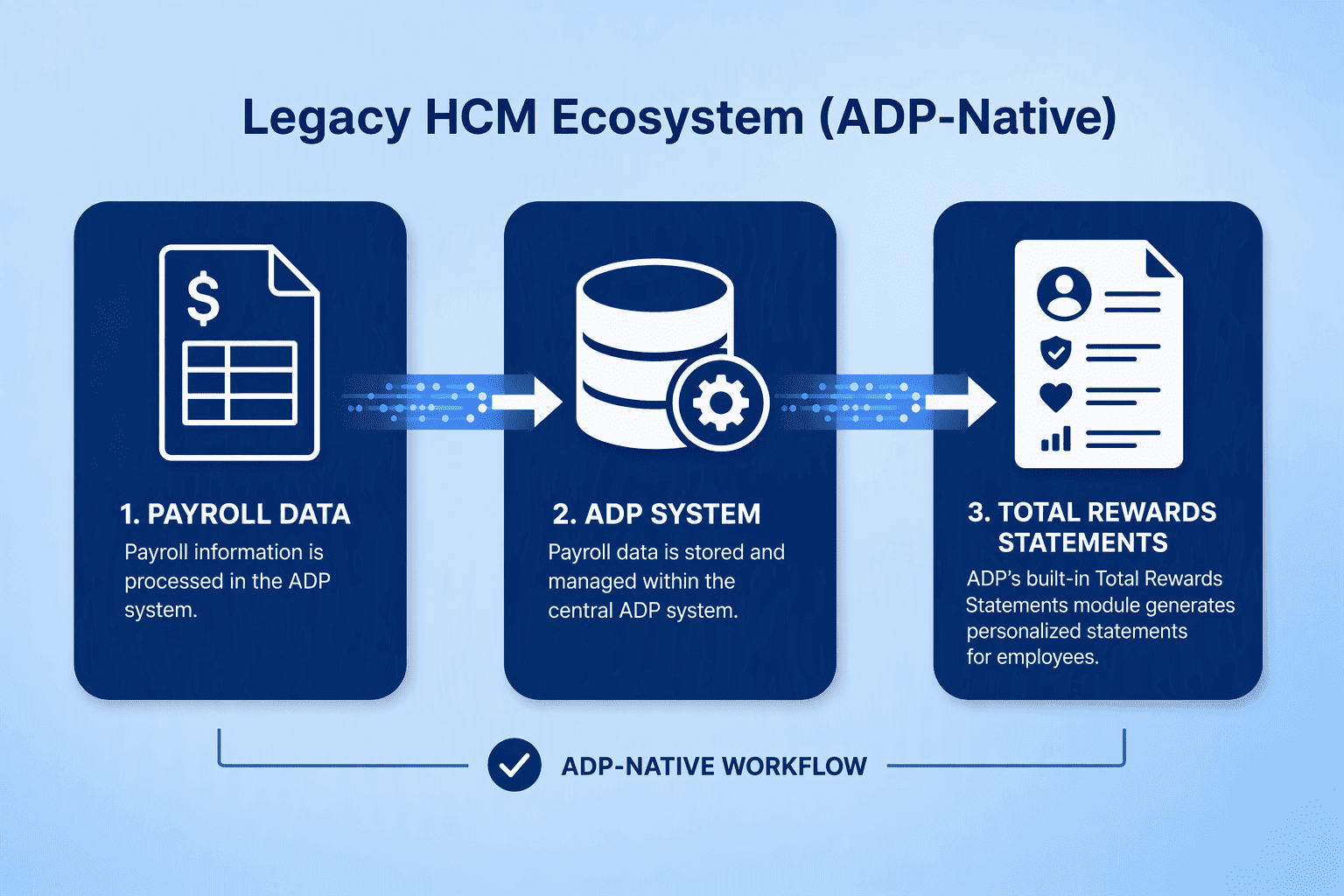
If your organization already runs payroll through ADP, the path of least resistance for total rewards statements is clear: flip the switch on ADP's built-in module. The integration friction nearly vanishes because all data lives within one ecosystem. But convenience has a ceiling.
ADP's native total rewards statements are feature-limited relative to dedicated platforms. The data integration is restricted to ADP data. If your benefits administration, equity management, or non-ADP HRIS holds a component of total compensation, that value will be absent from the statement. Partial data produces a partial narrative. The statement you generate becomes incomplete, showing employees some of their salary and benefits but leaving out whatever sits outside the ADP walled garden.
Pay transparency compliance support follows the same pattern. The platform can generate a statement that shows base salary and employer-paid benefits components, but it lacks the built-in, jurisdiction-specific compliance frameworks dedicated compensation platforms embed. For a company with operations in multiple US states with conflicting pay transparency requirements, this limitation shifts the burden back onto HR teams to verify disclosures manually. You will be cross-referencing state mandates on your own.
Custom branding sits at the low-to-medium end. The statement templates are functional but firm. Organizations that view the total rewards statement as a strategic employer-brand asset will find the visual and conditional logic constraints restrictive. ADP's module works as an employee communication tool. It was not built to double as a rewards marketing and compliance system.
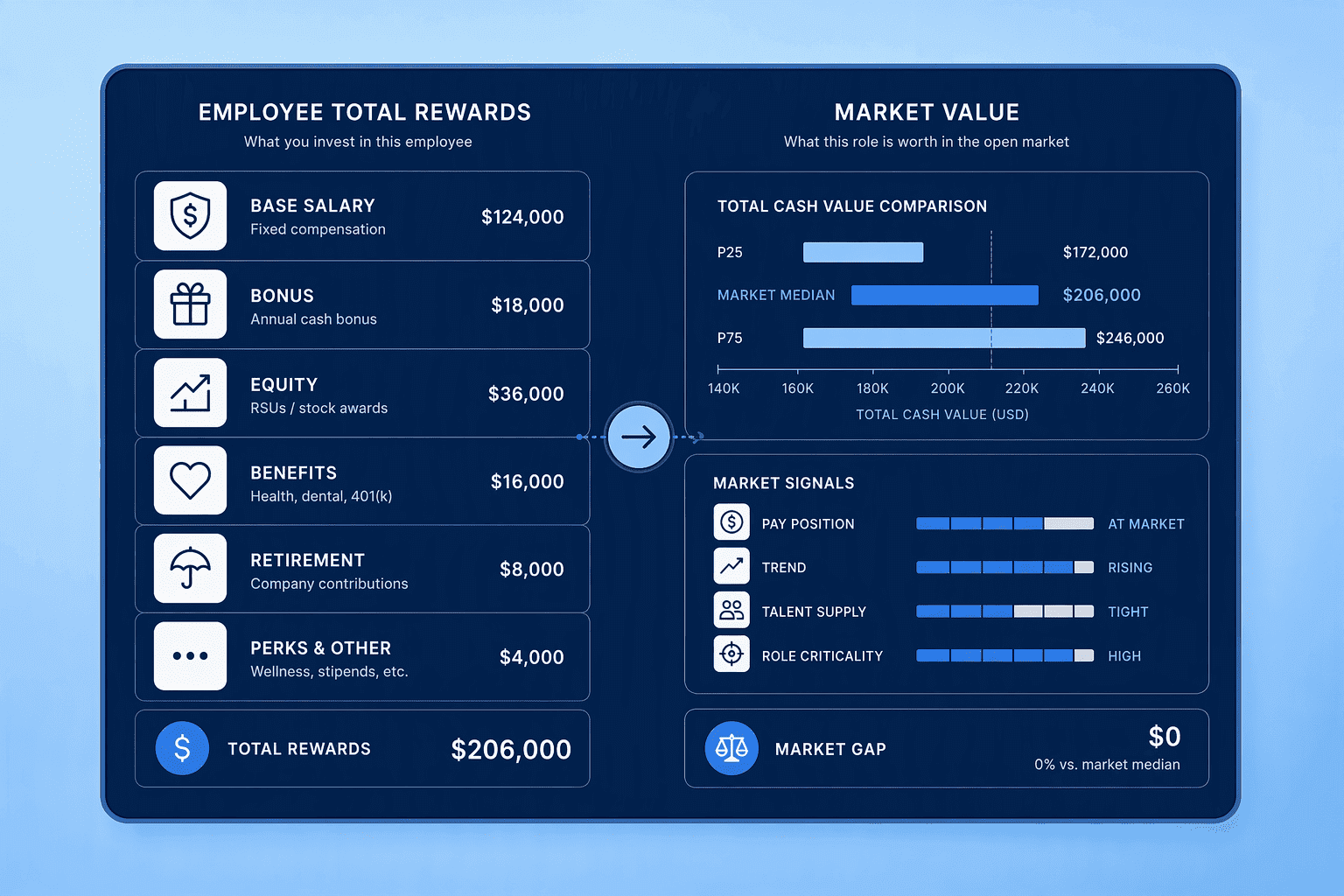
Many compensation teams build total rewards statements to show employees what they receive. PayScale Insight Lab builds them to show employees what their compensation is worth in the open market. This distinction defines its value proposition.
PayScale is a market-data company with configurable planning layered on top. It leverages compensation survey data drawn from over 30,000 organizations in 22 countries to enrich employee statements with external market context. When an employee sees not just their salary but its market percentile alongside their full benefits load, the communication moves from informational to persuasive. The narrative shifts from "here is what you cost us" to "here is why this is a competitive package."
This analytics layer is where Insight Lab differentiates. The platform aggregates an enormous dataset, a proprietary AI framework drawing on more than 10 billion data points across more than 225 industries, to power its visualization and benchmarking engines. For compensation teams focused on pay competitiveness messaging, this market-data-backed storytelling capability is the core reason to choose PayScale over a pure statement generator.
Its G2 rating as of July 2026 is 4.3 out of 5, matching the competitive cluster for data-heavy planning tools. The fit is specific: PayScale Insight Lab works best for analytically mature compensation teams that want to embed survey-grounded market narratives into every statement, not for HR generalists primarily seeking simplified compliance automation.
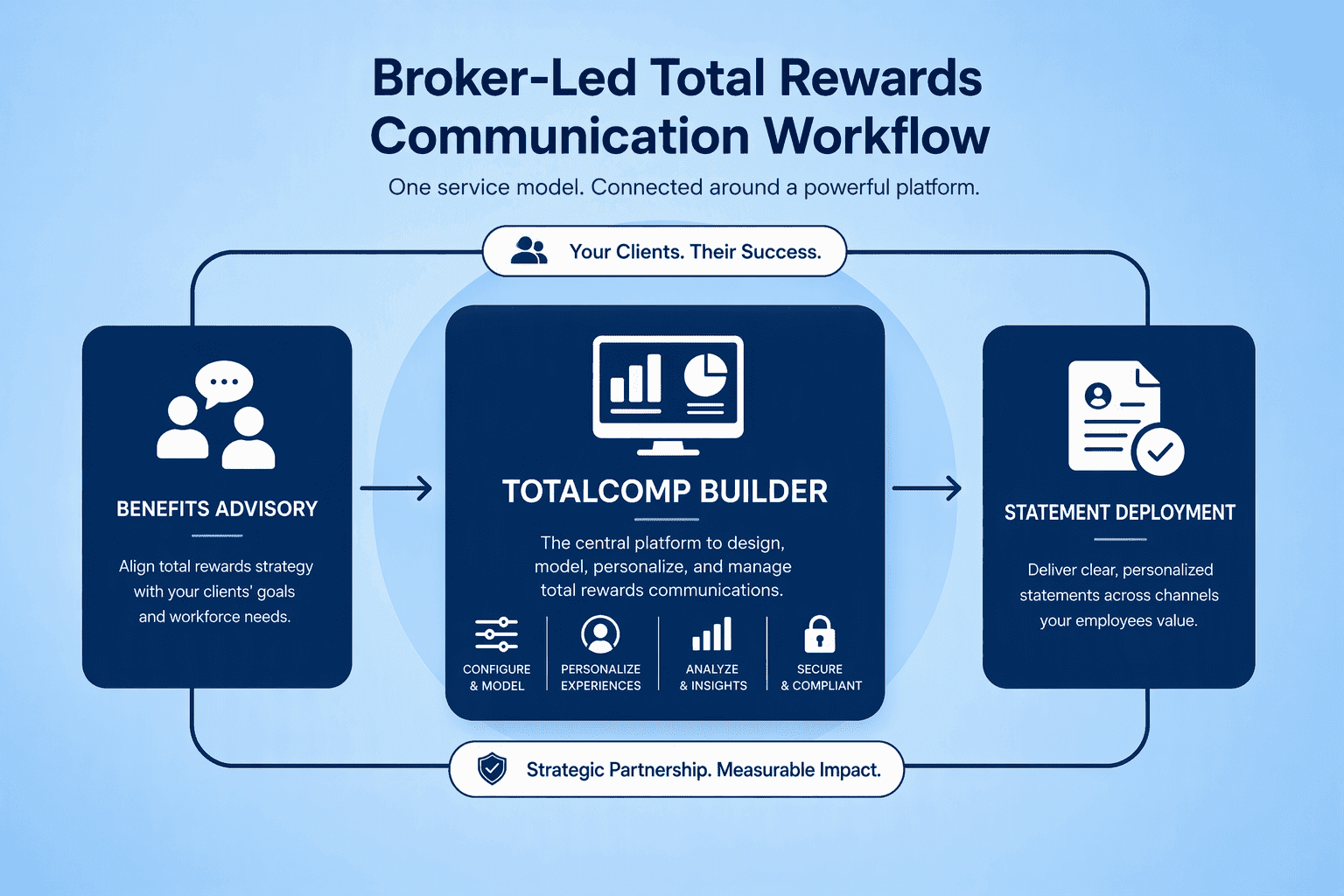
When the benefits line dominates total compensation value, a standalone SaaS tool can miss the real communication challenge. NFP's TotalComp Builder approaches total rewards from the benefits advisory and brokerage side.
When a multinational's compensation philosophy is anchored to Radford survey benchmarks, generating statements from those same data foundations keeps the compensation story internally consistent. Aon Radford Complogix leverages this connection as its core architectural advantage.
Complogix is built to use Aon's Radford survey assets as the modeling backbone for market-aligned total rewards. It fits enterprises that run rigorous, data-driven equity and compensation planning cycles and need their statement output to reflect the same benchmarks that drove their comp decisions. When statements pull from a different dataset than the one that set the ranges, employees spot the inconsistency. This platform prevents that.
Advanced analytics for pay equity and compliance run alongside this modeling capability. For a global enterprise, the platform addresses the compounding complexity of multi-country equity adjustments. It supports total rewards communication within a broader compensation management and planning ecosystem. The statements are outputs of a continuous compensation cycle, not one-off deliverables.
The cost is implicit in the Radford ecosystem subscription. Suitability narrows to the Radford-aligned organization willing to invest in that integrated analytics layer in exchange for compensation communication rigor.
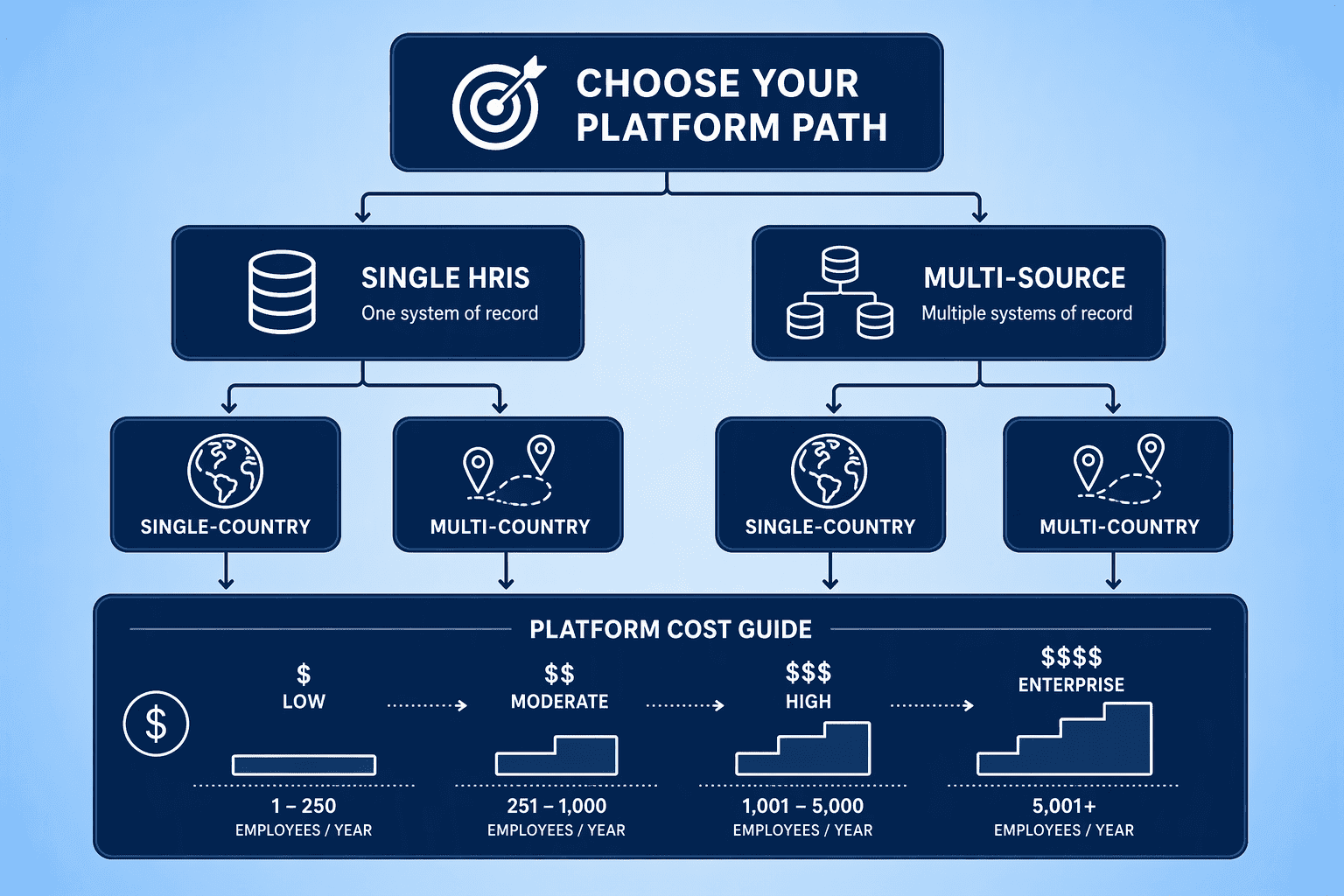
Selecting a platform is a decision about complexity tolerance. The framework begins with your data architecture: how many systems must you pull from, and are they in one country or many? A single HRIS ecosystem allows simpler tools; multi-source, multi-country requirements tilt the field toward platforms like beqom or Aon Radford Complogix.
Pricing should be modeled against this complexity. The market range of $3 to $15 per employee per year reflects exactly these variables: data source count, audience segmentation depth, and delivery format. Satisfice the compliance minimum in low-complexity environments, but pay for year-round portal delivery and interactive digital statements where pay transparency laws in California, New York, and Colorado put your annual PDF at legal risk.
A paper total rewards statement handed out once a year was already fighting for relevance before California and Colorado mandated job-post salary ranges and half a dozen other states tightened pay-transparency laws. In 2026, that PDF doesn't just feel stale. It undercuts the real work your comp team is doing to keep people from walking out the door over a number they don't understand.
The shift is toward always-on digital total rewards experiences that pull double duty: retention for the employees you can't afford to lose, and the employer-brand and compliance signal that every candidate now Googles before the first interview.
Pick a platform that matches your actual data complexity. If your HRIS feeds are clean and you run a single country payroll, a lightweight tool built for that is a better answer than a suite that assumes you have a dedicated comp analyst modeling a hundred eligibility rules. The reverse holds, too. A company juggling equity, deferred comp, and multi-country consolidation should not be twisting a small-business-only module into something it was never meant to be.
So map the hard constraints first: which state pay-transparency obligations you trigger, whether your integrations are a comma-delimited file export or a real API, and who inside the business will own the statements after go-live. Then let that decision framework surface the software, not the other way around. The legislation is already in effect. Your statements should be too. If you're weighing options, CompUp is worth a closer look.
It is software that automatically pulls data from payroll, benefits, and HR systems to generate individual employee reports showing the full value of total compensation, not just base salary. Companies need it at scale to improve retention, justify compensation spend, and comply with state pay transparency laws.
Key capabilities to look for in a total rewards platform include:
CompUp is best for SMBs needing affordable, high-automation statements with strong custom branding. Beqom fits global enterprises managing multi-country, multi-source compensation. ADP offers built-in but feature-limited statements restricted to its own data ecosystem, trading capability for convenience.
Pricing for total rewards platforms typically ranges from $3 to $15 per employee per year, with the primary cost drivers being:
Best practices for deploying total rewards statements include:
Legislation in states like California, New York, and Colorado now requires clear communication of total compensation. This turns total rewards statements from a nice-to-have retention tool into a compliance requirement that makes static, salary-only offer letters legally insufficient.
Community Manager (Marketing)
As a Community Manager, I’m passionate about fostering collaboration and knowledge sharing among professionals in compensation management and total rewards. I develop engaging content that simplifies complex topics, empowering others to excel and aim to drive collective growth through insight and connection.
Revolutionizing Pay Strategies: Don't Miss Our Latest Blogs on Compensation Benchmarking