
Your quarterly board deck shows headcount aligned with revenue and your open-role pipeline is moving. Then a critical product launch stalls for six weeks because the two senior engineers you were grooming just accepted offers at a 22% premium. The exit interviews mention a vague sense that compensation 'wasn't keeping up,' but your last annual pay review flagged nothing. You are not alone: 50% of global organizations report difficulty retaining their best talent.
The problem is not that you lack data. You have payroll exports, performance ratings, job codes, and tenure history. The problem is that your workforce planning tool treats headcount as a supply-and-demand equation while your compensation review lives in a separate, static spreadsheet. By the time an unexplained pay gap surfaces, the affected employee is already updating their LinkedIn profile.
Regulators are closing this gap from the outside. Over 40 U.S. states now mandate some form of pay data reporting or equal pay certification, and federal contractors face OFCCP audits that demand statistical evidence of equity. The EEOC recovered over $1.6 million per case on average in 2026. That figure does not include the remediation cost of fixing the gaps you find only after a complaint is filed.
This article examines seven workforce planning platforms that embed pay equity analysis directly into the planning cycle. Some are dedicated compensation specialists; others are full-suite HCM tools adding equity intelligence to existing workflows. The right choice depends on whether your priority is litigation-grade statistical defense, smooth HRIS integration, or continuous monitoring that catches inequity before it costs you a critical hire.
Before examining the platforms, here are the structural trade-offs and operational shifts that define the 2026 market for workforce planning software with integrated pay equity analysis:
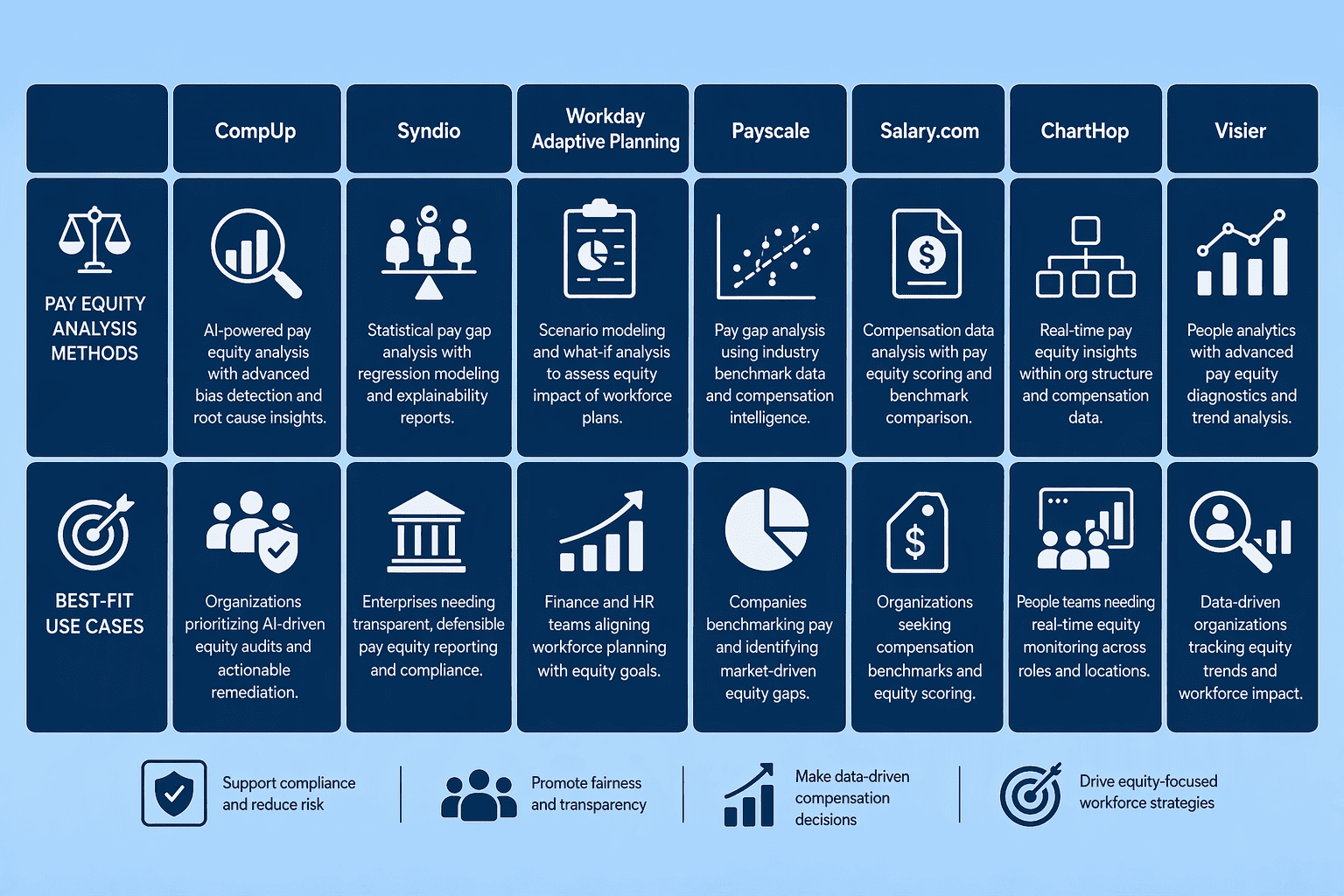
Here is how the options compare across the dimensions that matter most.
| Platform | Type | Pay Equity Analysis Method | Best For | Key Limitation |
|---|---|---|---|---|
| CompUp | Dedicated compensation specialist | Regression modeling with remediation scenario planning | Full compensation lifecycle management | Less deep HRIS integration than suite tools |
| Syndio | Dedicated pay equity specialist | Advanced statistical regression and litigation-grade analysis | Litigation defense and regulatory compliance | Higher cost and narrower scope than full HCM |
| Workday | Full-suite HCM with equity module | Integrated into HCM planning cycle | Organizations already using Workday HCM | Less analytical nuance than specialist tools |
| Payscale | Compensation analytics | Market-based benchmarking and pay equity auditing | Salary benchmarking and market data integration | Limited workforce planning capabilities |
| Visier | People analytics platform | Predictive modeling and equity dashboards | Continuous monitoring and workforce planning alignment | Requires strong data infrastructure or dedicated analysts |
| beqom | Compensation and performance management | Total rewards and equity analysis | Global enterprises with complex compensation structures | Steep learning curve for implementation |
| Sage | HRIS with embedded pay equity | Automated pay gap reporting within HCM | Mid-market organizations needing basic compliance | Less sophisticated for deep statistical analysis |
CompUp is a purpose-built compensation management platform that combines budget forecasting, salary benchmarking, and pay equity analysis into a single workflow. You manage the entire compensation lifecycle, from headcount budgeting through merit-cycle execution to post-cycle equity review, inside one system.
The platform ingests live data from integrations with BambooHR, Darwinbox, Lattice, and Workable. Your equity analysis draws on current pay outcomes. CompUp then runs regression models that control for legitimate pay drivers like role, tenure, and performance rating.
When the model flags a statistically significant gap, the remediation cost estimate appears in the same dashboard where you are already modeling next quarter's headcount growth. For organizations running quarterly planning cycles, this continuous monitoring loop changes the rhythm of equity work. You spot an emerging inequity in Q1 at a projected remediation cost of $18,000, rather than discovering it in Q4 after two affected employees have already left.
CompUp does not replace Workday, SAP SuccessFactors, or Oracle. Its pricing starts at $3 per employee per year, and the platform holds a 4.9 G2 rating across more than 100 clients in over 140 countries. The trade-off is scope: you get a specialized compensation and equity tool rather than a general-purpose HRIS. What you gain is a workflow where pay equity is embedded directly into workforce planning rather than retrofitted as an annual compliance exercise. For mid-market organizations outgrowing spreadsheets but not yet needing the statistical complexity of a Syndio-grade litigation defense, CompUp's integrated approach closes the gap between planning and equity without adding a separate vendor.
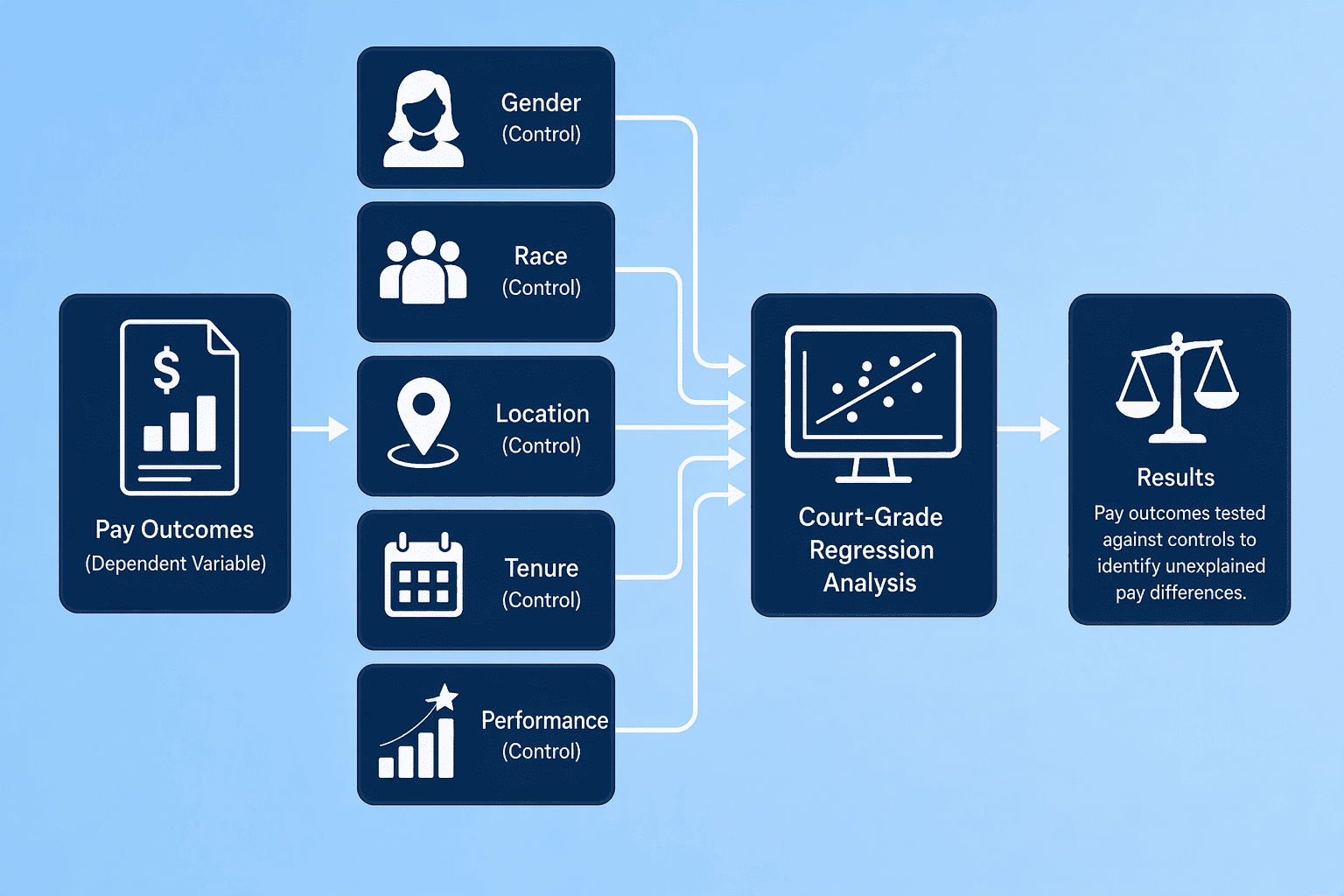
Syndio is the pay equity platform Fortune 500 legal teams reach for when a multi-jurisdictional audit or an OFCCP compliance review demands court-grade statistical methodology. Its regression engine runs on a 95% confidence interval standard, modeling pay outcomes across gender, race, and other protected characteristics while controlling for legitimate factors like role, location, tenure, and performance. The output is a defensible statistical finding that can withstand the scrutiny of a federal auditor or a plaintiff's expert witness.
Syndio's remediation scenario modeling is what sets it apart operationally. When the platform surfaces an unexplained pay gap affecting 114 employees across three job families, you can model the cost and timeline of closing that gap under different scenarios: immediate adjustment, phased equalization over two budget cycles, or targeted increases for the highest-risk employee segments. Each scenario calculates the total remediation cost, the impact on comp ratios, and the residual equity risk after adjustment. For organizations operating across 40-plus state jurisdictions with conflicting pay-reporting mandates, this scenario layer transforms equity analysis into a proactive budget-planning input. You know before the merit cycle opens how much it will cost to stay compliant, and you fund remediation in the same planning round that allocates headcount growth.
The trade-off is integration depth outside the compensation domain. Syndio connects to your HCM for data extraction, but it does not replace your workforce planning tool. It is a specialist that produces statistically rigorous equity analysis that holds up under legal challenge. You use it alongside your headcount forecasting and talent planning infrastructure.
Workday Adaptive Planning layers equity intelligence on top of the same live payroll, headcount, and performance data already flowing through the Workday HCM suite. There is no file export, no data mapping project, and no reconciliation between systems that have drifted out of sync. When you run an equity audit in Workday, the regression model pulls from the same single source of truth that feeds your financial planning, your talent review, and your quarterly headcount forecast.
This architectural advantage matters. In a dedicated platform setup, the quality of your equity analysis depends entirely on the accuracy and timeliness of the data import. A promotion that closed last Tuesday won't appear in an external equity tool until the next monthly file refresh. Workday eliminates that latency.
The trade-off is analytical granularity. Workday's equity module covers the core regression use case: identifying statistically significant pay gaps after controlling for role, tenure, performance rating, and location. It does not offer the remediation scenario depth of a Syndio or the compensation-lifecycle breadth of a CompUp. For many organizations, that trade-off is acceptable. The convenience of single-vendor architecture, one contract to negotiate, one security posture to audit, one integration to maintain, outweighs the marginal improvement in statistical methodology that a dedicated tool might provide.
Workday is strongest for enterprises already committed to the Workday ecosystem. If your finance team uses Adaptive Planning for budgeting and your HR team uses Workday HCM for the employee lifecycle, adding equity analysis to that stack is a natural extension rather than a new vendor evaluation. You lose some analytical nuance. You gain a data foundation whose quality is institutionally maintained rather than dependent on periodic extracts.
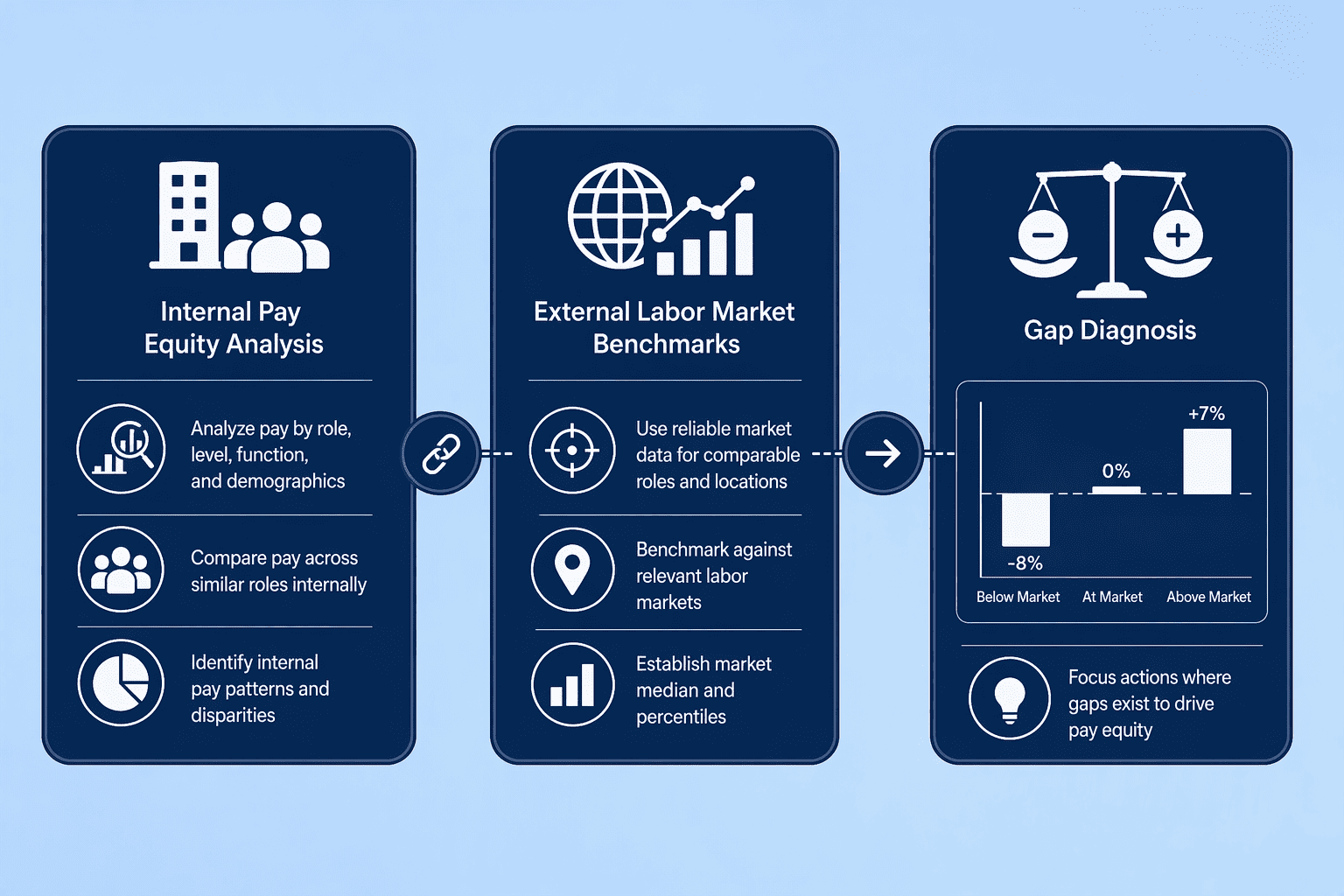
Payscale's proprietary crowdsourced market data set is what sets it apart. It anchors internal equity analysis to real-time external labor market benchmarks. When the platform flags an unexplained pay gap in your organization, it also surfaces whether that gap comes from an internal inequity, a market-rate discrepancy, or a combination of both.
That external-internal linkage changes when and how you address a pay gap. A female senior product manager earning 8% less than her male peers is one problem if the market rate for both sits at the higher comp figure: that goes straight to remediation. It becomes a different problem if the higher-paid peers are themselves above market because of a retention counteroffer from two years ago. You cannot adjust everyone down, but freezing the inflated salaries while bringing the underpaid employee to market rate becomes the dollar-optimal path. Payscale surfaces both dimensions simultaneously, so you model remediation against internal fairness and external competitiveness at once.
The platform also integrates job-leveling algorithms that match roles to Payscale's compensation taxonomy. This establishes valid peer groups before any regression runs. It removes one of the most common failure modes in equity analysis: comparing pay across employees whose job titles sound similar but whose actual scope, market value, and internal leveling differ materially. For compensation teams building salary structures that must satisfy internal equity standards and external recruiting demands, Payscale's combined market-data and equity-analysis workflow prevents pay gaps from entering the system at the point of offer and promotion. You catch the issue at the source rather than discovering it months later during the annual audit.
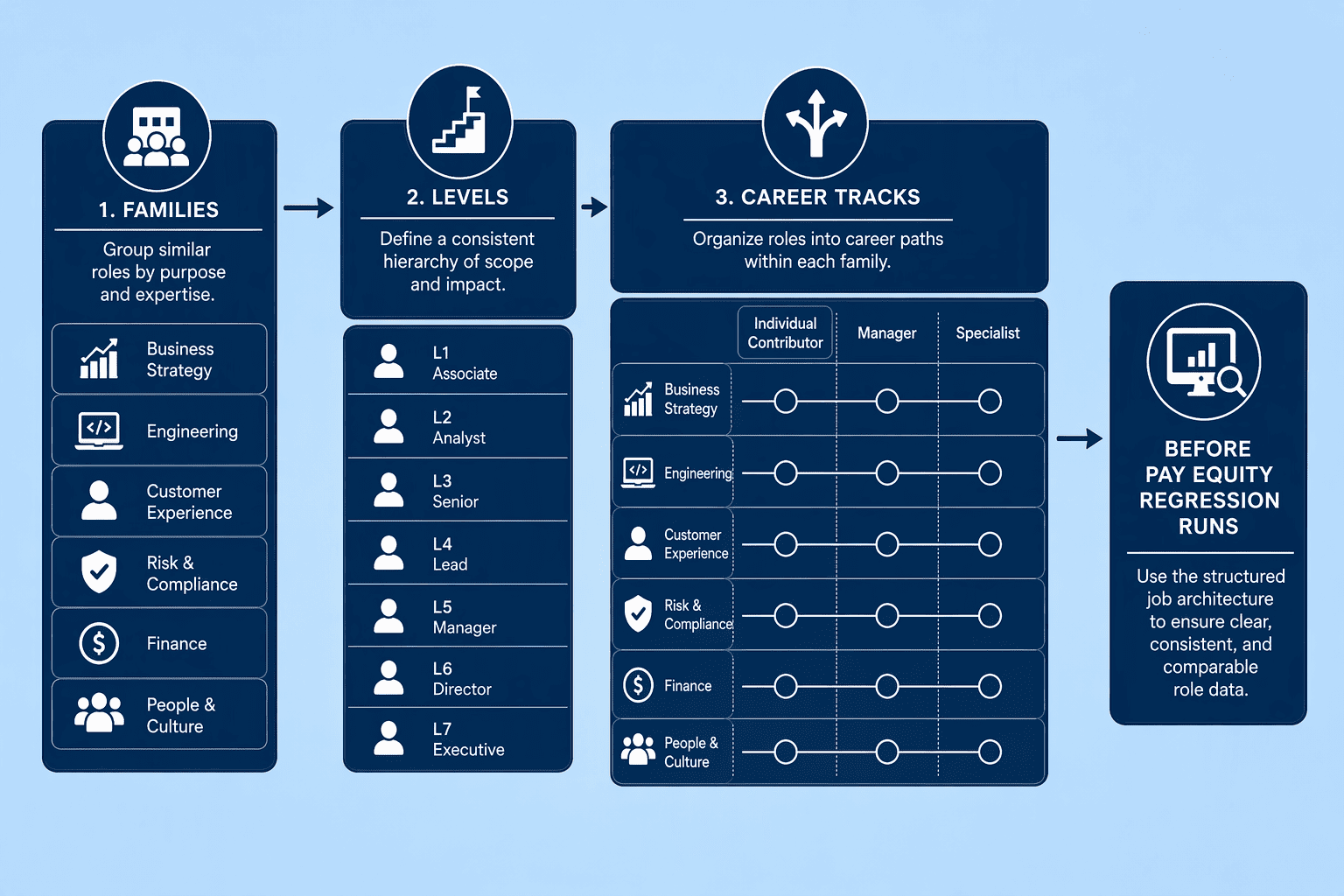
CompAnalyst approaches pay equity analysis by tackling the peer-group validity problem head-on. Its core methodology anchors every regression on a defensible job architecture, building valid comparison groups before any statistical test runs. Key operational features:
ChartHop embeds pay equity analysis inside a dynamic organizational design layer, making compensation fairness visible alongside reporting lines, spans of control, and headcount plans. When a department head proposes a restructuring that consolidates three teams under two managers, ChartHop surfaces the equity impact as part of the scenario: the consolidation shifts 14 employees into a peer group where their pay now sits below the median, creating a statistical flag that a traditional headcount-planning tool would miss.
The platform's visualization-first approach maps compensation data onto live org charts, coloring nodes by compa-ratio or flagging employees whose pay falls outside the predicted band for their role and tenure. Pay equity becomes a visible, interactive variable during headcount planning conversations, instead of a separate compliance report that arrives after decisions are locked. During mergers or rapid scaling events, ChartHop's equity-inside-org-design model helps leaders see the fairness implications of structural changes before they get baked into the new organization.
ChartHop is not a regression engine. It does not produce the same statistical documentation that Syndio provides for an OFCCP audit file. Its role is different: it integrates equity insights into the organizational decisions that create or amplify pay gaps in the first place. You use ChartHop to prevent inequity during planning; you use a dedicated statistical tool to document the equity of the resulting outcome.
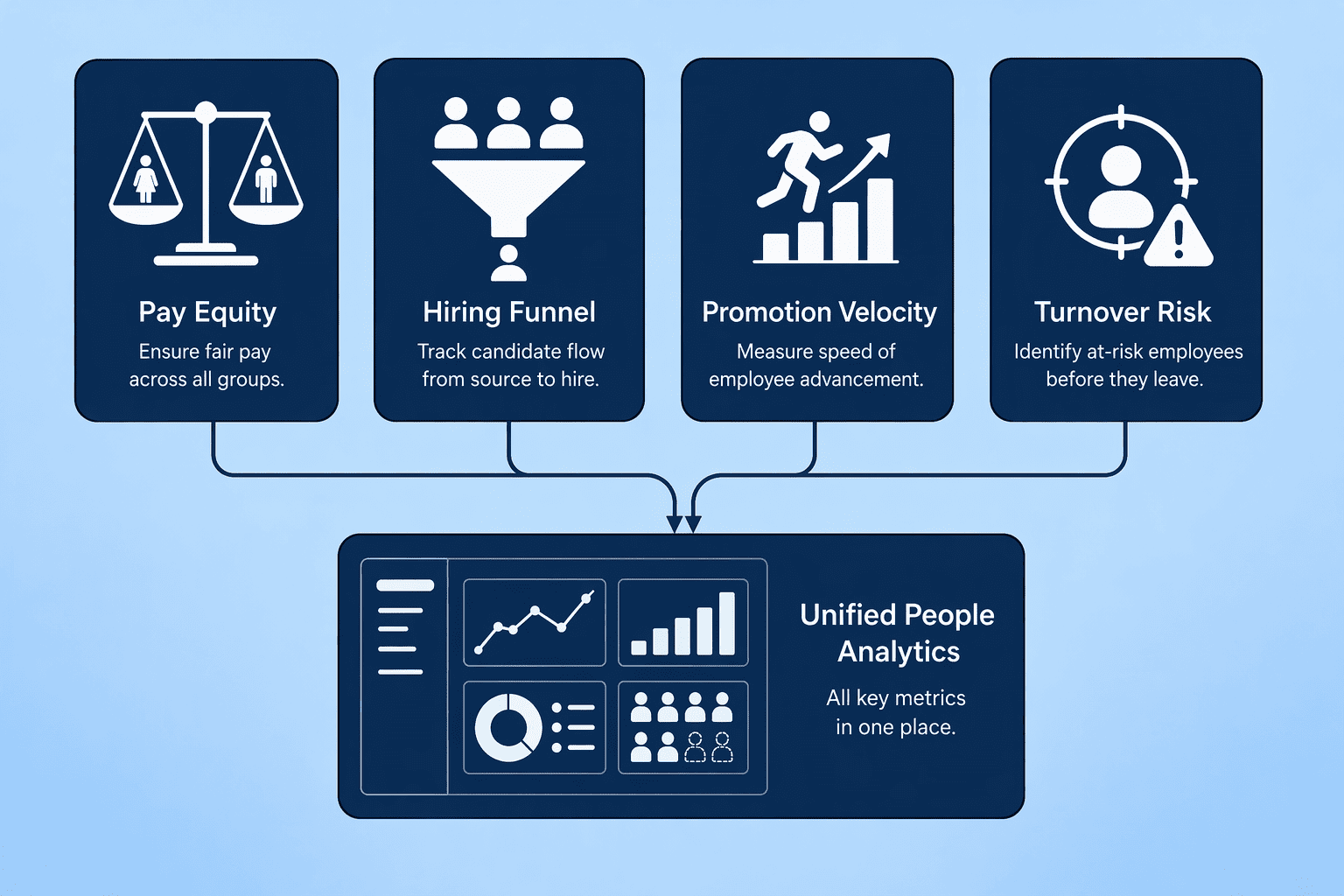
Visier operates as a people analytics platform that embeds pay equity intelligence inside a broader workforce decision-support system. Rather than treating equity analysis as a standalone compliance workflow, Visier surfaces unexplained pay gaps alongside talent acquisition funnel metrics, promotion velocity data, and turnover risk indicators. The platform's AI models detect patterns across these data sets: an unexplained pay gap in a department that also shows elevated regrettable turnover and slower promotion velocity for women signals a retention risk multiplier that the system surfaces automatically.
The analytic methodology is designed for HR business partners and people analytics teams rather than compensation specialists. Visier pre-builds the data models, so you do not need to specify control variables or select regression specifications. The trade-off is transparency: you get faster time-to-insight but less control over the precise statistical methodology than you would in a dedicated pay equity platform.
Visier is strongest for organizations that have invested in a centralized people analytics function and want equity recommendations integrated into the dashboards that already drive workforce decisions. The platform bridges analysis with action by embedding equity insights into retention and talent planning workflows, ensuring that flagged gaps show up where leaders are already making headcount and compensation decisions.
For organizations without a mature analytics team, Visier's pre-configured approach reduces the implementation barrier: you get equity intelligence without building statistical models from scratch or hiring a compensation data scientist.
The seven platforms profiled here map onto a clear decision framework. If your primary risk is litigation exposure, and you need regression outputs that can survive a federal audit without your legal team flinching, Syndio is the reference standard. If you operate inside the Workday ecosystem and value smooth data integration over analytical granularity, Workday Adaptive Planning is the natural extension of your existing stack. If you are a mid-market organization outgrowing spreadsheets and seeking a unified compensation lifecycle where equity monitoring runs alongside budget forecasting and merit planning, CompUp closes that gap without adding a separate vendor. Payscale and Salary.com anchor equity on market data; ChartHop and Visier embed it in organizational design and people analytics, respectively.
The operational shift that matters most, regardless of which platform you select, is moving from an annual compliance cadence to a continuous monitoring rhythm. Run your equity analysis quarterly, inside the same cycle as your headcount planning and budget forecasting. Remediation costs become a planned line item you track instead of an emergency liability discovered after the fact. The $1.6 million average EEOC settlement is the stick. The 12 to 18% reduction in voluntary turnover that equity-focused organizations report is the carrot that matters more for your P&L. A good next step is seeing how CompUp puts this into practice.
When evaluating pay equity software, look for these core capabilities:
Pay equity analysis follows seven defined steps, as outlined by Workday's methodology:
It uses compensation data, job codes, performance ratings, tenure, location, and demographic attributes to statistically isolate whether protected characteristics predict pay differences after controlling for legitimate factors.
The regulatory landscape for pay equity is intensifying:
Dedicated platforms like Syndio or CompUp offer more sophisticated regression modeling, remediation scenario planning, and compensation-specific workflows. Full-suite HCM tools like Workday provide smooth access to live payroll and headcount data without file exports. The trade-off is analytical depth versus integration convenience, and your choice should reflect whether litigation defense or data integrity is your primary concern.
The standard pay equity analysis process follows five steps:
Documented outcomes include reduced litigation risk from EEOC settlements averaging $1.6 million per case, 12 to 18% lower voluntary turnover among equity-focused organizations, stronger DEI metrics for investor ESG reporting, and the operational advantage of catching and remediating inequity during quarterly planning cycles rather than reacting after an employee exit or a regulatory complaint.
Community Manager (Marketing)
As a Community Manager, I’m passionate about fostering collaboration and knowledge sharing among professionals in compensation management and total rewards. I develop engaging content that simplifies complex topics, empowering others to excel and aim to drive collective growth through insight and connection.
Revolutionizing Pay Strategies: Don't Miss Our Latest Blogs on Compensation Benchmarking