
Ask most employees what they earn, and they will recite a base salary figure. That single number, however, routinely represents only 60 to 70 percent of what their company actually invests in them. The gap between the salary a worker remembers and the true total cost of their employment is the single largest communications failure in modern compensation.
It is also a retention emergency. According to a 2024 Qualtrics study, 64% of non-frontline employees and 50% of frontline employees are happy with their pay and benefits. That implies 36 percent of non-frontline workers, and fully half of frontline workers, feel the package is insufficient. Most of those people have never seen a document that captures everything their employer contributes on their behalf.
Health insurance premiums, retirement matching, statutory contributions, paid leave, disability coverage, and equity grants sit invisible. A purpose-built total compensation breakdown tool pulls employer-paid benefits, mandatory contributions, and direct pay into one personalized view. In 2026, the market includes dedicated statement software, consulting-led services, free calculators, HRIS-native modules, and compensation platforms where a total rewards portal is a native feature. This article ranks the seven most practical approaches.
The tools that give employees a complete total compensation breakdown fall into distinct categories. Before evaluating individual options, here is the decision landscape in brief.
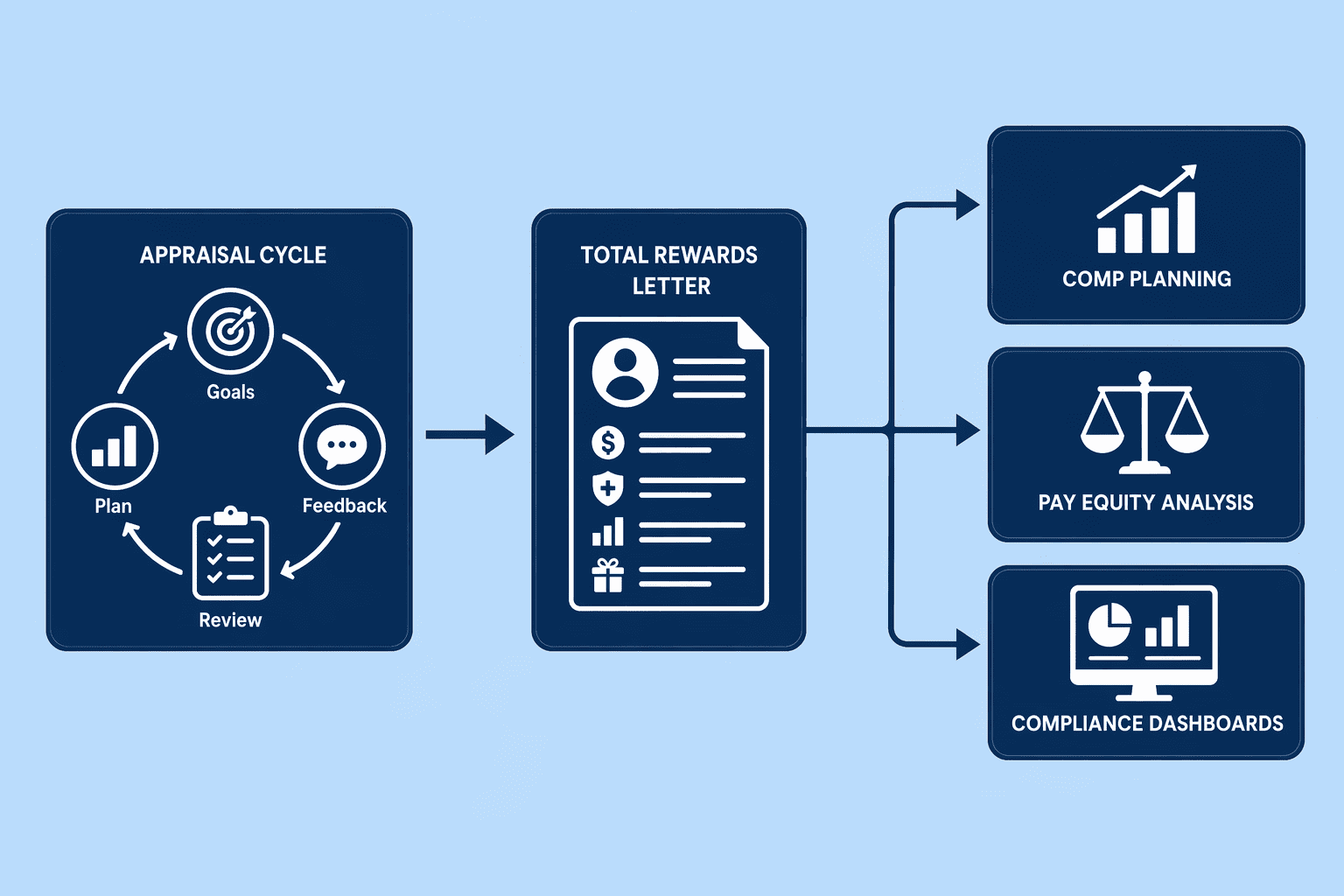
CompUp's Total Rewards Communication ties personalized Total Rewards Letters to the appraisal cycle. When an employee is already reviewing a raise or bonus, the platform delivers a complete picture of their compensation. That timing makes the breakdown land harder than a generic annual mailer.
CompUp is built for HR and Total Rewards teams. The platform connects compensation planning with pay equity analysis and compliance dashboards in a single environment. Real-time compa-ratio tracking, budget simulation, and scenario modeling tools sit alongside the Total Rewards Communication module. The statement an employee sees is backed by the same data driving the company's compensation decisions, including salary, incentives, and benefits valuations. Over 200 global companies use the platform today, and its G2 rating sits at 4.9 out of 5.
CompUp starts at $3 per employee per year. That pricing puts it within reach for mid-market organizations that need lifecycle-integrated rewards communication without an enterprise HCM suite commitment.
BenefitWerks is the speed play. The company publishes a 45-day or less implementation timeline for its total compensation statement software, making it the fastest dedicated tool available for organizations that need a complete document without a lengthy consulting engagement or platform migration. That timeline matters for HR teams staring down an open enrollment window or a retention fire.
The software centralizes salary, bonuses, employer-paid benefits, retirement contributions, and statutory costs into a single employee-facing document. Configurable templates let you match corporate branding and choose which compensation categories to surface. For mid-size employers who have clean payroll data but no existing total rewards visibility layer, BenefitWerks is the plug-and-play answer.
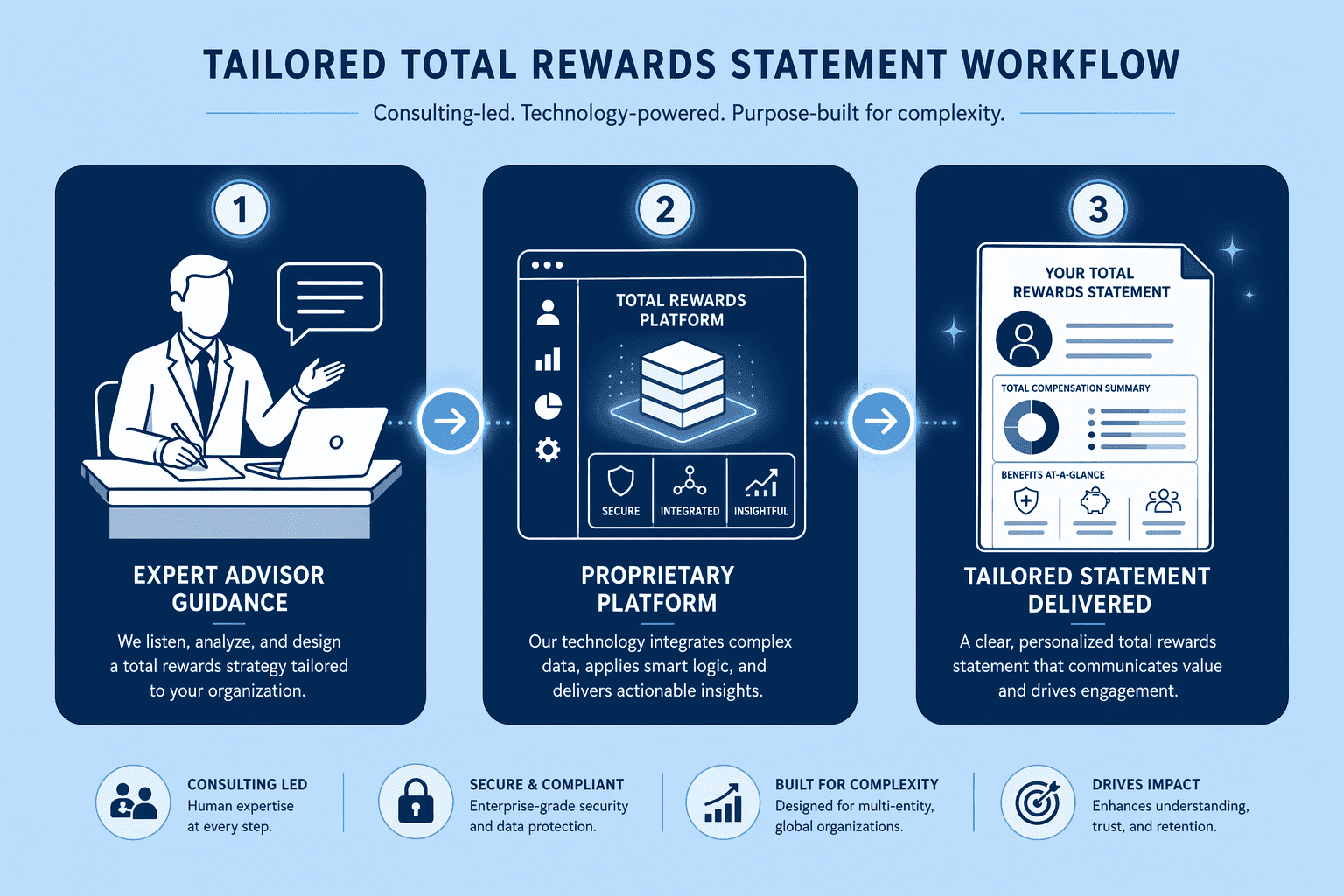
Compensation Resources takes the opposite approach from rapid-deployment software. Their model is consulting-led, producing highly tailored total rewards summary statements through a proprietary platform paired with strategic advisory work. For complex enterprises with layered benefits structures, multiple employee classes, and specific communication goals, this bespoke depth is the differentiator.
What distinguishes their service from pure SaaS:
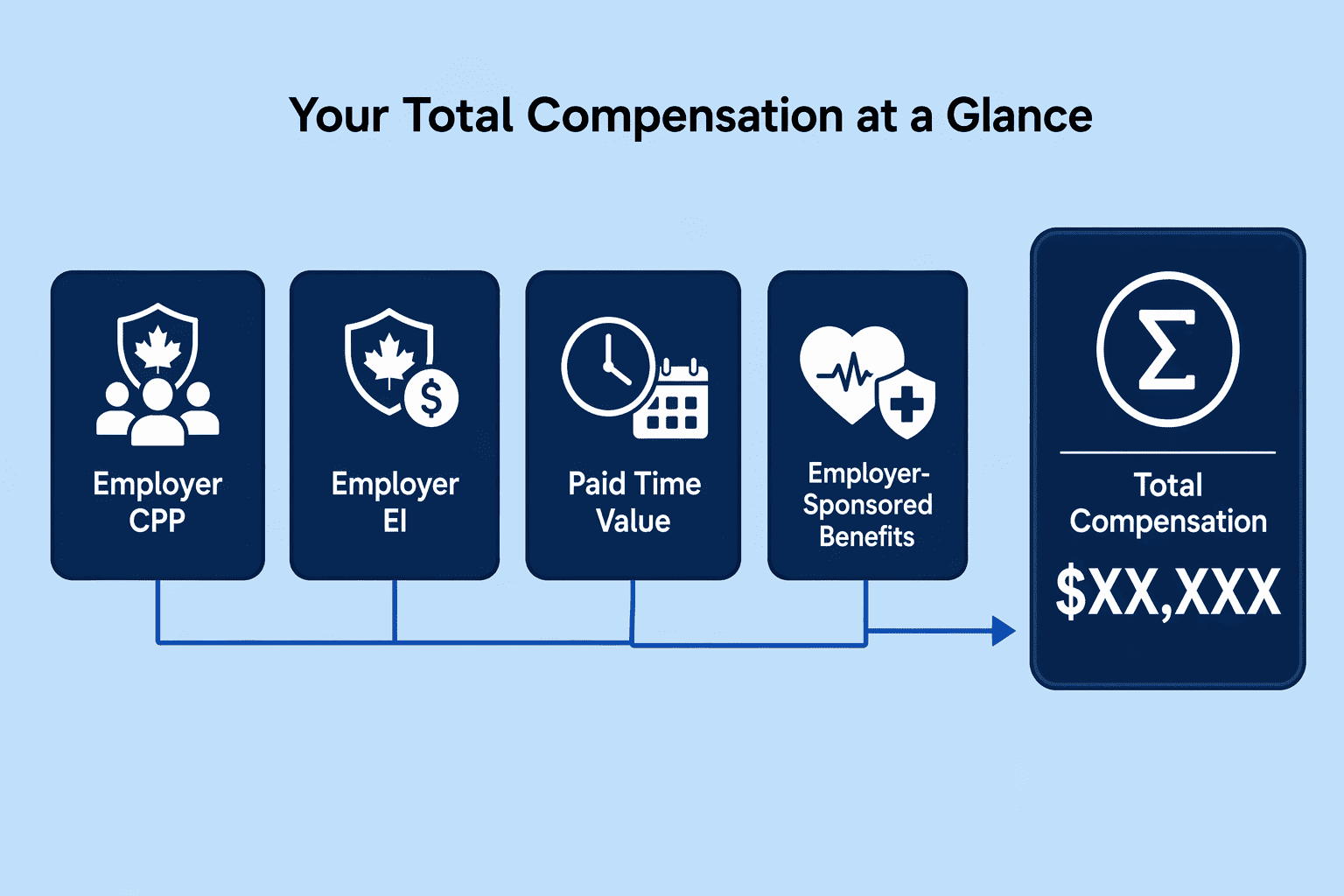
Not every employer conversation about total compensation needs to start with a procurement process. Healthwise Benefits Advisory offers a free Total Compensation Calculator that automatically computes the employer's side of the ledger, including 2026 statutory contributions. The tool pulls in employer CPP at $3,362 and EI at $1,369 for the year, then adds paid time value, direct pay, and employer-sponsored benefits into a single view.
The calculator's real value is as an engagement accelerant. An HR leader can sit with a skeptical employee or a prospective hire, walk through the inputs in real time, and watch the total compensation figure come together. The free tool is Canadian-focused, and its statutory figures apply to the Canadian market rather than the US. Employers operating in the United States should use it as a conceptual proof point.
But that proof point matters. 23% of respondents disagree that their organization offers competitive packages, with another 13% neither agreeing nor disagreeing in a 2024 Harvard Business Review survey of 214 members. Translating invisible employer spending into a visible number shifts that conversation before it becomes an exit interview.
A free calculator is the fastest way to demonstrate the concept and build internal buy-in for a paid platform. It won't be your permanent solution.
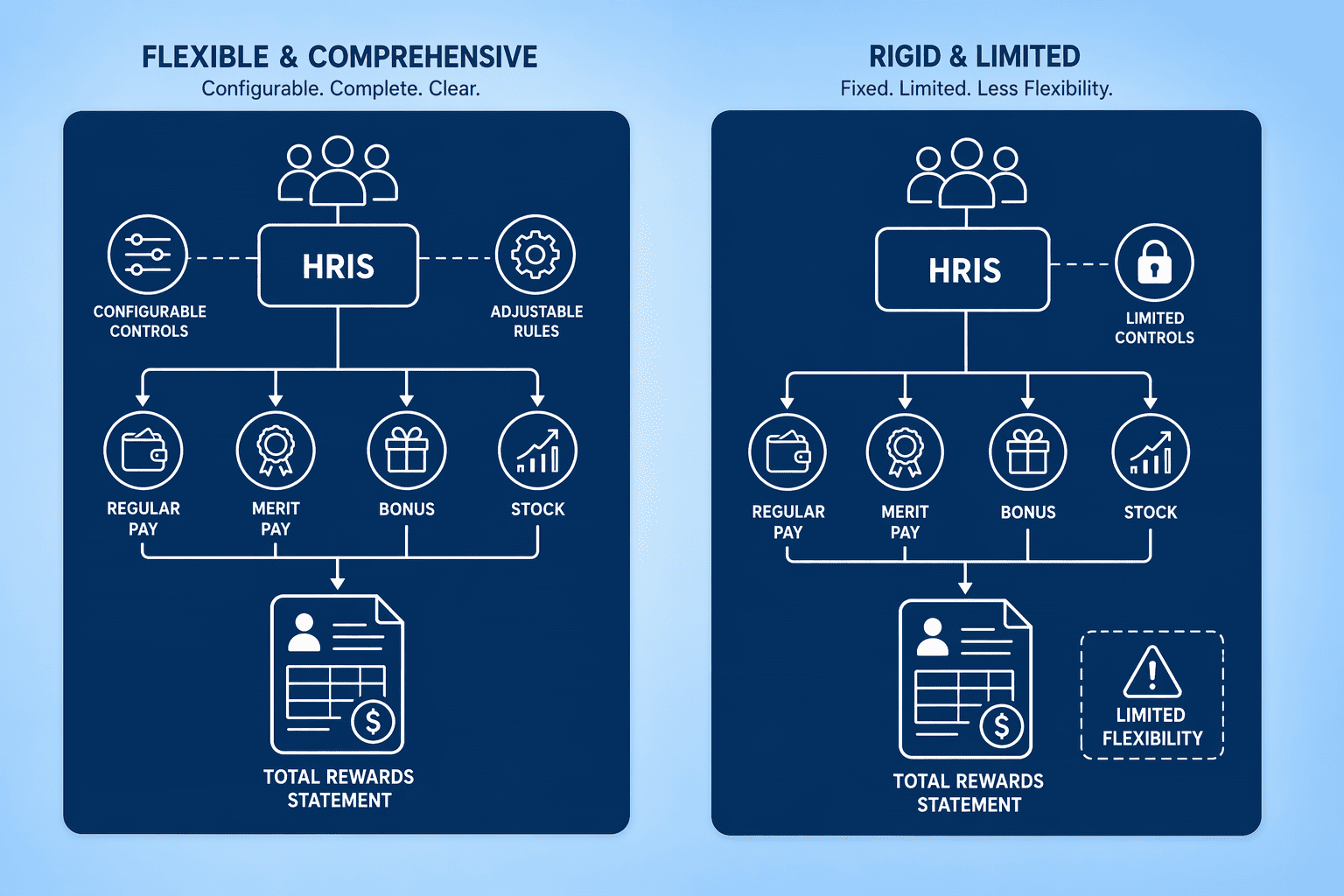
If your organization already runs Workday, UKG, or ADP, the path of least resistance is switching on the native compensation statement module. Workday's total rewards statements, for instance, come standard with the platform and let you combine compensation components from regular pay to merit, bonus, and stock. Workday also reports that customers reduced end-to-end compensation planning cycles by 80%, suggesting the underlying data infrastructure is solid.
The integration advantage is real. These modules draw directly from the same payroll and benefits data that feeds every paycheck and W-2, so the numbers match. There is no reconciliation step between systems, and no employee looks at a statement and sees a figure that contradicts their pay stub. For compliance-heavy environments, that single-source truth is non-negotiable.
Where these modules fall short is communicatiion design. The statements tend to be functional rather than clear: dense grids of numbers with minimal narrative framing, designed by engineers rather than rewards communicators. Customization is constrained by the platform's template structure. One HRIS administrator described the output as visually accurate but emotionally flat. For organizations where the goal is moving employee perception and retention, a native module alone often undershoots the mark.
An HRIS-native statement is your floor, not your ceiling. It audits correctly but rarely persuades.
Some organizations have the technical resources to extract payroll and benefits data and build custom total compensation statements internally. The control is complete: every line item, every category label, and every visual element can match the company's exact total rewards philosophy. For a university, government agency, or large enterprise with in-house development capacity, this route avoids vendor lock-in entirely.
The hidden cost is maintenance. Employer contribution rates change annually. Benefit costs shift at renewal.
Tax thresholds, statutory contribution caps, and paid-leave accrual rules all require updates, and each update is a point of potential error. Virginia Tech's own total compensation estimator illustrates the scope: it must account for annualized salary, health insurance, retirement, cash match for 403b/457 plans, Social Security, Medicare, annual leave, holidays, sick leave, family personal leave, short and long term disability, community service, and group life insurance. Keeping all of that current requires dedicated analyst time every quarter.
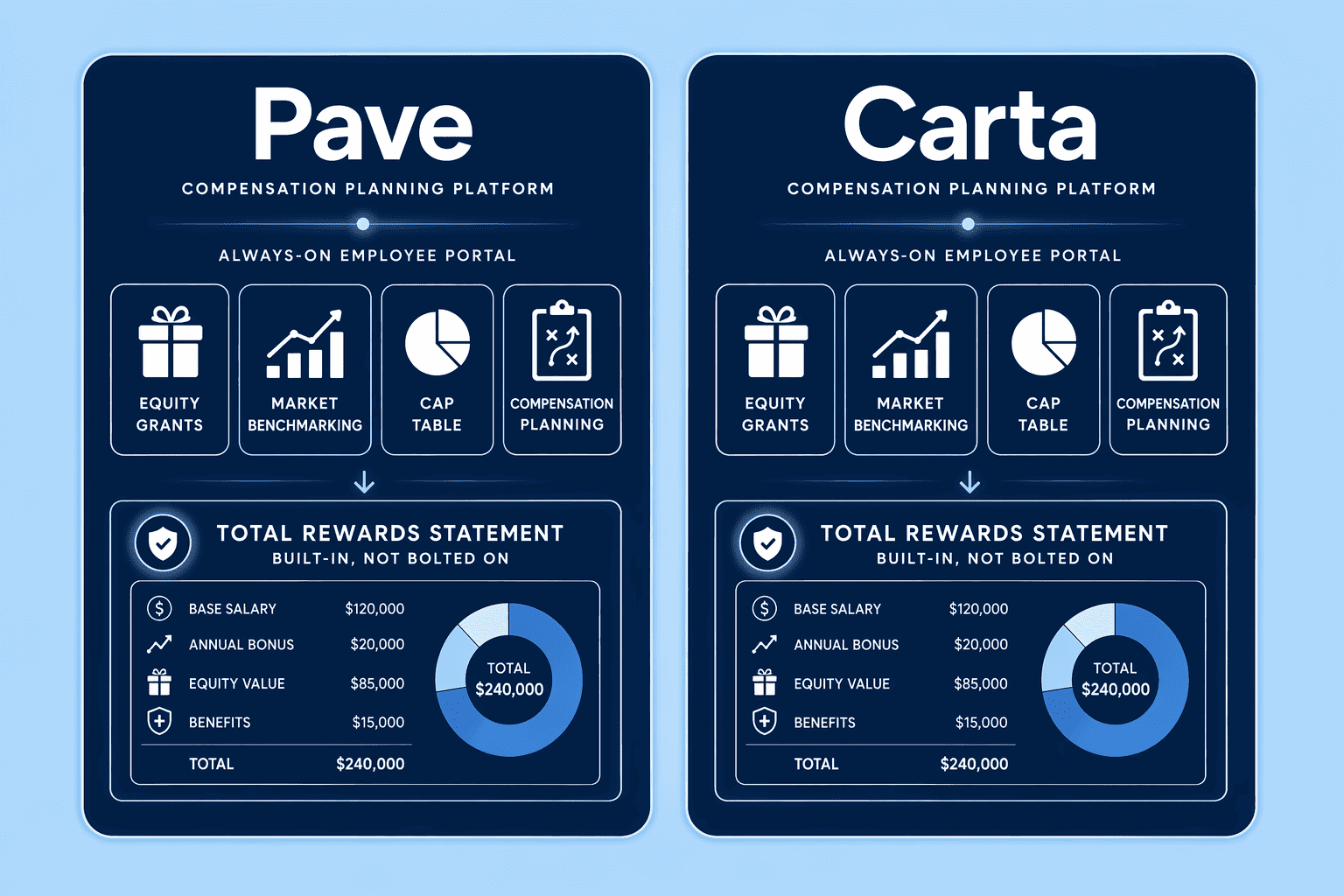
Pave and Carta sit in a different category from the rest of this list. They are compensation planning and equity management platforms first. Total rewards statements are a by-product of that core workflow, not a separate project. For venture-backed or public tech companies already managing cap tables, equity grants, and real-time market benchmarking, these platforms surface compensation data inside an always-on employee portal with no extra document-generation step.
How the two platforms compare on total rewards delivery:
| Dimension | Pave Total Rewards | Carta Total Rewards |
|---|---|---|
| Core platform category | Compensation planning and benchmarking | Equity management and cap table administration |
| Total rewards portal format | Personalized, always-on portal | Compensation statements generated from equity and payroll data |
| Market data integration | Real-time data from 8,000+ companies, powered by predictive ML | Valuation and equity benchmarking tied to cap table data |
| Equity projections | Compensation simulator and share price slider model how growth impacts earnings | Equity value projections derived from 409A valuations and funding rounds |
| Free tier availability | Market Data Lite is free for companies with 1 to 200 employees | No free total rewards tier |
| Best fit | Tech-forward companies running merit cycles with market data | Companies where equity is the dominant compensation narrative |
Both platforms share a conceptual advantage: the employee's total rewards statement is not a separate artifact someone has to build. It emerges from the same data the company uses to decide compensation in the first place.
The market for total compensation breakdown tools spans from zero-cost concept calculators to embedded compensation planning platforms.
Healthwise's free calculator proves the concept in a single conversation. BenefitWerks delivers a dedicated statement in 45 days. Pave and Carta embed total rewards visibility into the compensation planning cycle itself, while Compensation Resources builds statements from scratch with consulting depth. CompUp connects total rewards communication with pay equity analysis, scenario modeling, and merit cycle management in a single system.
Your choice hinges on three questions. Are you solving a one-time communication gap or building an ongoing compensation transparency strategy? Do you need a document or a living portal? And does your compensation data already live in a platform that can surface it, or does it need to be extracted and assembled for the first time? Answer those three, and the right tool on this list becomes the obvious one. A good next step is seeing how CompUp puts this into practice.
A total compensation statement is a personalized document that shows an employee their full earnings and employer-paid benefits beyond base salary. It captures health insurance premiums, retirement contributions, paid leave, statutory contributions, and equity. It matters because most employees only see salary and underestimate their total package, which erodes retention and satisfaction.
Dedicated statement software like BenefitWerks, consulting-led services like Compensation Resources, HRIS-native modules in Workday or ADP, free calculators from Healthwise Benefits Advisory, compensation platforms with total rewards portals like Pave and Carta, and unified platforms like CompUp all provide total compensation breakdowns. The right fit depends on speed, customization, and integration needs.
CompUp generates personalized Total Rewards Letters when the appraisal cycle closes, tying compensation visibility to the moment employees focus on their pay. The platform pulls data from its compensation planning, pay equity, and budget simulation modules, ensuring the statement reflects the same figures used in compensation decisions.
A thorough overview should cover base salary, bonuses, equity awards, employer-paid health insurance premiums, retirement plan contributions, statutory employer contributions like Social Security and Medicare, paid time off, short and long term disability coverage, and any other employer-paid benefits. The Virginia Tech estimator includes all of these as a reference model.
HRIS-native modules in Workday, UKG, or ADP integrate directly with payroll data, so numbers always match pay stubs, and Workday includes the feature standard. Dedicated tools like BenefitWerks offer faster deployment and richer customization, while compensation platforms like Pave and CompUp add real-time market data and equity projections.
Effective statements surface the numbers employees cannot see on their pay stubs: employer-paid insurance, retirement matches, paid leave value, and statutory contributions. Timing the statement around appraisal cycles makes the message land harder, and using an always-on portal rather than an annual PDF keeps total compensation visible throughout the year.
Community Manager (Marketing)
As a Community Manager, I’m passionate about fostering collaboration and knowledge sharing among professionals in compensation management and total rewards. I develop engaging content that simplifies complex topics, empowering others to excel and aim to drive collective growth through insight and connection.
Revolutionizing Pay Strategies: Don't Miss Our Latest Blogs on Compensation Benchmarking