
Your last merit cycle took three months, and the spreadsheets still contained errors that auditors flagged. Half the managers submitted forms late, and your C-suite asked for an equity burn-rate analysis that simply wasn't possible with the current setup. That is a structural breakdown, and the clock is ticking louder in 2026.
The EU Pay Transparency Directive is now in effect, demanding gender pay gap reporting and proactive disclosure. In the U.S., more than a dozen states, including California, New York, Colorado, Washington, and Illinois, now require salary range disclosures in job postings. Meanwhile, AI-driven analytics have moved from a luxury to a baseline expectation for responding to real-time market data. Manual planning, built on yesterday's logic, cannot scale to meet these demands.
Work has changed fundamentally. Compensation planning software now goes well beyond simple salary allocation. The leading tools ingest workforce and pay data, apply statistical analysis, and manage the full scope of total rewards: merit, bonus, equity, and long-term incentives, all within audit-ready workflows. This guide compares seven tools that solve these distinct challenges, from live benchmarking for fast-moving skill areas to compliance-heavy global administration.
The compensation software market in 2026 coalesces around a few distinct leaders, matching specific operational pain points rather than delivering a single shared mold. Here are the top-line findings:
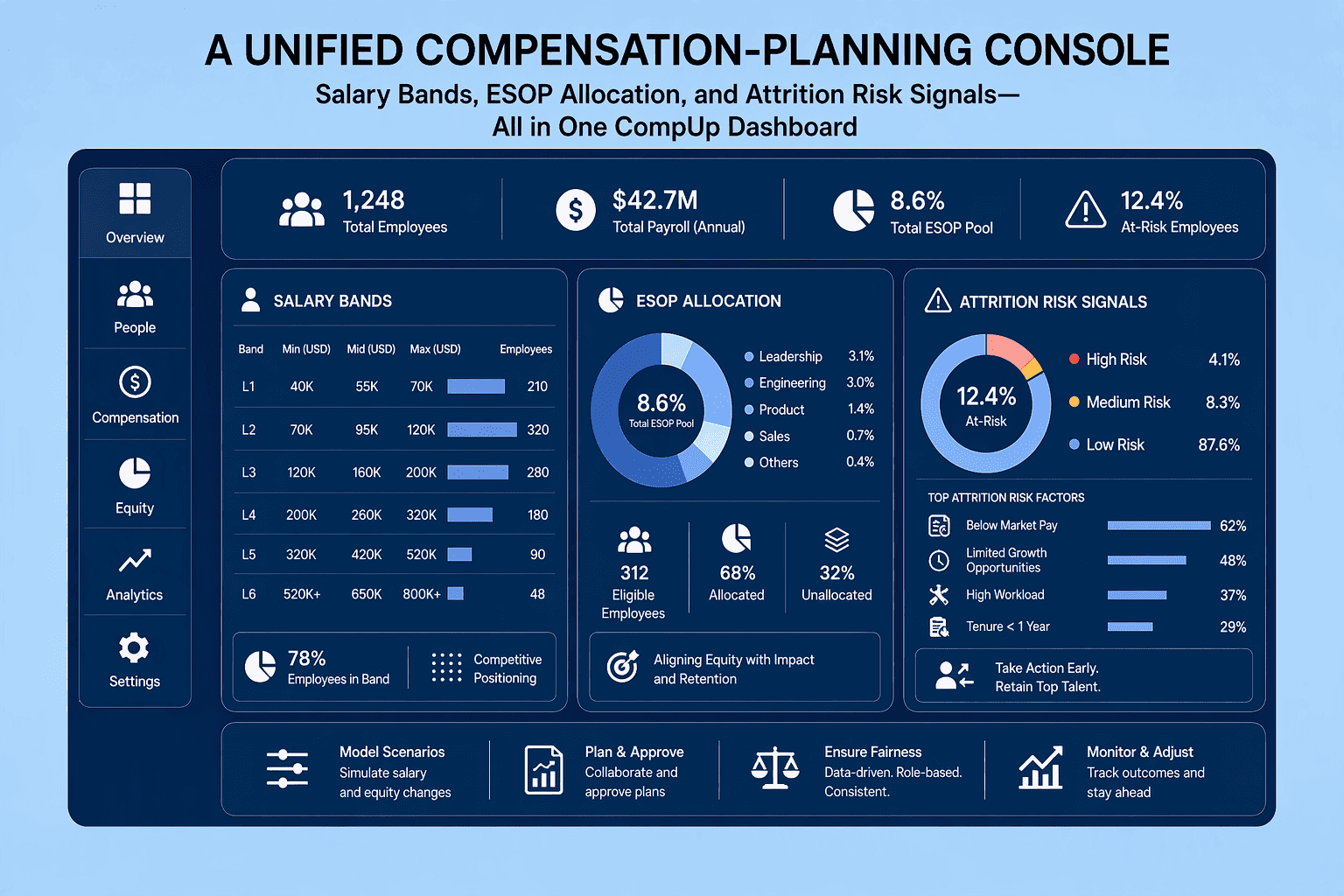
For mid-market and growth-stage companies juggling salary, equity, and attrition signals in a single view, CompUp delivers the rare unified console without the enterprise price tag. It’s built for organizations that need to move fast and keep pay structured.
CompUp starts at $3 per employee per year, making it one of the most accessible platforms on this list. But affordability isn't its only angle. The system brings together compensation management, total rewards statements, appraisal letters, attrition analysis, and workforce planning in one web-based SaaS model. It integrates with tools like BambooHR, Lattice, Darwinbox, and Workable, so you're not starting from a blank data slate.
What makes this platform stand out operationally is its ESOP management module. Equity is often the messiest part of a total rewards puzzle, and CompUp handles it natively, not as an afterthought bolted onto a salary tool. This is purposeful design for companies scaling teams across multiple countries.
The platform supports 80+ currencies and is trusted by 100+ leading companies across 140+ countries. When your planning cycle closes, CompUp can automatically generate personalized total rewards statements, giving employees clear visibility into the full scope of their compensation.
This is not an HCM suite, and it doesn't pretend to be one. It’s a compensation-specialized platform that keeps the scope tight, which means implementation is measured in weeks, not quarters.
Aeqium is built for enterprise total rewards teams running complex programs across business units, countries, and currencies. That is the operational reality of a platform designed to manage merit, bonus, equity, and long-term incentives in one interconnected cycle. If your organization has outgrown per-country spreadsheets and needs a single source of truth for 20 jurisdictions, Aeqium sits at the top of the shortlist.
The capability that lands Aeqium its rank is its configuration AI, called Assist. Assist handles the deep, fiddly work of setting up multi-country compensation cycles: adjusting guidelines, carry-forward rules, and proration logic that would otherwise take teams weeks to build manually. Customers like Amazon, PwC, Klaviyo, and Redis run on Aeqium.
Concrete operational results back up the platform's claims: IFS cut its global cycle to about a month, roughly half its previous length. Braze and Hopper report 90% fewer errors in compensation data after moving to the system.
Aeqium's out-of-the-box pay equity reports are tightly aligned with emerging regulatory demands like the EU Pay Transparency Directive. The tool surfaces unexplained pay differences across protected characteristics using statistical analysis, organizing them for audit-grade reporting. This moves the pay equity conversation from a once-a-year panic to a continuous governance loop, embedding fairness checks into the standard workflow. For multinational total rewards leaders who cannot afford fragmented data or manual cycle mistakes, Aeqium is a structural upgrade.
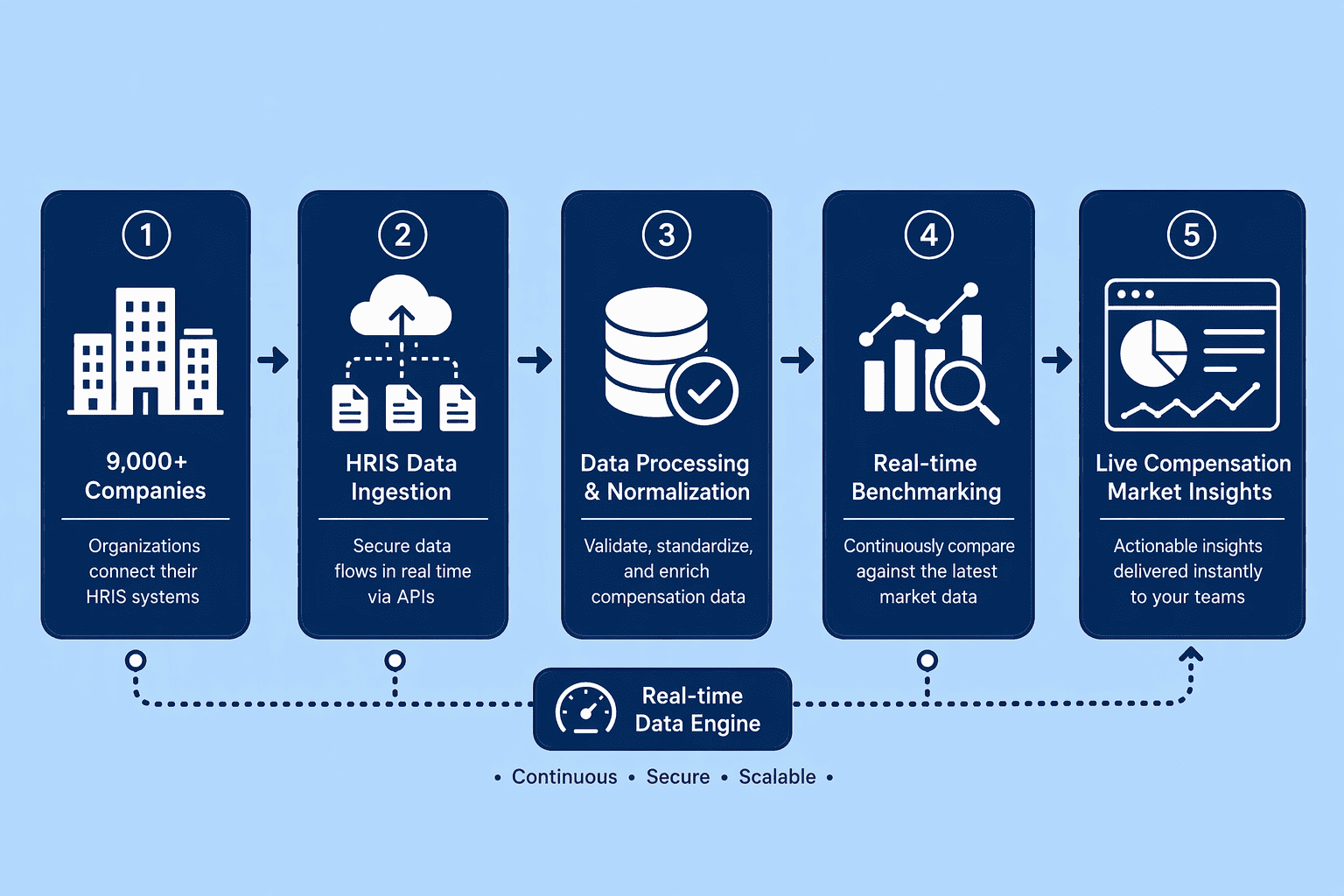
Market data that’s six months old is market data that’s wrong. Pave redefines compensation benchmarking by anchoring every decision in live information, pulled continuously from a dataset that now represents more than 9,000 companies through direct HRIS integrations. This is not survey data with a lag. It's a real-time reflection of what the talent market is doing right now, which matters enormously when hiring in new markets or planning for hard-to-fill skill areas such as AI and engineering.
The consequence for manager workflows is significant. Pave equips compensation partners and line managers with immediate, context-rich data during salary and equity recommendations, cutting down the back-and-forth that drags cycles into overtime. Approval chains operate faster because the anchoring data is unambiguous and fresh. When a hiring manager needs to price a role for which competitive offers shift weekly, Pave’s benchmark isn't a median drawn from two years ago, it’s today’s going rate, pulled from integrated systems across the participating network.
One critical caveat: benchmarking's value depends entirely on consistent job leveling. Without it, employees are matched to incorrect market comparators, and the resulting ranges lose their integrity. Pave provides the data depth and velocity, but the reason the tool earns its rank is that it shifts the organizational muscle memory away from speculative guesswork and toward evidence-led pay. Teams that invest in clean internal leveling see Pave's live data unlock decision-making speed that conventional survey cycles simply cannot match.
When the foundational need is analytical depth and a dataset that spans decades of salary survey participation, no tool competes with Payscale’s institutional muscle. Its MarketPay and CompAnalyst platforms draw from one of the largest compensation datasets in the market, which makes Payscale the de facto standard for organizations that build compensation architecture from exhaustive market pricing and job evaluation.
Payscale’s strength is the modeling engine, which lets a rewards team run compensation scenarios, simulate market adjustments, and build salary structures backed by statistically significant survey coverage. In a planning cycle where the remit is complex job architecture redesign, this depth becomes non-negotiable. The platform supports strategic compensation planning: long-term philosophy design, framework construction, pay equity analysis, and budget modeling, all within the same system. Organizations that prioritize data maturity and want to control their own benchmarking methodology, rather than rely on pooled HRIS aggregates, will find Payscale the most defensible choice for evidence-led governance.
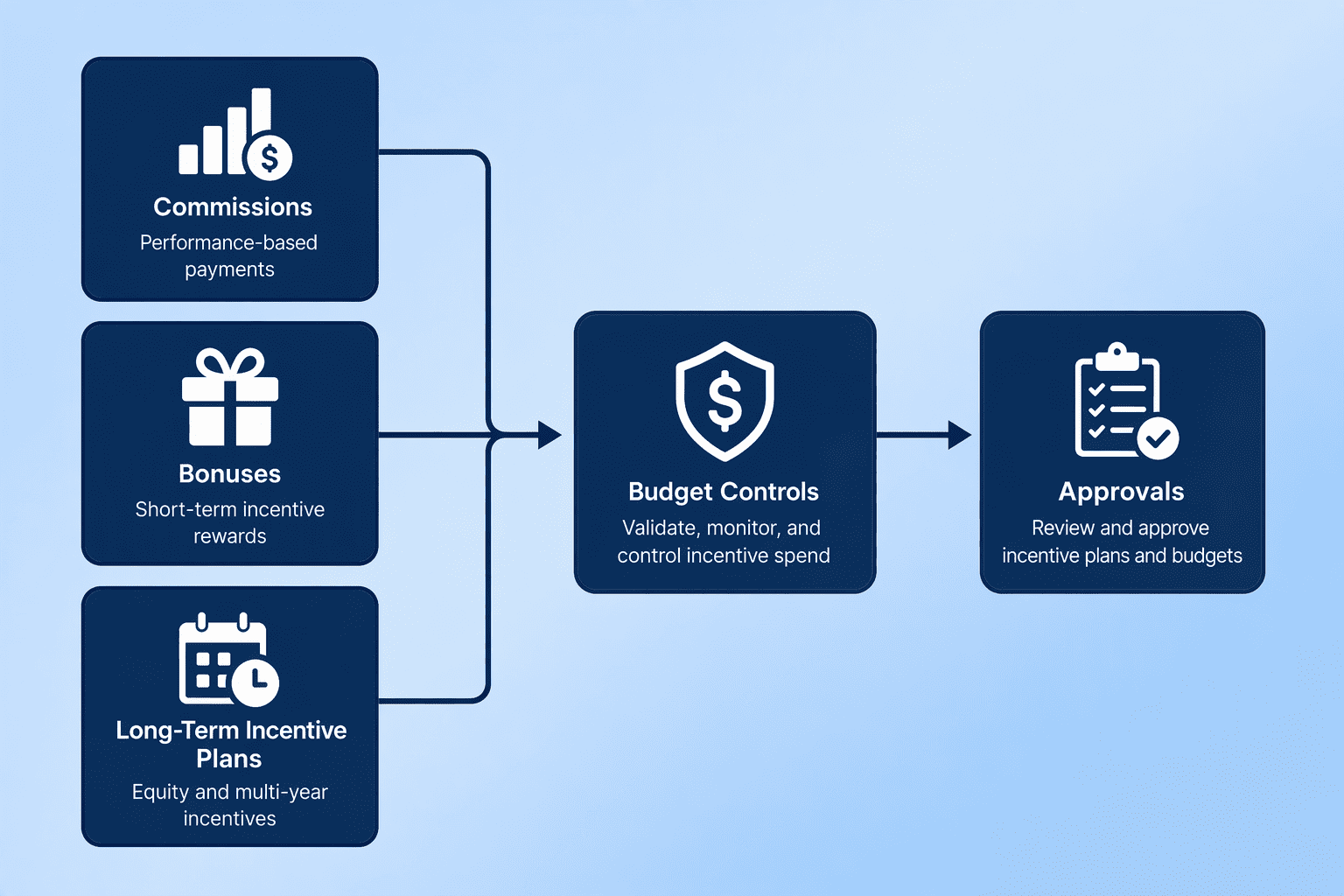
Large enterprises rarely run one compensation plan. They run dozens, sales commissions, management bonuses, long-term incentive plans, spot awards, each with its own rules, eligibility criteria, and approval chain. CompXL targets exactly this complexity, providing flexible incentive management and tight budget control at a scale where governance failures can cost millions.
CompXL gives compensation administrators granular control over plan workflows and budget allocation, with real-time visibility into aggregate spend. Reports flag anomalies and potential overruns before recommendations reach approval. The tool sidesteps the full-suite HCM play entirely and focuses on the mechanics of incentive administration where complexity and financial exposure are highest.
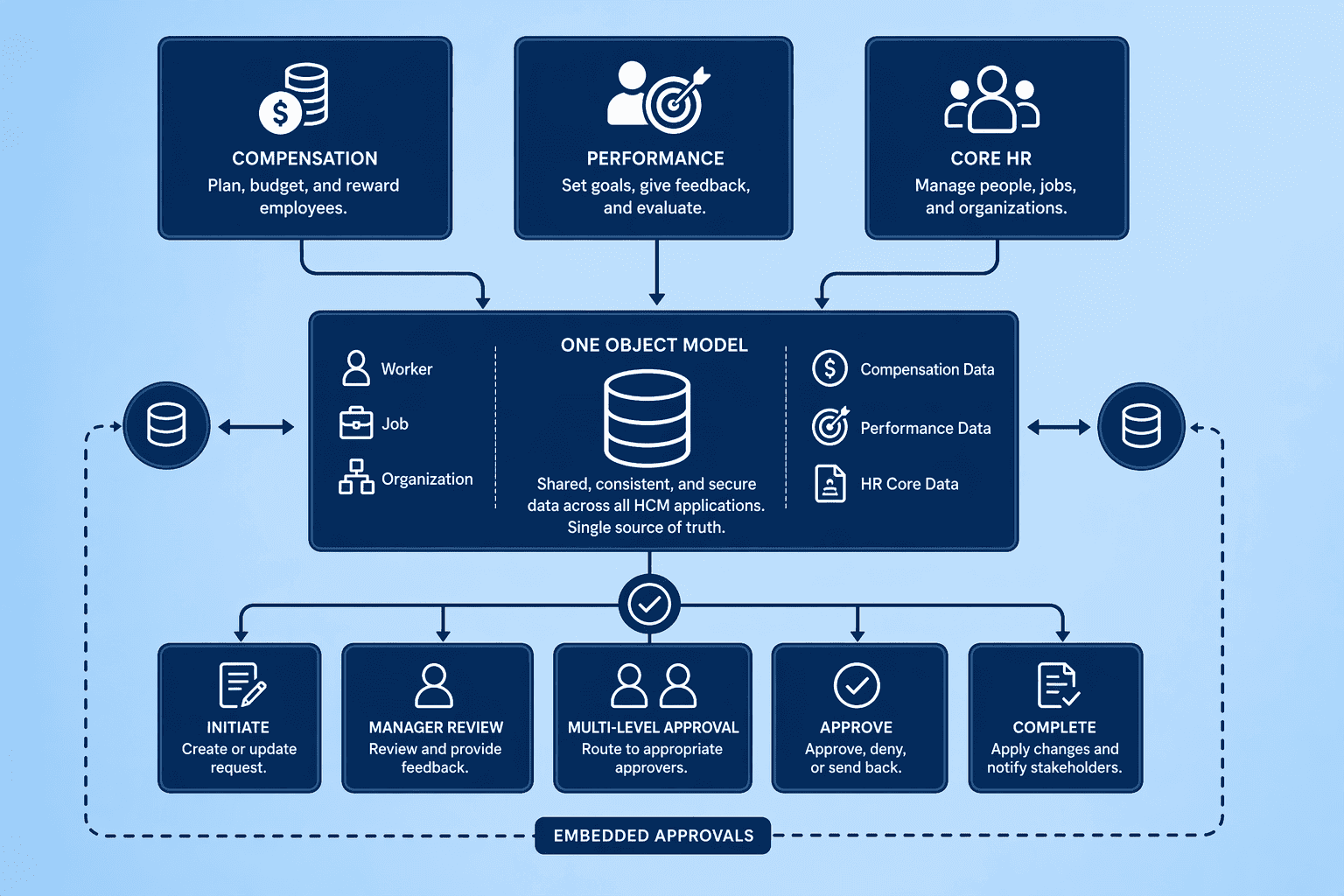
Organizations already entrenched in the Workday ecosystem gain a distinct advantage from its native compensation module: no data mapping, no middleware, and no reconciliation between systems of record. Here is how the integration advantage materializes operationally:
Workday's compensation module lacks the benchmarking depth and incentive-design complexity of the best standalone tools. What it delivers is the lowest data friction for organizations that already treat Workday as their HR source of truth. The trade-off is clear: flexibility is sacrificed for seamlessness, and organizations that prize a unified total rewards workflow will find that trade worthwhile.
Not every company needs multi-country cycle configuration or AI-assisted modeling. For straightforward merit and bonus cycles where the priority is getting managers aligned on budget and out the door quickly, CompBldr strips compensation planning down to its most functional core. Here is how it stacks against enterprise counterparts on key decision dimensions:
| Dimension | CompBldr | Enterprise Tools (Aeqium, Workday) |
|---|---|---|
| Primary Audience | Mid-market teams seeking simplicity | Global enterprises with complex cycles |
| Cycle Configuration | Pre-built templates, minimal customization | Deep AI-assisted, multi-business-unit rules |
| Pay Equity Reporting | Basic summary reports | Statistical regression, audit-ready outputs |
| Incentive Plan Complexity | Simple bonus and merit flows | Long-term incentives, equity, commissions |
| Integration Depth | Standard HRIS connectors | Suite-native or broad multi-system API layers |
| Implementation Timeframe | Weeks | Months, often with dedicated SI support |
| Pricing Philosophy | Accessible, flat-rate designed for mid-market | Per-employee, scaled to enterprise volume |
CompBldr makes a deliberate trade-off: it steps back from the deep configuration and compliance firepower of Aeqium or the HCM-nativity of Workday in exchange for speed and affordability. HR teams that don't need to administer global equity plans or satisfy multi-jurisdictional regulatory filings will find that CompBldr handles the core compensation planning workflow without the enterprise overhead.
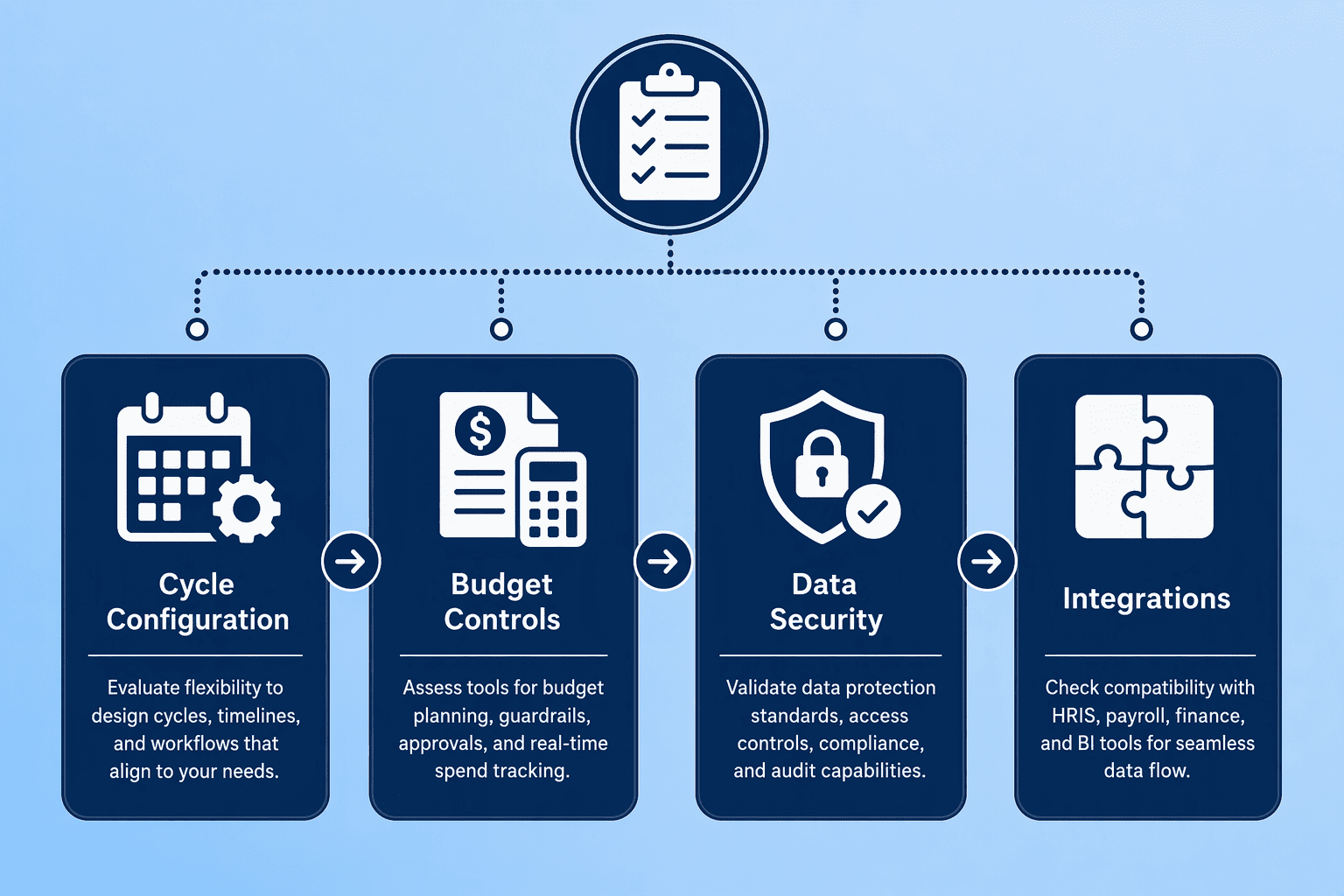
Demos showcase the same features, but compensation planning tools diverge sharply once they hit your real data. This checklist isolates the dimensions that separate a surface-level match from a platform that actually scales with your organization:
Your right compensation planning tool depends on scale, global regulatory exposure, data philosophy, and budget. There is no universal winner.
Global enterprises managing cycles across 20 countries with complex equity and incentive plans will find Aeqium's deep configuration, AI, and pay equity governance hard to replace. Organizations that compete on speed and market attunement should look first at Pave's real-time dataset of 9,000+ companies.
Mid-market and growth-stage firms needing a unified platform for salaries, ESOPs, and attrition analysis, without enterprise pricing, get purpose-built specialization at an accessible scale from CompUp. The common thread: manual planning is a mounting risk, not a cost-saving measure. Choose a tool that fits your complexity, integrate it deeply, and treat compensation decisions as the continuous strategic function they have become. A good next step is seeing how CompUp puts this into practice.
Top tools in 2026 include the following:
When evaluating, assess cycle configuration, budget controls, pay equity reporting, and AI transparency first.
CompUp provides real-time access to industry-specific compensation data and pay equity management as part of a unified platform. Unlike dedicated benchmarking tools such as Pave or Payscale, CompUp connects benchmarking directly to attrition analysis, ESOP management, and total rewards statements within a single system at $3 per employee per year.
The dominant 2026 trends are AI-assisted cycle configuration (led by tools like Aeqium's Assist), mandatory pay equity reporting under the EU Pay Transparency Directive, and real-time market benchmarking replacing lagging survey data. More than a dozen U.S. states now require salary range disclosures in job postings, making continuous compliance a core platform requirement.
Aeqium handles merit, bonus, equity, and long-term incentives in a single cycle. CompUp integrates ESOP management natively, not as an add-on, and automatically generates personalized total rewards statements at cycle close. Most platforms now treat equity as a core total rewards component, with varying depth of administration.
Pricing varies widely by platform:
Leading tools incorporate several core security and compliance features:
Aeqium offers out-of-the-box pay equity reporting, and platforms supporting EU operations maintain GDPR readiness for data access and erasure rights.
Community Manager (Marketing)
As a Community Manager, I’m passionate about fostering collaboration and knowledge sharing among professionals in compensation management and total rewards. I develop engaging content that simplifies complex topics, empowering others to excel and aim to drive collective growth through insight and connection.
Revolutionizing Pay Strategies: Don't Miss Our Latest Blogs on Compensation Benchmarking