
Your star engineer just resigned. The replacement cost alone will hit six figures, and the exit interview reveals a competitor offered 15% more for the same scope of work. When your CFO asks whether your current salary bands reflect the market or just last year's guesses, you need an answer grounded in data, not intuition.
Pay band software builds that answer into your operations. It's a dedicated platform that structures salary ranges for every role by connecting internal job levels to live external compensation benchmarks. For startups scaling past Seed stage, the shift from ad hoc spreadsheets to a structured compensation framework is an immediate retention and hiring prerequisite.
It's also a new baseline for due diligence. Carta's H2 2025 data confirms median salaries rose 6.4% over the preceding two years. Investor scrutiny now routinely examines pay structures for equity gaps, and more jurisdictions are mandating pay transparency. Data sources like Radford and Comptryx supply the raw market intelligence these tools ingest. The platforms ranked below turn that intelligence into defensible salary bands, automate midpoint adjustments, and flag pay disparities before they become retention emergencies.
Integrated benchmarking and equity-aware tools have replaced static spreadsheets as the operational backbone of startup compensation in 2026. Before diving into each platform, here are the actionable insights that matter most for a founder or people leader evaluating solutions.
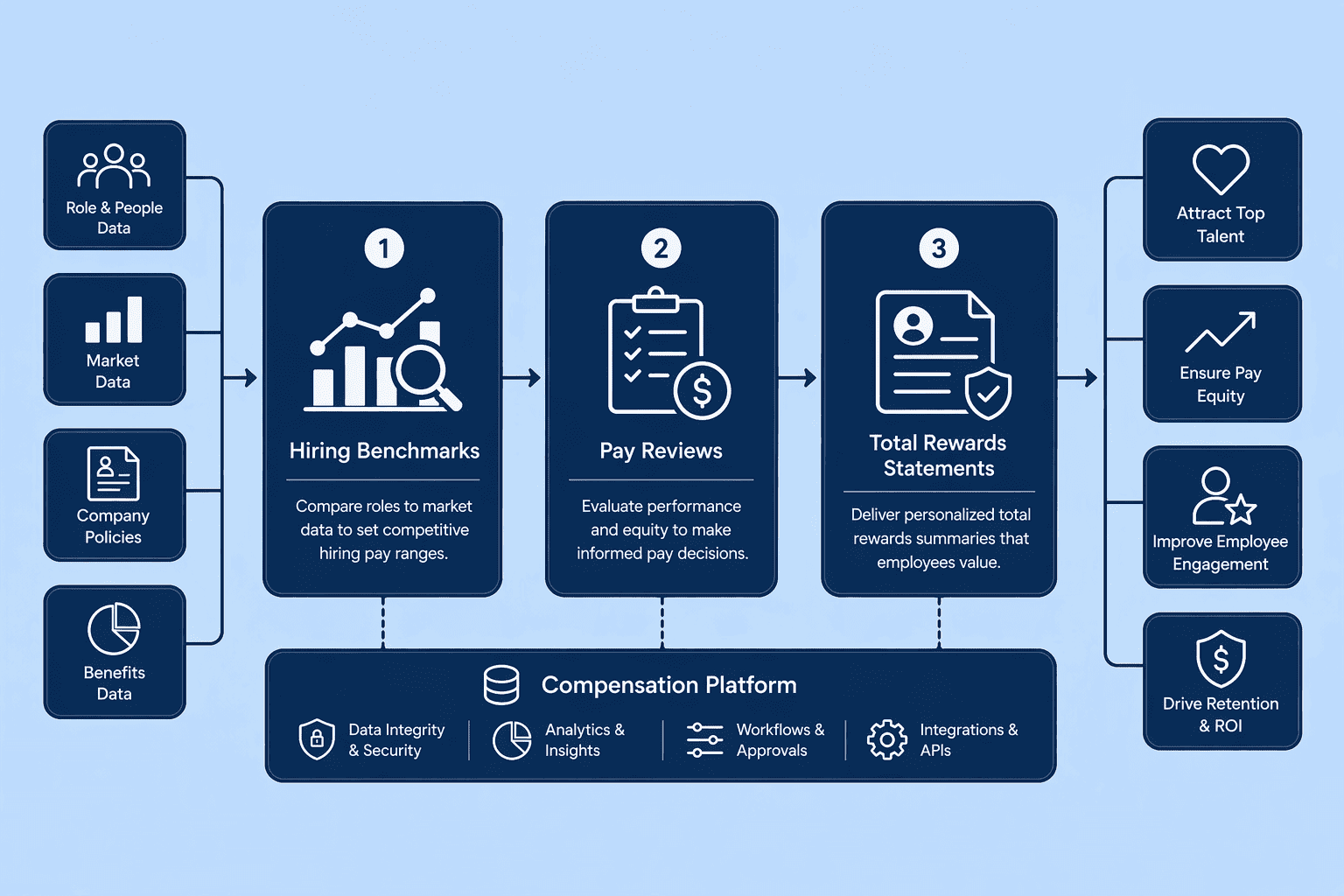
CompUp is the most thorough single-platform option for startups that want to consolidate the entire compensation lifecycle, from offer creation through to personalized total rewards statements. It starts at $3 per employee per year and provides real-time access to industry-specific compensation data, purpose-built to serve growing companies scaling across borders. With a 4.9 rating on G2 and a client base of 100-plus leading companies covering over 150,000 employees across 140-plus countries in more than 80 currencies, CompUp has built a global compensation management platform without the bloat of an enterprise HCM suite.
What distinguishes CompUp operationally is its module set. The HireSure.ai module powers hiring benchmarks. The pay review workflows automate approval chains during compensation cycles.
At the close of an appraisal cycle, the platform can automatically generate personalized Total Rewards Statements, giving every employee a clear view of salary, equity, and benefits in one document. Integrations with BambooHR and Darwinbox mean the platform slots into an existing people stack rather than demanding a rip-and-replace. CompUp runs from the first structured offer through every subsequent review, adjustment, and communication event.
Pave is the tool startups reach for when the pain point is outdated market data driving every offer and review cycle. It is not a survey company. It connects directly with HCM and equity management systems at 9,000-plus companies to capture every offer, promotion, equity grant, and compensation adjustment automatically. That infrastructure choice means the benchmarking data feeding your salary bands reflects actual compensation decisions, not self-reported survey responses lagging by six months.
The product range is structured by data depth. Market Data Lite provides real-time compensation data spanning 290-plus job families in the overall U.S. and one additional market of the user's choice, which suits a domestic-first startup beginning to structure bands. Market Data Pro expands coverage to 290-plus job families, 190-plus countries and metros, multiple pay types, and peer group reporting at a single price, built for startups hiring across borders from day one.
Pave also captures equity grants at a granularity traditional surveys cannot. It connects directly with equity management systems to capture what surveys structurally can't: every unique grant, enabling benchmarks on new-hire awards that give founders a defensible basis for option packages. The LeadChange Group scores Pave at 6.1 out of 10 and identifies it as the highest-scoring product that lists small businesses as a target segment. Pricing follows a per-employee model starting around $50 per month, scaling with headcount. For a startup that wants market data to flow directly into offer workflows and compensation review cycles without manual spreadsheet interventions, Pave is the leading choice in 2026.
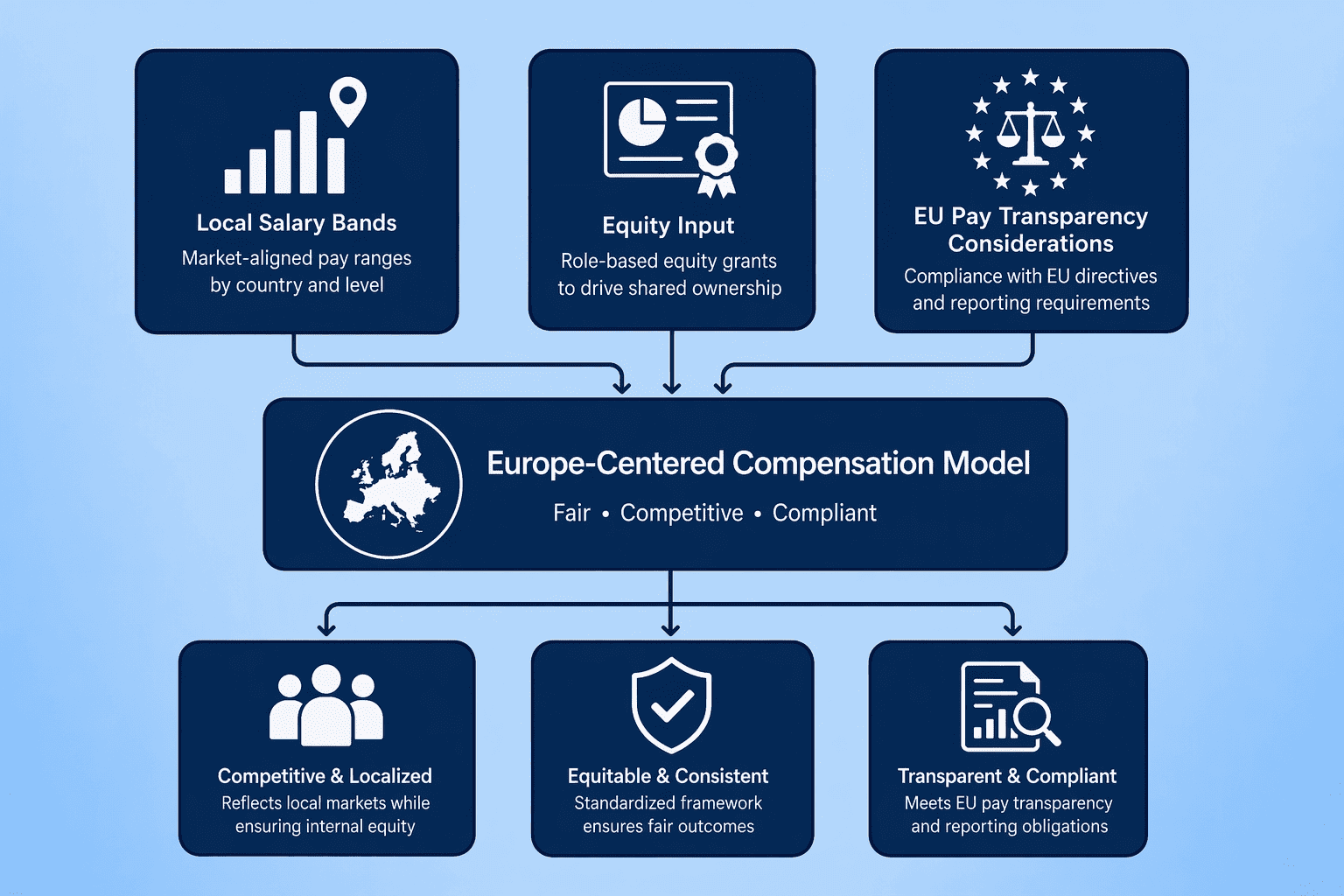
Figures is purpose-built for European founders navigating euro-denominated markets, equity-heavy compensation packages, and the approaching EU Pay Transparency Directive. Most benchmarking tools default to U.S. market logic. Figures starts with European data, so salary band recommendations reflect local competitive dynamics rather than converted dollar surveys. It treats equity as a first-class input to every compensation decision. Below are the capabilities that define its fit for Seed through Series B startups in Europe.
Compa takes a fundamentally different data approach, one that appeals to data-driven compensation leads who need to simulate decisions before executing them. Its core dataset is derived from aggregated offer letters, which means the market signals it surfaces reflect what companies are actually putting in front of candidates right now, not what incumbents paid last year. This offer-based intelligence gives hiring managers a real-time negotiation baseline at the moment they are extending a term sheet.
| Dimension | What Compa Delivers | Why It Matters for Startups |
|---|---|---|
| Data Source | Aggregated, anonymized offer letters | Reflects live offer activity, not lagged survey data |
| Scenario Modeling | Test band changes against budget and equity pool constraints | Prevents overextension on a single hire that blows comp architecture |
| Primary Use Case | Offer-time intelligence and compensation simulation | Speeds time-to-offer while anchoring terms in defensible data |
| Fit Profile | Data-centric comp leads at startups with 50 to 500 employees | Adds analytical rigor without enterprise software overhead |
The scenario modeling capability is the differentiator that earns Compa this spot. Before a founder commits to a salary band adjustment, the platform models the downstream impact against budget constraints and equity dilution limits. That simulation prevents the classic startup trap of fixing one compensation problem while creating three more. For startups where every offer in a competitive talent market feels like a high-stakes negotiation, Compa provides the analytical cover to move fast with confidence.
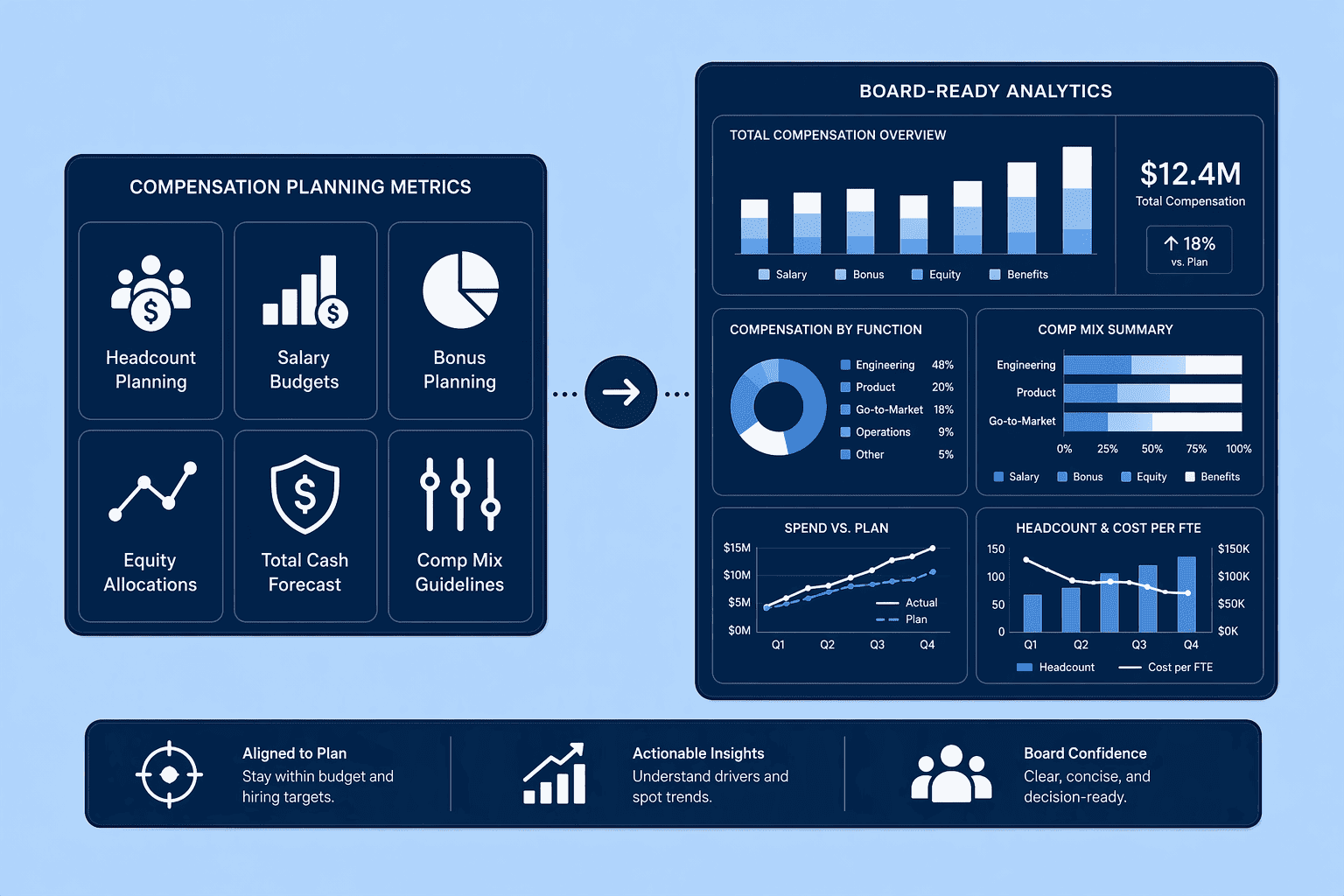
OpenComp is built for the moment a startup's compensation strategy moves from an operational concern to a board-level discussion. Its platform benchmarks roles against pay data sourced organically from real HRIS and equity systems, not self-reported surveys, and it delivers analytics packaged for investor scrutiny. For founders preparing for a Series A or B round, the platform bridges the gap between day-to-day comp planning and the defensible reporting that investors and boards now demand.
Pequity earns its place for the growing people team that has graduated from manual spreadsheet cycles but has not yet added a dedicated compensation analyst. Its primary strengths are workflow automation for compensation review cycles and built-in pay equity analytics that flag disparities without requiring a specialist to run a regression analysis.
The automation layer handles approval chains, notification triggers, and manager-level visibility into band adherence. Instead of email threads and version-controlled spreadsheets, the review cycle runs inside the platform with guardrails that prevent out-of-band offers.
Pay equity analytics are embedded in the core workflow, not a separate reporting module.
The platform proactively surfaces pay gaps by gender, race, and tenure cohort at the point of decision-making. It is active through the entire cycle, flagging issues while you can still act on them. Correcting a disparity during a review cycle is an adjustment.
Explaining it six months later to a regulator or a disgruntled team is a much harder conversation. For startups operating in jurisdictions with emerging pay transparency requirements, this proactive flagging reduces compliance risk and builds a defensible internal record.
Pequity integrates with major HRIS platforms to pull employee data and push compensation decisions back into the system of record, eliminating the double-data-entry problem that plagues homegrown solutions. It automates the two highest-friction compensation processes: cycle management and equity auditing.
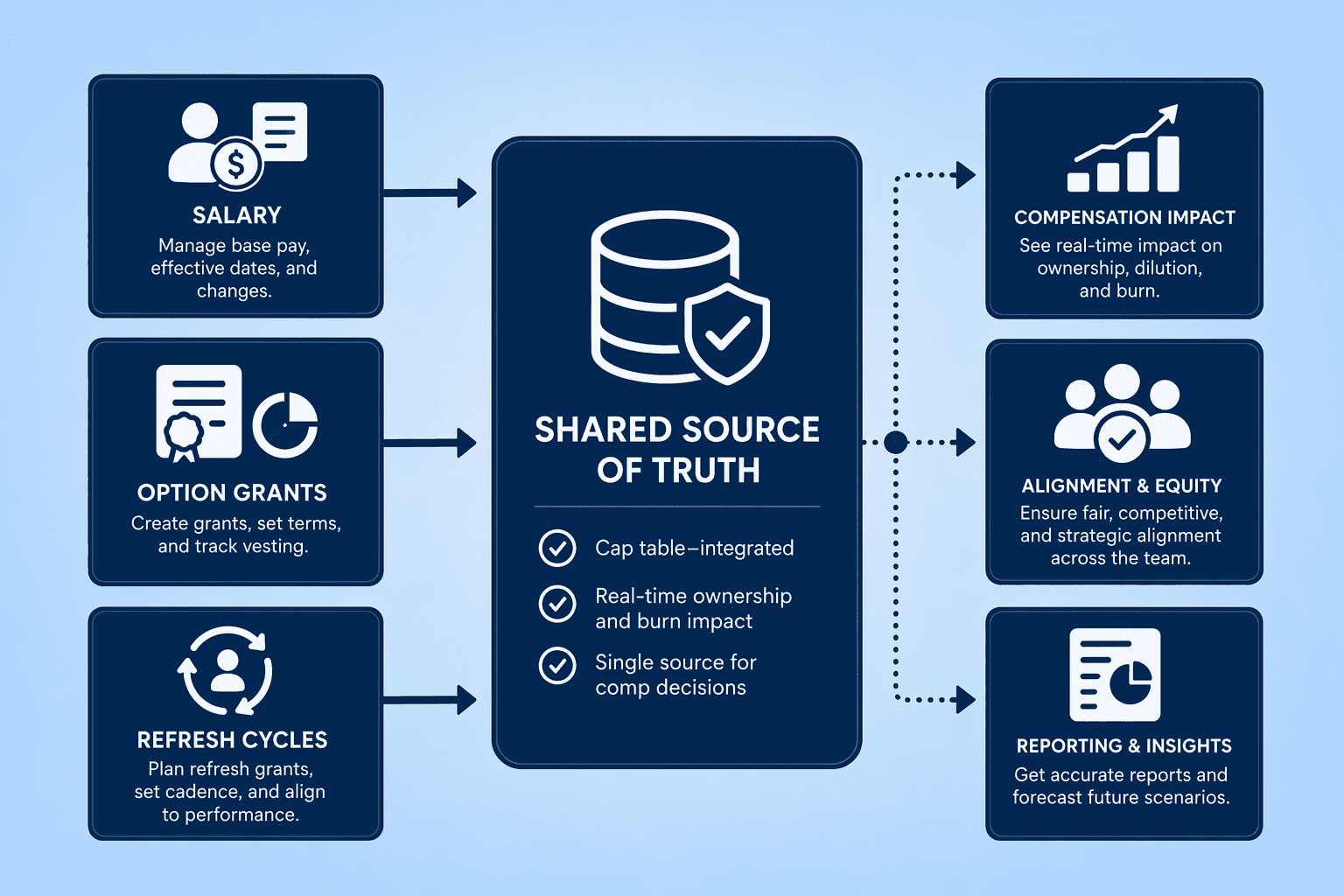
Carta Total Comp is the logical compensation layer for startups already running their equity management on Carta's cap table platform. Instead of maintaining separate systems for salary banding and option tracking, the integrated module calculates total rewards, base salary plus option grants plus refresh cycles, using a single source of truth. For a startup where dilution tracking is a monthly board metric, eliminating the reconciliation step between the compensation tool and the cap table is a data integrity requirement.
When a founder issues a new hire grant or a retention refresh, the equity value flows directly into the employee's compensation view without manual entry. That real-time connection means band adherence checks reflect actual dilution impact as it stands right now.
Salary.com occupies a distinct position on this list because its core asset predates the modern compensation software category. The company runs its own survey operation, drawing from over 15,000 participating organizations, and that depth of defensible market data is what a startup buys when it outgrows the lightweight benchmarks of newer entrants. For a Series B company building formal job architecture across dozens of departments and multiple geographies, the breadth of Salary.com's dataset is the reason to choose it.
The CompAnalyst platform wraps that data in pre-built salary structures that a startup can deploy quickly rather than building every band from scratch. For teams without a dedicated compensation function, Salary.com also offers on-demand consulting alongside the software. A people leader can buy a market pricing analysis for a specific role family alongside the tool that maintains the structure going forward.
For a five-person startup setting its first two bands, the data depth is overkill and the pricing reflects an enterprise heritage.
It is the bridge pick. For startups that have grown past the point where Pave or Figures alone suffice but that do not yet need (or cannot afford) a full Workday implementation, Salary.com provides enterprise-grade market data with enough flexibility in deployment model to work inside a lean people team's constraints.
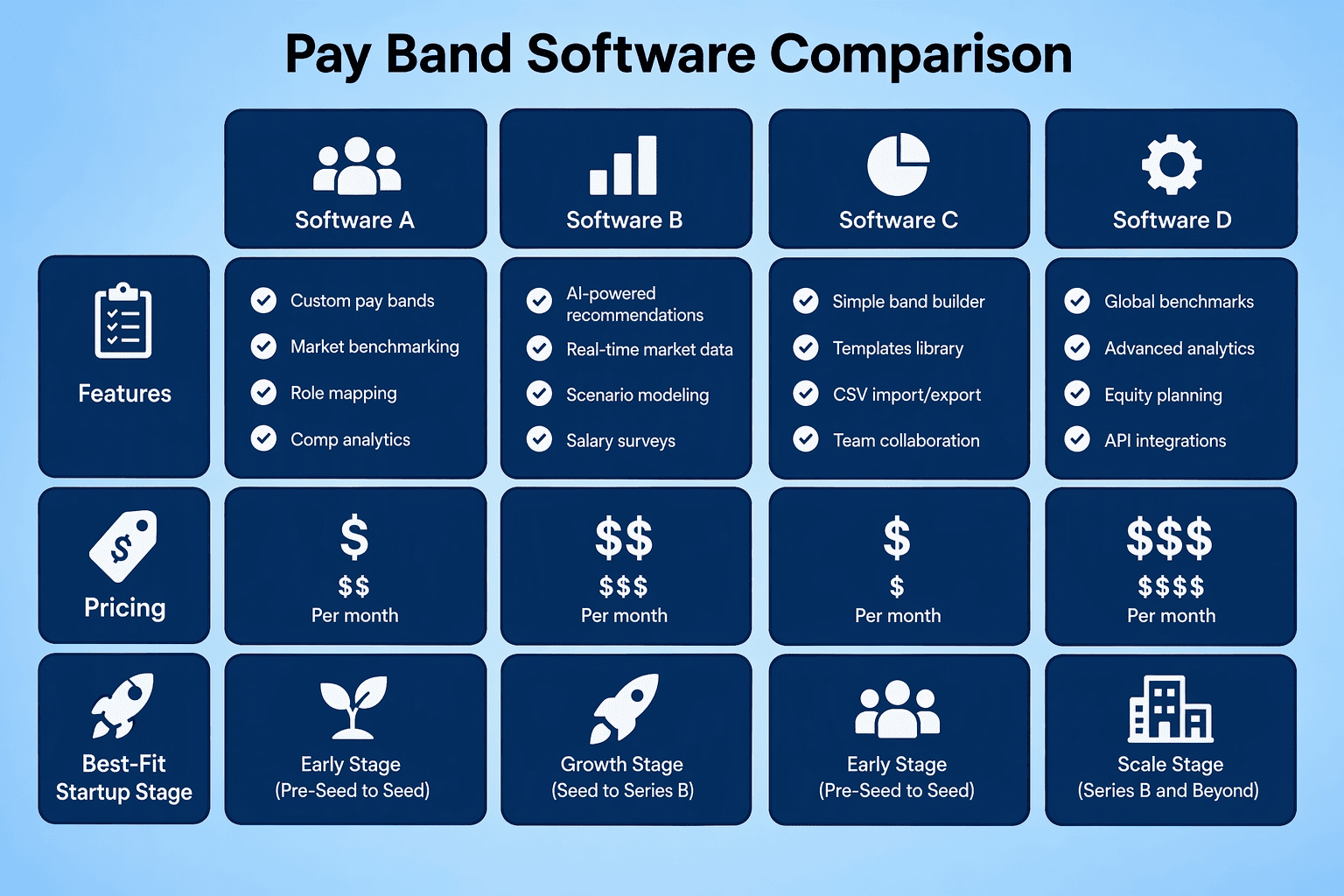
A side-by-side evaluation cuts through the marketing claims and forces a decision on the dimensions that actually affect your daily operations and budget. Deel's compensation band documentation clarifies exactly how the automation logic works in practice when a vendor does it right: a worker is automatically assigned to a compensation band when three conditions are met simultaneously. The worker must be assigned to a geographical sub-market, their worker type must be assigned to that same market, and they must have a job profile attached. Platforms that use this three-criteria assignment logic update bands dynamically; others require manual mapping every time you hire into a new location.
A vendor ready for your startup right now may be a poor fit for your scale-up needs eighteen months from now. The difference often comes down to whether the tool was built purely for U.S. markets or for multi-country, multi-currency deployment from day one. If your hiring map shows two new countries in the next quarter, pick a tool that already models local benchmarks in those markets. CompUp's real-time industry-specific compensation data and multi-currency support across 80-plus currencies make it the fit for teams scaling internationally now.
The pricing landscape ranges from per-employee models to flat-rate enterprise agreements. CompUp charges $3 per employee per year. Pave starts around $50 per employee per month.
Aeqium runs $15,000 per year for up to 300 employees. For a Seed-stage startup with 20 employees, the annual cost can differ by more than $10,000 between the bottom and top of this range. That gap buys data depth, automation, and compliance features that Seed-stage teams may not yet need but will require by Series A. Your pricing decision is essentially a timing decision: pay now for the platform you will grow into, or switch tools at each funding milestone.
Your choice of pay band software maps directly to your startup's current operational reality and its near-term growth trajectory. A company running its cap table on Carta and adding a dozen roles this quarter reaches a different answer than a European startup preparing for a Series A with equity-heavy offers and looming EU Pay Transparency Directive deadlines. Match the tool's primary strength to the biggest compensation risk you face in the next six months.
For Pre-seed startups hiring domestically into a handful of roles, a lightweight benchmarking tool like Pave's Market Data Lite provides the data foundation without overbuilding. Seed-stage companies adding international hires should evaluate CompUp's full-stack platform for multi-currency support and total rewards automation or Figures for European-centric benchmarking. By Series A, the requirement shifts to investor-grade analytics and board-ready reporting.
OpenComp and Salary.com's CompAnalyst are purpose-built for that inflection point. Every tool on this list solves a real problem. The decision is which problem is yours. A good next step is seeing how CompUp puts this into practice.
Pay band software is a dedicated platform that structures salary ranges for every role by connecting internal job levels to external compensation benchmarks. It replaces static spreadsheets with automated midpoint adjustments, pay equity flags, and offer workflows. For startups, it transforms ad hoc salary decisions into a defensible, scalable compensation framework.
Seed-stage startups can expect pricing between $50 and $200 per month, typically scaling with employee count. Per-employee annual models start as low as $3 per employee per year (CompUp), while dedicated platforms like Pave begin around $50 per employee per month. Enterprise-oriented tools like Aeqium start at $15,000 per year for up to 300 employees.
Prioritize real-time market benchmarking data, built-in pay equity analytics that proactively flag disparities, and automated compensation review workflows. For equity-heavy startups, total rewards modeling that combines base salary and option grants in a single view is key. Multi-country and multi-currency support should be non-negotiable if you are hiring internationally.
The software identifies employees above or below range, spots pay outliers, and supports pay equity analysis across gender, race, and tenure cohorts. By embedding these checks into offer workflows and review cycles rather than post-hoc audits, it catches disparities at the point of decision-making, building a defensible internal record before pay transparency requirements become regulatory mandates.
Leading 2026 tools include CompUp for full-stack compensation lifecycle management starting at $3 per employee per year, Pave for real-time integrated benchmarking, Figures for equity-first European plans, Compa for offer-based salary intelligence and scenario modeling, OpenComp for investor-grade analytics, and Pequity for automated pay equity auditing.
Start by defining roles with precision and establishing a consistent leveling framework. Source market data from providers like Radford or Comptryx to set midpoint and spread for each band. Use a tool like CompUp to automate midpoint adjustments and proactively flag gaps. Connect the finalized bands to your financial model so hiring plans reflect compensation reality in real time.
Community Manager (Marketing)
As a Community Manager, I’m passionate about fostering collaboration and knowledge sharing among professionals in compensation management and total rewards. I develop engaging content that simplifies complex topics, empowering others to excel and aim to drive collective growth through insight and connection.
Revolutionizing Pay Strategies: Don't Miss Our Latest Blogs on Compensation Benchmarking