
Your highest-paid employee just resigned. In the exit interview, she told you a competitor offered nearly the same base salary. You never showed her the $18,000 health premium you pay, the 401(k) match you fund, or the equity grant vesting next quarter. She walked because she didn't know what she had.
The compensation perception gap is not a communication soft spot. It is a hard retention liability that costs organizations capable people every quarter. When total compensation statements live in spreadsheets, HR teams spend weeks assembling data that is already stale, error-prone, and impossible to keep current across a growing workforce.
This article maps the purpose-built platforms that eliminate spreadsheet dependency from total compensation communication. You will see AI-native engines, enterprise HCM agents, dedicated statement builders, market-data integrators, and lightweight SMB suites. Each category solves a different slice of the same core problem: employees undervalue benefits representing 30 to 40% of total compensation costs because nobody shows them the full picture in a format they can trust.
These six findings frame the platform evaluation and implementation logic that follows.
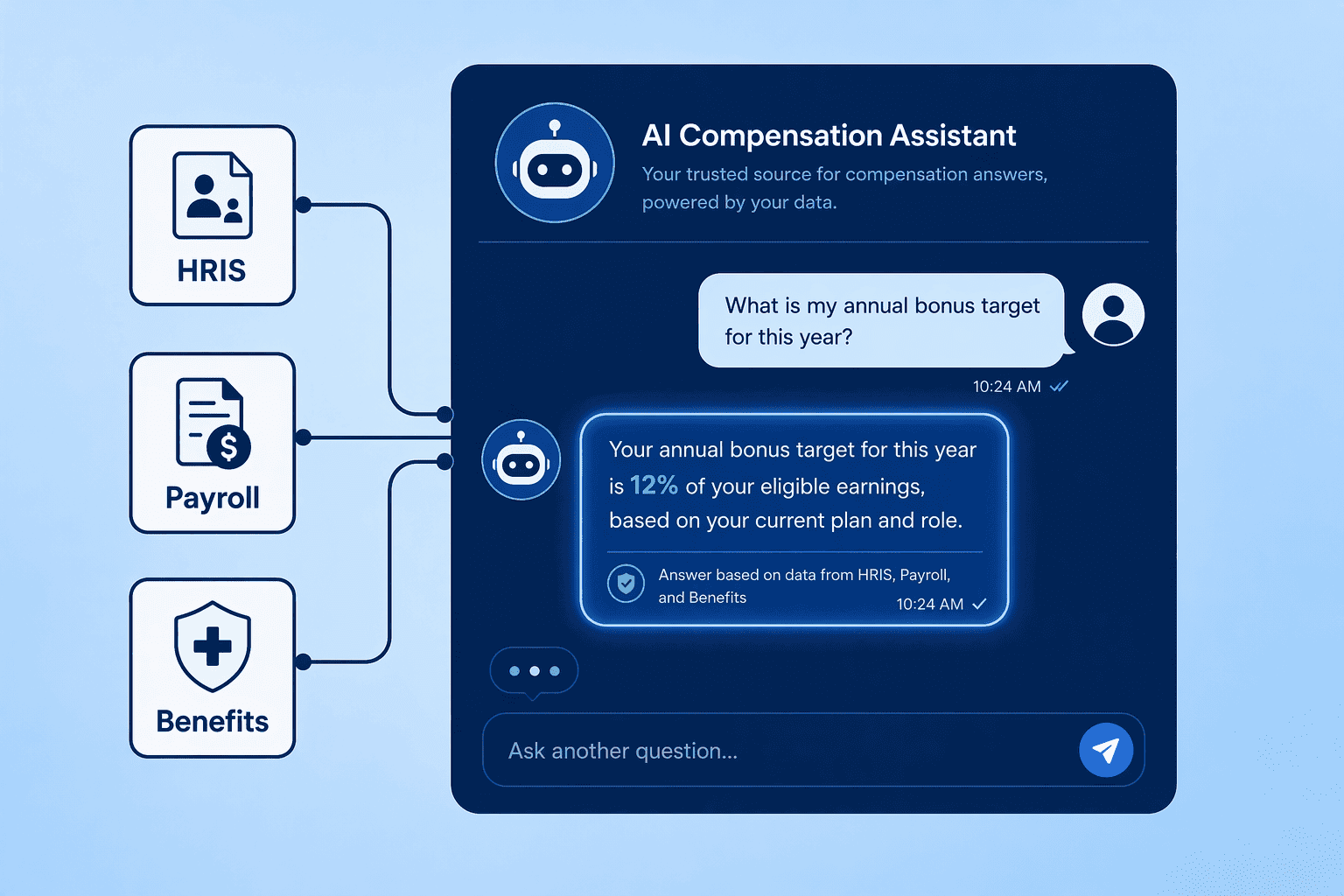
CompUp is an AI-native compensation communication platform that replaces the annual PDF with a live, query-driven conversation. Instead of generating a statement once per cycle, the platform pulls current payroll and benefits data and surfaces it through a chat interface. Employees ask a question and get an answer drawn from the same source systems HR trusts, months before the next cycle would have landed.
The architecture relies on RAG-based AI agents that read live employee data, so the system handles contextual questions about individual compensation without a human in the loop. Someone can ask for a cash-comp breakdown, a list of every bonus paid that year, or the employer contribution on a specific benefit. The response is auditable and traces back to a real system of record.
Most employees register their total compensation during open enrollment or right after a merit increase. The rest of the year, that awareness evaporates. A tool that lets people query their full rewards whenever a question occurs builds the cumulative awareness that any once-a-year document leaves on the table.
CompUp starts at $3 per employee per year, which opens the door for organizations that want AI-driven communication without an enterprise HCM suite's price tag. The platform manages compensation data for over 2,00,000 employees and passed 100 clients by February 2023. For comp teams that need real-time pay equity analysis, compa-ratio tracking, and compliance automation on top of continuous employee dialogue, platforms like CompUp trade periodic statement generation for always-on transparency.
Oracle Redwood's Total Compensation Statements Agent is a capability embedded in Oracle HCM Cloud that lets employees interrogate their own compensation data through a natural-language chat interface. The agent reads live employee data, which means it answers what an employee actually earns and receives, not a generic policy summary.
Ask the agent for a compensation summary, a list of bonuses, contribution details on benefits, or even a printable version of the statement, and it returns an answer drawn from the live HRIS record. Role-based security governs every interaction, so a manager sees only what their permission set allows. For large organizations where compensation inquiries currently land in HR's inbox by the hundreds, this agent offloads routine Q&A at scale.
The setup requires creating a guided journey with an agent-type task in Oracle's workflow engine, which means an administrator activates it rather than procuring a separate platform. The trade-off is clear: this is not a standalone communication tool you can bolt onto a different HCM stack. It lives inside Oracle's ecosystem and delivers disproportionate value there.
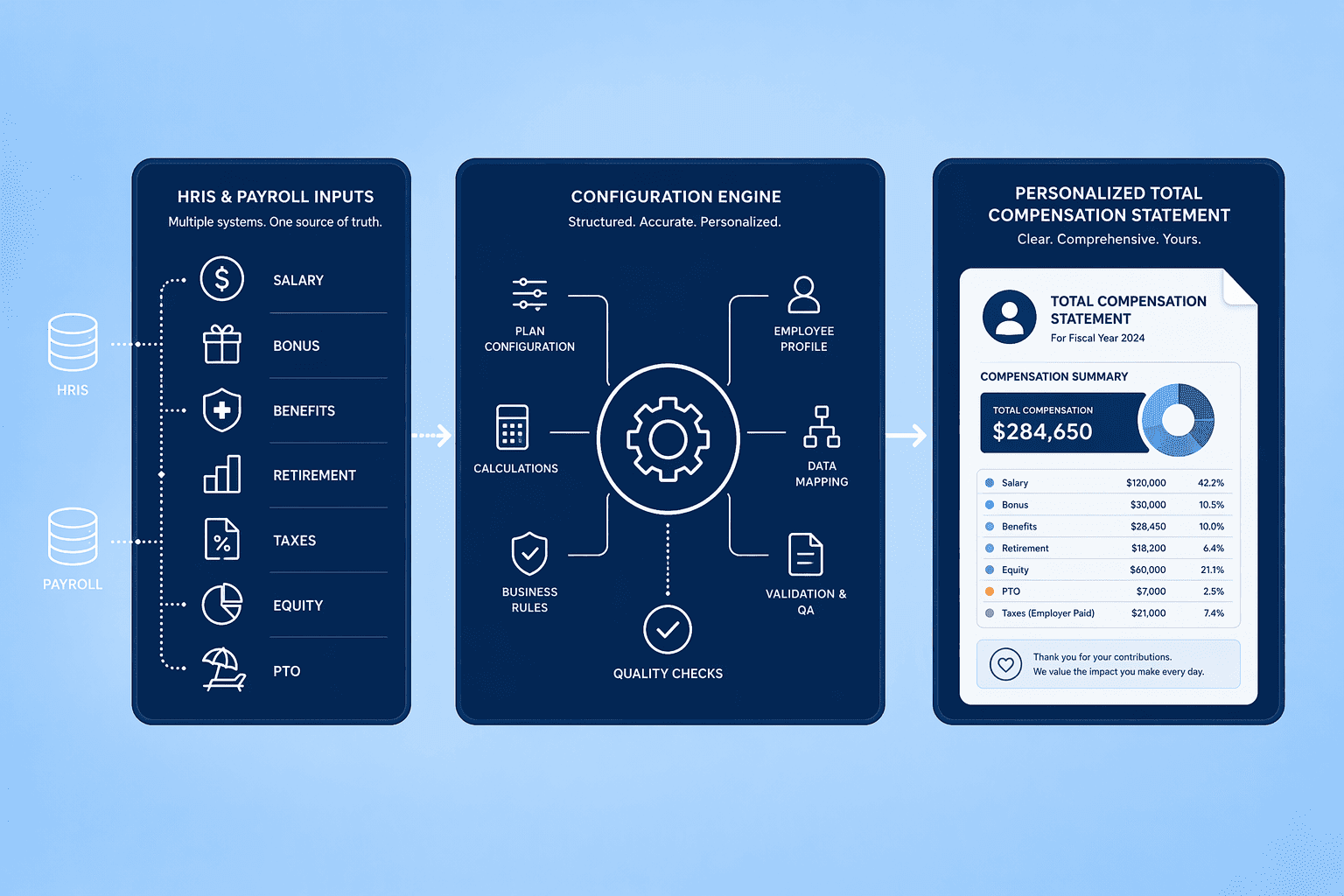
CompBldr is a dedicated total compensation statement platform built for organizations that need branded, design-controlled digital statements generated straight from HRIS and payroll source systems. It does not rely on AI agents or conversational interfaces. Its strength is in the configurable engine that pulls structured data, base salary, variable pay, health benefits, retirement contributions, employer taxes, equity grants, PTO value, and additional benefits, and transforms that raw feed into a polished, personalized employee experience.
The integration approach is what eliminates the spreadsheet. CompBldr connects directly to payroll and HRIS systems, pulls live data, applies calculation logic configured per compensation component, and generates personalized documents for each employee. What once took weeks of manual data pulls, formula checks, and formatting adjustments becomes an automated pipeline that generates hundreds or thousands of personalized statements in minutes.
CompBldr's differentiation is in the output layer. The statements are brand-controlled digital experiences, custom layouts, conditional logic per employee, and secure self-service portals combine to create communication assets that employees actually read. Not system-generated tables. Not a compliance report you hand out and hope gets opened.
For organizations that prioritize polished employer-brand presentation and deep configurability over AI-driven interactivity, CompBldr delivers the specialization that generalist platforms do not attempt. Kara, the benefits manager who opened this piece, sent her first CompBldr statements to a pilot group of 47 engineers three weeks ago. One forwarded it to his wife. "She had no idea the company covered that much," he told HR. That's the output the platform is built for.
SalaryCube layers external market context onto internal compensation data so employees see not just what they earn but where they stand. A standard total compensation statement answers the internal question: here is everything the organization invests in you. SalaryCube adds the external question: here is how that investment compares to the market.
This matters because closing the perception gap requires more than showing employees a health premium line item. It requires anchoring that number in a credible external reference. When an employee sees their base salary plotted against the market range for their role, the compensation narrative shifts from an employer's assertion to a data-supported fact. The dual value proposition is real: internal perception recovery combined with retention defense through competitive context.
For comp teams accustomed to running market data analyses in separate tools and copy-pasting the output into manually assembled statements, the integration collapses a multi-step process. Benchmark data flows into the same automated pipeline that generates the statement, so every employee sees their position against external ranges without HR touching a spreadsheet. Organizations already subscribing to Salary.com CompAnalyst, which covers over 800 million HR-reported data points across 16,000-plus job titles, can use that underlying data infrastructure to power statement-level benchmarking.
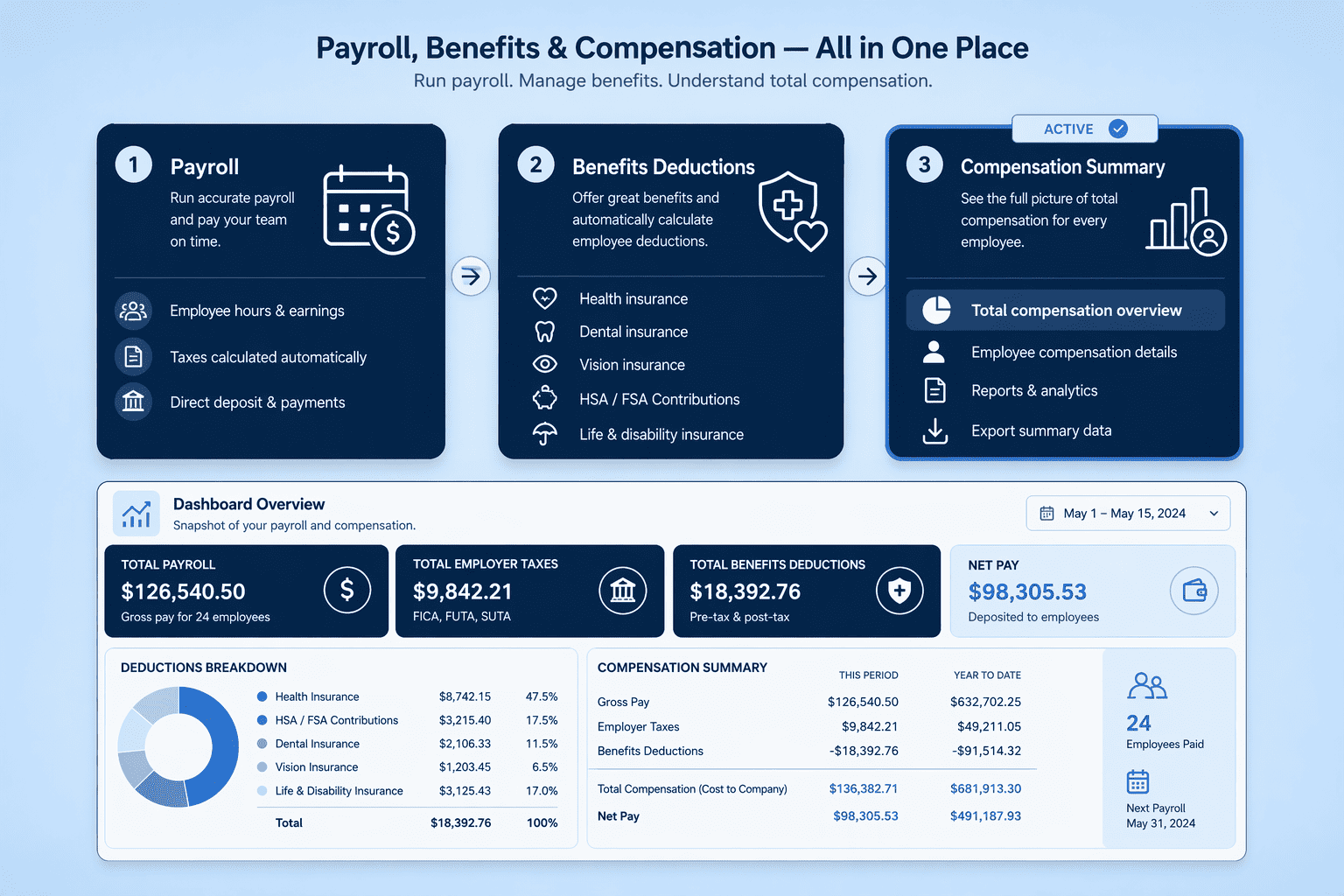
Maria runs a 140-person construction supply company and spent three years emailing total compensation PDFs she assembled in PowerPoint. When her payroll processor added a compensation summary tab, she switched it on in five minutes and stopped getting questions about benefit deductions. That is the SMB reality these suites live in, and why the product boundaries matter to anyone scaling past that point.
For organizations under roughly 200 people that run payroll, benefits, and HR on a unified platform, Gusto and Rippling offer a pragmatic automation path with no additional procurement. The platforms pull live payroll and benefits enrollment data into a running total compensation summary: base pay, employer-paid benefits premiums, and retirement contributions. The numbers refresh with every payroll run, so employees see a current figure rather than a stale annual snapshot.
What you give up is depth. Neither platform offers the configurable statement design of CompBldr or the conversational AI querying of CompUp's RAG agents. You cannot design branded, multi-page statements with conditional logic, and employees cannot ask their compensation questions in natural language. Market data benchmarking is absent.
For many small organizations the trade-off is acceptable. The built-in views close the perception gap, the employer-paid portion of health premiums and retirement, without anyone touching a spreadsheet. There is no export, no manual assembly, and no formatting step. The moment you need compliance-grade auditable statements with version history for California or Colorado mandates, or personalized digital experiences that reinforce employer brand, a dedicated builder becomes necessary.
The spreadsheet elimination logic here is straightforward: the data source and the communication layer collapse into one system. For Maria, that meant answering four questions a month instead of twenty, and killing a recurring Friday-afternoon manual task she had resented for years.
Across CompBldr, Oracle, SalaryCube, and the SMB suites, the same four-step sequence governs a successful transition.
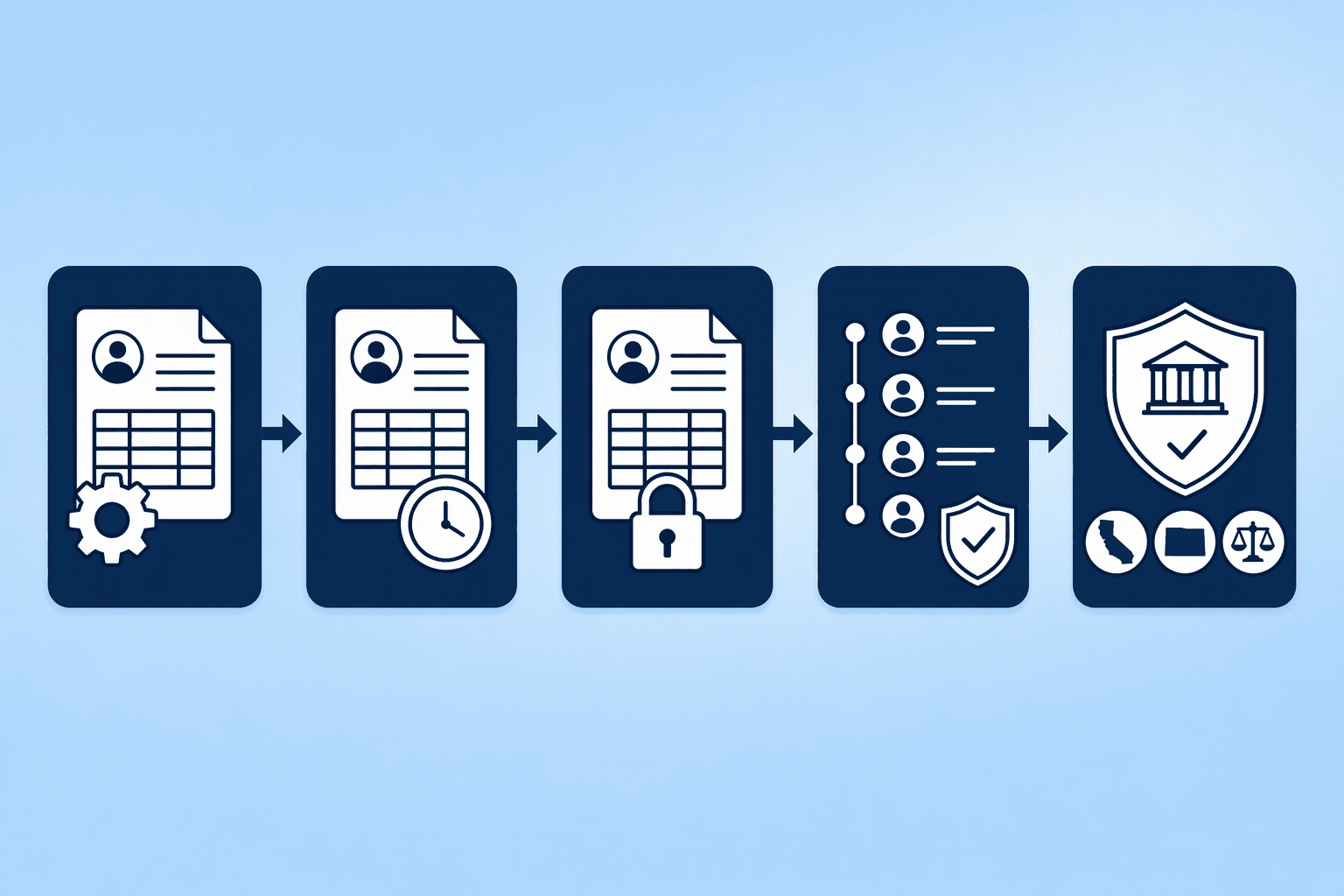
Pay transparency laws in California and Colorado mandate disclosure of compensation ranges and components. EEOC recordkeeping rules require auditable compensation documentation. Manual spreadsheet assembly cannot produce the version-controlled, time-stamped, and data-lineage-tracked statements these regulators expect. Automated platforms can.
Two years ago, a midsize tech firm in Denver lost a job candidate over a spreadsheet-generated offer letter that listed the right salary range but accidentally swapped the 401(k) match and health premium fields. She took the offer to a competitor who noticed the discrepancy. HR switched to an automated total-compensation platform the following quarter. The head of people told me last month they haven't had a single candidate challenge a number since.
A platform that merely produces statements solves one problem. A platform that works as a strategic retention and compliance asset needs these five features. The table below maps them against the platform categories covered.
| Feature | CompUp | Oracle Redwood | CompBldr | SalaryCube | Gusto/Rippling |
|---|---|---|---|---|---|
| RAG-based AI agent for employee Q&A | Yes, conversational interface reads live data | Yes, Redwood agent embedded in HCM Cloud | No, static statement delivery model | No, integrates market data, not conversational AI | No, dashboard-only views |
| Real-time market data integration | Not core offering | Not core offering | No, internal data only | Yes, connects to CompAnalyst market data | No |
| Role-based security | Configurable access controls | Inherits Oracle HCM permission sets | Configurable access controls | Configurable access controls | Inherits platform permission model |
| Self-service employee portal | Yes, interactive query interface | Yes, guided journey with Ask Anything chat | Yes, secure portal for branded statement delivery | Yes, portal with benchmark context | Yes, basic dashboard view |
| Continuous data refresh (not annual batch) | Yes, reads live payroll and benefits data | Yes, agent queries live employee records | Configurable, can set refresh cadence | Yes, market data updates continuously | Yes, refreshes with each payroll run |
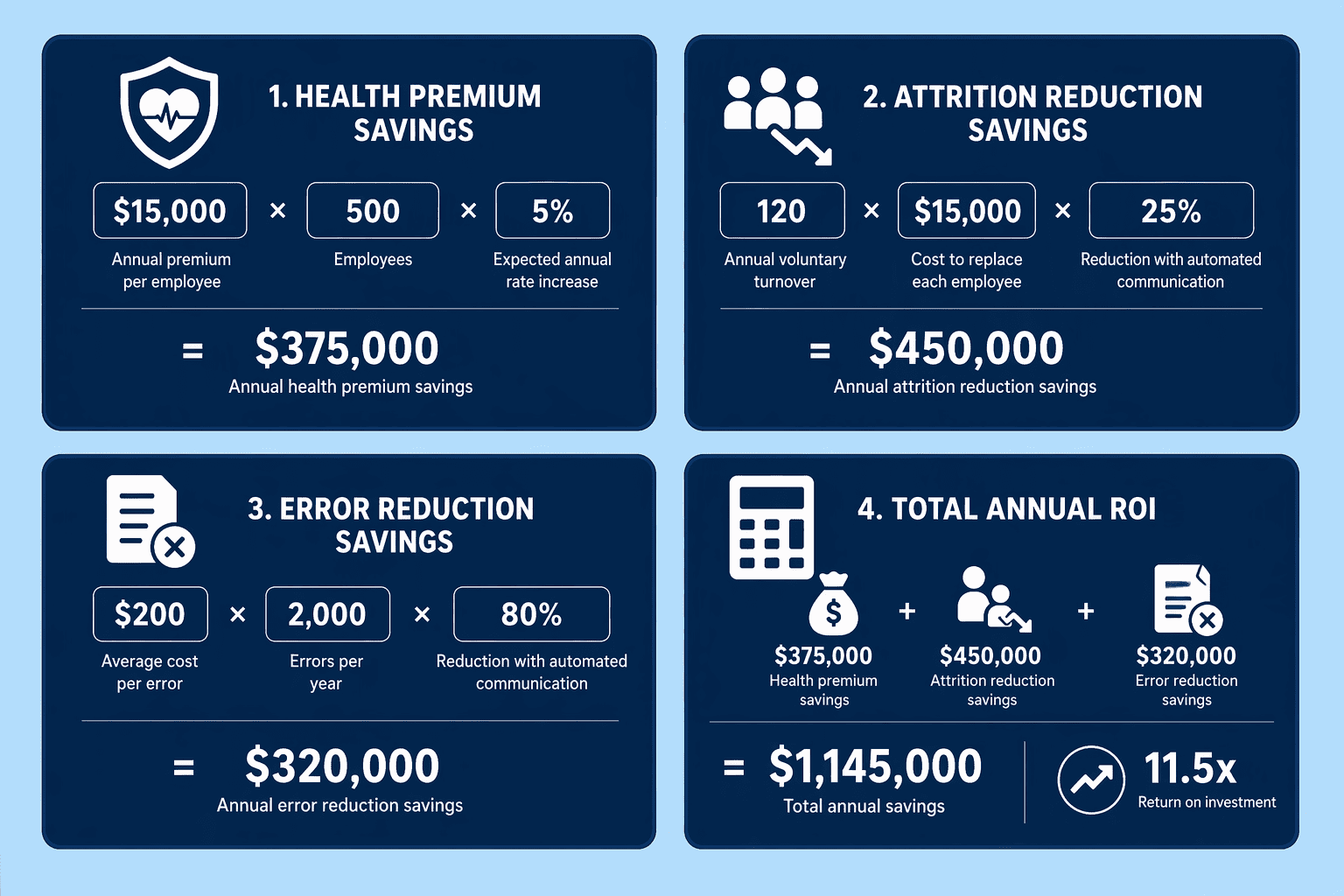
Start with the health premium. In a typical US employer-sponsored plan, the organization pays $15,000 to $25,000 per employee annually in premiums. The employee never sees that number on a pay stub unless you show it to them. Closing that perception gap turns an invisible expense into a retention asset.
Now model attrition reduction. Assume a 500-employee organization with a voluntary attrition rate of 12%. If better total compensation communication reduces that rate by conservatively two percentage points, ten fewer employees leave each year.
At an average replacement cost of 50% of salary for a $75,000 role, that is $37,500 per departure, or $375,000 in annual savings from ten retained employees. The attrition linkage is well-evidenced: employees who understand and appreciate their total rewards are more likely to stay. A platform that automates and personalizes total rewards communication makes that understanding systematic rather than dependent on a manager's ability to explain it during an exit interview.
Error elimination provides the second recoverable cost layer. Manual spreadsheet assembly carries a predictable error rate: mis-mapped benefits enrollments, outdated salary figures, incorrect PTO valuations. Each error generates HR investigation time, employee distrust, and in jurisdictions with pay transparency mandates, potential legal exposure. Automated platforms eliminate the manual transfer steps where those errors originate.
The ROI model is straightforward. Annual platform cost for 500 employees with a tool like CompUp at $3 per employee per year is $1,500. Layer on implementation time for HR staff. Offset against attrition savings, error remediation cost elimination, and the employee trust value of visible health premiums. The business case closes before you factor in compliance defense value, which alone can justify the investment in states with active pay transparency enforcement.
You have real money leaking out of spreadsheet-driven compensation communication every month, in attrition you can measure, in compliance exposure you can't always see until an audit letter arrives, and in HR hours burned on assembly that should go to strategy.
The market in 2026 gives you a fix at any scale. CompUp handles AI-driven continuous dialogue. Oracle Redwood embeds HCM-native agent interaction for shops already on the Oracle stack.
CompBldr delivers branded statement precision. SalaryCube layers in market context so employees understand their number against the outside world. For SMBs, Gusto or Rippling automate the lightweight end of the problem without a heavy platform lift.
The four-step transition, integrate, configure, test, distribute, doesn't change with the vendor you pick. The governance rigor does. Compliance rules in California, Colorado, and at the EEOC level have made auditable, automated statements an operational baseline. If your current statements wouldn't hold up to a regulator's request, the platform question has already been decided for you.
Close with one action: audit the gaps in how you communicate total compensation today. Find the line items employees never see and the statements that wouldn't survive a reviewer. That list is your requirements document. Everything a platform needs to do is already sitting in the silent cost of what you don't show them.
Sarah's team ran that audit in March. What they found, one missed equity vesting detail and a Colorado notice window they'd been two days late on for eighteen months, turned the budget conversation around before she even asked for approval. A good next step is seeing how CompUp puts this into practice.
A well-configured statement personalizes each component to the individual employee rather than showing averages or plan-level summaries:
Choose your platform based on your primary need:
Each step applies regardless of which platform you select:
Automated platforms generate statements with version control, time-stamped source-data snapshots, and audit trails that trace every figure back to its origin system. California, Colorado, and EEOC mandates require defensible compensation documentation that manual spreadsheet assembly cannot reliably produce at scale.
These five features distinguish a strategic retention asset from a basic statement generator:
Reduced voluntary attrition from closing the perception gap; elimination of manual error remediation costs; and recovery of the $15,000 to $25,000 annual health premium value in employee perception. A modest attrition reduction of two percentage points in a 500-employee organization can save over $375,000 annually.
Community Manager (Marketing)
As a Community Manager, I’m passionate about fostering collaboration and knowledge sharing among professionals in compensation management and total rewards. I develop engaging content that simplifies complex topics, empowering others to excel and aim to drive collective growth through insight and connection.
Revolutionizing Pay Strategies: Don't Miss Our Latest Blogs on Compensation Benchmarking