
Your latest compensation review cycle just closed, but two senior engineers resign within a week because a competitor mapped your salary bands with greater precision. Spreadsheets, the default for so many HR teams, turn chaotic the moment hiring scales. Ravio observes that while spreadsheets work initially, they start breaking as headcount grows and pay structures become complex, creating inconsistency rather than clarity. The manual tangle of disconnected files, email approvals, and late payroll updates burns through hours that should go to strategy.
The alternative is a dedicated compensation management platform. These tools centralize salary benchmarking, band creation, review cycles, and pay equity analysis in one system, replacing error-prone manual processes with automated workflows. Instead of chasing version histories or reconciling manager submissions, you get a single source of truth with in-app approvals and enforced budgets.
Below, we examine nine leading tools that help you manage compensation cycles without endless spreadsheets. Each profile explains what the tool does, who it suits best, and where it fits as compensation tech gets smarter and more data-driven.
The shift from spreadsheets to dedicated compensation software is not just about efficiency, it is about fairness, accuracy, and strategic control. Here is what to know before choosing a tool:
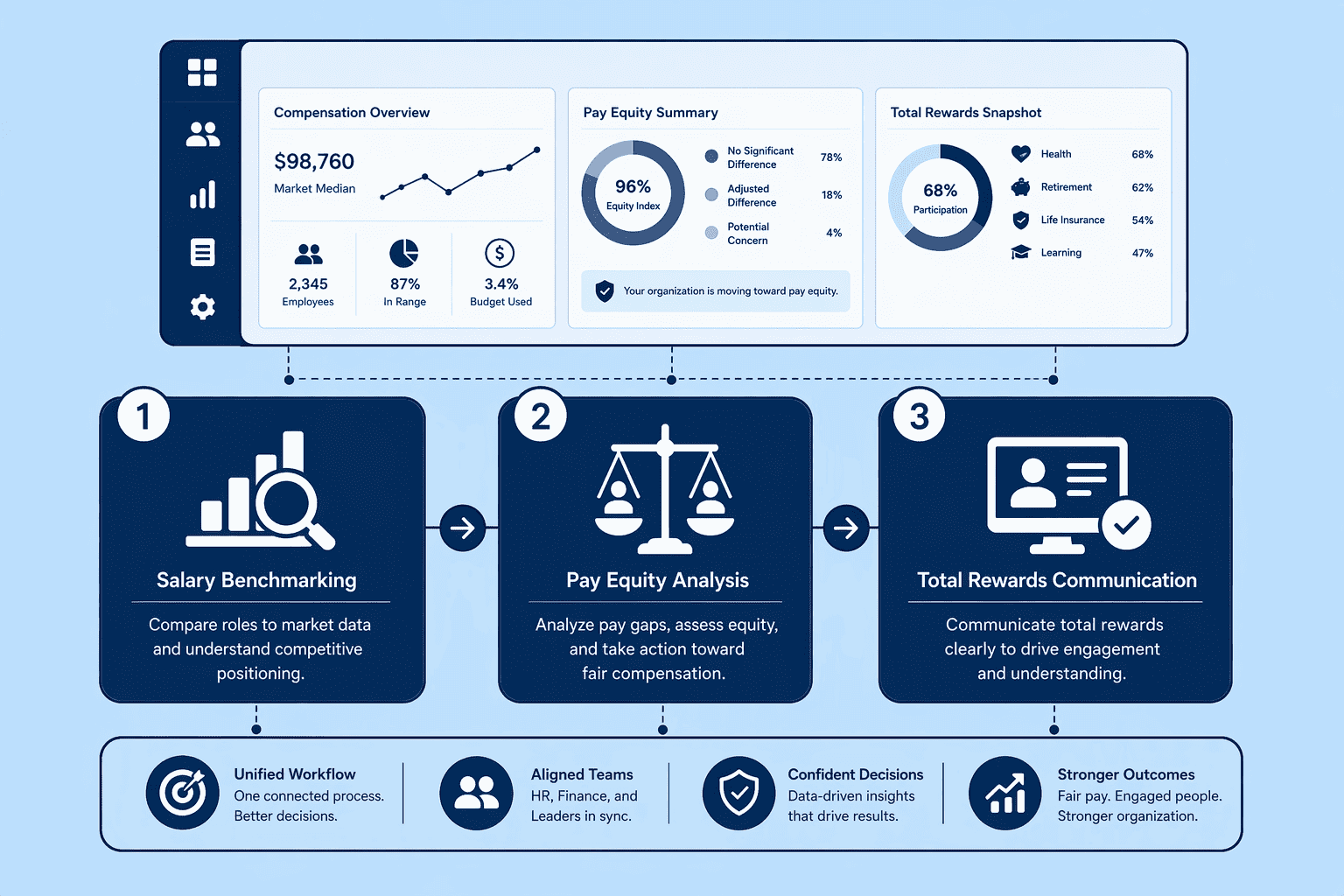
CompUp is a compensation-specialized platform that replaces spreadsheet chaos with a unified system for salary benchmarking, pay equity analysis, and total rewards communication. It starts at just $3 per employee per year and holds a 4.9 rating on G2, making it an accessible entry point for growing teams that need structured compensation management without the overhead of enterprise suites.
The platform benchmarks your salaries against real-time market data from over 140 countries and 80 currencies, helps you build and adjust salary bands, and runs compensation review cycles with built-in budget controls. CompUp doesn't try to be an HCM suite, it streamlines pay decisions and leaves your HR stack alone. It plugs into BambooHR, Lattice, Darwinbox, and Workable to pull in employee records, and at the end of a review it can auto-generate personalized Total Rewards Statements so employees see their full package in one place.
A mid-size company that used to juggle shared spreadsheets and email approvals can move its whole merit cycle into CompUp. Budgets stay in check, bands act as guardrails, and pay gaps become visible. The platform’s built-in cost modeling and documentation support pay transparency. Some teams will still need separate tools for advanced multi-country payroll or unusually complex equity, but for the organizations already using it, CompUp cuts through spreadsheet dependency with a clear workflow.
Lattice puts managers in charge of compensation cycles. It cuts out the budgeting and approval mess that spreadsheets create without stripping away oversight.
Managers get their own budgets to distribute. You set the increase targets per employee, then hand those budgets to managers. They make the decisions, working inside guardrails you define. No one has to chase down a spreadsheet or wait for a finance override.
Approval chains map to your actual org chart. Instead of forcing your structure into the tool, Lattice adapts. Adjustments route through the right people at every level, so a director in engineering and a VP in sales each see only the flows that match their reporting line. Custom hierarchies mean compensation doesn't stall on a missing sign-off.
Performance data drives the numbers. Because Lattice ties review cycle results into pay decisions, merit raises use real performance information. You are not relying on memory or a manager's last impression. The same system that captured quarterly feedback feeds the compensation process directly.
Everything happens in one place. No email versions, no shared sheets with someone else's overwrites. Managers and approvers enter and submit adjustments inside the platform, and the data stays consistent across the cycle. Raise guidelines get configured once, merit rules, promotion bands, proration rules, and they sit in the background, referenced by everyone during every adjustment.
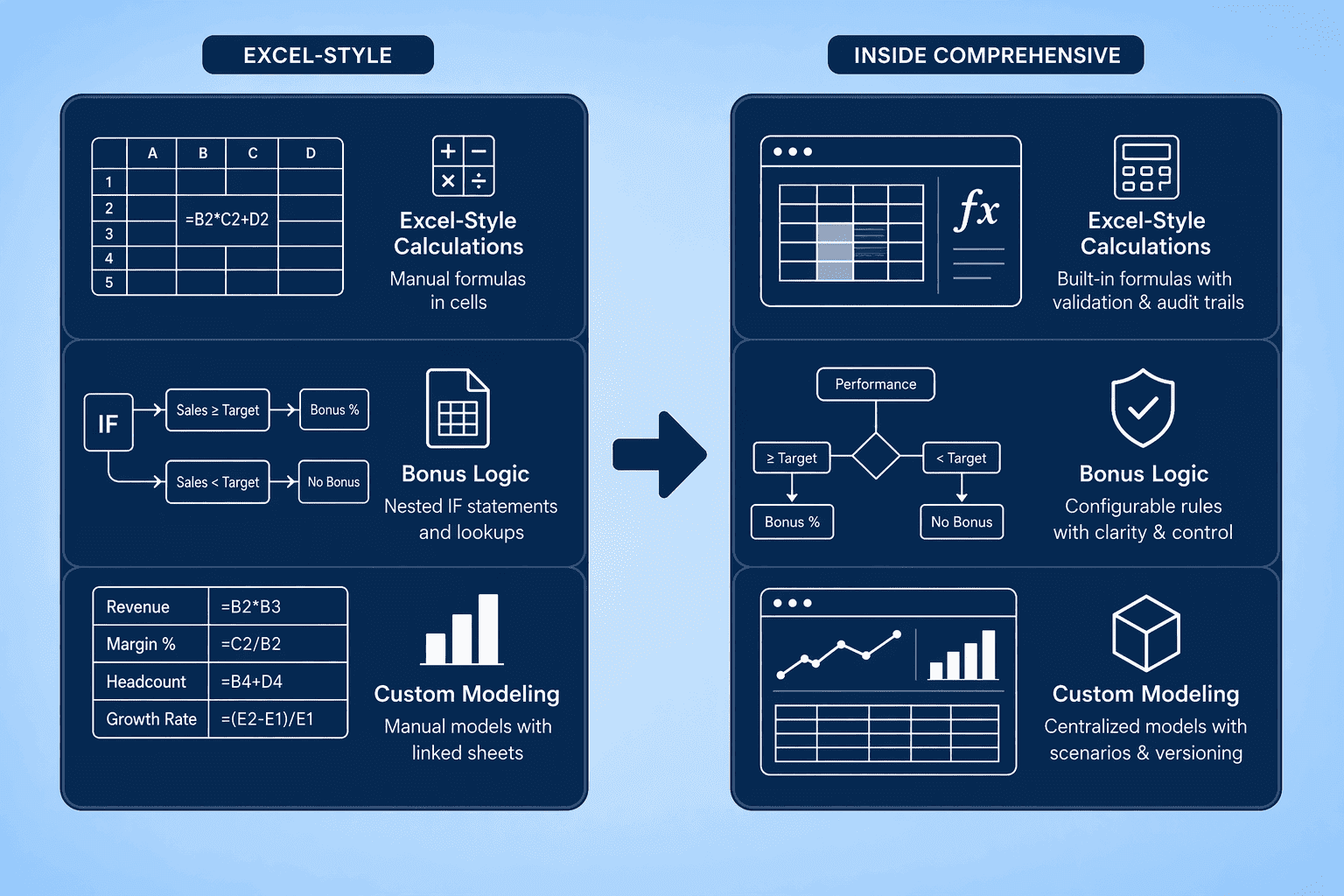
Comprehensive bridges the gap between the Excel formulas your team already knows and the automation you need. Its core promise is straightforward: any formula you can write in Excel, you can replicate in the platform.
This Excel-like flexibility extends beyond simple calculations. Comprehensive supports complex bonus logic, multi-country pay structures, and custom modeling that most compensation tools avoid. Rather than forcing your organization into rigid templates, it lets you build the exact compensation models your business requires. For global teams, this means one system handles a dozen different pay frameworks without workarounds.
AI integration marks the 2026 shift for Comprehensive. The platform embeds AI to surface compensation data insights and coach managers on how to have pay conversations. Managers receive talking points and data-backed rationale so they can discuss raises confidently, rather than stammering through a spreadsheet printout.
Comprehensive’s approach recognizes a practical truth: many compensation professionals are spreadsheet power users. Ditching spreadsheets entirely feels risky. By replicating the formulas you trust while adding guardrails, approvals, and audit trails, Comprehensive makes the transition less of a leap and more of an upgrade. It is ideal for organizations with complex, custom compensation logic that still want to escape manual errors.
Pave addresses a foundational problem with spreadsheet-driven comp cycles: stale data. Your last merit review might have relied on benchmarks that were already six months out of date, leaving your offers vulnerable to competitors with fresher intelligence.
Pave’s platform integrates real-time market benchmarks directly into your compensation planning workflows. Instead of exporting static survey reports and pasting them into a master spreadsheet, you see live data from multiple sources in a single view. The platform connects with your HRIS to pull in employee records, then overlays market rates so you can model adjustments and spot out-of-band salaries instantly. Pay equity analysis is built in, helping you proactively identify and correct gaps before they become retention or compliance issues.
For compensation cycles, Pave provides dedicated workflows that replace the email-and-spreadsheet merry-go-round. Managers get controlled access to market data and salary bands, so offers stay within agreed ranges and principles. Approvers see a clear audit trail of every change.
The 2026 context matters here. Lighthouse research found AI to be the most desired improvement area among compensation tech users, yet also the greatest source of dissatisfaction.
Pave is investing in AI-driven insights, but the platform’s immediate strength is its market data freshness and integration depth. HCM bolt-ons simply cannot match this level of real-time intelligence.
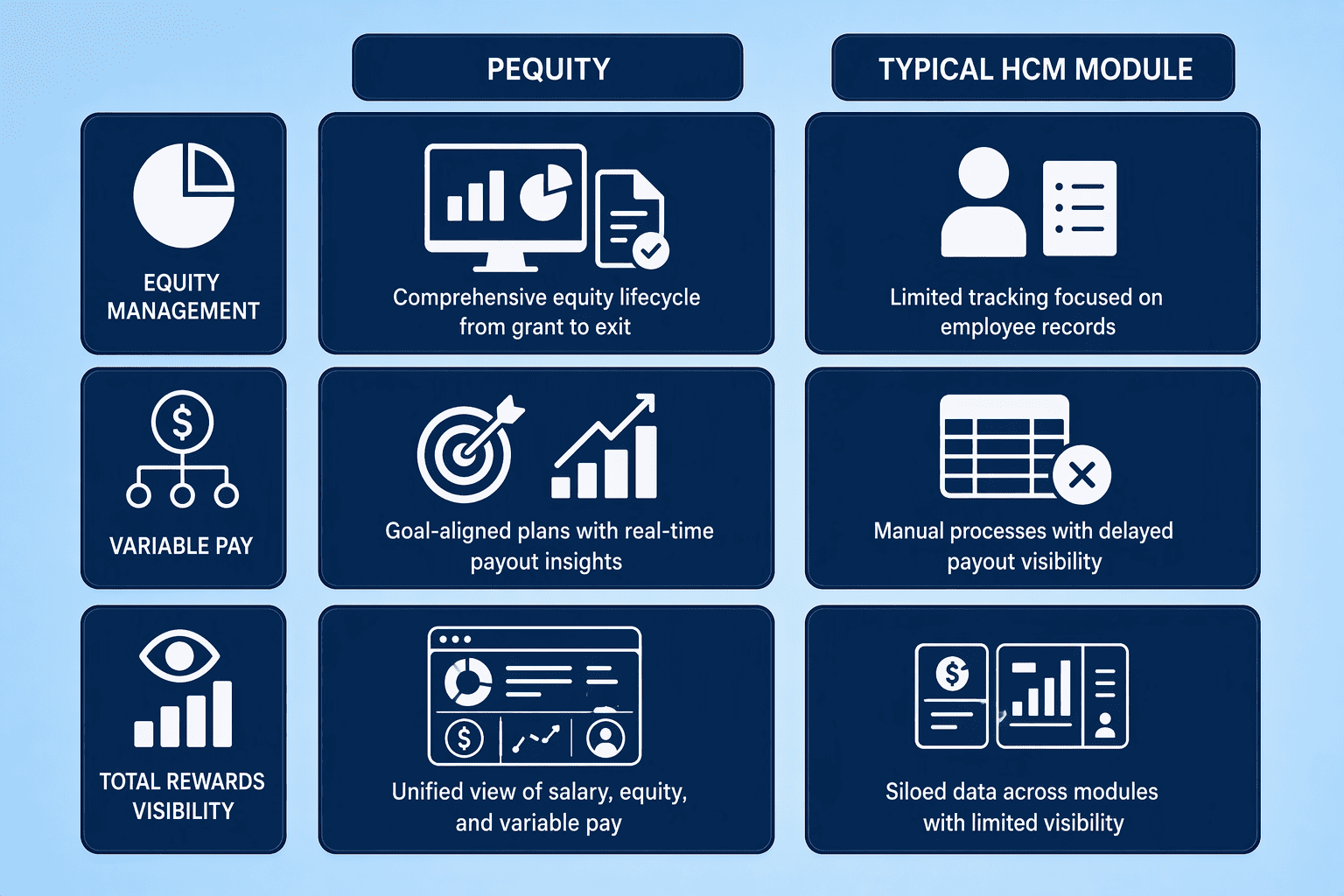
Pequity targets organizations where equity and variable pay are not afterthoughts but core components of compensation. For these teams, a generic merit cycle tool misses half the picture.
| Feature | Pequity | Typical HCM Module |
|---|---|---|
| Equity management | Dedicated equity modeling and tracking | Minimal or none |
| Variable pay configuration | Supports complex bonus, commission, and incentive logic | Limited configurability |
| Total rewards visibility | Unified employee-facing statements including equity | Separate systems, fragmented views |
| Compensation cycle support | Built for equity-heavy cycles and audits | Standard merit-only workflows |
Pequity is good at making total rewards transparent and manageable during compensation cycles. It gives both administrators and employees a clear picture that includes stock options and RSUs, not just base and bonus. For organizations with complex equity structures, this specialization avoids the dangerous spreadsheet tracking that often accompanies equity administration.
Workday’s compensation module lives inside a broader HCM suite. That is both its strength and its limit.
If your organization already runs HR, payroll, and finance on Workday, adding its compensation planning features removes data silos. You skip the error-prone import and export routines that come with spreadsheet-plus-suite hybrids. The platform handles complex compensation cycles, multi-step approvals, and the interplay of salary, bonus, and equity from one system.
For large enterprises with standardized processes, that integration is hard to beat.
But compensation is often the largest expense on a P&L, and HCM add-ons rarely offer the depth of dedicated tools. Pave notes that HCM modules provide snapshots, not real-time market intelligence, and their workflows serve general HR, not specialized comp cycles. Dynamic benchmarking across multiple data sources, custom formula builders, and advanced pay equity analysis often require a separate tool. For the right organization, this trade-off is worth it: integration simplicity in exchange for some analytical depth. For others, Workday becomes the single source of HR truth while a dedicated tool like CompUp or Comprehensive layers on top for compensation-specific workflows and insights.
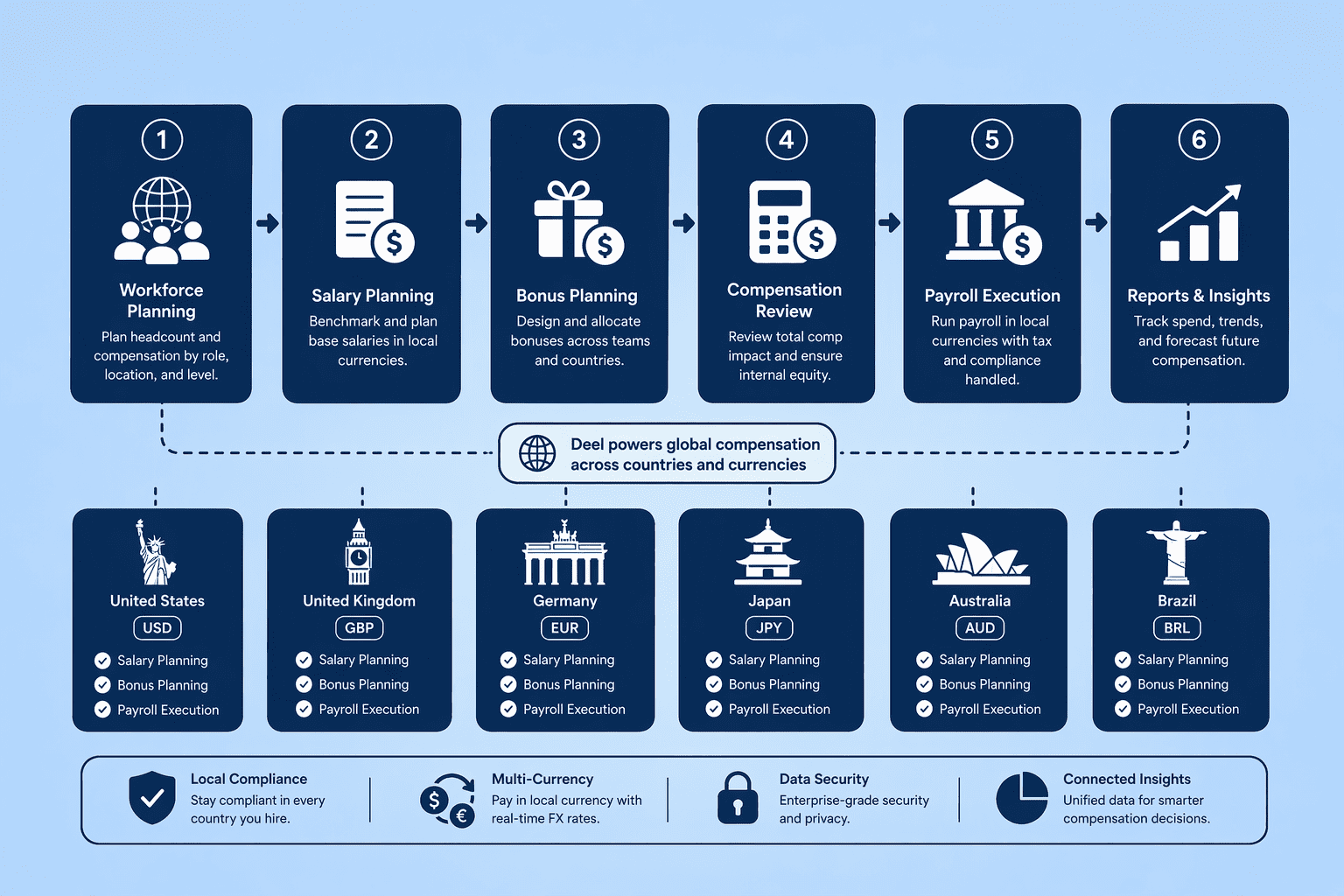
Deel is the natural choice for organizations managing compensation across borders. Its platform combines automated compensation workflows with global payroll, localized compliance, and multi-currency support across 150+ countries, making it far more than a compensation tool, it is a global employment infrastructure.
For compensation cycles specifically, Deel automates salary, bonus, and benefits planning, reducing the manual workload that plagues international teams. Pricing is transparent and usage-based, so high-growth teams avoid enterprise overhead. However, Deel is not a pure compensation management platform in the way CompUp or Pave are; its compensation features are part of a broader global payroll and HR suite. If your primary pain point is spreadsheet-driven comp cycles, a specialized tool may offer more depth, but if your chaos stems from multi-country complexity, Deel is unmatched.
Salary.com’s CompAnalyst suite is where you go when the core headache is reliable market data, not workflow approvals. For teams whose spreadsheet process stitches together survey snippets from a half-dozen vendors, CompAnalyst pulls that mess into a single, searchable database that stays current.
It is less a cycle management tool and more the data engine that should power your decisions. The suite is strong on job matching, market pricing, and analytics that let you build defensible salary structures. During a compensation cycle you can use its benchmarking data to set ranges and model increases before you execute the actual adjustments somewhere else.
The limitation is clear: Salary.com does not handle approvals, manager workflows, or total rewards communication. It is a data source, not an end-to-end cycle platform. For many spreadsheet-weary teams, fixing the data layer first makes everything downstream faster.
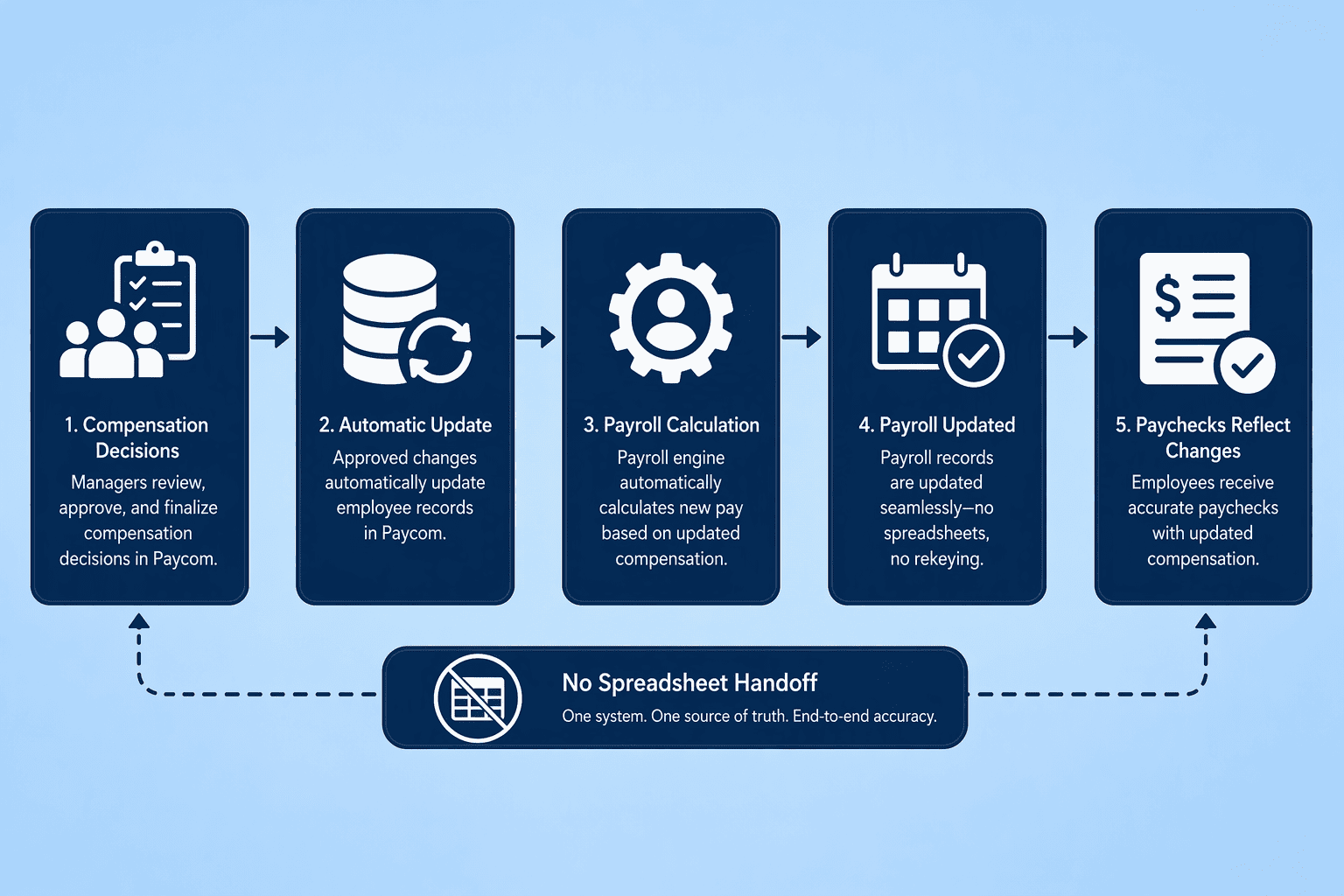
Paycom offers an integrated HR and payroll platform with built-in compensation management, well-suited to midsize and large organizations that want fewer systems, not more. Its compensation tools live inside a broader HR suite that includes payroll, benefits, and talent management, meaning compensation decisions flow directly into paycheck changes without a spreadsheet handoff.
For companies that have outgrown spreadsheets but are not ready to manage a separate compensation specialist platform, Paycom provides guardrails around manager recommendations, approval workflows, and budget tracking. The trade-off is breadth over depth. Paycom's compensation analytics and benchmarking capabilities are less advanced than dedicated tools, and its workflows may lack the configurability that a complex merit cycle demands. Still, for organizations prioritizing integration simplicity over specialized analytics, Paycom eliminates the spreadsheet pain without adding vendor complexity.
Dedicated compensation platforms like CompUp, Lattice, Comprehensive, Pave, and Deel replace spreadsheets by centralizing salary bands, review workflows, approvals, and benchmarking in one system. They eliminate version conflicts and manual tracking.
It enforces budgets and ranges, automates approvals, and syncs directly with HRIS and payroll. This removes human calculation errors, ensures offers stay within guidelines, and cuts administrative time spent chasing emails and spreadsheet versions.
Prioritize real-time market benchmarks, customizable approval hierarchies, formula builders that match Excel logic, manager budget distribution, pay equity analysis, and employee-facing total rewards statements. AI insights are increasingly important in 2026.
Specialized tools like CompUp or Pave offer deeper benchmarking, flexible workflows, and purpose-built analytics. HCM suites like Workday provide integrated data but may lack advanced compensation depth. Choose based on whether you need depth or integration simplicity.
AI integration leads the 2026 trends, with tools using AI for data insights and manager coaching. Real-time market data and multi-currency support are also critical. User research shows AI is both the most desired and most dissatisfying feature currently.
Community Manager (Marketing)
As a Community Manager, I’m passionate about fostering collaboration and knowledge sharing among professionals in compensation management and total rewards. I develop engaging content that simplifies complex topics, empowering others to excel and aim to drive collective growth through insight and connection.
Revolutionizing Pay Strategies: Don't Miss Our Latest Blogs on Compensation Benchmarking