

<meta charset="utf-8">
“An imbalance between rich and poor is the oldest and most fatal ailment of all republics.” Commonly attributed to ancient Greek Biographer Plutarch, sums up the conversation around income disparity. Now, there are reasonable doubts whether Plutarch said this or not. But that doesn’t dilute the truth in the statement.
Income disparity has long been a significant issue in economies worldwide, especially in the United States. It has worsened with the passing years and recurring financial crises like the 1970 and 2008 economic crashes.
If you’re thinking, why do you need to know the history of income disparity as an HR professional? Understanding these trends is essential for you as you play a major role in advocating for workplace equality and shaping policies that can help mitigate inequality in the workplace and beyond.
In this blog, let’s examine the historical trends of rising income inequality, analyze the factors contributing to it, and discuss its impact on society.
Income disparity, or income inequality, refers to the unequal distribution of income across different segments of society. This issue manifests when a disproportionate share of income is concentrated in the hands of a small percentage of the population, while the majority struggle with stagnating or declining wages.
For instance, the income disparities are so distinct that in 2021, the top 1 percent of households in America earned an average of 139 times more than the bottom 20 percent, as reported by the Congressional Budget Office.
The implications of income disparity go beyond economics, affecting social equity, access to opportunities, and overall societal well-being. It often leads to reduced social mobility, exacerbating challenges for those already in lower-income brackets.
Let’s understand the factors that impact income disparity on a deeper level.
Suggested Read: Two Types of Gender Pay Gap: Unadjusted and Adjusted
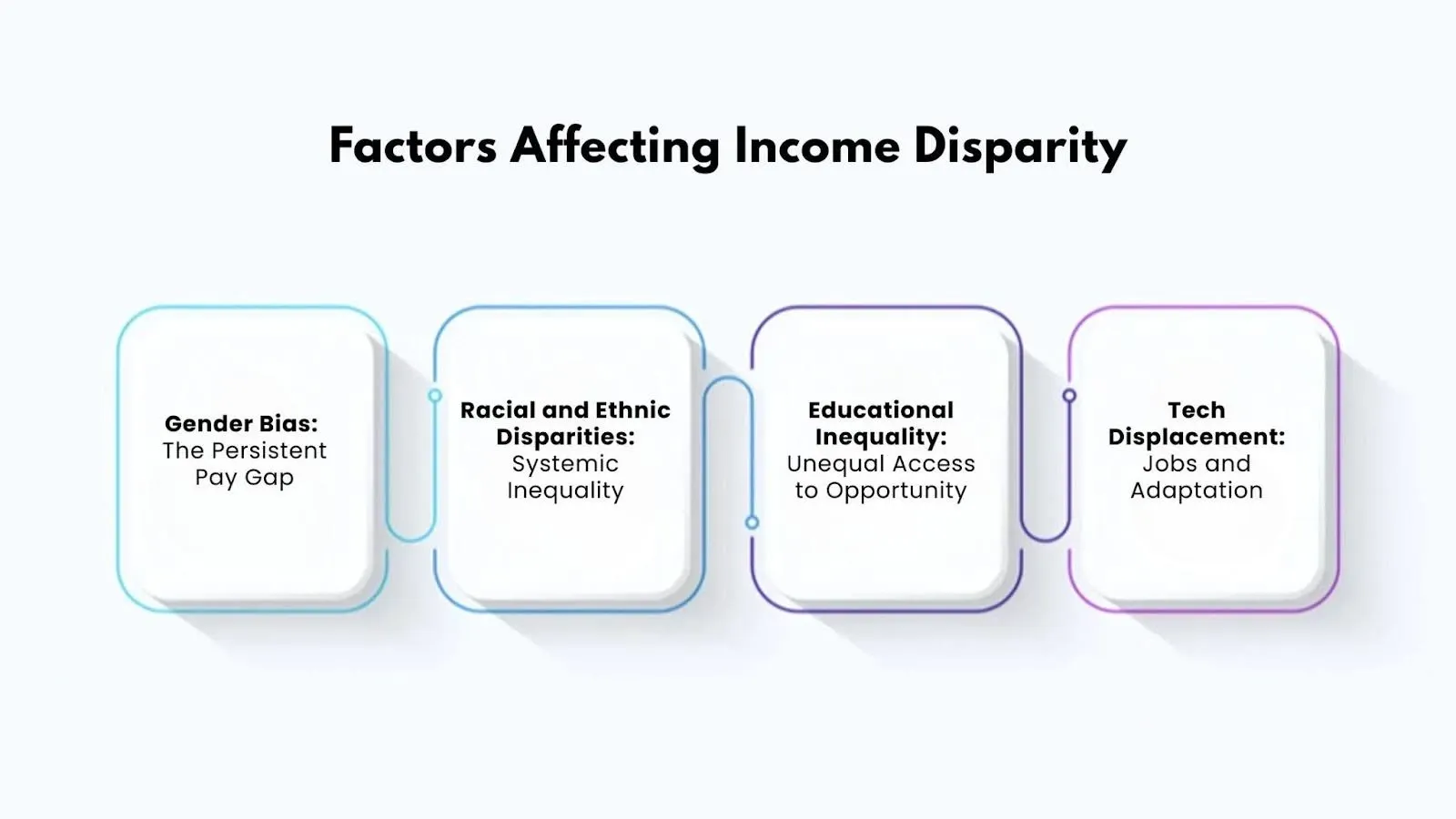
Income disparity arises from several intertwined factors that create and sustain inequality. These factors, including gender bias, racial disparities, educational inequality, and technological displacement, contribute to a growing gap between high-income and low-income groups. Here’s a closer look at each of them, along with supporting statistics.
Gender bias remains one of the most significant contributors to income disparity. Despite progress in recent years, women, especially women of color, still earn less than men for similar work. The gender wage gap persists as a significant issue, with women often overrepresented in lower-paying sectors. Research by Pew Research Center indicates that women aged 25 to 34 earned, on average, 95 cents for every dollar that men in the same age range earned in 2024, showing a 5-cent difference. For that same year, the gap among workers across all age groups was 15 cents.
Systemic racism has excluded minority groups from equitable economic opportunities, resulting in significant income gaps. Black and Hispanic communities, in particular, face barriers that limit income growth, leading to a persistent wealth gap. According to a study, in 2021, the Fortune 500 CEOs included only four Black individuals and 17 Latino individuals. However, Black and Latino individuals constitute 31% of the entire labor force in the U.S.
Education plays a critical role in determining income levels, as higher education typically correlates with higher earnings. However, access to good quality education remains unequal, particularly for lower-income and minority groups, contributing significantly to income inequality. For example, as per the US Bureau of Labor Statistics, adults with a bachelor’s degree earn a median income of $1,543 per week, as opposed to adults with a master’s degree, who earn $1,840 weekly. The median income for an individual with a high school diploma is $930, as per the same data set as of April 2025.
Students from low-income families often face barriers to higher education, which restricts their ability to earn higher wages. This cycle of limited access to education perpetuates economic inequality.
The rapid growth of technology, including automation and artificial intelligence (AI), has led to job losses in certain sectors, particularly affecting lower-income workers. These workers often lack the skills to transition into new fields, widening the income gap. A Pew Research Center study shows 19% of all American workers are in jobs exposed to AI as of 2022. While technological advancements create new opportunities in industries like tech and AI, they often require advanced skills and education, leaving displaced workers behind.
Meanwhile, the income disparity is not something new to deal with. Let’s take a look at the historical trends driving income inequality in the USA.
Suggested Read: Pay Transparency: Understanding Salaries in the Workplace
From 1970 to 2000, the U.S. experienced a period of significant economic expansion that resulted in substantial median income growth. This era, marked by a booming economy, a growing workforce, and technological advancements, allowed many Americans to see tangible increases in their earnings. However, the growth trajectory began to shift dramatically after 2000, with income growth stagnating for many households, especially those in the middle and lower-income tiers. This period of economic transition is critical in understanding how income disparity widened and the challenges that remain.
During this period, the U.S. economy saw consistent and substantial growth, and median household incomes surged across various demographic groups. The economic boom was driven by several factors, including the expansion of global trade, technological innovations, and rising productivity, which created new industries and job opportunities. The post-World War II period laid the foundation for significant upward mobility for many Americans.
The U.S. Census Bureau reports that real average household income in the U.S. grew by about 41% between 1970 and 2000. This represented a period of economic prosperity during which wages rose in parallel with productivity, creating a relatively more equitable distribution of income.
This period was also characterized by a thriving middle class, with many households enjoying increased purchasing power, better healthcare access, and improved living standards. The rising income levels were seen across various income brackets, contributing to a broader sense of economic opportunity.
Meanwhile, the income inequality increased by about 20% between 1980 and 2016, as estimated by the Census Bureau.
However, the period from 2000 to 2018 marked a significant slowdown in income growth, especially for middle and lower-income households. While the upper-income brackets continued to see income growth, largely driven by gains in capital income, wages for many Americans remained stagnant. This shift was influenced by a combination of economic forces, including globalization, technological changes, and the aftermath of the Great Recession of 2008.
According to Pew Research Center, the real median household income grew by just 0.3% per year from 2000 to 2018. In comparison, the previous three decades had seen much higher growth rates, reflecting a stark slowdown.
The slowdown in income growth was particularly evident for middle-income families, many of whom saw little to no real income gains. Even as productivity continued to rise during this period, the economic benefits were not distributed equally, and the wage gap between the highest and lowest earners widened significantly.
While median income growth slowed across the board, the top income earners, especially the top 1%, continued to see significant increases in their income. A large part of this growth was driven by income from investments, capital gains, and stock market returns, rather than wages.
An analysis by the Economic Policy Institute shows that between 1979 and 2019, the income of the top 1% grew by 160%, while the income of the bottom 1% grew by only 26% during the same period. The growing concentration of income in the upper brackets has been a key driver of income disparity.
This shift created a more divided economic landscape, where the benefits of economic growth were increasingly concentrated at the top. In particular, high-income earners, particularly in finance, technology, and corporate sectors, saw their wealth grow substantially, while many in the middle class experienced stagnation or modest increases at best.
Suggested Read: Understanding What Salary Bands and Pay Bands Mean
Over the past few decades, significant changes in wealth distribution have mirrored the growing income disparity in the U.S. Between 1971 and 2019, the middle class saw its share of national income shrink, while upper-income groups experienced considerable increases in their income and wealth. This widening gap between the wealthiest Americans and the rest of the population has been a key driver of the country's growing economic divide.
Pew Research Center data shows that between 1970 and 2018, middle-class households saw their share of total income decrease from 62% to 43%. In contrast, upper-income households experienced a rise from 29% to 48%. Meanwhile, the portion received by lower-income households slightly declined from 10% in 1970 to 9% in 2018. This trend reflects stagnating wages and fewer opportunities for wealth accumulation, particularly through homeownership and savings, as the cost of living, especially housing and education, has risen.
In stark contrast, the wealthiest Americans, particularly those in the top 1%, have seen their wealth grow exponentially. Between 1989 and 2019, the wealthiest 1% saw their net worth increase by 300%, while the bottom 90% saw just a 24% increase in their wealth. This growth was fueled by investments in stocks, real estate, and other assets, leaving the wealthiest Americans with a disproportionately large share of the nation’s wealth. As of 2016, the top 1% controls 40% of the nation’s wealth, which has risen 4 times since the 1980s.
Wealth has remained stagnant or declined for middle and lower-income households. With wages largely unchanged since the early 2000s and rising living costs, particularly in housing and healthcare, many Americans are unable to build wealth. The 2008 financial crisis wiped out significant wealth for many, and the recovery has been slow and uneven.
In 2019, the average net worth of an American household was $128,200, which rose by 30% to $166,900 by 2021. However, for lower-income households, the median income of households in the U.S. fell by 2.5% from 2019 to 2021 when adjusted for inflation, according to the U.S. Census Bureau.
Rising income disparity significantly impacts intergenerational mobility, making it harder for children from lower-income families to achieve upward mobility. As wealth becomes more concentrated in the hands of a few, the cycle of inequality is passed down from generation to generation. This limits opportunities for those at the bottom, reinforcing barriers to access to education, healthcare, and stable employment.
The growing concentration of wealth among the wealthiest families restricts economic opportunities for lower-income households. Children born into poverty face significant obstacles in accessing resources like quality education, healthcare, and job opportunities, making it difficult for them to escape their circumstances. This cycle reinforces social and economic stratification. A 2020 Brookings Institution study found that children born into the bottom 20% of income earners have just a 7% chance of reaching the top 20%. Conversely, the chances for those in the top 20% have increased to 37%.
Education is a critical pathway to upward mobility, but access to quality education is often tied to income. Wealthy families can afford private schooling and extracurriculars, while lower-income families are usually stuck in underfunded public schools, limiting academic opportunities and future success. Studies show that children from low-income families tend to attend schools with relatively higher student-to-teacher ratios and fewer resources, affecting their chances of success.
Healthcare disparities also affect intergenerational mobility. Low-income families often struggle to afford medical care, which can hinder educational performance, employment, and overall well-being. Chronic health issues disproportionately affect lower-income families, creating long-term economic disadvantages. Studies found that children from low-income families with health problems have a higher dropout rate compared to their peers.
Employment opportunities are critical for economic mobility. Wealthier families have access to better job networks and internships, giving their children a competitive edge. In contrast, children from lower-income families face challenges entering well-paying fields, often lacking the social capital and resources needed to secure high-income jobs. The U.S. Bureau of Labor Statistics (2025) shows that people with a college degree earn a median income of $1,543 per week, compared to $930 per week for high school graduates, but access to higher education is limited for low-income children.
The historical trends of rising income disparity in the United States highlight the complexities of addressing economic inequality. From gender and racial disparities to the impacts of economic recessions and technological change, income inequality continues to have far-reaching consequences for economic stability and social equity.
For HR professionals, understanding these trends is crucial in crafting policies and initiatives that address income disparity in the workplace and advocate for fair compensation practices. By fostering a more equitable environment, HR leaders can contribute to reducing the growing divide between different income groups and help ensure that all employees have the opportunity to succeed.
Policy interventions, both at the governmental and organizational levels, are essential in reversing these trends and creating an environment that supports equitable growth. Addressing income disparity is not just a moral imperative; it’s also a strategic priority for building a stable and prosperous future for all.
If you are seeking help in forging your compensation policies to help reduce the income disparity, let CompUp do the heavy lifting. We create customized plans as per your business needs so you can concentrate on running the show. Contact us for a consultation today!

Co-founder & Head of Product
Anshul Mishra, Co-founder and Head of Product at CompUp, blends technology and total rewards to create smart, user-friendly solutions. He focuses on building data-driven tools that help companies design fair and effective compensation strategies, making complex processes simpler and more impactful.
Revolutionizing Pay Strategies: Don't Miss Our Latest Blogs on Compensation Benchmarking