compup
India’s Labour Codes: Why This Is a Compensation Reset, Not a Routine Compliance Exercise
22 Dec 20257.44 min

India’s Labour Codes: Why This Is a Compensation Reset, Not a Routine Compliance Exercise

Understand India’s new Wage & Labour Codes, the 50% wage rule, PF and gratuity impact, gig worker coverage, and how HR & comp teams can ensure compliance using compensation technology.

Compensation Philosophy
Shradha Vadhone

The Indian government replaced 29 previous laws with four unified labour codes on November 21, 2025. This is arguably the largest overhaul of workforce-governance in decades for CHROs, compensation heads, and HR leaders, making it more than just a compliance update.


The ripple effects are significant. Current salary structures will need redesigning to meet the mandatory 50% wage definition. PF and gratuity bases must be recalculated. Fixed-term employees are now entitled to benefits after one year of service instead of five and i.e., fundamentally reshaping benefit eligibility timelines.


This is not a procedural update, it’s a structural overhaul of how compensation is defined, administered, and governed in India. Organizations that respond only at a compliance level risk financial liabilities, employee trust issues, and long-term cost unpredictability.


This guide is designed to equip HR and compensation leaders with clarity and direction - explaining each change, its implications, and how to rebuild compensation frameworks that are compliant, cost-balanced, and future-ready.
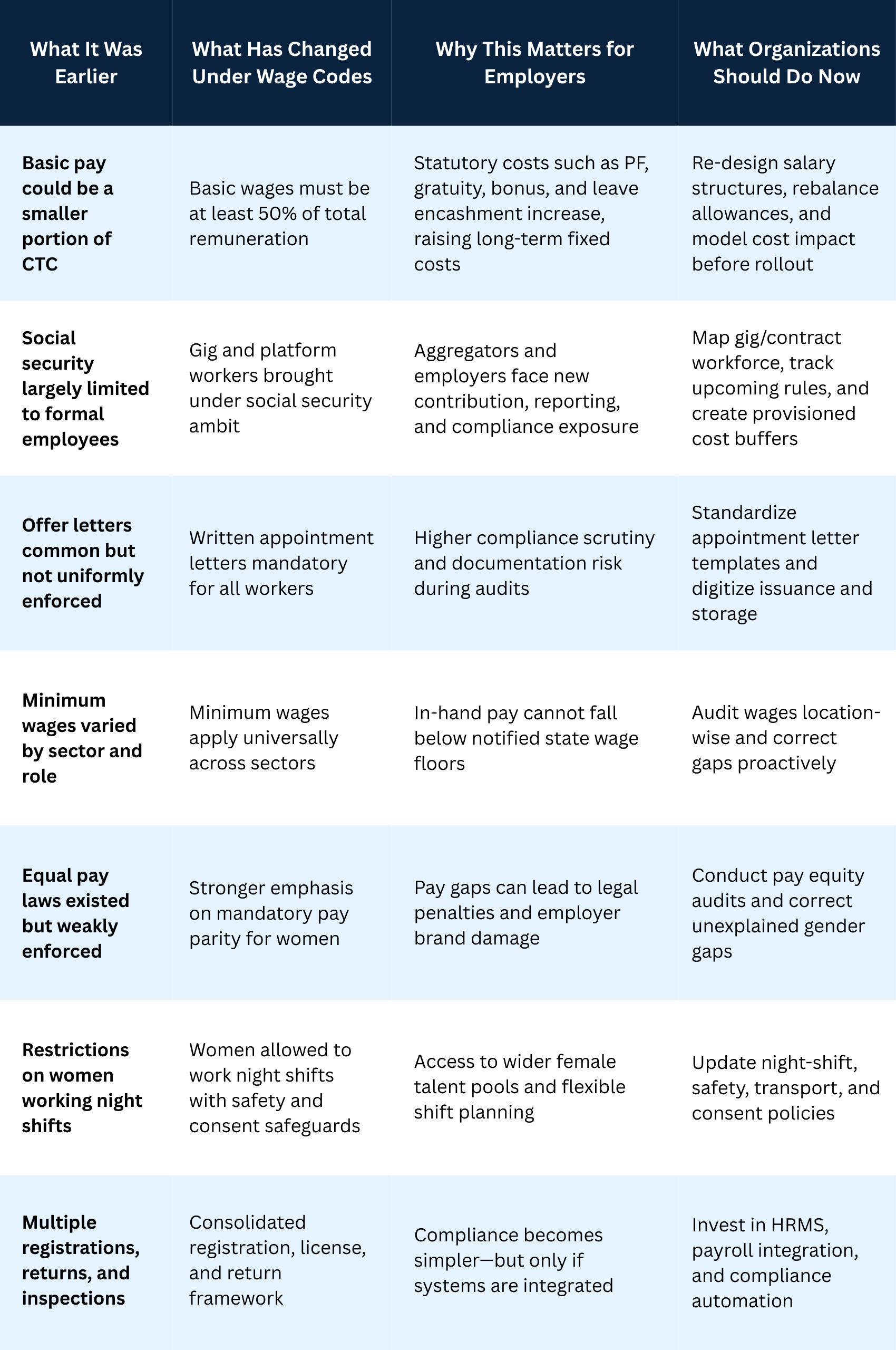
 

Highlights at a glance -
 

Article table.svg


At a glance: The wage codes push organizations toward higher transparency, higher statutory costs, and stronger governance. Employers who act early—by redesigning pay, auditing equity, and digitizing compliance - will reduce risk and avoid last-minute disruption.


Key Provisions & What They Mean (for Employers & HR Teams)
 

1- Uniform, stricter definition of “wages”

  • Under the new code, “wages” are defined as Basic Pay + Dearness Allowance (DA) + Retaining Allowance.
  • Other components — like allowances (HRA, special allowance), bonus, travel allowance, overtime, gratuity — are excluded from “wages.”
  • Crucially: non-wage allowances cannot exceed 50% of total remuneration (CTC). In effect, Basic + DA + Retaining Allowance must be at least 50% of CTC

Implication: For organisations that previously kept “basic pay” low (say 30–40% of CTC) and had large allowance components, there is a need to restructure salary components. This will affect statutory benefits, take-home pay, and payroll accounting. 


2- Impact on Take-Home vs Long-Term Benefits

Because of the redefinition:

  • Provident Fund (PF) contributions - both employer’s and employee’s - now apply on a higher base (since Basic is higher).
  • Gratuity liability goes up, since gratuity calculations are tied to “wages.”
  • Social security benefits (PF/ESIC), bonus, overtime, etc., now have more consistent legal grounding across all employees.

What this means: Many employees may see a drop in take-home (in-hand) pay compared to older packages - because a larger portion is statutory deductions — but their retirement savings, benefits, and long-term security improve. 

For example: industry analyses (for some sample CTC levels) show monthly in-hand salary may drop by a few thousand rupees, but PF and gratuity accumulation increases. 


3- Minimum Wages & “National Floor Wage”

  • Under the new code, minimum wage provisions now apply to all employees, both in organised and unorganised sectors — not just select “scheduled employments.”
  • The law empowers the central government to set a National Floor Wage, below which no state-level minimum wage can go — thereby establishing a uniform baseline across states.
  • Minimum wages will be periodically reviewed (expected every five years) to adjust for inflation / cost-of-living changes.

Implications for Compensation Teams:

  • Compensation benchmarking needs to align with the floor wage, especially for lower-wage roles and unorganised sector employees.
  • For organisations operating across multiple states, the floor wage helps maintain uniform bottom-line wage norms, reducing complexity due to differing state-level minimum wages.


4- Timely Payment, Transparency & Compliance / Documentation

  • Employers are now legally required to issue appointment letters to all workers (permanent, fixed-term, contract, gig) — specifying designation, wages, and social-security entitlements.
  • Wages must be paid within specified timelines: e.g. monthly salaries by 7th of next month; for daily/weekly/fortnightly workers — at end of shift/week/fortnight respectively; dues on resignation/termination within 2 working days.
  • Over-time pay for work beyond stipulated hours (daily 8–12 hrs; weekly 48 hrs) must be at twice the ordinary wage rate. 

For payroll / HR teams: This demands robust payroll systems, digital record-keeping, timely salary-run, utility of appointment letters, and better compliance processes — especially for a mix of permanent + contract + gig workers.


5- Extended Coverage: Gig workers, fixed-term employees, unorganised sector

One of the more transformative aspects: the new codes aim to bring vast swathes of the workforce that were previously unregulated — into the formal labour / benefits ambit. 

  • Fixed-term employees now become eligible for gratuity (after one year), benefits equal to permanent workers. 
  • Gig/platform workers (e.g. delivery workers, app-based services) now get legal recognition under social security provisions — including PF/ESIC/social-security benefits. Aggregators are required to contribute to a social security fund.
  • Workers in unorganised and informal sectors, previously outside minimum-wage coverage, are now covered by minimum wage provisions.

What this means for HR/Comp professionals: As organisations — especially in services, gig economy, platform-based — expand or formalise, they need to incorporate these benefits and compliance requirements. Payroll, social-security account-management, hiring contracts, benefit slabs, etc., all need rethinking.
 

Image 3 (1).png


Trade-offs, Challenges and Strategic Considerations for Employers / HR Leaders

While the new codes bring clarity and fairness, there are real challenges for organisations — especially in Compensation & Benefits and payroll functions:

  • Higher Statutory Costs: With basic pay rising to ≥ 50% of CTC, PF, gratuity, and other social-security liabilities will increase. Even if total CTC remains the same, the employer’s cost burden per employee may go up (or they may re-work other components).
  • Reduced Take-Home Pay for Employees: Because deductions increase, net in-hand salary may dip — which can impact employee perceptions, especially among mid/senior-level staff used to large allowance-based CTCs. 
  • Need to Re-structure Compensation Architecture: Benchmarking, CTC structuring, allowances, benefits, bonus policies — all need revisiting. Pre-existing salary structures built on allowance-heavy models need redesign.
  • Payroll & Compliance Overhaul: Appointment letters, timely wage payment, record-keeping, compliance with overtime rules — firms need systems (HRIS / payroll) to ensure compliance.
  • Cost Pressure on Gig / Platform-based Businesses: For aggregator/platform businesses, extending social security benefits to gig workers means higher costs and possibly rethinking business models. 
     

    What you need to do (1).png


What Compensation/HR Professionals Should Do - Practical Steps & Strategic Advice

Given the scale of changes, here’s what HR / Comp & Ben / Payroll leaders should prioritize over the next 3–6 months:       
  • Run a “Structure Audit” of existing CTC / compensation packages — for all levels (entry, mid, senior), including fixed-term, gig, contract. Identify packages where basic pay < 50% of CTC and plan re-structuring.
  • Model financial impact — estimate how increased basic components will affect PF, gratuity, overall employer costs, and employee take-home. Use scenarios (e.g. for a ₹10 L CTC, ₹15 L, ₹25 L, etc.) to inform budget planning.
  • Update payroll systems, HRIS & compliance frameworks — ensure appointment letters, monthly payroll by 7th, statutory deductions, PF/ESIC contributions, overtime tracking are systematised.
  • Revise benefits & retention policies — communicate to employees why take-home may change (if it does), highlight enhanced long-term benefits (PF, gratuity, social security), and consider compensating via other perks if needed (voluntary benefits, flexible allowances compatible with code).
  • Ensure compliance for all worker types — full-time, fixed-term, gig/platform workers, contractors — especially ensuring benefits parity, statutory coverage, and record-keeping.
  • Prepare internal & external communication — to managers, finance, leadership; and to employees — clarifying what changes, why, and how it impacts their compensation and benefits going forward.
Testimonial.png


Key Takeaways for Compensation Professionals & CHROs
 

  • The new code pushes for transparency and standardisation - compensation packages need to be re-thought from allowance-heavy to basic pay heavy.
  • While short-term take-home pay might drop, long-term benefits - PF, gratuity, social security — become stronger and more secure.
  • The reform has wide coverage — not just regular full-time employees, but gig workers, fixed-term, contractors, unorganised sector labour - meaning compliance scope and complexity increases.
  • For businesses, this signals higher statutory cost burdens - which may need to be absorbed or compensated via CTC redesign, benefits re-work or cost-control in allowances.
  • HR / Compensation & Benefits teams now have a strategic role: they must balance statutory compliance, talent retention, cost management, and transparent communication while re-structuring salary & benefit plans.


Why Labour Code Compliance Breaks Without Technology

India’s labour codes are not difficult because of interpretation alone. They are difficult because they introduce interconnected calculations at scale.

Every wage decision now touches multiple downstream outcomes: statutory costs, long-term liabilities, employee communication, and audit exposure. When these connections are managed manually, organizations lose control faster than they realize.

Why Labour Code Compliance (3).png


The Real Risk Is Not Non-Compliance - It’s Invisible Errors

Most organizations believe they will “catch issues during review.” In reality, labour code transitions expose a different risk pattern:

  • A single formula change alters PF, gratuity, and bonus calculations simultaneously
  • State-level minimum wage updates invalidate earlier assumptions
  • Parallel Excel versions create conflicting “sources of truth”
  • Approval decisions are made without full downstream cost visibility

The danger is not one incorrect salary. It is hundreds of correct-looking salaries built on the wrong logic.

Once letters are issued and payroll is run, corrections become expensive—financially and reputationally.


What a Technology-Led Approach Actually Enables

Technology does not just “speed up” labour code compliance. It changes the quality of decision-making.

A structured compensation platform allows teams to:

  • Encode wage rules once and apply them uniformly across populations
  • Instantly surface which roles, locations, or employees are non-compliant
  • Compare multiple restructuring paths before committing to one
  • Quantify trade-offs between take-home pay, statutory costs, and long-term liabilities
  • Maintain a living audit trail instead of reconstructing logic after the fact

For professionals, this means decisions move from intuition to evidence.


The Strategic Upside Most Organizations Miss

Forward-looking HR leaders are using labour codes as a forcing function to fix what already wasn’t working:

  • Over-engineered salary structures
  • Poor employee understanding of pay
  • Manual dependency for high-risk decisions
  • Limited visibility into long-term benefit liabilities
  • When compensation is simpler, rule-driven, and transparent, employees trust it more. Enhanced statutory benefits stop being viewed as “loss of take-home” and start being understood as deferred value.

That shift only happens when organizations can explain compensation clearly and consistently—at scale.


What This Means for HR and Rewards Leaders

This transition is not about whether you comply. Everyone will.

The real question is how much control you retain while doing so.

Organizations that rely on spreadsheets will spend months validating numbers and responding to questions. Those that invest in compensation technology will finish earlier, communicate better, and make structurally stronger decisions.

Labour codes are rewriting the rules of compensation governance in India.
The winners will not be those who react fastest—but those who build systems that last.


Where Technology Changes the Equation

Purpose-built compensation platforms like CompUp replace fragmented manual effort with structured, rule-driven execution.

Instead of recalculating packages individually, teams can define wage rules centrally. Once the 50% threshold is set, any non-compliant structure is automatically identified, along with the exact adjustment required to bring it within limits.

State-level minimum wages can be maintained centrally and applied consistently across employee populations, eliminating manual tracking and reducing the risk of oversight.

What truly changes how teams work, however, is scenario modelling.
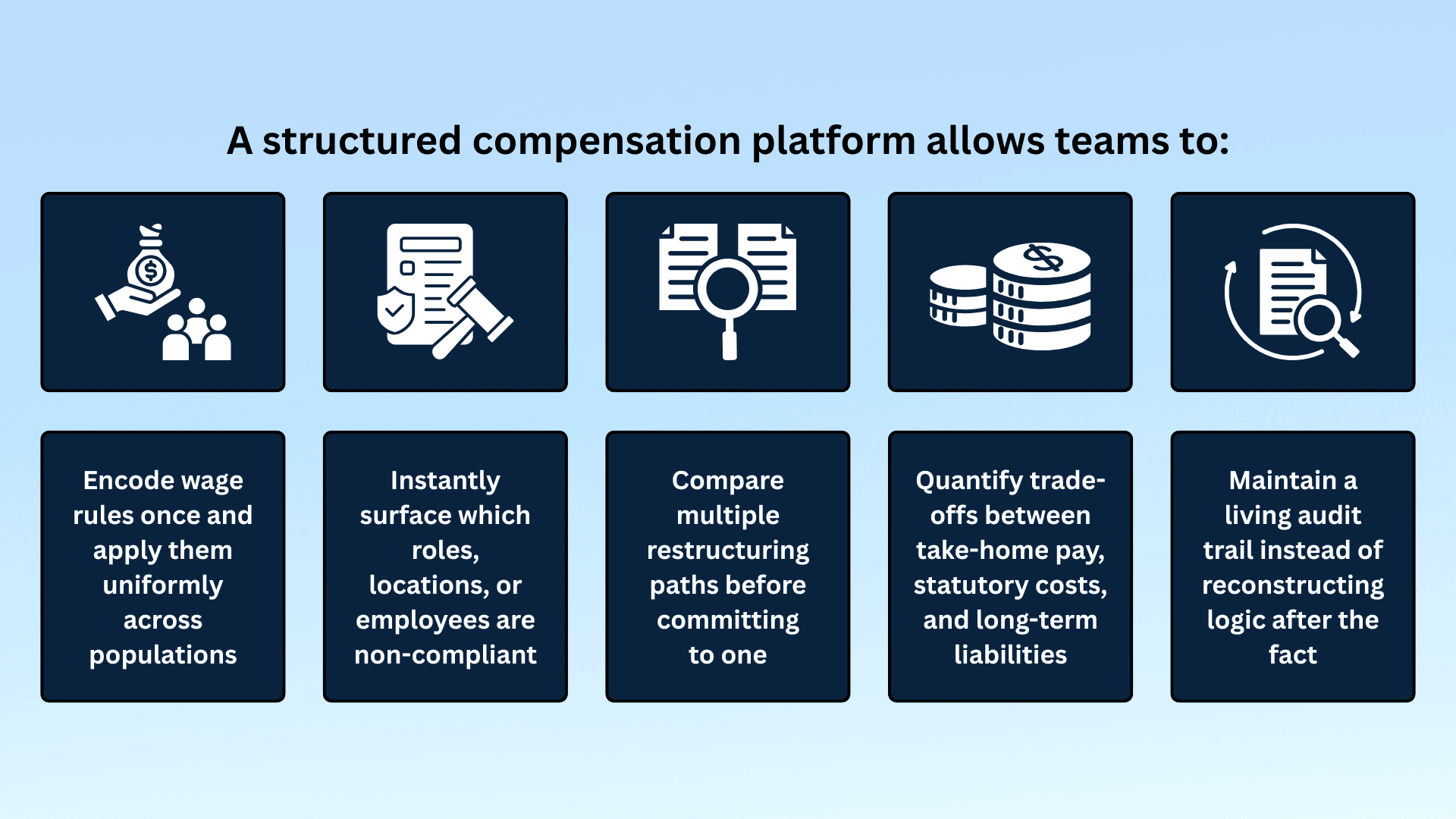
 

image 5.png


From Calculation to Decision Support

With CompUp, comp&ben and rewards teams can model multiple restructuring scenarios in parallel and understand their implications before implementation:

  • Compare PF outflows across different wage structures
  • Assess gratuity liability impact over time
  • Evaluate budget trade-offs at role, level, or cohort level

This allows leaders to move beyond “what is compliant” to “what is optimal” — balancing cost, take-home pay, and long-term benefits.

CompUp also enables more transparent employee communication. Instead of generic explanations, teams can generate personalised compensation letters that clearly show what has changed, why it has changed, and how long-term benefits have increased — supported by real numbers.


FAQs

  • Are the labour codes only a payroll issue?
    No. They directly impact compensation design, workforce costs, benefits strategy, employee communication, and audit governance.

  • Will take-home pay reduce for all employees?
    Not necessarily. Impact varies by structure, location, and employer strategy. The key is modelling scenarios before implementation.

  • Is technology mandatory for compliance?
    Legally, no. Practically, for medium-to-large organizations managing scale and risk, it is increasingly unavoidable.

  • What are the four Labour Codes?
    1- Code on Wages (2019)
    2- Code on Social Security (2020)
    3- Occupational Safety, Health and Working Conditions Code (2020)
    4- Industrial Relations Code (2020)

  • Will salaries increase under the new labour codes?
    Not necessarily. CTC may remain unchanged, but take-home pay could reduce due to higher PF contributions on a larger wage base. Whether organisations increase CTC to offset this impact depends on internal policy decisions.
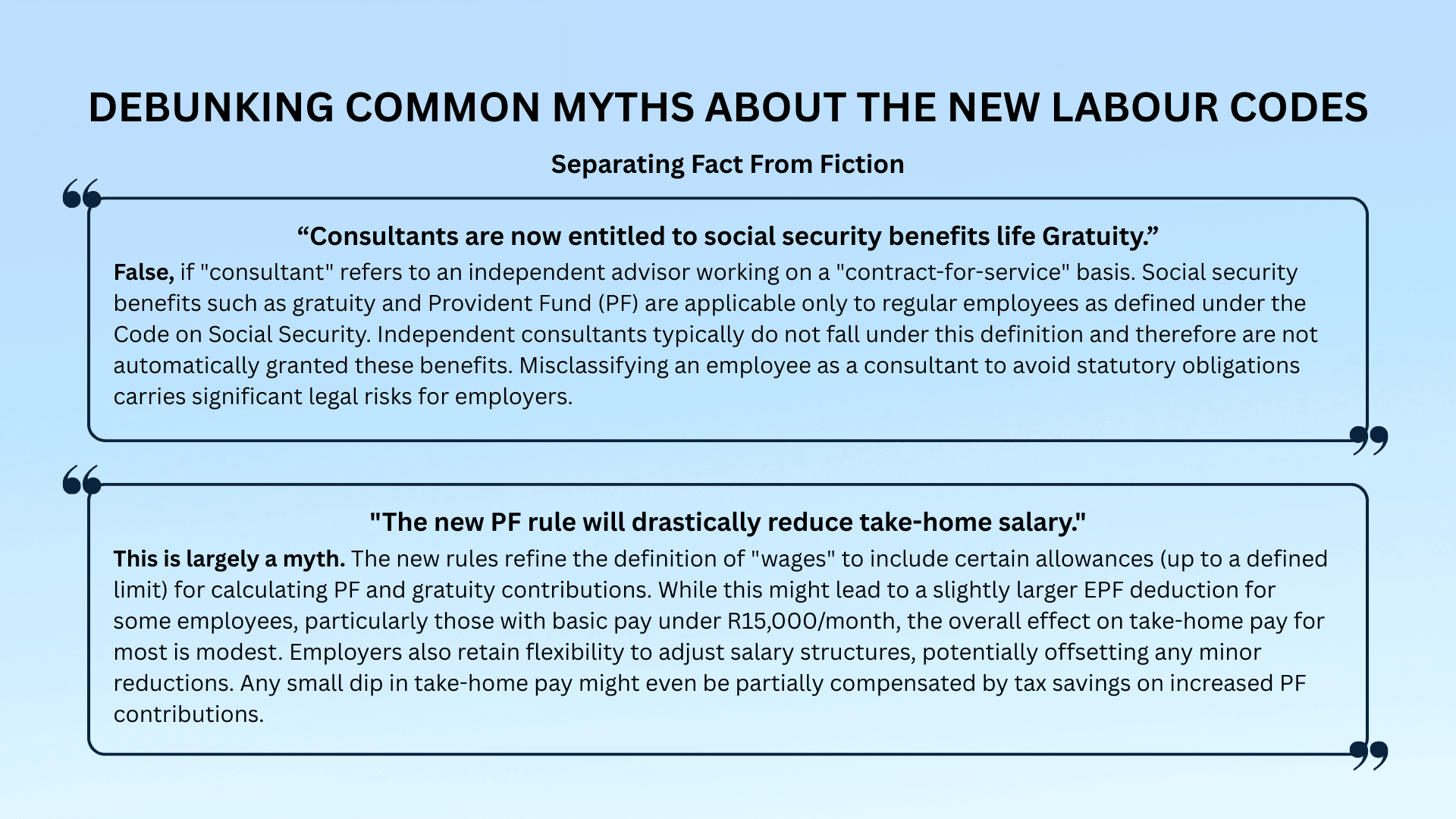
     

image 5 (2).png


BLOG FOOTER WITH CTA (1).png

Tags:
compensation management
compensation planning
employee benefits
total rewards planning
compensation philosophy
Share:

Shradha Vadhone
Shradha Vadhone

Community Manager (Marketing)

As a Community Manager, I’m passionate about fostering collaboration and knowledge sharing among professionals in compensation management and total rewards. I develop engaging content that simplifies complex topics, empowering others to excel and aim to drive collective growth through insight and connection.


Our Latest Posts

Revolutionizing Pay Strategies: Don't Miss Our Latest Blogs on Compensation Benchmarking

View All
Ready to Get Started?
HiresureLogo
ApicaSocLogoISOCertifiedGDPRLogo