Your 2026 pay structure likely carries hidden liabilities that reactive compliance will not catch. The regulatory playbook is being rewritten to shift the burden of proof from the individual employee to the employer. The UK government’s 2026 research confirms that pay discrimination remains a central driver of persistent gaps, but it explicitly flags that data gaps from low pay transparency make current detection methods ineffective.
Proposed UK reforms are now formalizing this shift. The consultation introduces a new Equal Pay Regulatory and Enforcement Unit with the power to initiate proactive employer audits, bypassing the need for an individual complaint. This is paired with mandatory pay transparency in job adverts and standardized discrimination questionnaires designed to surface systemic bias long before a lawsuit lands.
This structural overhaul means your compensation data has become your primary legal defense. What follows is a seven-step, statistically grounded process to transform raw payroll exports into a defensible, continuous pay equity capability, moving you from reactive remediation to operational control.
A systematic pay equity analysis is a data-driven audit that isolates unexplained gaps before regulators or legal action force your hand. Here are the statistically grounded steps you need to operationalize:
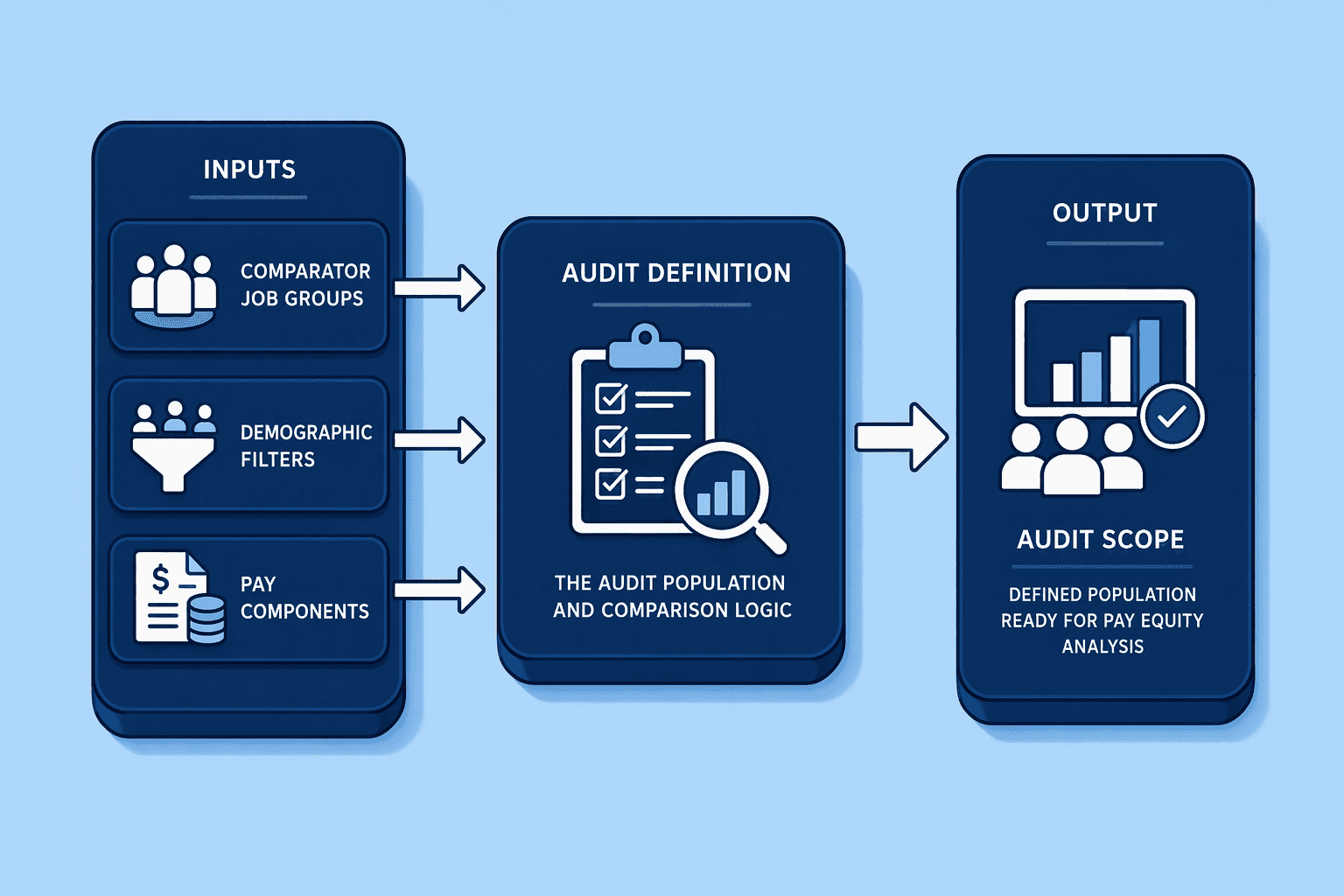
Anchor your audit in the legal definition of 'equal work' by completing these steps:
Your statistical model is worthless if your raw data is not scrubbed and standardized. You pull fields from your HRIS and payroll systems: date of hire, job title, job level, full-time equivalent (FTE) base salary, bonus payouts, performance scores, and protected group identifiers. The critical task is standardization. Free-text job titles must be mapped to a consistent job architecture, and tenure must be calculated identically across the organization.
Data gaps are the primary failure point. The UK government’s 2026 research explicitly notes that low pay transparency makes detection difficult, but internal transparency starts with your own dataset. Flag incomplete records immediately. For a statistically sound regression, you need at least 10 employees for each variable in your model; groups with sparse cells or severe imbalance will produce unreliable results and require alternative testing methods. You can use a platform like CompUp to centralize this data and integrate budget pools with your existing HRIS, ensuring real-time visibility rather than a static, stale export.
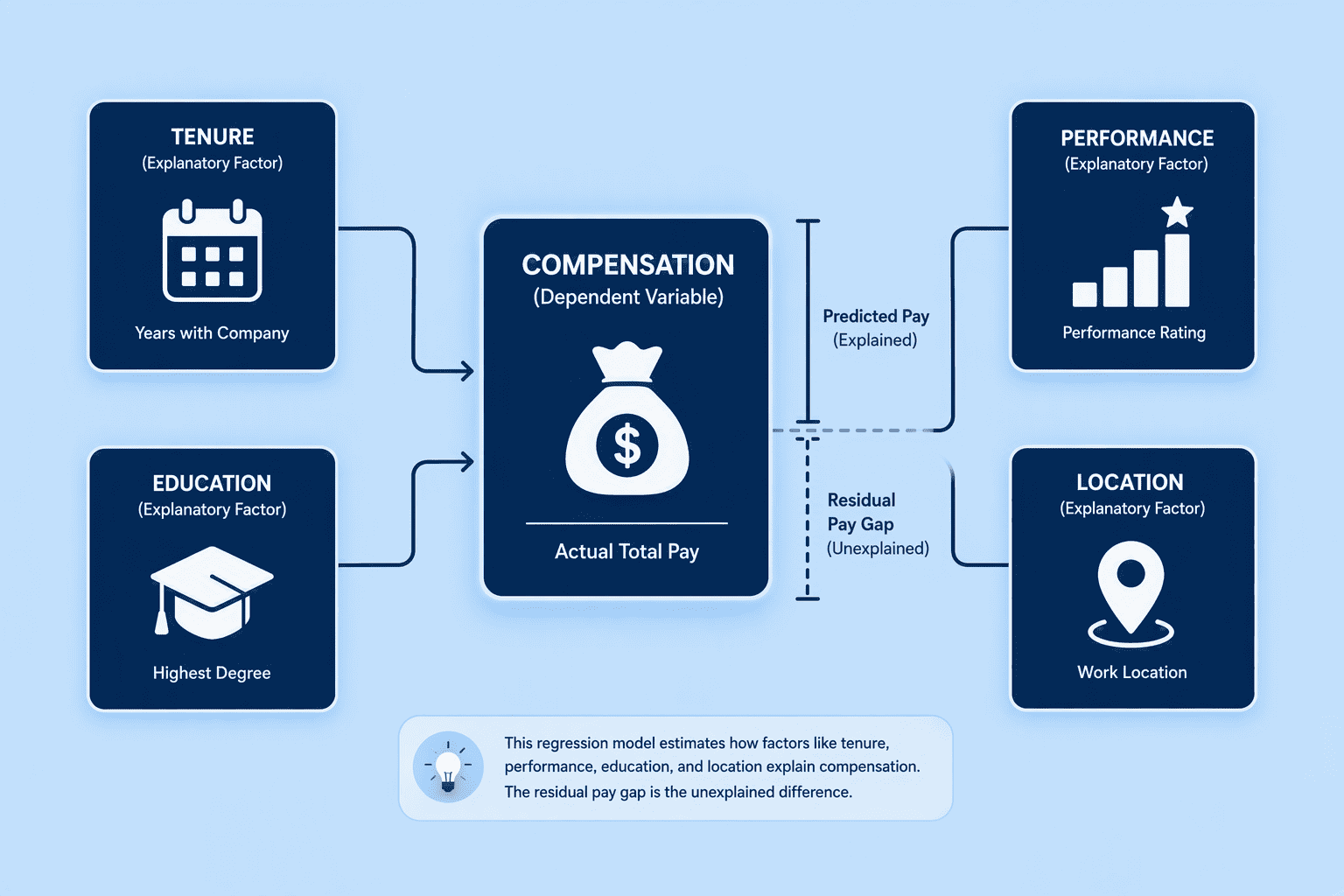
The wage equation is the primary statistical tool for moving from raw pay comparisons to evidence of potential bias. You construct a multivariate regression model where the log of compensation is the dependent variable. Independent variables include the legitimate business factors that should explain pay differences: tenure, full-time status, performance rating, education, and geographic location. You then introduce indicator variables for the protected group you are testing, such as sex or race.
The output that matters most is the coefficient and statistical significance of that protected-group variable. If sex is statistically significant in your model, it signals an unexplained pay difference that persists even after your legitimate factors have done their explanatory work. The residual is the amount of the gap not attributable to job-related attributes. A 4.9% adjusted gender pay gap in the United States, as reported by Glassdoor, is the type of finding a properly specified regression surfaces.
This isolates the signal from the noise. A statistically significant residual is a red flag for potential discrimination and your trigger for root-cause diagnosis. Large samples that meet the 30/5 rule, meaning at least 30 employees and 5 instances per group, are reliable for regression. You ignore this step and you are navigating compensation risk based on vibes, not evidence.
Smaller groups require different statistical machinery. For samples that do not meet the 30/5 threshold, regression is unreliable; you default to methods like Fisher's exact test or nonparametric comparisons. The methodology must fit the data, or your conclusions are indefensible.
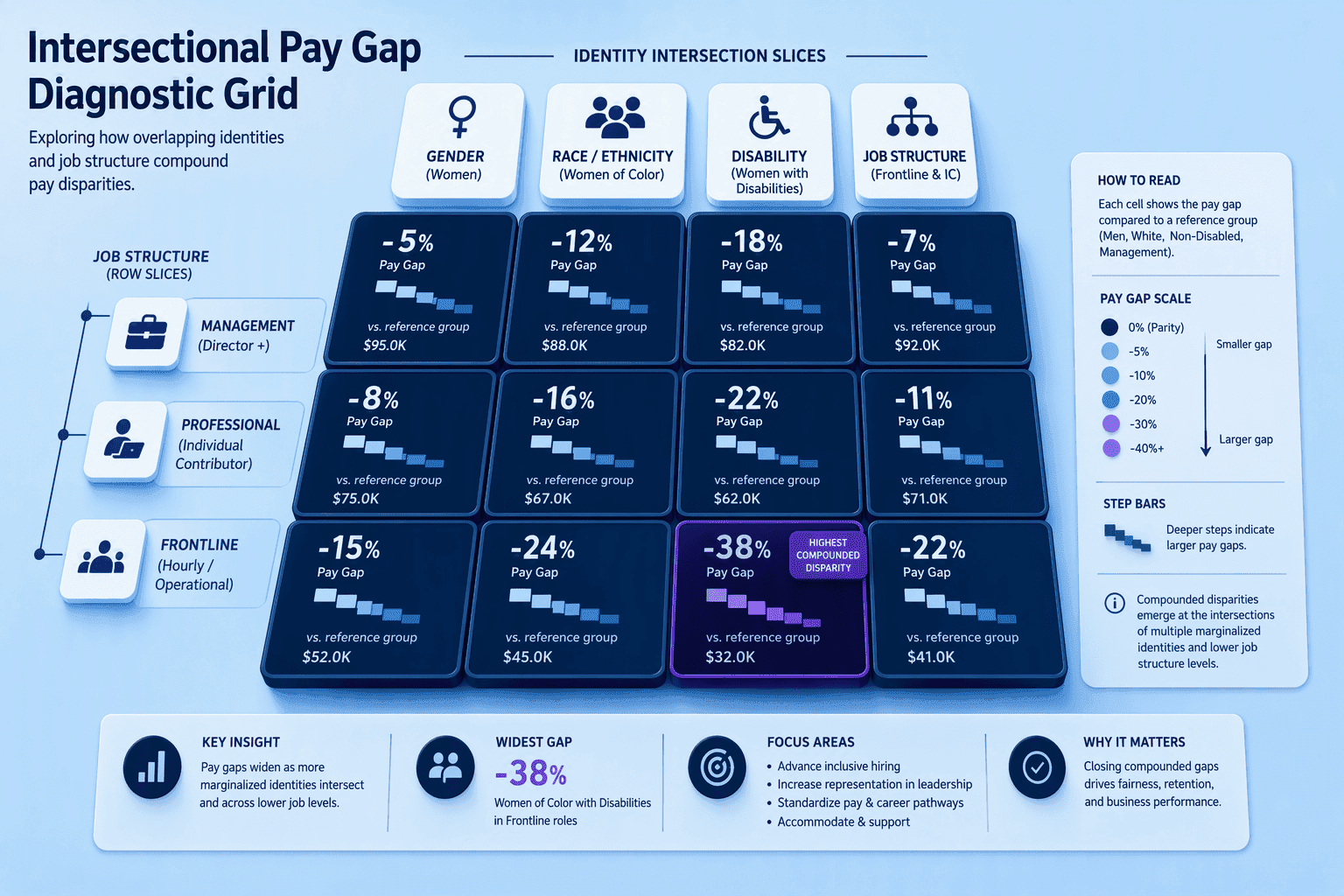
A statistically significant residual is a symptom, not a diagnosis. Your next move is to slice the data intersectionally to uncover the systemic disease. Single-axis reviews, looking only at sex or only at race, hide compounded disparities.
The UK’s 2026 research specifically identifies disabled women of color as facing deep, compounded pay gaps. To find this in your own data, isolate groups like 'Black women,' 'Hispanic women,' and 'disabled workers of color,' and observe their distribution across your job architecture. The tell-tale red flag is clustering, where these groups are compressed into lower-paying job levels or roles with narrower salary bands, a dynamic confirmed in health care where nearly half of Black, Latina, and 'other' female health care workers earned <$15 per hour compared to about a quarter of White and Asian female workers.
You also examine entry-level pay compression. If protected groups are hired at or near a single, low entry rate while non-protected peers see a wider distribution, you have a structural intake problem that will compound over careers. These intersectional findings shift remediation from a simple check-cutting exercise into a structural redesign of promotion pathways and job architecture, a task that a centralized system like CompUp supports by linking pay equity analysis to workforce planning data.
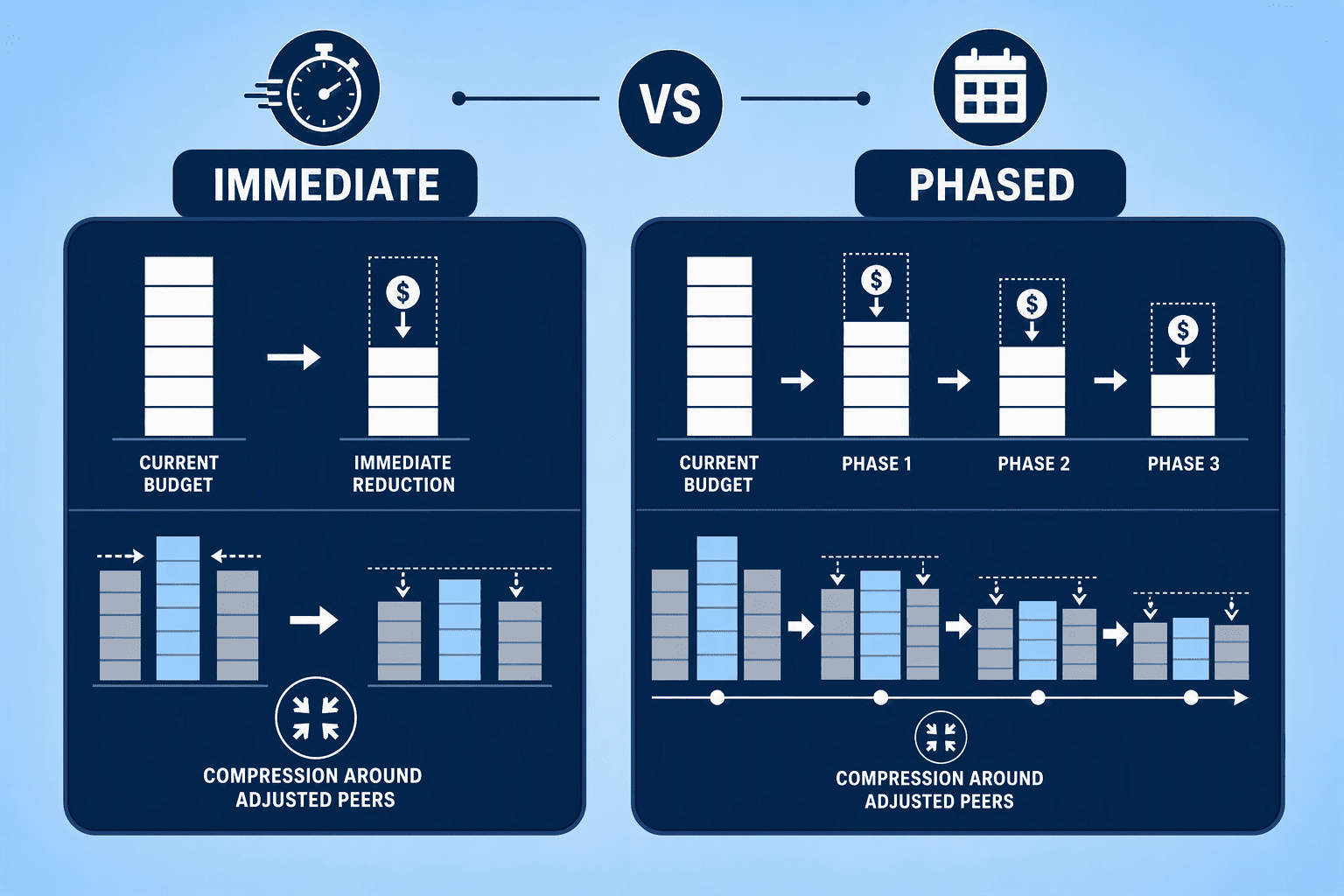
You now have a list of statistically unjustified pay shortfalls and their intersectional root causes. Turn these findings into a concrete financial plan by simulating the cost of closing every gap. Budgeting is not simply multiplying a gap by the number of affected employees; it requires modeling second-order effects, such as compression with newly adjusted peers, and choosing a timeline.
You must compare the fiscal impact of immediate, one-time corrections against a phased approach spread over multiple quarters. The table below lays out the critical financial dimensions you model to secure executive approval without creating new equity risks.
| Budget Dimension | One-Time Lump Sum Correction | Phased Multi-Cycle Remediation |
|---|---|---|
| Immediate Fiscal Impact | High upfront cost; spikes a single quarter's budget. | Lower per-cycle outlay; smooths budget over fiscal periods. |
| Employee Relations Signal | Risks 'special treatment' stigma if communicated poorly. | Integrates into regular merit cycles, reducing questions. |
| Compression Risk | High; must include a separate fund for ripple adjustments. | Moderate; new equity adjustments handle ripples over time. |
| Audit Trail Clarity | Simple to document; one line item for the correction. | Requires meticulous documentation linking phased amounts to the gap. |
| Sustainability | Fixes a snapshot; gaps may recur without process change. | Builds time for concurrent promotion pathway redesign. |
Once modeled, you create a specific budget line item. This must also fund the structural fixes identified in Step 4, like redesigned promotion criteria, so you close today's gap while dismantling the machinery that produced it.
Sustainable remediation means redesigning the process itself. You embed equity adjustments directly into your regular compensation cycle. A tool like CompUp provides automated approval workflows with a strict audit trail, linking each manager's proposed adjustment to the gap analysis that justified it.
When you integrate an equity correction into the merit process, an employee sees a single raise. A 6% increase might bundle a 3% merit raise with a 3% remediation adjustment. This achieves the same dollar outcome as a separate corrective payment while sidestepping the stigma and questions that two distinct pay actions would produce.
Every adjustment must carry an auditable rationale. The proposed FY 2027 budget and recent Executive Orders are reshaping federal enforcement structures, according to the Office of Federal Contract Compliance Programs' Congressional Budget Justification, but the core principle of traceability stays fixed. Require a second-level approval for any adjustment flagged by the regression model, and document the business justification. Link this workflow to your performance and promotion modules so that compensation governance in CompUp, for example, enforces these rules automatically. The result is a permanent, auditable operational control that de-risks pay decisions at their origin.
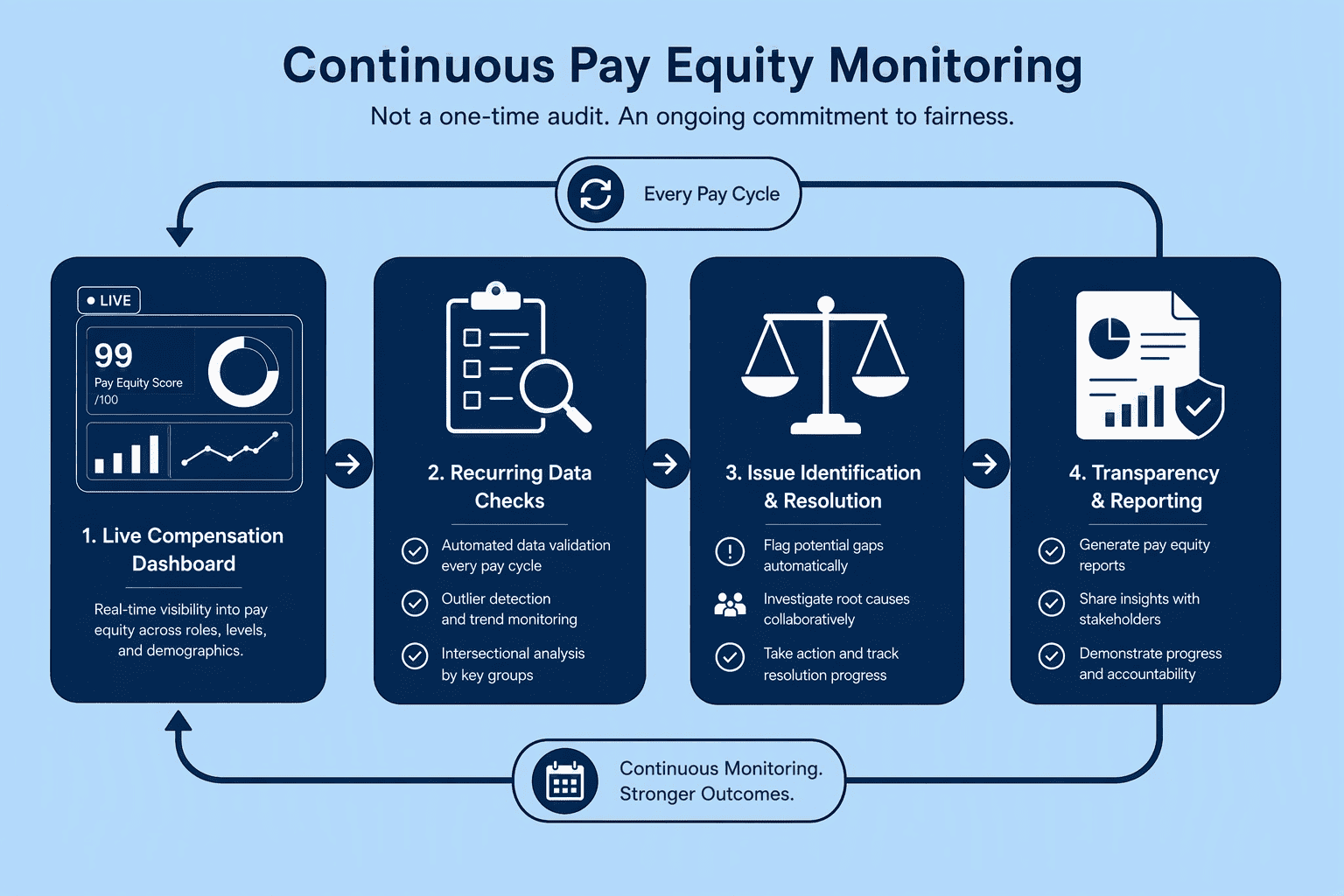
Pay equity is a sustained operational capability, not an annual project. You shift from reactive audit to continuous monitoring by operationalizing these three steps:
Federal and state agencies now treat pay equity as a continuous audit function embedded in your compensation cycle. You have a sequenced, statistical method to identify unexplained gaps, cost structural fixes, and build monitoring into every pay decision. Organizations that operate this evidence-based capability now convert a regulatory shift into a defensible compensation architecture. If you're weighing options, CompUp is worth a closer look.
Pay equity analysis uses statistical methods, primarily regression modeling, to compare compensation across groups performing equal work and isolate unexplained gaps that suggest bias. It is key because shifting regulations, like the UK's proposed proactive employer audits, make statistical evidence your primary legal defense rather than an after-the-fact reaction to an employee claim.
You build a multivariate regression model where compensation is the dependent variable and legitimate factors like tenure and performance are controls. By testing the statistical significance of protected-group coefficients, you surface unexplained residuals. For small groups that fail the 30/5 sample rule, you must use alternative methods like Fisher's exact test.
Statistical significance on a protected group's regression coefficient is the primary analytical red flag. Operationally, look for intersectional clustering of groups like disabled women of color in lower-paying roles and pay compression at entry levels, where protected groups hired at a single low rate point to a structural intake problem.
Integrate remediation into regular merit cycles as a single raise to reduce stigma, rather than issuing separate lines. Fund both the one-time gap closure and the redesign of broken promotion pathways. Implement automated approval workflows with a full audit trail to permanently govern adjustments at their origin within normal compensation cycles.
Specialized platforms centralize HRIS data, run regression models, and enforce auditable workflows. CompUp, for example, is built for Total Rewards teams to manage base pay, simulate budget impacts, and integrate pay equity checks into automated approval flows with a strict audit trail. General-purpose BI tools lack compensation-specific governance structures.
At the federal level, the Equal Pay Act and Title VII remain foundational, enforced by the EEOC, while federal contractor audit requirements are in flux following FY 2027 budget proposals. The primary compliance vector has shifted to state-level mandates, particularly salary range disclosure laws in states like California and New York, which require a transparent internal pay structure.
Community Manager (Marketing)
As a Community Manager, I’m passionate about fostering collaboration and knowledge sharing among professionals in compensation management and total rewards. I develop engaging content that simplifies complex topics, empowering others to excel and aim to drive collective growth through insight and connection.
Revolutionizing Pay Strategies: Don't Miss Our Latest Blogs on Compensation Benchmarking