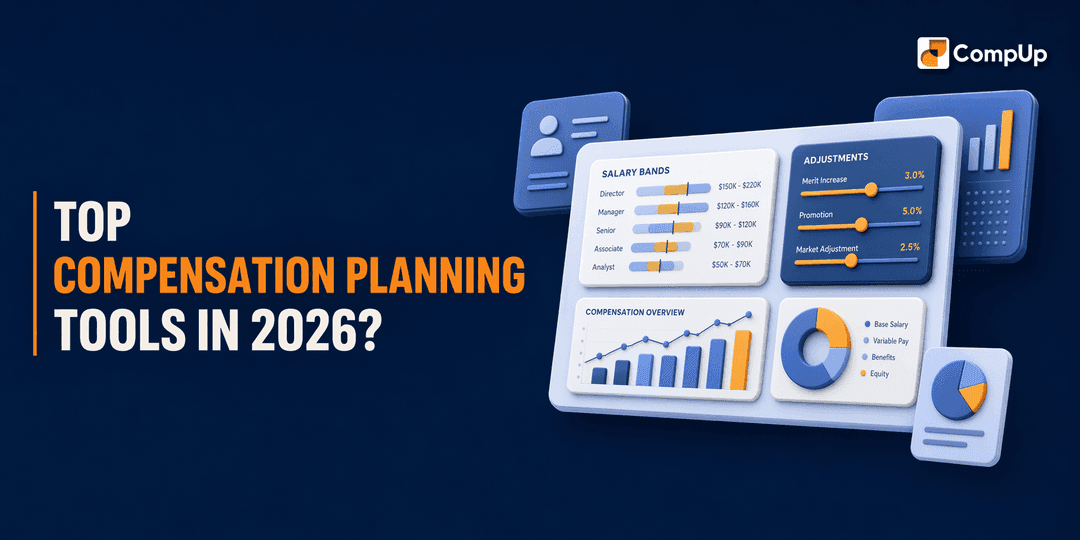

Compensation planning software has evolved from spreadsheet templates to sophisticated platforms that automate merit cycles, simulate budget scenarios, and ensure pay transparency compliance across multiple jurisdictions.
This guide evaluates leading platforms across multiple dimensions to help mid-market and enterprise buyers select the right tool for their compensation complexity.
A compensation planning tool is a tool that helps HR teams structure, model, and execute pay decisions across the full planning cycle, from setting salary bands and benchmarking against the market, to running merit cycles, simulating budget impact, and communicating compensation outcomes to employees and managers.
Here is what a compensation planning tool typically does:
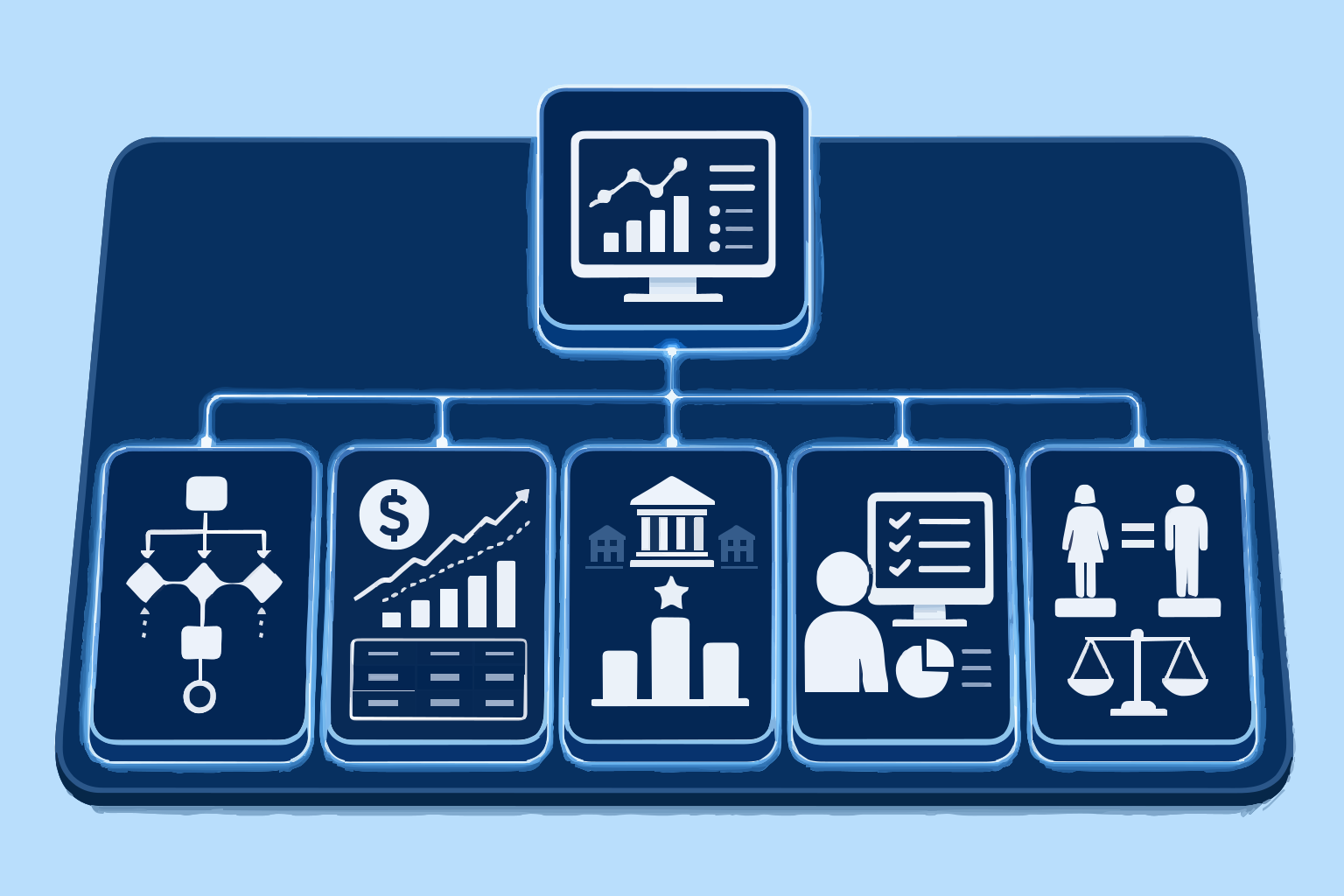
Does the tool support the full cycle from band-setting to increment approval, or only part of it? A tool that handles benchmarking but not manager workflows will create gaps you fill with spreadsheets.
Can HR and finance model multiple scenarios before committing, and does it show the cost impact in real time? This is the feature that most directly prevents budget overruns during planning season.
Is market data built into the platform, how current is it, and how granular can it get by role, level, and geography? A planning tool is only as reliable as the benchmarks it uses to set midpoints.
Can line managers navigate the planning cycle without training, or does every action require HR involvement? The more friction managers face, the longer planning cycles take and the more errors get introduced.
Does equity analysis sit inside the planning workflow, or is it a separate report run after decisions are already made? The former catches disparities before increments are finalised. The latter catches them too late.
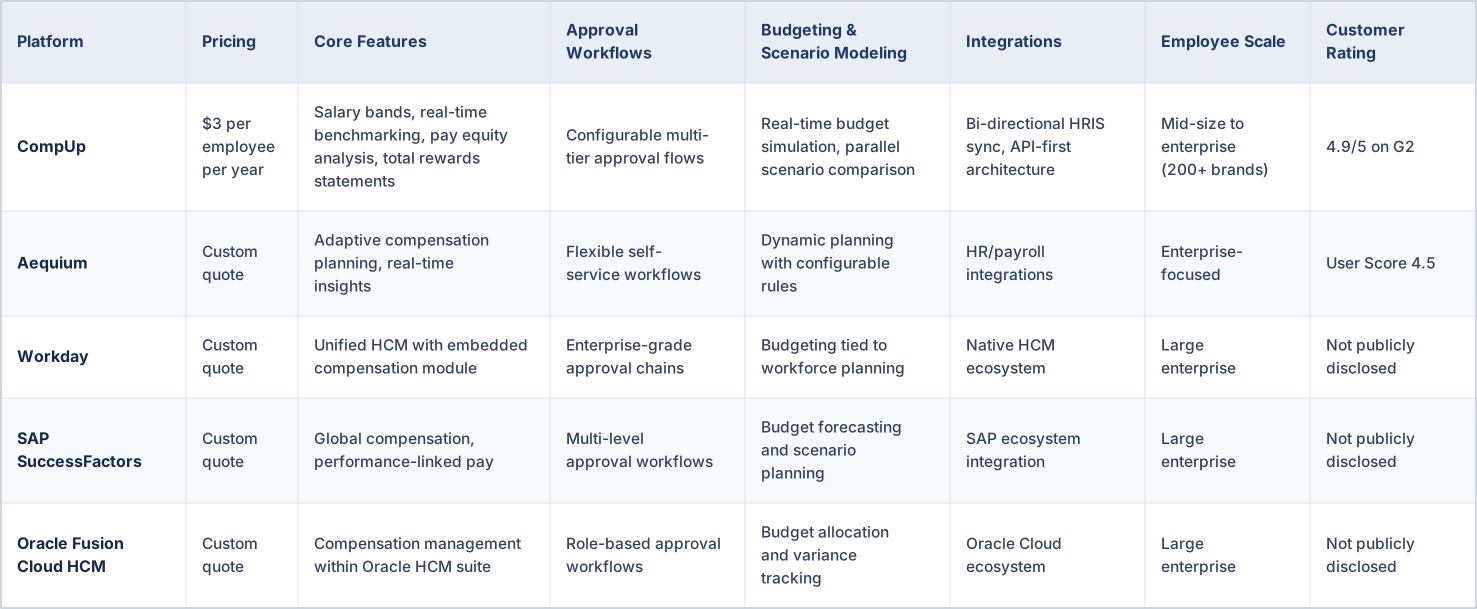
This comparison evaluates five platforms on pricing transparency, core compensation planning features, approval workflow depth, budgeting and scenario modeling, integrations, enterprise scale, and customer ratings.
We reviewed over 20 platforms and compared up to 5 products at a time to identify the tools that best serve mid-market HR teams and complex enterprise structures. The ratings below are drawn from verified user reviews.
G2 rating: 4.9/5
CompUp is a full-stack compensation management platform built specifically for HR and Total Rewards teams that need to manage the entire planning cycle in one place. From setting salary structures and benchmarking against the market to running appraisal cycles and communicating outcomes to employees, CompUp replaces fragmented spreadsheets and disconnected workflows with a single, structured platform.
It is particularly well suited for mid-sized to large organisations managing complex compensation structures across multiple roles, levels, and geographies. Rated 4.9 on G2 and trusted by 100+ companies across 140+ countries, it is one of the highest-rated dedicated compensation platforms available today.
Key planning features:
Best for: Mid-sized to large organisations that want a single platform to manage the full compensation planning cycle without stitching together multiple tools.
Pricing: Starting at $3 per employee per year
G2 rating: 4.7/5
Aeqium is a dedicated compensation planning platform built for growing organisations with complex compensation structures. It helps HR and finance teams streamline merit cycles, bonus planning, and equity reviews by replacing error-prone spreadsheets with a secure, centralised system. The platform is designed to be flexible enough to match each organisation's unique compensation plan while being easy enough to configure without relying on vendor support.
A standout feature is the speed of implementation. Aeqium integrates with existing HR systems in around two hours on average, making it one of the faster platforms to get up and running. It is trusted by companies including Warby Parker, Braze, Hopper, Whoop, and Mixpanel, and is SOC 2 Type 2 certified.
Key planning features:
Best for: Growing mid-market organisations that need a fast-to-implement, flexible planning platform that can adapt to frequent organisational changes without heavy overhead.
Pricing: Subscription-based pricing tailored to employee count and organisational complexity.
G2 rating: 4.1/5
Workday is an enterprise-grade human capital management platform with a comprehensive compensation module that handles merit planning, bonus cycles, and equity grants at scale. Its core strength is integration: compensation planning sits within the same system as finance, workforce management, performance, payroll, and recruiting data, giving large organisations a single source of truth across all people-related processes.
It is built for organisations where cross-functional alignment is the central planning challenge and where compensation decisions need to flow directly into payroll and financial reporting without manual intervention. Implementation costs and timelines are significant, and the platform requires Workday HCM as a prerequisite, making it most justifiable for large enterprises already invested in the Workday ecosystem.
Key planning features:
Best for: Large enterprises with 1,000+ employees that need compensation planning tightly integrated with HR, finance, performance, and payroll systems within a single platform.
Pricing: Custom enterprise pricing.
G2 rating: 4.0/5
SAP SuccessFactors is a global, AI-powered cloud HR suite trusted by more than 10,000 organisations worldwide. Its compensation planning module sits within a broader HCM suite that spans core HR, payroll, talent management, learning, and workforce analytics, giving large enterprises a connected view of people and pay data across the entire employee lifecycle.
Its planning capabilities are strongest for organisations that need enterprise-grade compensation governance with 100+ country localisations, built-in compliance updates, and deep integration with SAP's broader ERP ecosystem. Like Workday, it is a significant implementation investment and is best suited to organisations with the technical resources to configure and maintain a platform of this scale.
Key planning features:
Best for: Large global enterprises already within the SAP ecosystem that need compensation planning tightly integrated with ERP, payroll, and talent management at scale.
Pricing: Custom enterprise pricing.
G2 rating: 3.9/5
Oracle Fusion Cloud HCM is a comprehensive cloud-based HR platform that covers the full employee lifecycle from hire to retire, including compensation planning, payroll, talent management, performance, learning, and workforce management. It is natively built for the cloud and delivers a consistent experience across devices, making it a viable option for large enterprises that need a unified HR platform with compensation planning embedded within it.
Its compensation planning capability is strongest when used as part of the broader Oracle ecosystem, where it can draw on connected data across finance, ERP, and HR to support planning decisions. Users frequently highlight the platform's customisability and depth of functionality, though the interface and implementation complexity are common points of friction, particularly for organisations without dedicated technical resources.
Key planning features:
Best for: Large enterprises already within the Oracle ecosystem that need compensation planning integrated with finance, ERP, and a full HR suite at global scale.
Pricing: Subscription-based pricing structured by number of users or employees. Custom enterprise quotes available.
Three questions will point you in the right direction before you evaluate any platform.
Straightforward, single-country merit increases can be handled by an HRIS add-on. Multi-geography planning, variable pay, long-term incentives, and equity analysis need a dedicated platform. If your current process involves multiple spreadsheets being reconciled manually, that is a clear signal a dedicated tool will pay off quickly.
Under 200, a lighter tool or HRIS add-on is sufficient. Between 200 and 2,000, a dedicated platform like CompUp or Compport delivers meaningful efficiency and accuracy gains. Above 2,000, enterprise-grade workflow, integration depth, and audit capability become non-negotiable, pointing toward Workday or HRSoft.
Budget overruns point toward forecasting capability. Pay equity gaps point toward platforms with equity analysis built into the workflow. Manager bottlenecks point toward usability and workflow design. Commission disputes point toward CaptivateIQ. Global compliance challenges point toward Deel.
The best compensation planning tool is the one that fits how your organisation actually plans, not the one with the longest feature list. Start with your biggest planning pain point, match it to the tool built to solve it, and treat the evaluation as a strategic decision. A well-chosen platform turns compensation planning from a stressful annual scramble into a structured, repeatable process your team can run with confidence every cycle.
CompUp's full-cycle approach — from salary structuring and budget simulations to total rewards communication — makes it a natural starting point for teams looking to consolidate fragmented workflows into one place. Request a free demo to see how it fits your planning process.
Compensation planning software automates merit cycles, salary band management, performance-linked pay, and budget simulation.[1] The best platforms integrate with HR and payroll systems to centralize workflows,[1] converging around core capabilities including salary band management, performance-linked pay, and market benchmarking.[1] Execution quality, not feature novelty, now separates leaders from laggards in this category.[2]
Focus on three criteria: workflow automation, budget simulation, and compliance readiness.[7][8] Platforms that integrate with over 50 HR systems eliminate manual CSV uploads by syncing employee records, org structure, and salary history automatically, reducing the risk that merit cycles operate on stale data.[7] Real-time sync keeps compensation planning grounded in current headcount and role changes.[8]
One-click sync with employee records and org structure is typically a deal-breaker; API customization is nice-to-have.[7] Platforms that integrate with over 50 HR systems eliminate manual CSV uploads, syncing employee records, org structure, and salary history automatically.[7] Real-time sync keeps compensation planning grounded in current headcount and role changes, reducing the risk that merit cycles operate on stale data.[8]
Platforms support compliance through salary band publishing, audit trails, and pay-equity reporting.[3][4] Numerous states and local jurisdictions require pay range disclosures,[3] creating obligations in California, New York, Colorado, Washington, Massachusetts, Vermont, Illinois, and Minnesota.[4] By early 2026, over 60 million workers across more than a dozen states operate under transparency laws requiring proactive disclosure.[3]
Merit-focused platforms are optimized for annual merit planning and budget simulation,[2] while equity-heavy platforms add long-term incentive complexity including ESOP, RSU, and stock options.[2] Buyers pursuing annual merit cycles need real-time benchmarking and no-code plan editing;[2] those addressing broader pay-equity concerns require equity analysis, demographic reporting, and vesting schedule management.[2]
No source provides concrete implementation timelines.[6] Qualitatively, embedded HRIS tools typically go live in 4-6 weeks due to pre-built data connectors, while standalone enterprise platforms may require 3-6 months for custom integrations, data migration from spreadsheets, workflow configuration, and multi-department training.[6] Implementation duration depends heavily on HRIS integration complexity and existing data quality.
Total cost of ownership includes implementation fees, HRIS integration hours, training investments, and ongoing technical support, not just per-seat pricing.[6] Embedded HRIS modules typically bundle integration and training into the subscription, while standalone enterprise platforms charge separately for custom integrations, data migration, and technical support.[6] No source provides apples-to-apples pricing totals across platforms.
Community Manager (Marketing)
As a Community Manager, I’m passionate about fostering collaboration and knowledge sharing among professionals in compensation management and total rewards. I develop engaging content that simplifies complex topics, empowering others to excel and aim to drive collective growth through insight and connection.
Revolutionizing Pay Strategies: Don't Miss Our Latest Blogs on Compensation Benchmarking