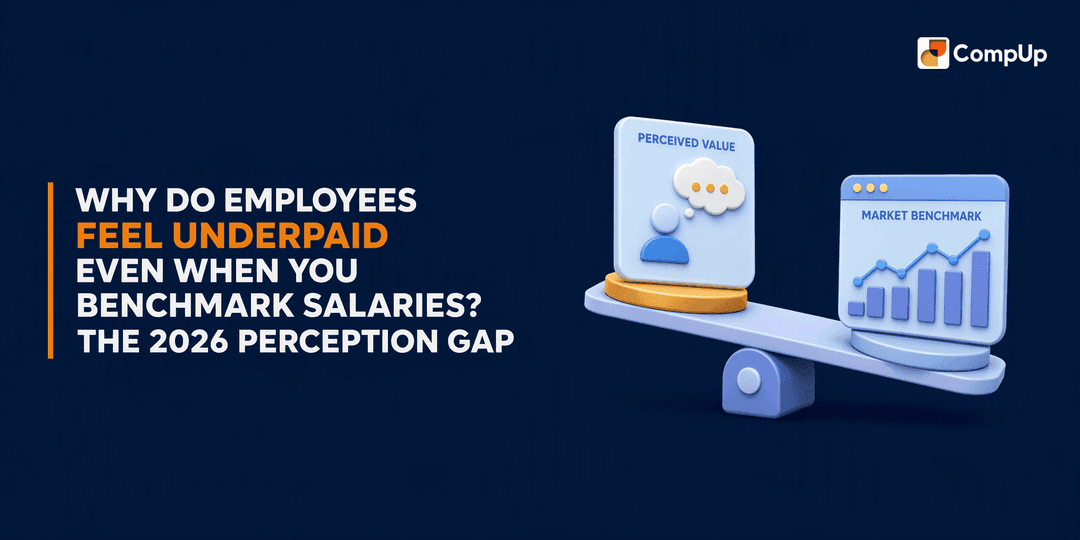

You just completed your annual compensation review. The data is irrefutable: your salaries are pegged to the 75th percentile of current market data. And yet, engagement scores on pay satisfaction are in freefall, and your top performer just asked for a "market adjustment" after browsing a salary aggregation site. This paradox is not a failure of your budgeting; it is a failure of perception.
Jobstreet’s 2026 *Salary Pulse: Singapore* report captures this perfectly: 74% of employees believe they are paid fairly, but only 37% are actually satisfied. That chasm between intellectual acknowledgment and emotional contentment is where retention is lost. It gets worse. Payscale’s global data confirms that 68% of employees believe they’re underpaid, even when their compensation is at or above market rates.
This is not a compensation crisis. It is a communication and data-integration crisis. When the machinery behind a pay decision is invisible, employees fill the void with doubt. The solution is not necessarily a bigger payroll budget; it is an evidence-based architecture that translates your compensation strategy into a narrative your employees can believe. We are going to dissect why market benchmarks fail to buy contentment and how to close the perception gap with continuous intelligence.
Before dissecting the psychological and systemic drivers, here are the critical data points and action frameworks that explain why competitive benchmarking alone cannot neutralize underpayment sentiment.
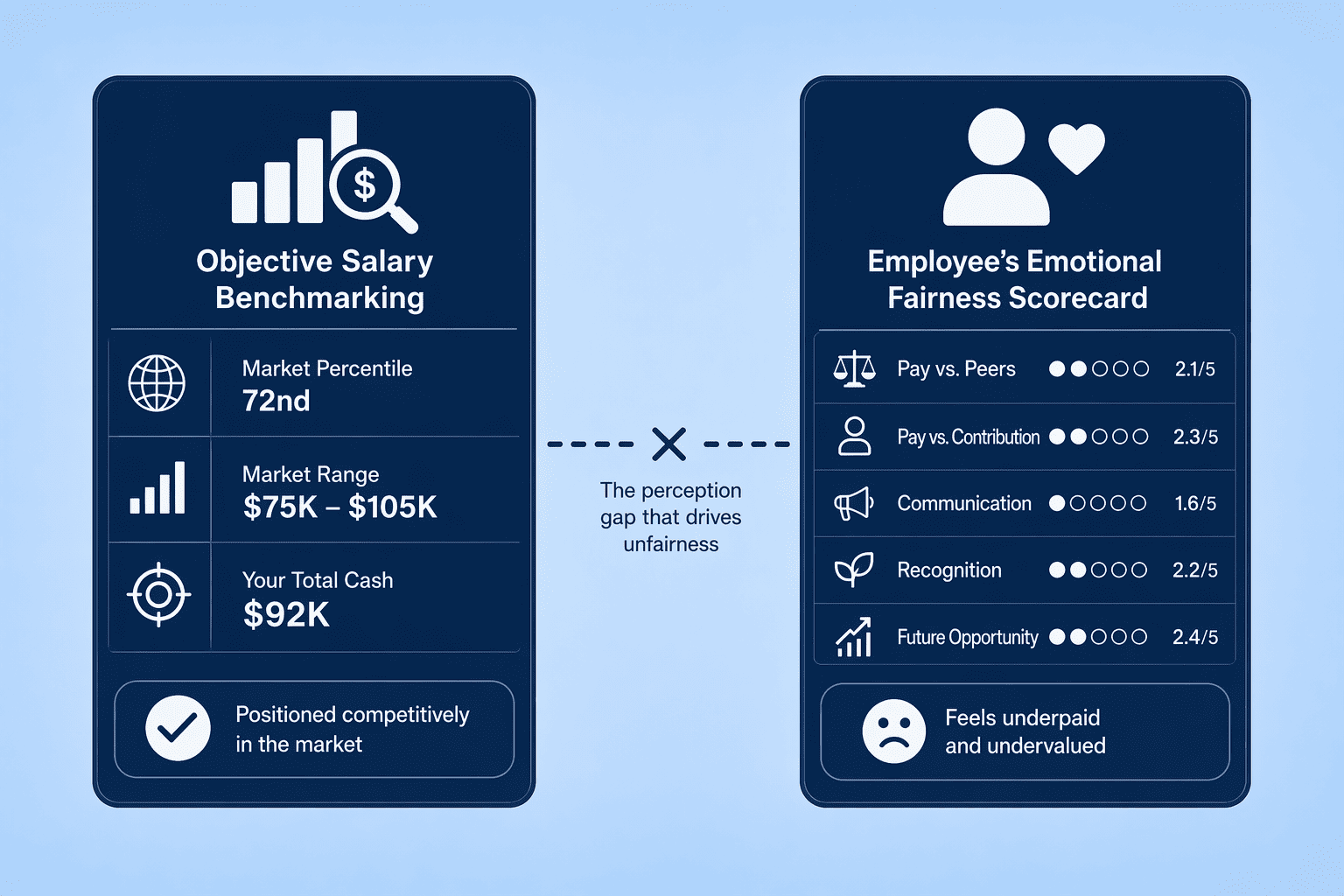
The fundamental flaw in relying on market data to justify pay is the assumption that employees view their salary as an objective market transaction. In reality, pay is a subjective scorecard of personal worth. Jobstreet’s 2026 data reveals that 7 in 10 employees who believe their pay is "about right" are still plagued by dissatisfaction. You are operating on the logic of precision, while your workforce is operating on the logic of emotion and social comparison.
Globally, the disconnect is stark. Among employees whose compensation is demonstrably above the market median, the anxiety persists. Almost half (47%) of those paid above market still believe they are underpaid. The market benchmark failed entirely as a psychological anchor.
The implication is severe. Perception dictates behavior far more powerfully than reality. An employee who perceives unfairness is a flight risk, regardless of how generous the spreadsheet says you are. In fact, the data shows employees who think they’re paid unfairly are 45% more likely to look for a new job, regardless of their actual compensation.
You are up against a narrative vacuum. When the link between effort, market data, and reward is invisible, the default assumption is that the reward is insufficient.
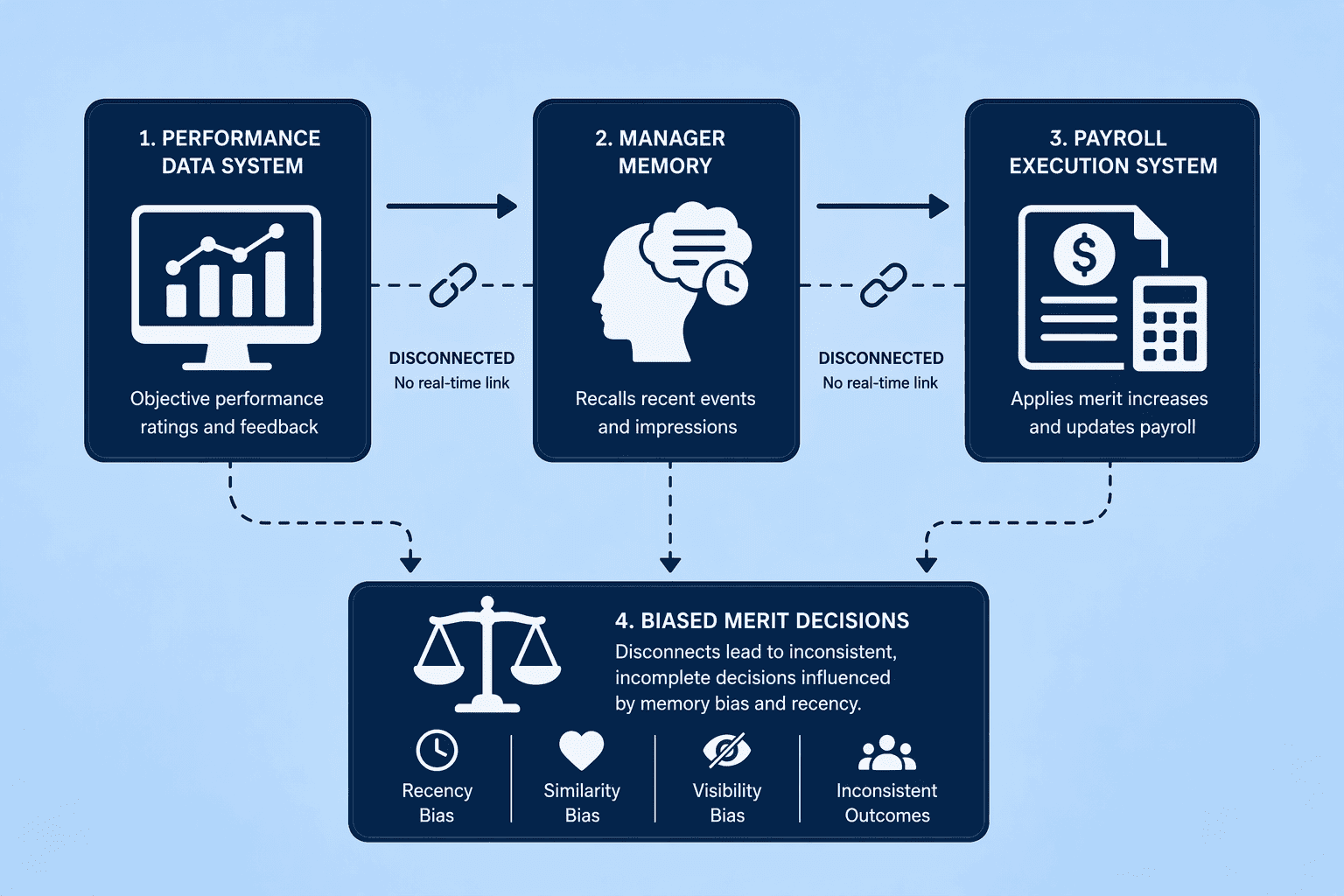
You hand a manager a compensation budget and expect them to distribute it fairly. But in many organizations, the performance data that justifies a merit increase lives in a completely different system than the payroll tool that executes it. This fragmentation forces managers into a cognitive shortcut: they make pay decisions from memory. And human memory is catastrophically flawed when it comes to assessing year-long performance accurately.
The result is recency bias. The employee who closed a massive deal in November gets a top rating, while the employee who hit every target from January to October gets compressed into the middle tier with a standard cost-of-living adjustment. Internal research confirms this distortion: the late-cycle performer is 22% more likely to receive the top rating.
When these two employees swap notes, the consistent performer has no credible explanation for why their raise was lower. The manager, lacking an integrated audit trail of performance touchpoints, cannot reconstruct the decision. The veneer of meritocracy cracks. The employee stops trusting the system and starts trusting their own narrative: they are underpaid.
This is a systems failure, not a managerial failure. You cannot expect a manager to be a credible arbiter of pay if you refuse to give them an integrated technology stack that connects daily output directly to compensation outcomes. At its core, this disconnect reveals that for high-skilled workers, pay is highly sensitive to internal benchmarks and increasingly insensitive to broad market data. Without that internal context, the pay story collapses.
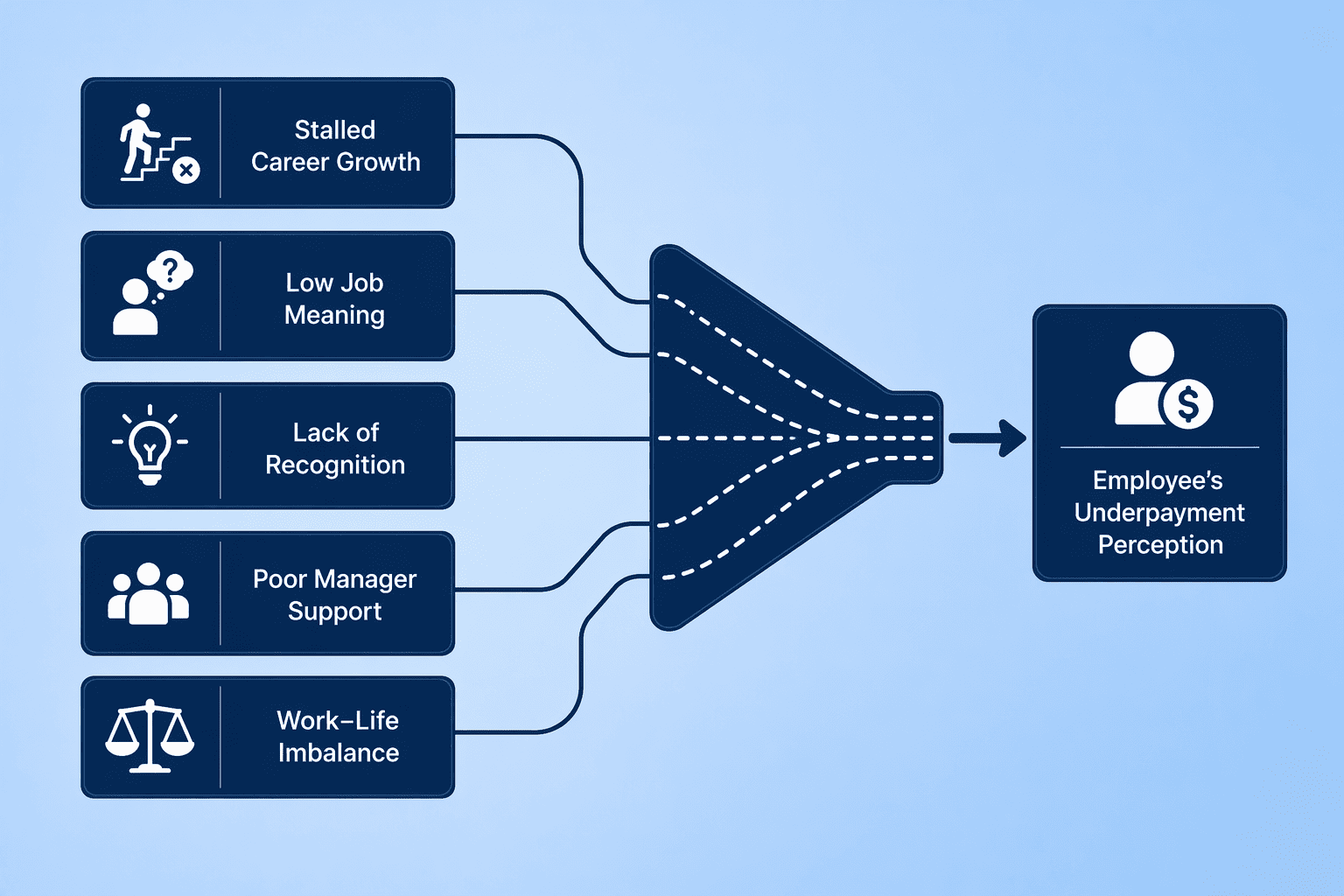
Base salary often acts as a pressure release valve for a much broader failure in the total employee experience. When the work itself lacks intrinsic meaning, or career progression stalls, employees fixate on a single, numeric lever: the paycheck. Address these non-salary amplifiers, or accept that no market match will ever feel sufficient.
The feeling of being underpaid is rarely triggered by an annual benchmarking report, it’s triggered by a peer’s offhand comment, a push notification from a salary platform, or the realization that a new hire earns more than a tenured expert. Understanding these distinct triggers is the first step to neutralizing them.
| Trigger | The Psychological Mechanism | How It Drives a Loyalty Tax | The Counter-Move for Employers |
|---|---|---|---|
| A peer's revelation | Social comparison theory predicts distress when input-output ratios diverge from a referent other, particularly a close colleague in a similar role. | Employees immediately re-code their compensation as below-market; tenure begins to feel like a penalty. | Train managers to proactively explain pay ranges and progression curves before an employee asks; equity requires transparent rationale, not secrecy. |
| A salary platform notification (e.g., Glassdoor, Levels.fyi) | Crowdsourced but unaudited data creates a high anchor point; employees treat the median as a personal minimum, ignoring role nuance and equity lag. | Your loyal staff benchmark against inflated, offer-stage comp from competitors, framing your total rewards as a deficit, despite internal equity. | Preempt the platform narrative by publishing your own compensation philosophy and annual refresh ranges; if you don't provide a credible data source, they'll find one. |
| A new hire's inflated package | Recovering from a hot labor market (2021 to 2022) created pay inversion in many firms; equity theory shows existing staff perceive this as a procedural fairness violation, the “rules” changed without explanation. | The loyalty tax becomes literal: tenure correlates with lower comp, and discretionary effort evaporates as a psychological rebalancing. | Institute a “tenure adjustment” review cycle separate from merit, correct inversions before they surface, and communicate the correction so it's received as a deliberate retention investment. |
| A promotion with a modest raise vs. an external counteroffer | Reference point adaptation means internal bumps feel incremental, while an external offer resets the entire comp frame; Kahneman and Tversky's prospect theory makes a small gain feel like a loss. | The employee leverages the counteroffer as proof of market worth; loyalty is reframed as the cost of a below-market discount. | Arm managers with market data during promotion conversations so the raise is justified against external benchmarks, not just internal bands; an employee should never learn their market value from a competitor first. |
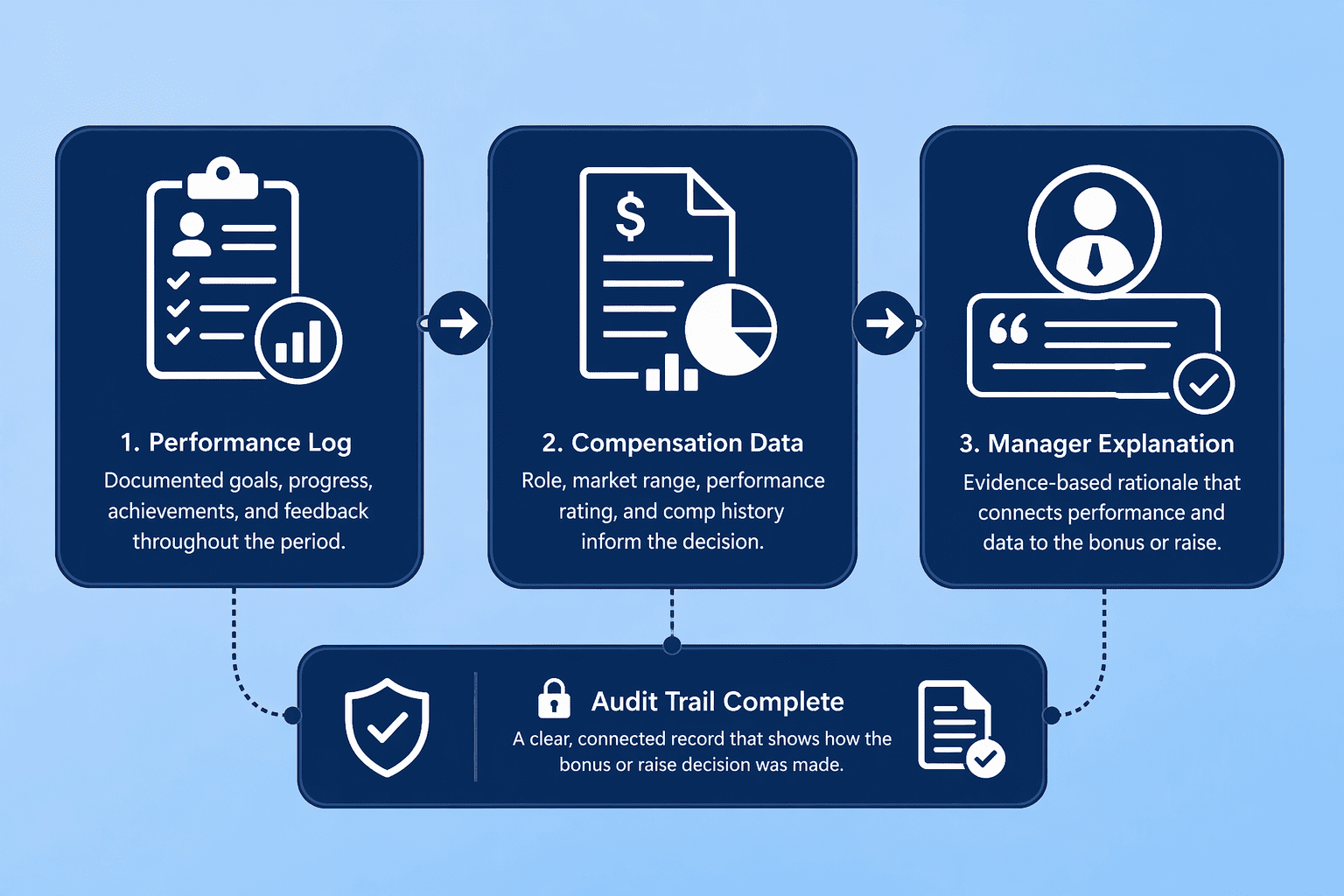
The goal is to defend pay with data so specific that it reduces a subjective feeling of unfairness to an objective disagreement with a performance log. The most powerful retention tool you can give a manager is an "audit trail."
Until you connect the daily performance log to the annual compensation event, you are asking managers to be unjustified judges. A platform that integrates performance and pay allows a manager to say, "Your Q2 sales conversion rate dropped by 12%, which shifted your bonus multiplier," rather than, "The budget was tight." This shift from budgetary constraint to performance causality is what defines an evidence-based conversation. You can use a tool like CompUp to generate these conclusions, stripping out recency bias and replacing it with a forensic timeline of achievement.
The data supports a transparent approach. SHRM data confirms 76% of employees want internal salary ranges disclosed, and 57% are less likely to apply to a role that omits pay details. But structural transparency about pay bands is not enough.
You must layer on personal transparency about performance. Start with the compensation philosophy. Eamonn Stanley, Head of Reward at Typeform, suggests boiling a complex structure down to core principles so employees build an intuitive understanding of how compensation actually works.
In a feedback vacuum, emotion wins. In a tight evidence framework, facts win.
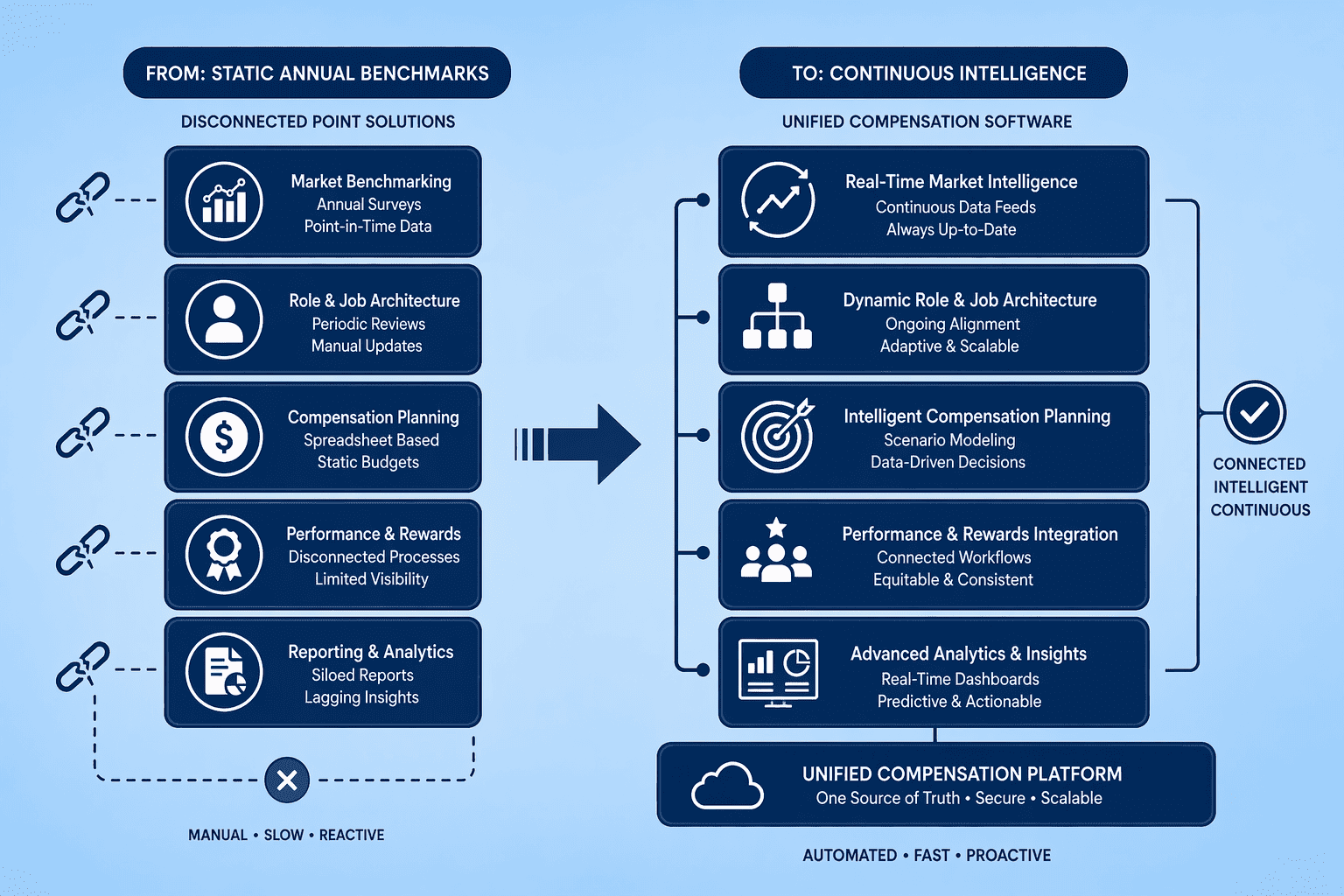
Annual benchmarking reports are rear-view mirrors. They tell you where the market was six months ago. In a labor market where wage growth has outpaced inflation cumulatively by 30% against 27% since 2019, relying on stale survey data leaves you negotiating against a moving target you cannot see. The future of pay satisfaction belongs to continuous intelligence.
Modern compensation management software unifies three historically fragmented pillars: real-time market data streaming, collaborative performance management, and pay planning. This integrated stack gives you the data you need for an evidence-based conversation. By ingesting data from providers that offer real-time industry access, you shift compensation from an annual event to an always-on capability.
This architecture serves a dual purpose. For the employer, it is a strategic cockpit. For firms relying on knowledge workers, failing to align internal pay structures leads to stagnation; research indicates that firms with greater internal pay alignment generate more patents, including breakthrough innovations. You are distributing cash to optimize your innovation flywheel by ensuring the right skills feel valued. For the employee, this integration finally offers a singular, defensible source of truth: "Here is your market value, here is your internal impact score, and here is why they intersect at this letter."
Static data creates doubt. Continuous data makes the psychological link between effort and reward tangible. When your stack refreshes in real-time, the conversation shifts from catching up to calibration.
Underpayment is a proxy for undermanagement of information. When employees revert to the default assumption that they are underpaid, they are telling you that your feedback loop is broken. They cannot see their value reflected in a system, so they assume it does not exist.
The cure is not to benchmark more aggressively. You close the architectural gap that creates recency bias, stop the loyalty tax by aligning internal equity with external movement, and arm every manager with an evidence-based narrative. The 74% who feel fairly paid but remain dissatisfied in Jobstreet's 2026 data are sending a clear signal: they require proof. Invest in the systems that generate that proof. If you're weighing options, CompUp is worth a closer look.
Because pay is a subjective scorecard of personal worth, not just an objective market transaction. Even when salaries are above market, studies show nearly half of employees still believe they are underpaid. Three shortcomings in particular inflate the fixation on the salary number:
Without transparency on how pay decisions are made, employees fill the information vacuum with suspicion. They default to the belief that the system is rigged, making them 45% more likely to leave. In contrast, transparent organizations see a 59% lower turnover rate, proving that openness builds psychological safety.
These factors act as amplifiers. When career progression stalls or specific achievements go unrecognized, employees lose non-monetary markers of success. They hyper-scrutinize base pay as the sole remaining proxy for their value and the company's fairness, making a competitive salary feel insufficient.
Social comparison is the primary driver. The 'loyalty tax' punishes tenure with lower raises compared to job-hoppers, while a new hire earning more instantly breaks the financial trust of a long-term employee. This is often viewed as a moral breach, far outweighing a company's defense of market-rate adjustments.
Employers must shift from announcing budget constraints to presenting performance-based audit trails. A three-part approach dismantles the perception of secrecy and unfairness:
Companies are moving from static annual surveys to platforms offering continuous, real-time benchmarking. A unified compensation stack pairs live industry data with internal performance metrics. This allows leaders to calibrate for real-time market shifts instantly, making the pay rationale objectively verifiable rather than historically retrospective.
Community Manager (Marketing)
As a Community Manager, I’m passionate about fostering collaboration and knowledge sharing among professionals in compensation management and total rewards. I develop engaging content that simplifies complex topics, empowering others to excel and aim to drive collective growth through insight and connection.
Revolutionizing Pay Strategies: Don't Miss Our Latest Blogs on Compensation Benchmarking