

Your quarterly board deck shows headcount aligned with revenue and your open-role pipeline is moving. Then a critical product launch stalls for six weeks because you cannot hire the three cloud architects you budgeted for. A voluntary turnover spike in your mid-level engineering group follows, triggered by a competitor’s transparent pay bands.
Workforce planning is not a headcount spreadsheet you update each quarter. It is the systematic process of balancing labour supply against demand to secure the right number of people with the right skills, in the right place, at the right time, and at the right cost. In 2025, that fifth R, the cost dimension, has been amplified by multi-jurisdiction pay transparency laws, global remote teams, and persistent skills shortages that make reactive hiring prohibitively expensive.
A Gallup survey found 51% of workers are watching for or actively seeking a new job and 59% are not engaged. A labour pool this detached means your five-year demand forecast is guesswork unless you build the planning discipline to stress-test it continuously. This article breaks down the three planning methodologies that matter most in 2025, shows where compensation intelligence fits into each, and gives you a decision framework you can use in your next planning cycle.
Workforce planning has moved from an HR exercise to a business-survival lever, with compensation data now as critical as headcount numbers. Here is what changed:


The organisations that get workforce planning right in 2025 treat three layers as a single stack, not sequential steps:

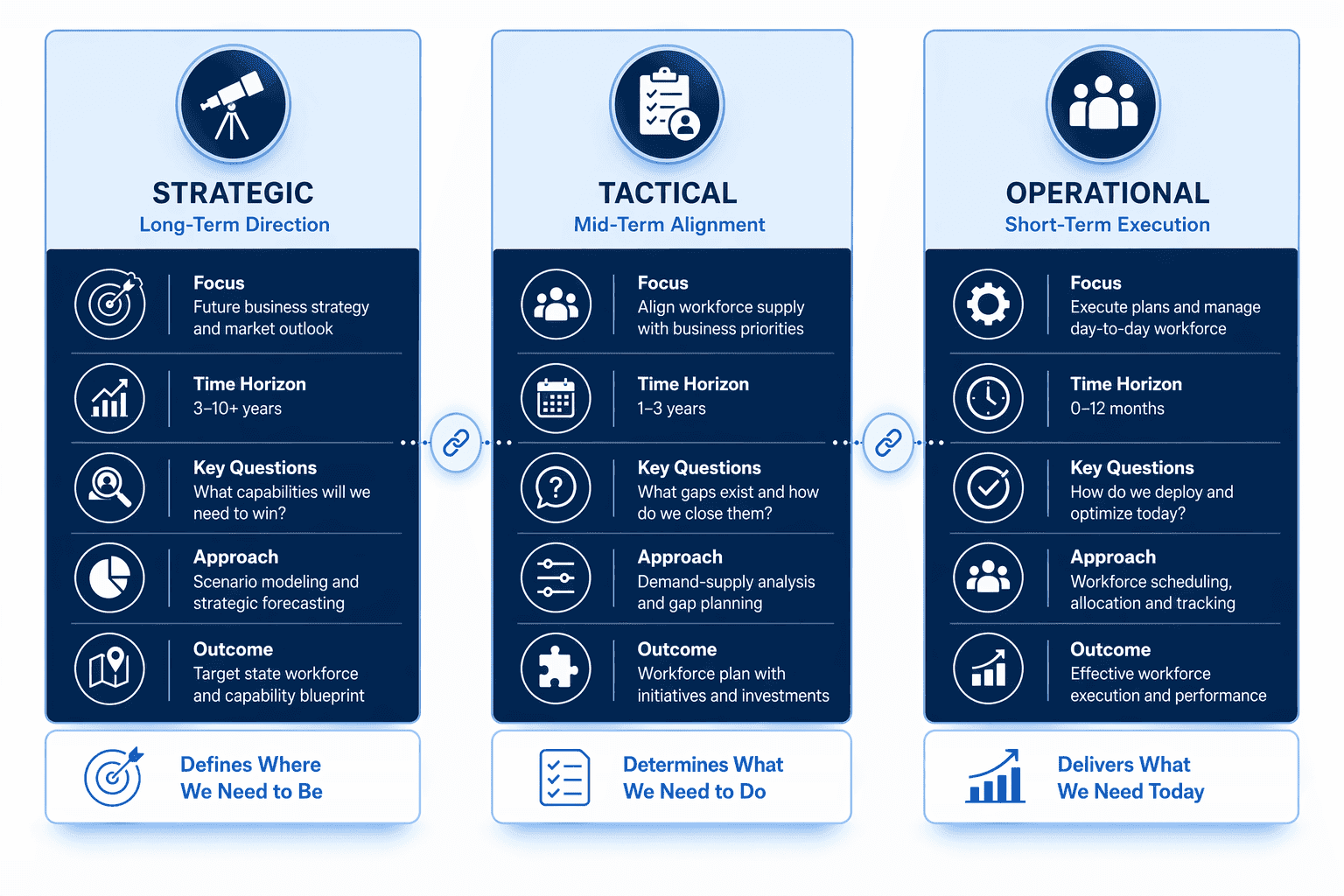
Each planning methodology serves a distinct purpose, runs on a different clock, and demands different tools. Treating them as interchangeable is a fast path to misaligned budgets and talent shortages.
Every organisation needs at least two of these three layers active at once. The table below makes the differences explicit so you can pressure-test whether your current process covers what it needs to cover.


You cannot build a five-year business plan on a spreadsheet of current open requisitions. Strategic workforce planning aligns the workforce with long-term business goals by analyzing supply and demand, identifying gaps, and guiding targeted talent interventions. It operates on a 3- to 5-year time horizon and ties directly to the company's mission, vision, and revenue objectives. This is not an annual HR headcount report; it is a scenario-planning capability that asks what skills the business needs to compete in a future shaped by AI, regulatory change, and new service models. The standard process follows six structured steps: Strategic Direction, Supply Analysis, Demand Analysis, Gap Analysis, Solution Implementation, and Monitoring Progress.
At that horizon, the exercise shifts from counting people to modelling capability. A retail bank planning its 2028 workforce, for example, is not forecasting teller headcount; it is modelling the migration from branch-based generalists to platform engineers, compliance analysts, and hybrid advisory roles. Scenario modelling lets you pressure-test different futures, say, one where a new labour code reclassifies a portion of your contractor base as employees, materially changing your on-cost projections.
Tools like HR analytics platforms, total compensation analysis, and contingency planning convert these scenarios into quantified gaps. The output is not a single headcount number.
It is a priced capability map that identifies which talent pools you must build, buy, borrow, or automate across multiple budget cycles. Without this map, your three-year transformation program is a wish list with a staffing bottleneck you will discover only when it is too late.
Operational workforce planning governs the next twelve months. It is a short-range staffing discipline built on supply analysis and shift-level scheduling that matches labour to daily demand patterns. Strategic planning asks what cloud architects the firm needs in 2028; operational planning answers the question that hits the P&L this week: how many licensed nurses are on the floor during a Tuesday night shift.
Workforce planning can reduce labour costs in favour of deployment and flexibility by cutting premium overtime, agency-spend spikes, and the service failures that turn into lost revenue. It also contributes to improved employee retention and work-life balance because predictable, well-designed shifts reduce burnout and last-minute schedule changes, two of the fastest drivers of frontline turnover. This layer is a direct profit-protection lever.
Operational planning is the engine that converts the strategic roadmap into weekly payroll. A logistics company with a five-year plan to roll out autonomous-vehicle technicians still needs to move packages tonight. If a sorter-shift gap forces overtime at 1.7 times base every weekend for a quarter, the labour variance consumes the budget line meant to fund the first wave of upskilling.
Operational rigour protects the strategic fund. Mature planning functions do not treat this layer as a junior scheduling task. They run it with the same analytics discipline they apply to a five-year demand forecast, scrutinising shift-level productivity data and churn-rate triggers to tighten deployment before the P&L turns red.
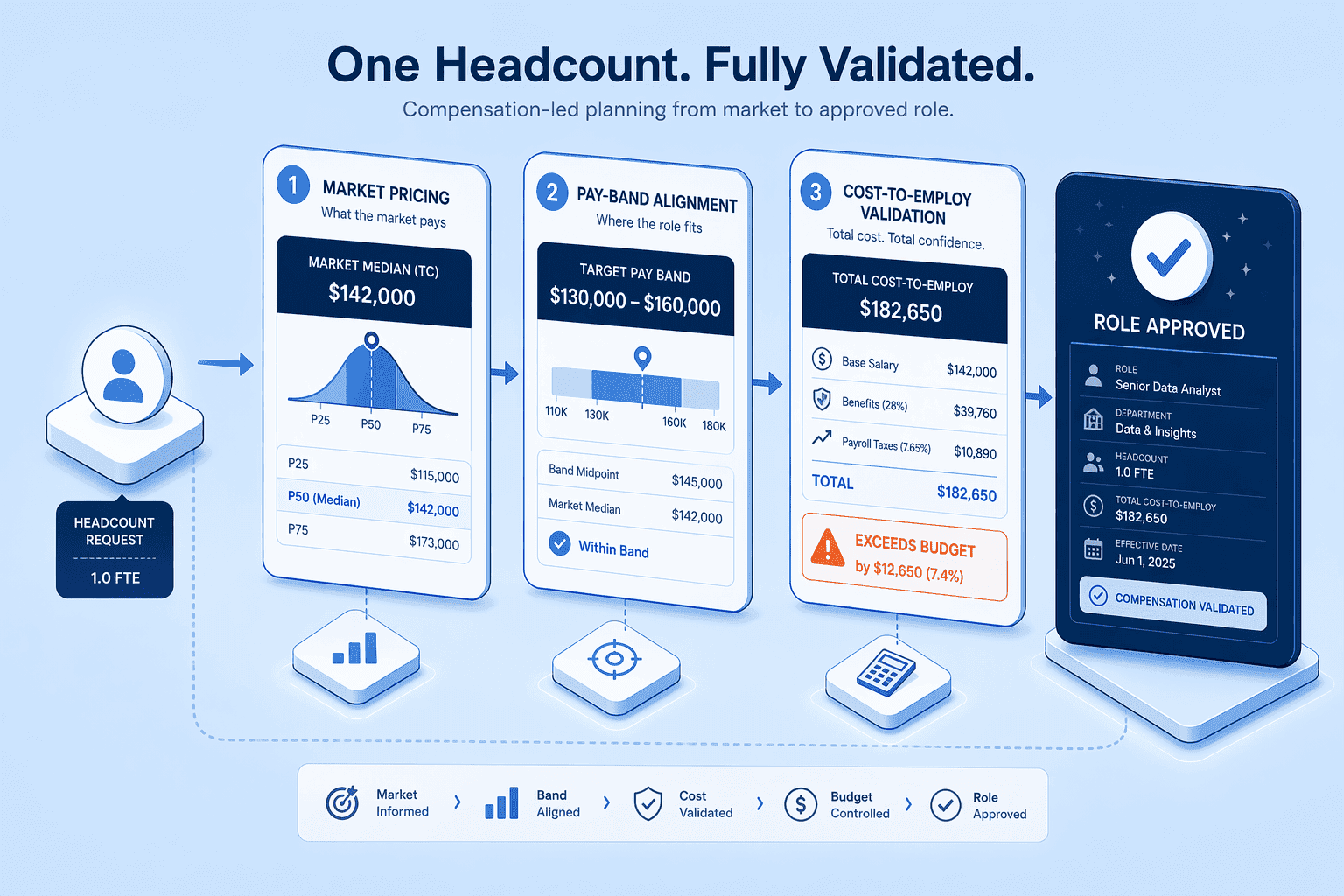
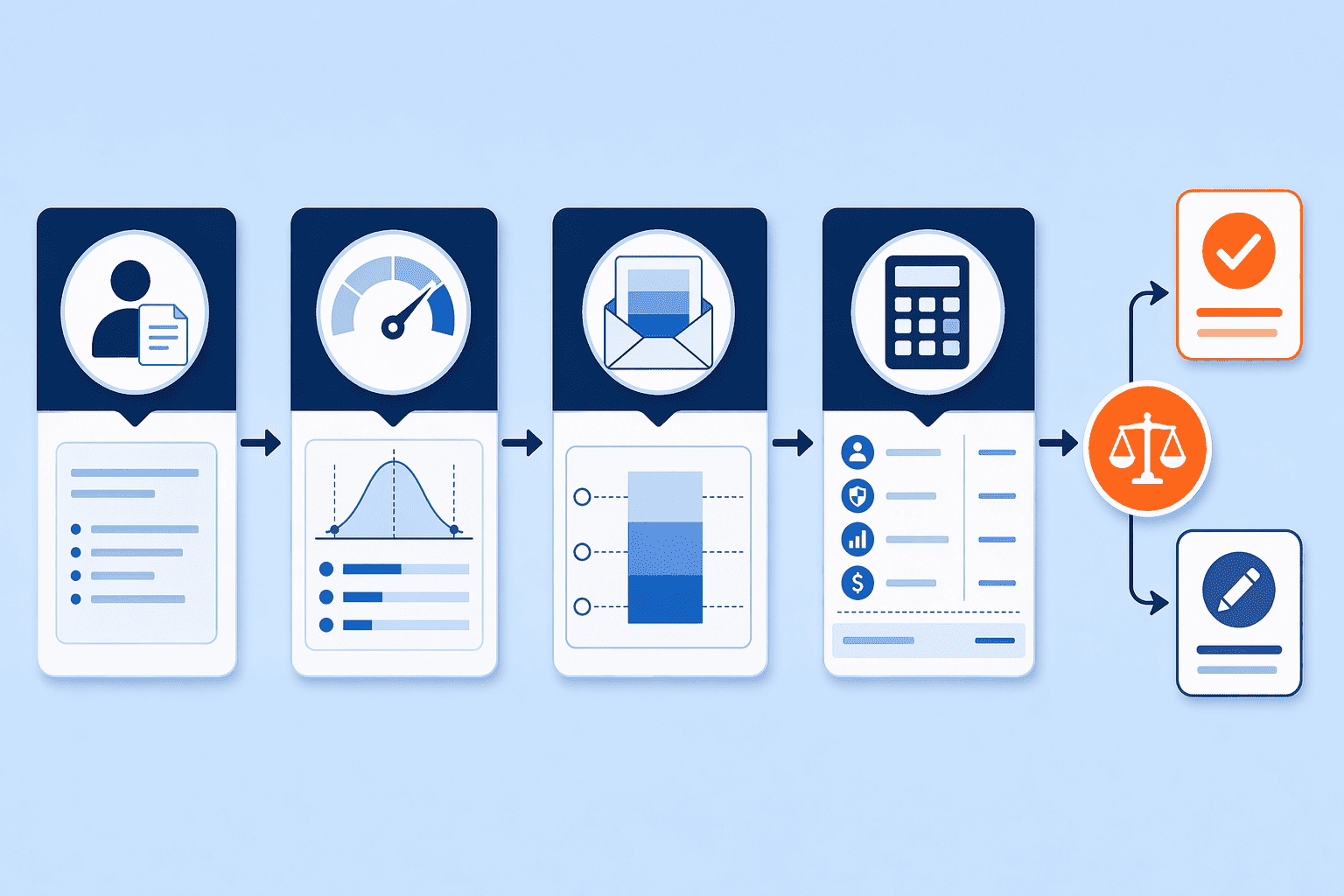
Compensation-led planning stops you from approving a role, posting it, interviewing candidates, and only then discovering the salary would blow your budget or sit wildly off-market. That sequence is backwards. Instead, you price the role at the point of planning, against live market data, your own pay bands, and the full cost to employ someone in that location.
The shift means moving pay strategy out of a once-a-year HR cycle and into every headcount conversation. When a manager asks to open a requisition, the system already knows what that person should cost. You are not guessing; you are pulling actual compensation intelligence.
The table below maps the difference across the dimensions that matter inside a planning workflow, with an integrated compensation layer in the mix.
| Dimension | Traditional Headcount Planning | Compensation-Led Planning |
|---|---|---|
| Market alignment | Generic salary surveys updated annually | Real-time compensation benchmarking and salary bands refreshed against current offers |
| Equity coverage | Post-hire audit, often reactive | Pay equity analysis built into requisition approval, flagging gaps before offers go out |
| Global costing | Single-currency estimates with manual on-cost | Multi-currency model with statutory employer contributions loaded per jurisdiction |
| Employee communication | Manager-delivered, inconsistent | Total rewards statements automatically generated at the close of each appraisal cycle |
| Systems integration | Spreadsheet-to-HRIS rekeying | API-layer integration with existing HR platforms including Bamboo HR, Lattice, and Culture Amp |
Pay transparency laws are forcing this approach. The EU Pay Transparency Directive, and similar rules rolling out in several US states, make it harder to post a salary range you cannot defend later. Your planning cycle has to forecast cost to a defensible band from the start. CompUp pulls live compensation benchmarks and overlays pay equity analytics directly onto your proposed headcount slate. Variable payouts, total rewards statements, and the analytics layer then carry that priced plan all the way through to execution and employee communication, so the cost dimension is baked in from day one.
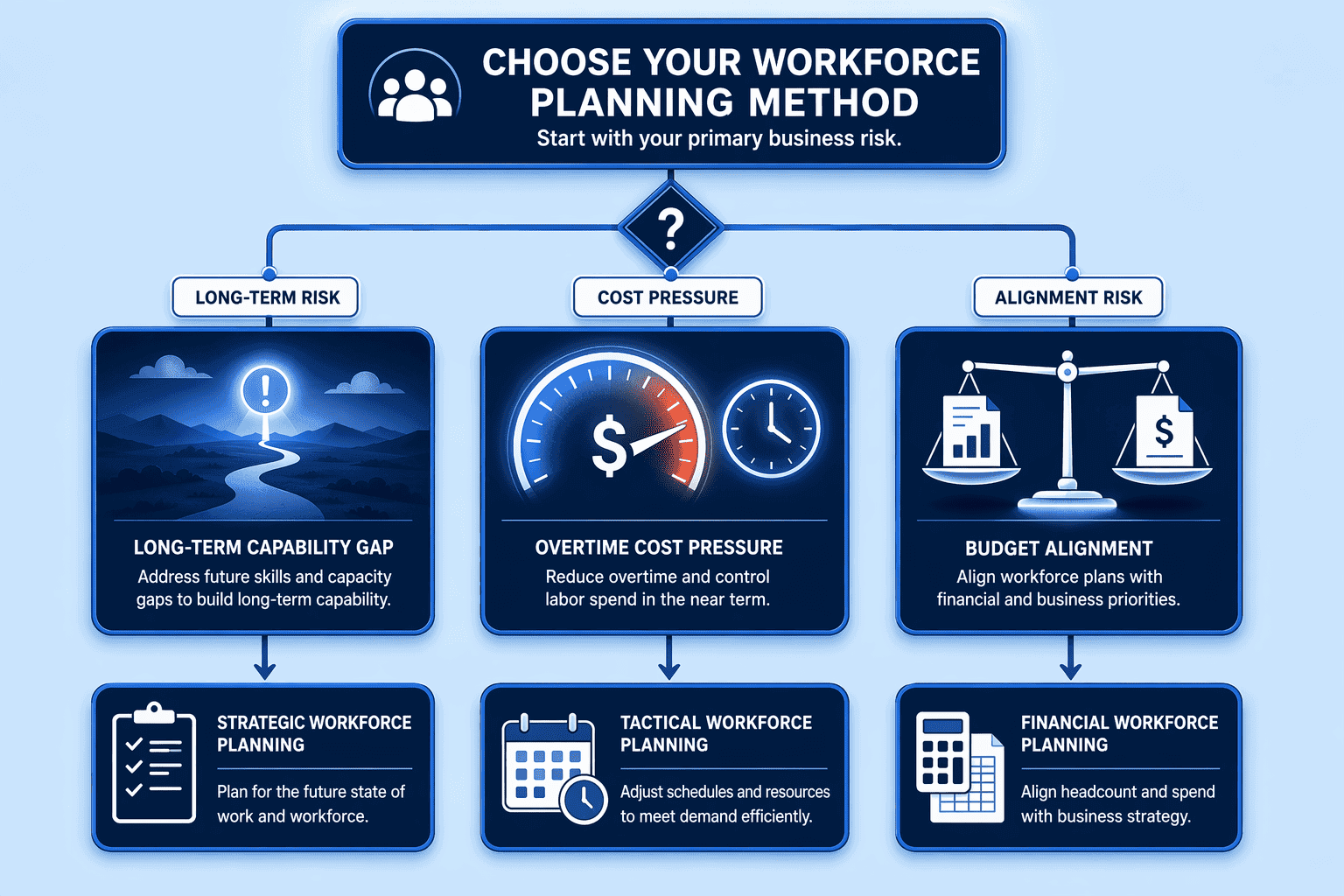
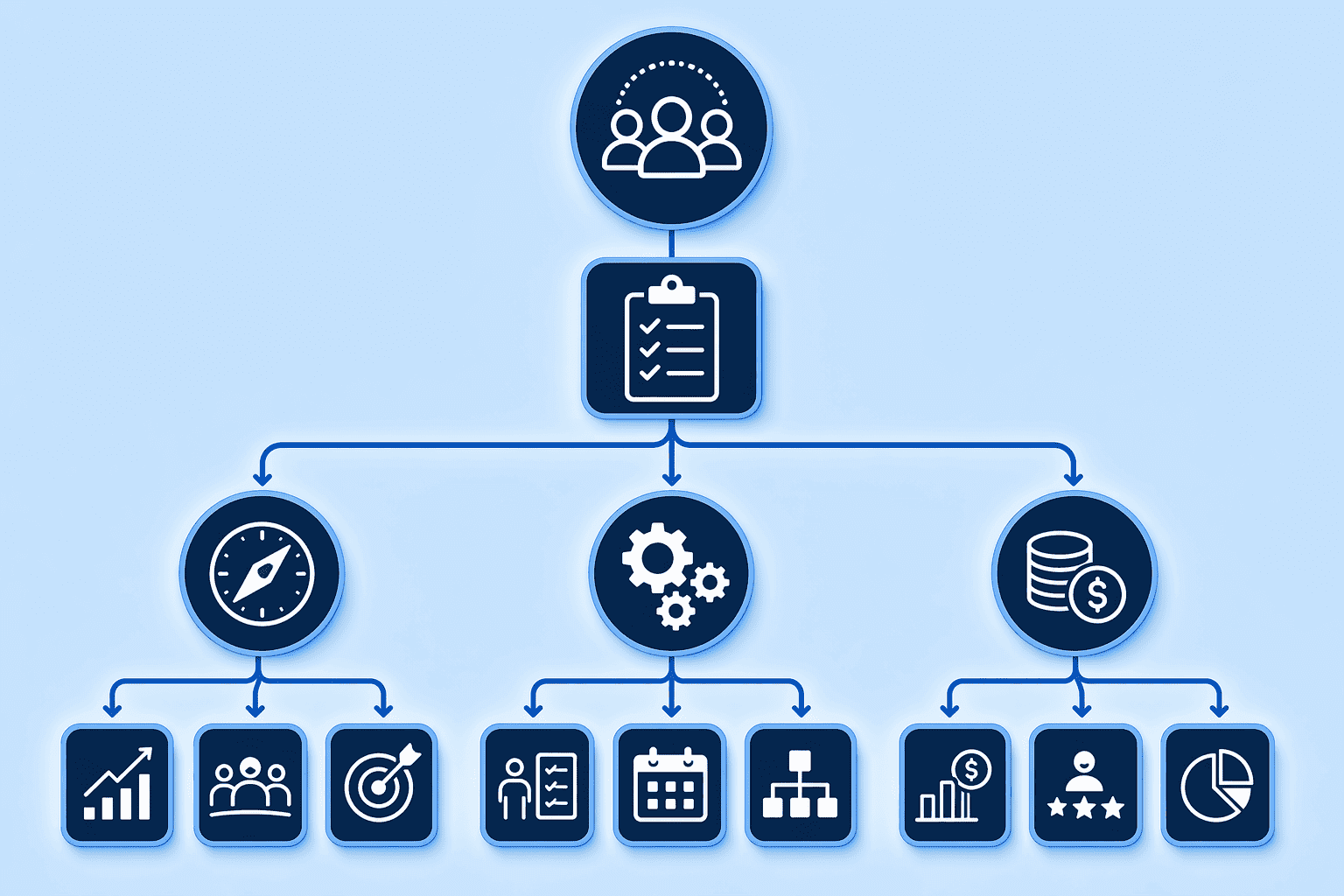
The choice is not binary, but sequence matters. Pick your dominant planning mode based on your most urgent business problem, then layer the others underneath it. Here is a practical decision sequence to follow:
The classic workforce planning formula, right people, right skills, right place, right time, right cost, has been quietly rewritten by the market. The silent sixth R, Right Cost, is no longer an output of the plan; it is the input that makes the other five achievable. Organisations that continue to treat compensation data as a lagging indicator will keep losing critical hires to competitors who price roles with the same precision they use to model demand.
Blending a strategic multi-year horizon with operational same-quarter rigor, and overlaying real-time compensation intelligence across both, is the planning posture that navigates a 2025 labour market where half your workforce is already looking for its next role. CompUp exists to make that compensation overlay operational, bringing benchmarking, pay equity, and total rewards into the planning workflow so your headcount plan lands as a funded, equitable, and communicable action plan, not a wish list. Book a free demo to see how CompUp puts this into practice in your own planning cycle.
Workforce planning is the process of balancing labour supply against demand to ensure an organisation has the right number of people with the right skills, in the right place, at the right time, and at the right cost. It is critical because it directly ties people strategy to shifting business goals, reduces labour costs, and builds the talent pipeline needed to execute long-term transformation instead of just filling vacancies as they appear.
A structured workforce planning cycle follows six foundational steps: defining Strategic Direction, analyzing current workforce Supply, forecasting future Demand, conducting a Gap Analysis between the two, designing and implementing targeted talent Solutions, and then Monitoring Progress with regular data reviews. Each step feeds the next in a loop that tightens with every planning cycle.
Modern HR analytics platforms move beyond static headcount dashboards to deliver prescriptive gap and risk analysis, scenario modelling, and total-compensation projections. When integrated with a compensation layer like CompUp, the technology overlays real-time salary benchmarks and pay equity audits onto headcount plans, turning a staffing number into a priced, defensible workforce investment that the CFO can fund immediately.
Strategic workforce planning operates on a 3- to 5-year horizon and models long-term capability gaps tied to business transformation goals. Operational workforce planning governs the immediate 12 months and focuses on precise shift and resource deployment to meet daily demand. Strategic planning answers 'what skills do we need to compete in 2028?'; operational planning answers 'who covers the Tuesday night shift?'.
Pay transparency mandates are compressing compensation into the earliest stage of planning, making pay equity and benchmarked bands non-negotiable inputs rather than post-hire audits. New labour codes that redefine wages and reclassify contractor relationships add structural on-cost calculations to every headcount model. Global teams add multi-currency, multi-jurisdiction complexity that makes traditional single-country spreadsheets obsolete and drives the need for an integrated compensation-led planning layer.
Community Manager (Marketing)
As a Community Manager, I’m passionate about fostering collaboration and knowledge sharing among professionals in compensation management and total rewards. I develop engaging content that simplifies complex topics, empowering others to excel and aim to drive collective growth through insight and connection.
Revolutionizing Pay Strategies: Don't Miss Our Latest Blogs on Compensation Benchmarking