
Your last headcount plan was obsolete the moment you finished it. While HR teams still cycle through annual budgeting rituals, the floor underneath them has shifted. Work is not just being automated; it is being atomized.
Individual tasks, not entire jobs, are being carved up and redistributed between people and machines. The central risk in 2026 is not a talent shortage. It is a "design gap" that leaves organizations with expensive humans doing work AI should handle, and burning out judgment on tasks that should be automated.
The static planning models that built the modern HR function cannot close this gap. OPM frameworks emphasize that effective planning requires a systematic process for identifying the human capital needed to meet organizational goals, but they were built for an era of stable job architectures. Recent Gartner research confirms that just 15% of organizations today engage in ongoing workforce strategic planning. The result is a reactive scramble where disconnected hiring sprees chase yesterday's skill taxonomies.
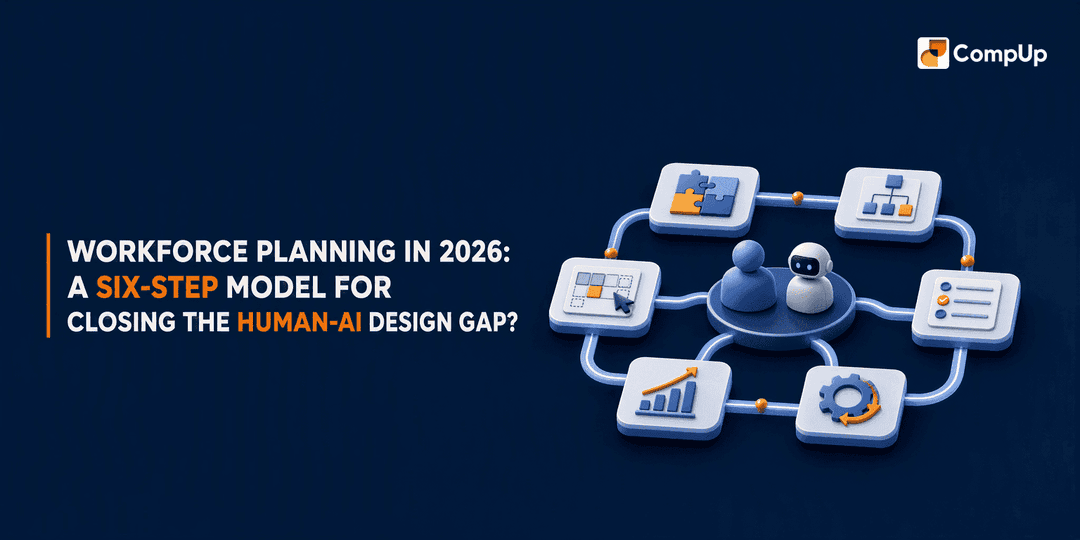
This is not an incremental update to your process. It is a structural pivot from filling headcount boxes to designing human-AI work systems. The following six-step model draws from federal planning frameworks, local government reinvention strategies outlined by ICMA, and Gartner's work decomposition methodologies. It gives you a practical, sequenced approach to build an organization that continuously reallocates tasks, not just people.
Workforce planning must shift from a headcount-filling exercise into a dynamic design function that determines how human judgment, analytical skill, and AI execute the mission together. The following points frame the operational argument for a complete reset in 2026.
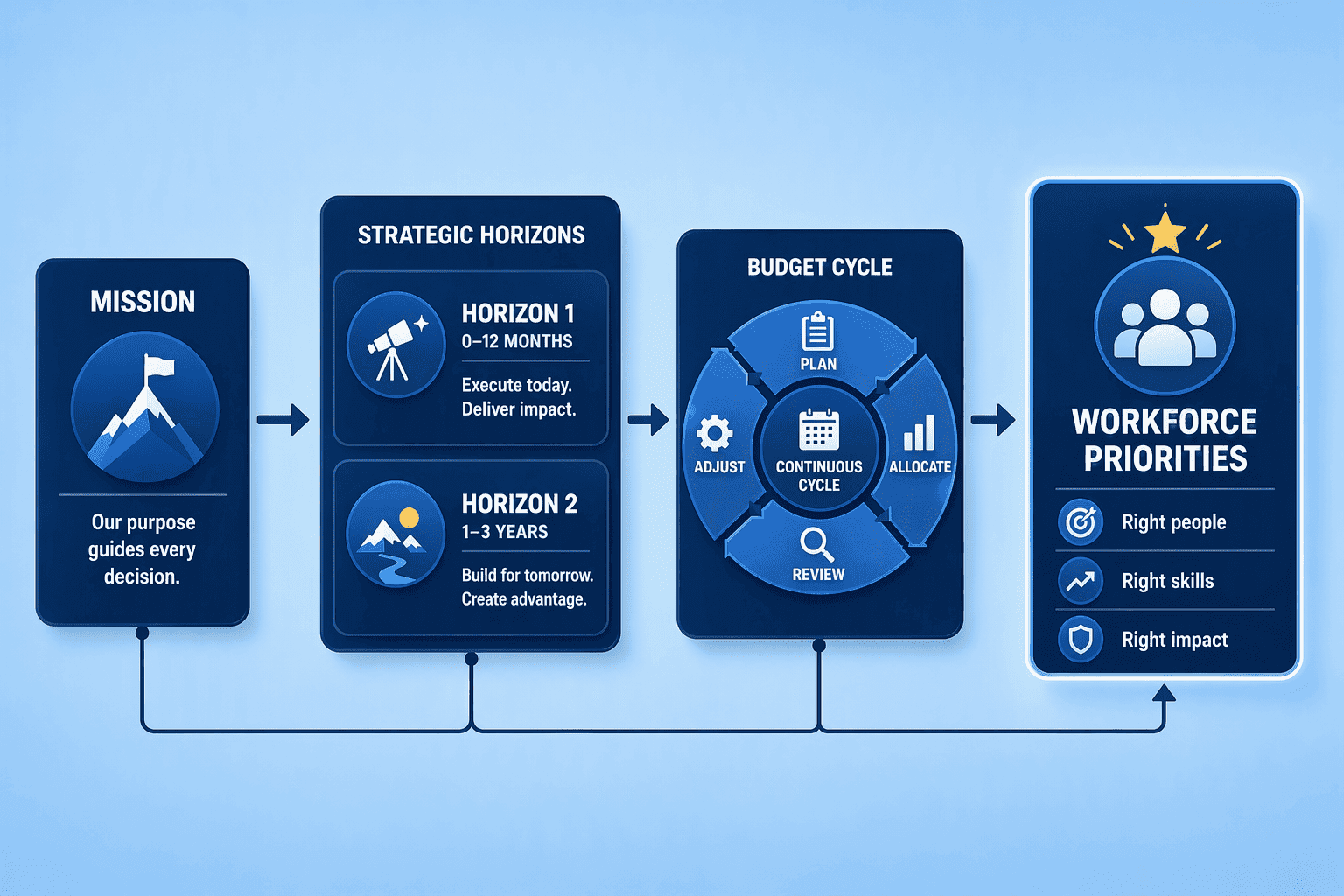
Most workforce plans fail because they start with the org chart. They tally current roles, forecast attrition, and produce a hiring schedule that locks in today’s structure for another three years. The problem is simple: your mission is not your org chart.
The OPM workforce planning framework treats this as a non-negotiable. Workforce planning should be aligned with the organization’s strategic plan and budget cycle, not bolted on as an annual HR exercise. That alignment is the difference between staffing a function that serves a five-year goal and staffing one that nobody will need by the time the hires complete probation.
Pick a concrete, time-bound strategic outcome. ICMA’s work on local government transformation asks leaders to map capabilities to the services a community will require in five years, not the vacancies of this quarter. If your horizon is decarbonization, you do not start by counting environmental compliance officers.
You design a work system that pairs regulatory AI, sensor data streams, and the human skills of community negotiation. The deliverable here is a capability blueprint, not a headcount request. Who builds that blueprint matters.
The OPM guidance is blunt: effective workforce planning requires senior leadership, managers, and HR professionals in the room together. Hand the strategy to HR alone and you get a disconnected cost-center spreadsheet. Embed it with operations leaders and you get a hard conversation about which work actually advances the mission, and which legacy tasks get dropped because they serve a horizon that already passed.
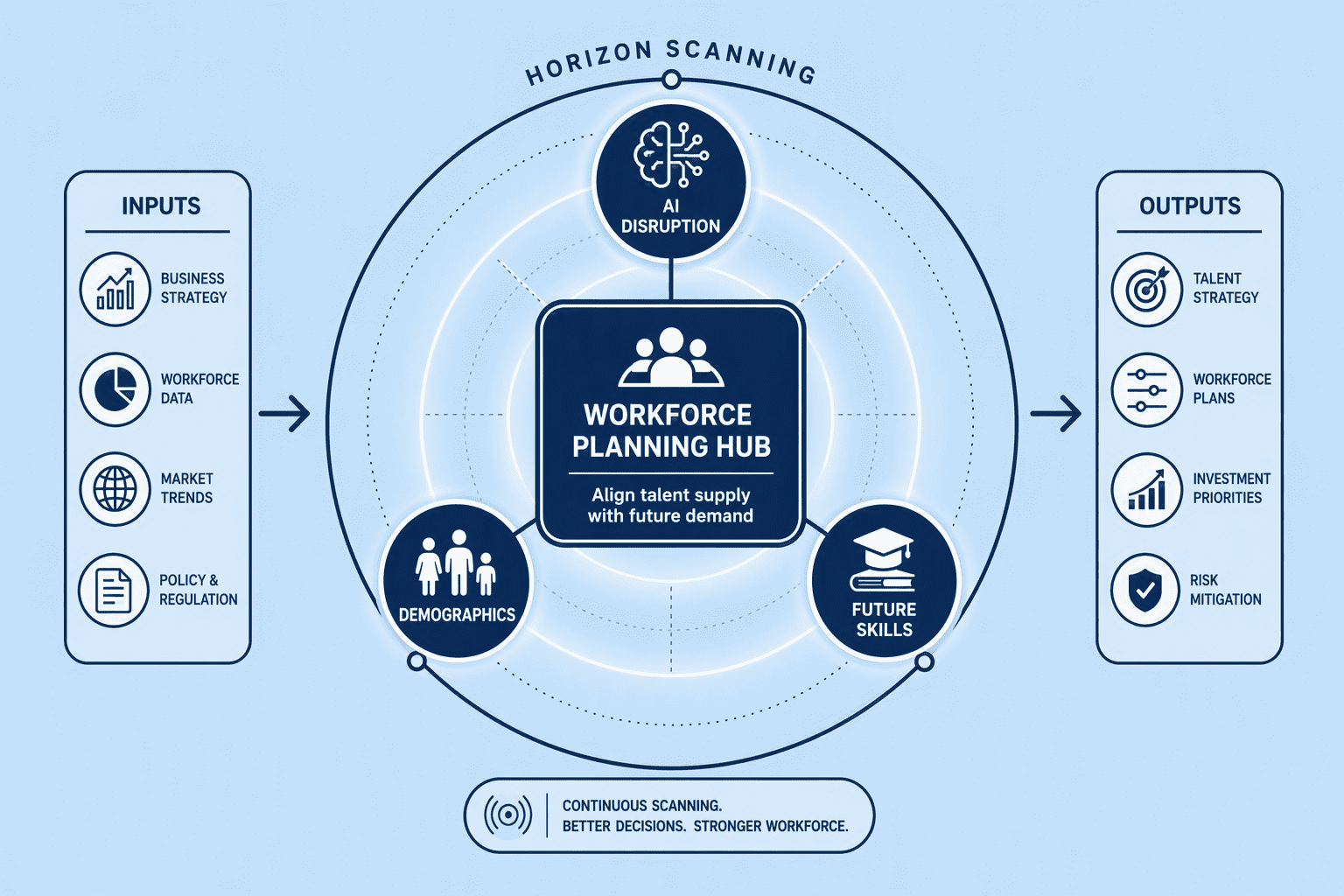
A mission-driven plan without an external radar is a plan that will be ambushed. Horizon scanning now requires a rigorous, structured process for tracking AI disruption, demographic pressure, and shifting skill half-lives. Workday's research underscores a blind spot here: just 54% of leaders say they have a clear view of the skills currently within their organization. If you cannot see the skills you have now, you certainly cannot see the ones disappearing or emerging.
The CIPD model puts understanding the operating environment as the first main stage. You move this from a periodic survey into a continuous function using predictive analytics tied directly to your supply chain. For instance, the MIT strategic planning model optimizes for recruitment and promotions by balancing the risks of not meeting headcount, budget, and productivity constraints, while keeping within a prescribed organizational structure.
Bring specific demographic and technological signals into the decision room. You should be tracking the adoption rate of generative AI in your sector and modeling when specific analytical roles hit a negative productivity return because the AI's accuracy surpasses a junior analyst. The MIT model further indicates that there are increased workforce risks faced by organizations that are not in a state of growth or organizations that face limitations to organizational renewal (such as bureaucracies). This is your signal to accelerate renewal cycles, not freeze them. A static bureaucracy facing AI acceleration is a workforce risk, not a stable baseline.
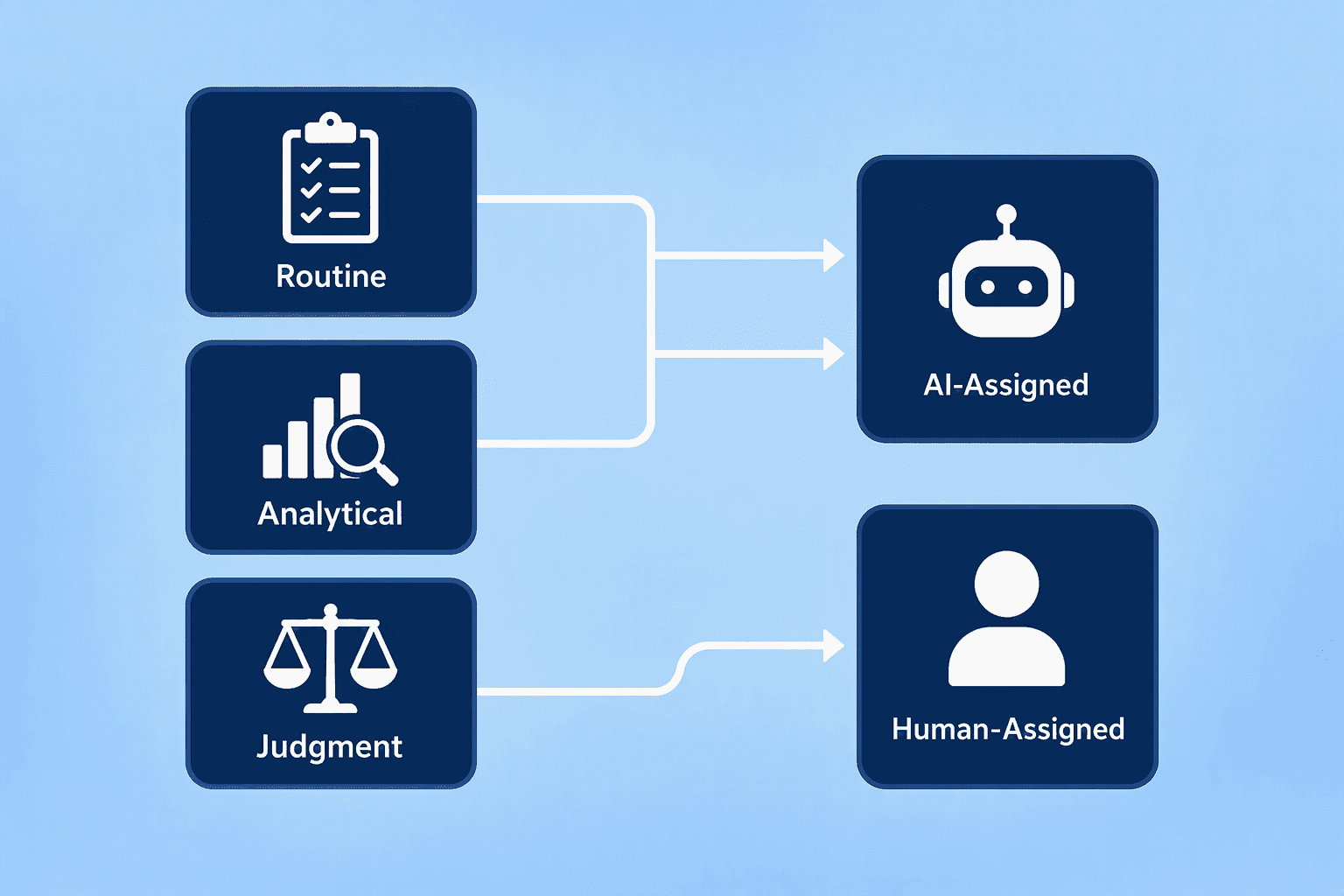
This deconstruction eliminates the design gap by assigning the right type of intelligence to the right work.
With the future work architecture defined in components, you must model the flow of talent against it. The CIPD defines workforce planning as the process of balancing labour supply (skills) against the demand (numbers needed), but the 2026 reality demands a dynamic, not a static, equilibrium.
The OSTI research describes a complete workforce system built on six elements: recruitment, attrition, promotion, training, retention, and scheduling. A dynamic model uses these levers under multiple scenario conditions, not a single baseline forecast. You model your internal supply of judgment talent against attrition risks.
You map external hiring pipelines for rapidly emerging AI oversight skills. Crucially, you identify where promotion channels have calcified, creating a blockage that will break under scenario stress. This transforms your analysis from a headcount spreadsheet into a risk instrument that prompts preemptive moves, such as adjusting a compensation lever or activating a contingent workforce pool, months before a talent bottleneck kills a strategic initiative.
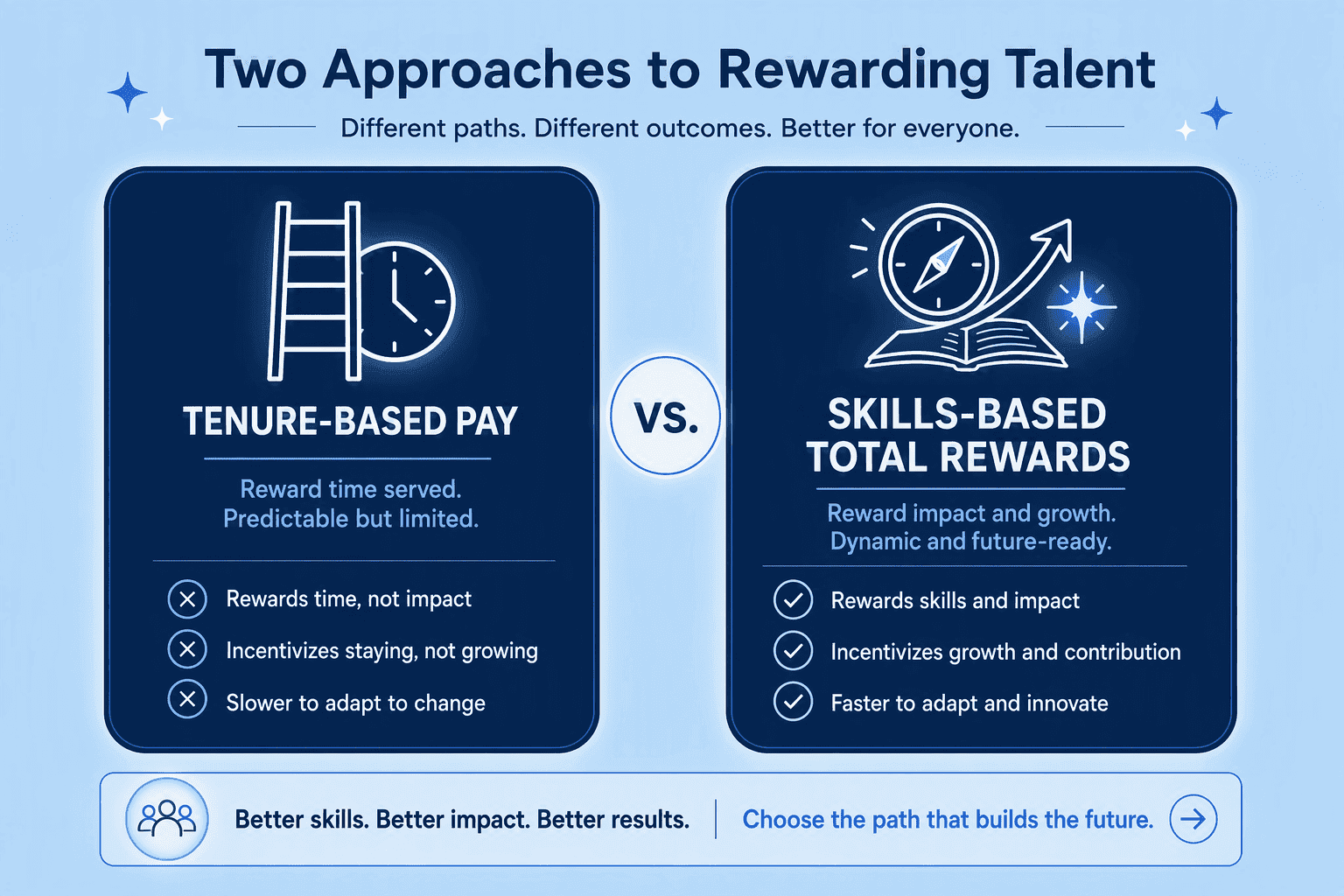
Most organizations treat compensation as a lagging consequence of workforce planning. That is an operational error. Compensation is the primary economic signal your workforce reads to understand what you value.
In a human-AI work system, you should urgently move away from tenure and job-title-based pay. The signal you need to send is that judgment, adaptability, and continuous learning are the premium skills.
A pure skills-based total rewards strategy is your primary retention tool for the human-centric capabilities you just isolated in Step 3. When you deconstruct a job and strip away the routine tasks that AI now handles, the remaining human role often looks smaller on a task list. If you do not explicitly reprice that condensed judgment work higher, your best people will perceive the redesign as a demotion and leave.
Platforms that automate advanced compensation logic are no longer a luxury. Tools that can provide data-driven salary benchmarking, model pay equity, and manage skills-based pay bands let you execute complex reward structures at scale.
CompUp, for instance, offers a suite of tools for compensation planning, pay equity analysis, and total rewards communication that can directly support this shift from role-based to skill-based compensation structures. Without this data layer, you will revert to paying for titles while the work itself has fundamentally changed.
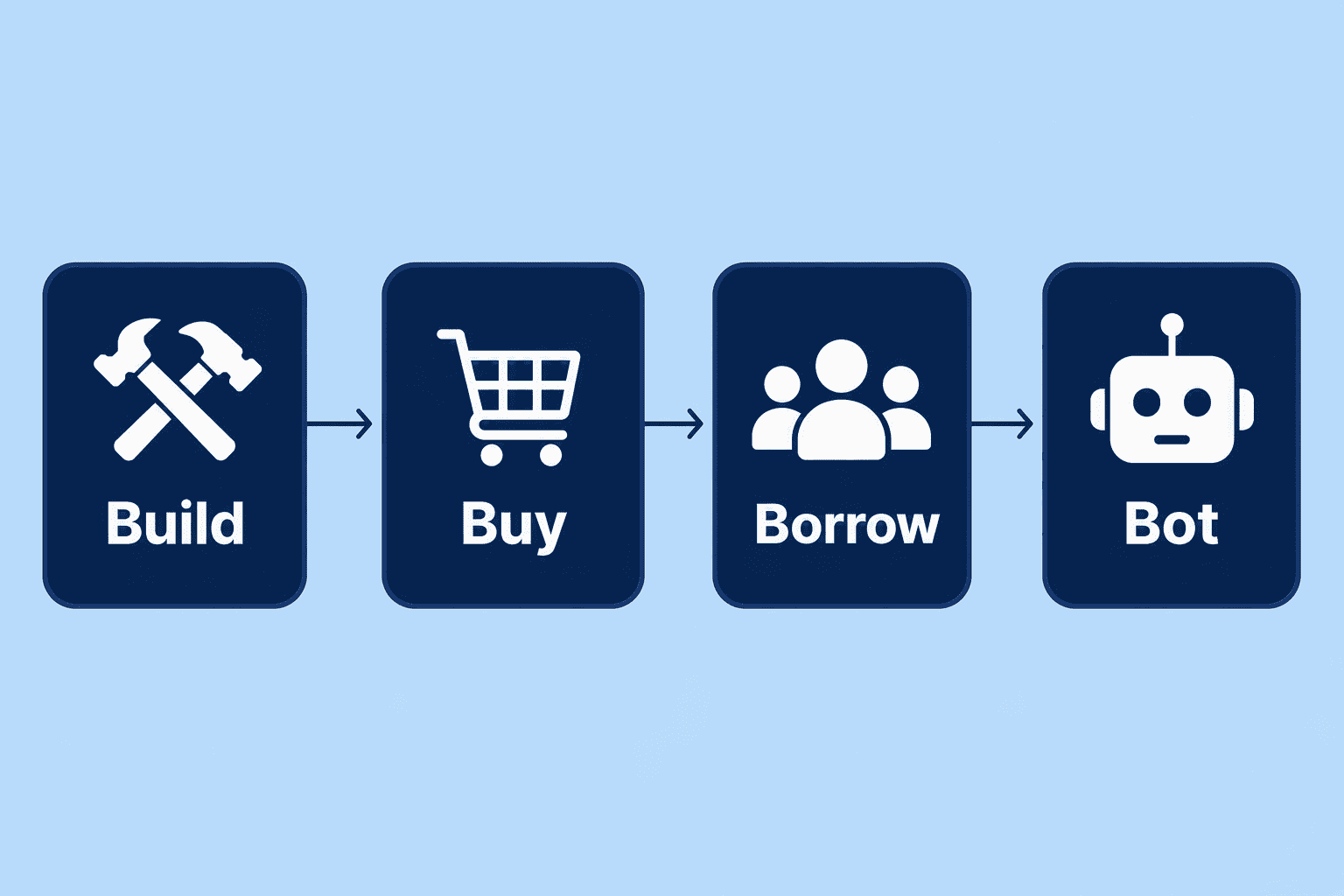
The final step converts analysis into a phased action plan. You close the gap between your current state and the target human-AI work architecture using a blend of four strategies: build, buy, borrow, and bot. Each carries its own change management demands.
| Gap-Closure Lever | Build (Reskill) | Buy (Hire) | Borrow (Contingent/Loan) | Bot (Automate) |
|---|---|---|---|---|
| Best Use Case | Deepening judgment, AI oversight, and complex stakeholder negotiation skills in existing employees. | Acquiring rare, emerging skills that do not currently exist internally (e.g., specific AI model trainers). | Accessing surge capacity for analytical work during a transition, or borrowing cross-agency talent. | Eliminating high-volume, rule-based tasks identified during work deconstruction. |
| Primary Implementation Action | Launch targeted L&D modules mapped to the new judgment-heavy roles created in Step 3. | Execute a precision recruitment campaign for identified skill gaps, using predictive analytics for pipeline mapping. | Activate approved vendor lists for managed services and explore inter-organizational talent exchange agreements. | Deploy prioritized automation sprints with IT, sequenced by the routine tasks that carry the highest labor cost. |
| Key Risk Factor | Reskilling fails if employees perceive the effort leads to a smaller role without the compensation shift from Step 5. | New hires in a dual system clash with legacy culture; they must be integrated via the new work design, not old job descriptions. | Over-reliance on contingent staff erodes institutional knowledge and complicates the promotion pipeline model. | Bot deployment stalls if you fail to decommission the legacy process the AI replaces, leading to double-running costs. |
| Change Management Requirement | Employees require a clear future-state role card and a timeline. No ambiguity on the end state. | Onboarding must explicitly state the human-AI division of labor from day one. | Contracts must define data ownership and end a project cleanly to feed back into build strategies. | Managers must be retrained to audit bot outputs, not to perform the original task. |
Filling seats does not work anymore. Workforce planning in 2026 means actively designing how human judgment and AI combine to get a job done, every day, not once a year.
Companies that treat this as a static spreadsheet exercise end up in two traps. They pay top dollar for people doing work a bot could handle, and they lose their most adaptable people to competitors who actually gave them harder problems to solve.
The six-step model gives you a system where the work itself is built intentionally, not just the headcount chart that sits next to it. If you're weighing options, CompUp is worth a closer look. Book a free demo today.
The modern 2026 workforce planning model adds a critical, validated set of core stages:
Beyond headcount and attrition, you need a skills taxonomy that tracks proficiency decay, dynamic supply forecasts, and demand projections tied to strategic scenarios, not just annual budgets. The OPM framework pushes for a direct analysis between current workforce capabilities and future mission needs, while MIT's model demands risk-balanced recruitment and promotion metrics.
Operational headcount planning and strategic workforce planning differ fundamentally in three ways:
Organizations face three key challenges when implementing strategic workforce planning:
Alignment requires shifting from paying for job tenure to paying for the judgment and adaptive skills that remain after routine tasks are automated. A tool like CompUp enables this by combining pay equity analysis with compensation planning, letting you model skills-based pay structures and identify biases in real time as work is redesigned.
Three dominant trends are reshaping strategic workforce planning in 2026:
Community Manager (Marketing)
As a Community Manager, I’m passionate about fostering collaboration and knowledge sharing among professionals in compensation management and total rewards. I develop engaging content that simplifies complex topics, empowering others to excel and aim to drive collective growth through insight and connection.
Revolutionizing Pay Strategies: Don't Miss Our Latest Blogs on Compensation Benchmarking