Your quarterly review reveals a painful truth. The marketing analytics hire you approved six months ago is still vacant, while the engineering team you staffed for a legacy product suddenly looks oversized. Both problems drain cash. Both started as spreadsheet requests.
Workforce planning is the systematic process for identifying and addressing the gaps between the workforce of today and the human capital needs of tomorrow, as defined by the U.S. Office of Personnel Management.
That definition separates it from headcount planning, which counts bodies and costs against a fixed forecast. Workforce planning aligns workforce requirements directly to your agency's strategic and annual business plans. It forces you to ask whether you have the skills and structure to deliver on next year's objectives.
The practice itself is evolving fast. Technology is moving the discipline from an annual, static exercise toward a continuous, data-driven rhythm. Tools from IBM now inject predictive analytics and scenario modeling into a space that was dominated by manual audits. This guide walks through the structured framework that leading organizations use, so you can stop reacting to talent shortages and start building the workforce your strategy demands.
Strategic workforce planning links every talent investment directly to your multi-year business objectives, treating skill requirements as rigorously as financials.
Do not open a spreadsheet. Start with the strategic plan.
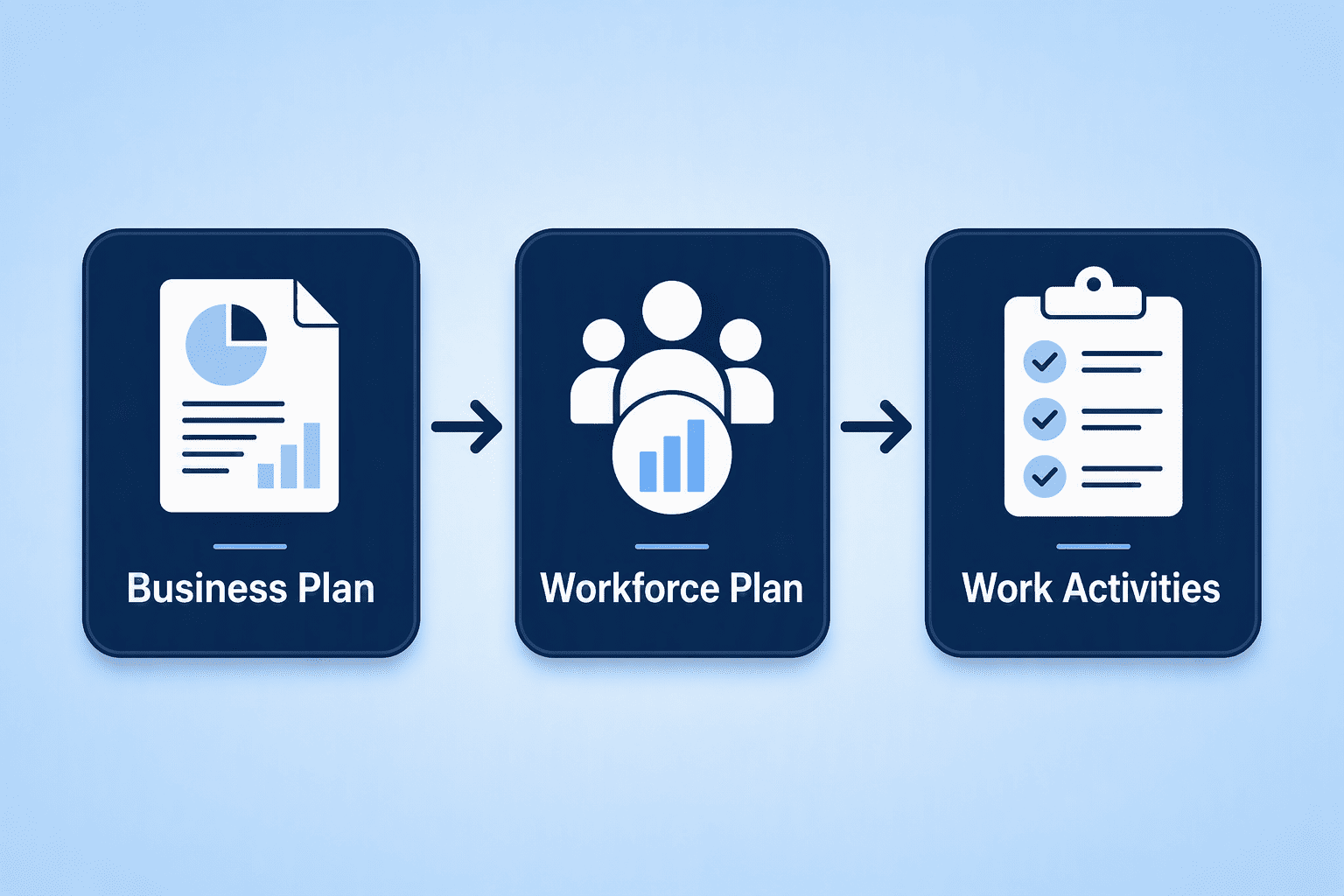
The most common failure in workforce planning is beginning with a headcount request. The U.S. Office of Personnel Management (OPM) mandates that Step 1 involves linking the workforce planning process with the agency's strategic plan, annual performance/business plan, and work activities required to carry out the goals and objectives of the strategic plan. Pull out your multi-year strategy, your annual performance goals, and the core competencies required to execute on them. If the goal is launching a new digital product line in 18 months, the question is "what product design and cloud architecture skills do we lack today?"
You need concrete inputs. Gather the organization's long-term strategic direction, the annual performance targets, and a list of the work activities that drive outcomes. The Department of Commerce's Strategic Workforce Planning Guide recommends establishing a strong planning foundation by validating mission objectives, assessing the current workforce, and identifying internal and external workforce conditions.
This is also the moment to scan the horizon. Shifts in population, technology, the economy, worker characteristics, and public perception have created difficult challenges in attracting, retaining, and developing a competent workforce. Document at least 3 risks that will shape your talent availability over the plan's horizon, whether that is automation, remote work competition, or changing credential requirements.
What this means for your planning team is a fundamental shift in the inputs they control. Instead of asking line managers "how many people do you need next year," you ask "what work must be accomplished to meet the mission, and what skills does that work require."
A workforce plan built on strategic direction prevents the costly mistake of hiring for today's structure while the business is already reorganizing for a different future. Once that strategic anchor is set, you can proceed to the hard numbers with confidence.
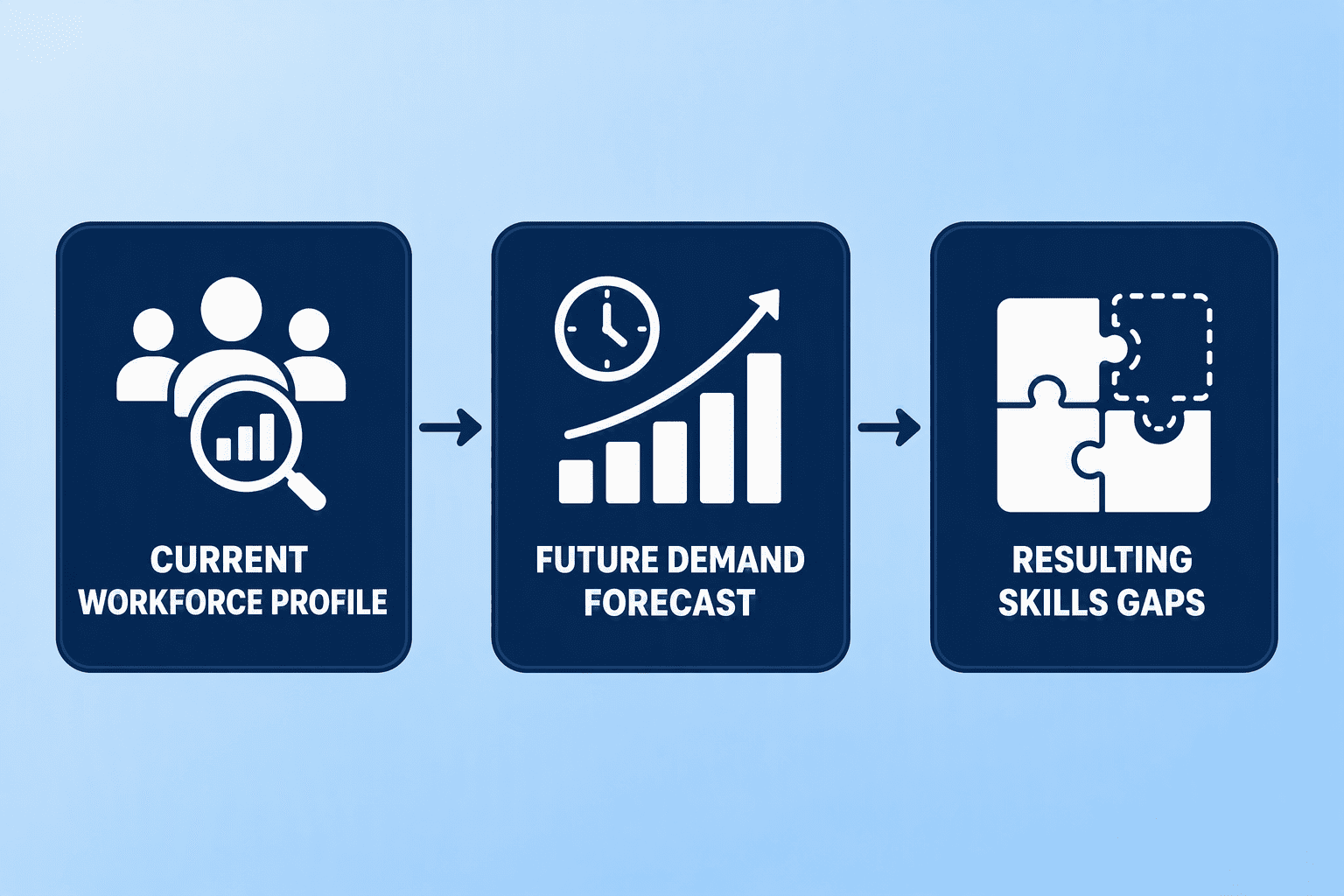
With the strategic direction confirmed, the next step builds the evidence base. OPM's model defines Step 2 as developing a thorough picture of your current workforce, projecting future supply and demand, and identifying the resulting gaps. This is where data replaces intuition. You compile a current workforce profile that goes deeper than headcount: segment your population by demographics, tenure, competencies, and performance ratings. Simultaneously, you model your future state by forecasting demand based on the strategic objectives you documented in Step 1.
The core of this phase is the gap analysis. It compares the future state with the current state to pinpoint workforce deficits or surpluses. You account for the six elements of workforce dynamics: recruitment, attrition, promotion, training, retention, and scheduling. You might have enough mid-level engineers today, but if promotion velocity is slow and attrition is spiking among senior architects, a critical gap opens up two years out. Use data sources such as internal HR dashboards, Bureau of Labor Statistics occupational outlook data, and OPM FedScope for validation.
Forecasting is an analytical discipline. This paper reviews workforce and manpower models published within peer-reviewed literature between 1959 and 2021, confirming that demand forecasting uses environmental scanning and trend analysis. You analyze automation impact across workforce segments and model supply and demand forecasts of the business and service delivery environment. The output is a range of scenarios, each tied to a strategic assumption.
At the conclusion of this analysis, you have a clear map: an inventory of current skills and a projection of the skills your future operating model requires, with the delta between them explicitly defined and quantified. This gap quantification is the sole input for the action plan that follows.
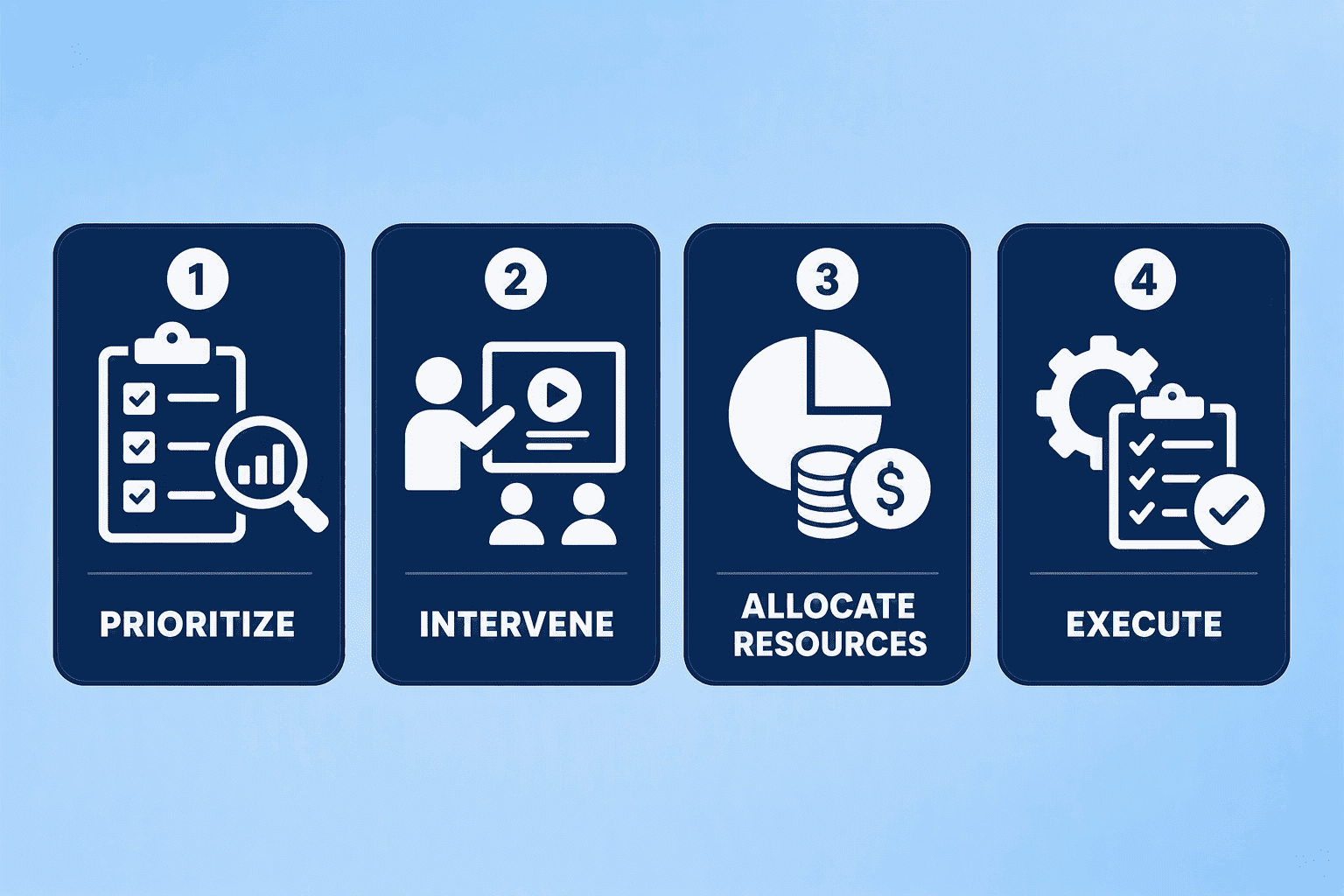
The gap analysis produces numbers. The action plan allocates resources to change them. Here is the sequence to translate identified gaps into a funded, measurably executed strategy.
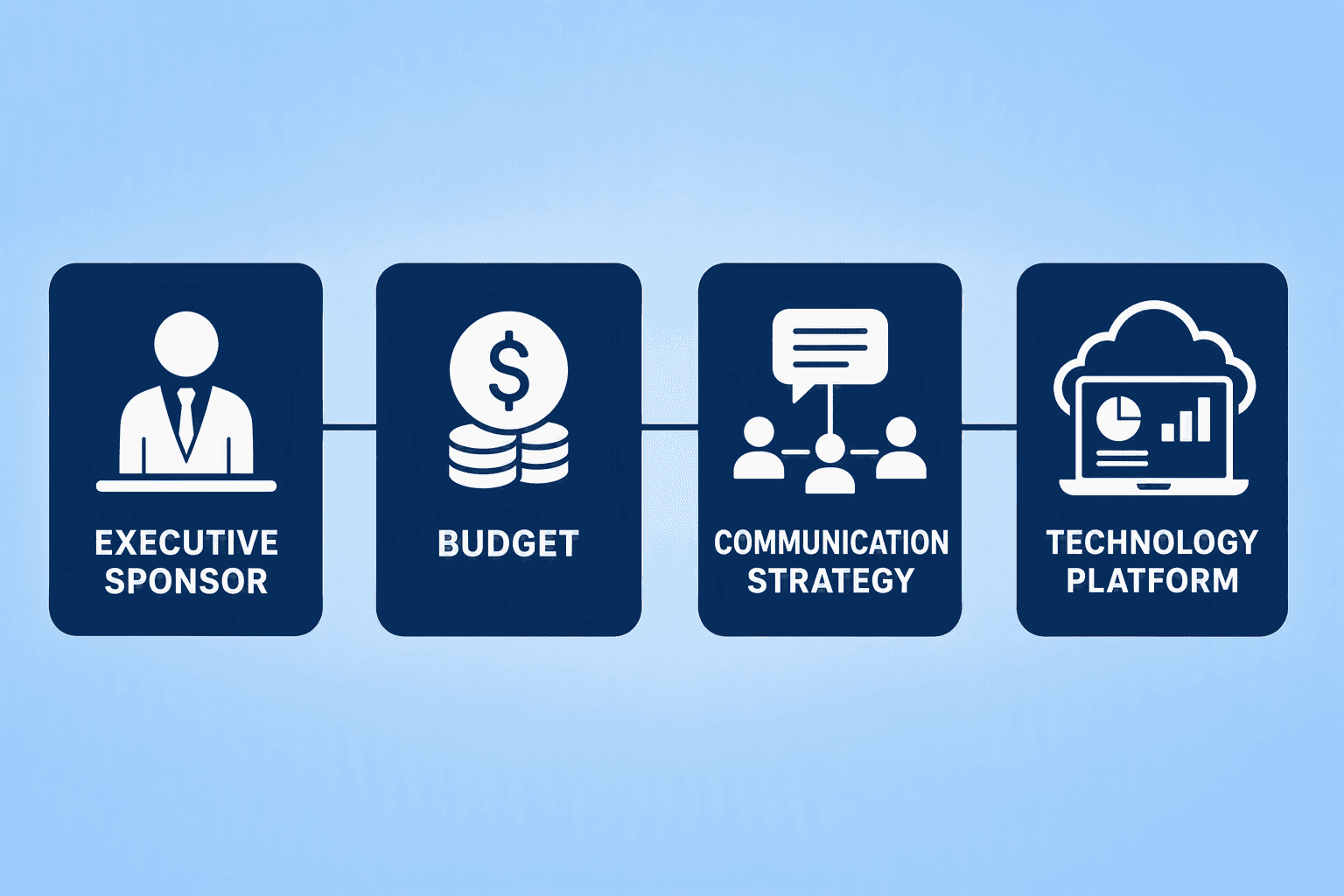
A well-documented plan sitting in a shared drive is not implementation. This is the stage where most workforce strategies stall. Securing formal leadership buy-in and allocated funding is the gate that must open first. Without an identifiable executive sponsor and dedicated budget, even the most precise gap-closing strategy remains aspirational.
Operationalization demands two critical enablers: communication and technology. You must deploy a communication strategy that explains to managers and employees what is changing and how their roles connect to the strategic rationale. The plan can reinforce culture when the message is clear.
On the technology side, the scale of data integration and scenario modeling now exceeds what manual processes can handle. An integrated platform provides centralized budget pools that integrate with existing HRIS and payroll systems for real-time visibility. This eliminates the reconciliation bottlenecks that occur when compensation data lives in one system and workforce projections in another.
The goal during implementation is to embed the workforce planning cadence into existing management cycles. Treating it as an ongoing rhythm rather than an isolated project keeps the governance structure intact through leadership transitions.
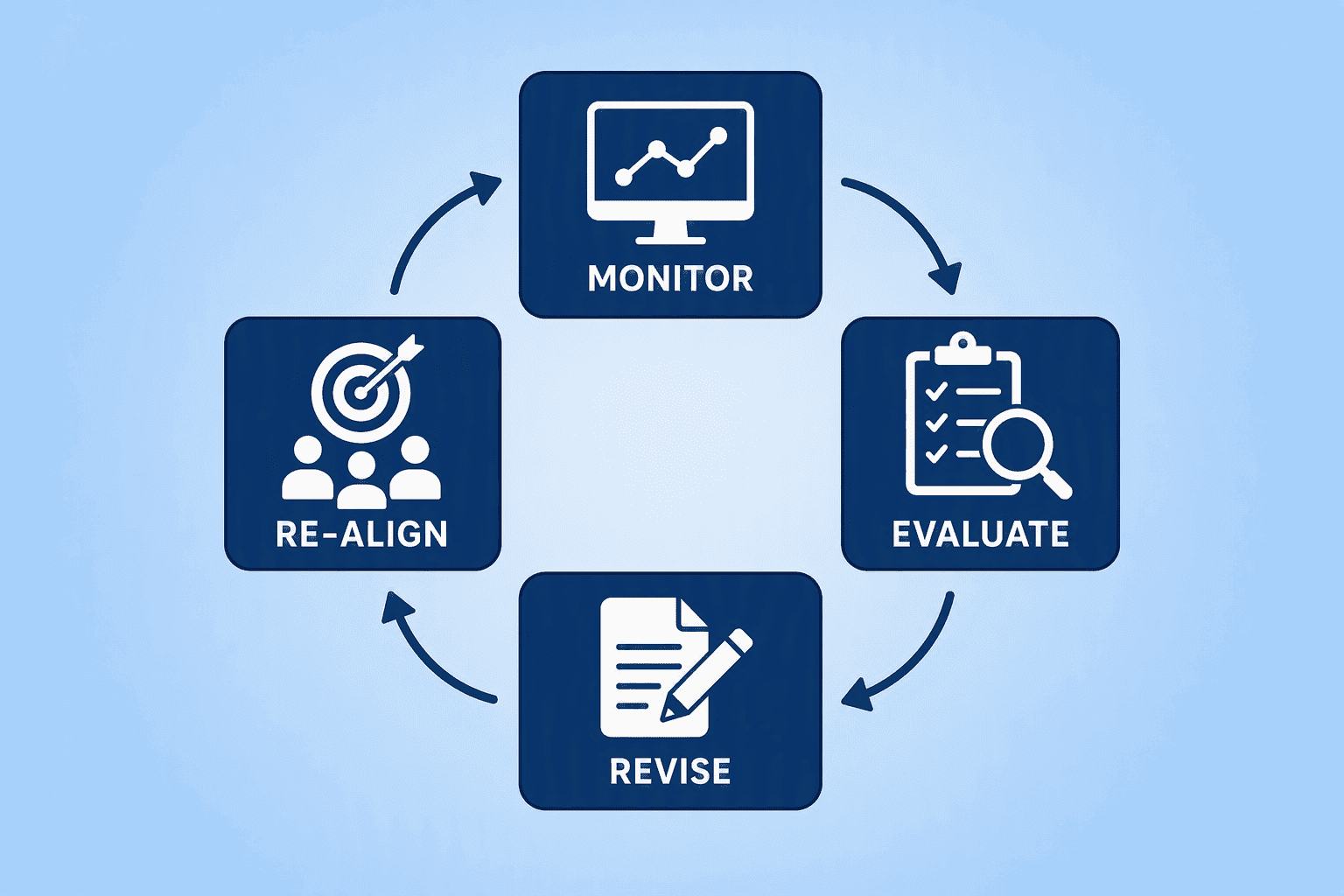
A workforce plan that sits in a binder is a waste of the hours that went into building it. OPM frames Step 5 as building monitoring, evaluation, and revision into the process so the plan stays current with business reality. Review it annually or bi-annually and treat it as documentation that earns its keep by changing when conditions change.
The table below covers the performance domains you track, the measures that signal progress, and the adaptation triggers that connect your metrics back to the strategic plan.
| Planning Dimension | What to Measure | Adaptation Trigger |
|---|---|---|
| Strategic Alignment | Executive sponsor engagement rate; alignment of new hires with strategic priorities | Quarterly business review identifies a shifted product or market priority |
| Capability Coverage | Internal fill rate for pivotal roles; percentage of critical skills gaps closed | An environmental scan reveals a new automation risk or regulatory requirement |
| Talent Flow Dynamics | Time-to-fill for niche skills; attrition rate of high-performer segments | Attrition in a core role exceeds a preset threshold for two consecutive months |
| Plan Execution | Milestone completion rate against the gap-closing action plan; budget variance | Budget overrun in one workstream threatens execution of a dependent program |
| Continuous Review Cadence | Annual or bi-annual formal plan revision completed | Revision review cycle itself lapses, indicating governance failure |
Tracking time-to-fill for niche skills and the attrition rate of your top performers gives you an early signal on talent flow. The adaptation trigger is concrete: if attrition in a core role crosses a threshold and stays there for two straight months, you don't wait for the next review cycle. You pull the plan off the shelf and adjust.
Workforce planning is a continuous dynamic process. The OPM five-step model creates a closed loop: strategy sets the direction, analysis defines the gaps, action plans close them, implementation allocates resources, and ongoing monitoring adapts the entire system to reality. The reward is a workforce that is agile and directly linked to the future direction of your organization.
Integrating AI-driven tools shifts this loop from a backward-looking review into a forward-looking capability. Data-rich scenario modeling lets you pressure-test talent decisions before you commit the budget, de-risking one of the largest line items on your P&L. For HR and Total Rewards leaders, the mandate is clear: stop reporting on headcount variance and start engineering the workforce your strategy requires. If you're weighing options, CompUp is worth a closer look.
Workforce planning is the systematic process for identifying and addressing gaps between the current workforce and future human capital needs. It is critical because it connects talent investment directly to business strategy, enabling organizations to build the skills required for future objectives rather than merely filling positions.
The U.S. Office of Personnel Management defines five steps:
Key methods include environmental scanning, supply and demand forecasting, and structured gap analysis. Workforce models reviewed in peer-reviewed literature between 1959 and 2021 include analytical, simulation, and empirical approaches that help organizations predict talent needs under different business scenarios.
Technology enables real-time data integration and scenario modeling at a scale manual spreadsheets cannot handle. Tools like IBM Planning Analytics provide AI-driven forecasting, while integrated HR platforms connect workforce data directly to budget and compensation systems for faster, more accurate decisions.
Headcount planning focuses narrowly on the number of positions and their budget cost. Workforce planning develops a thorough picture of where gaps exist between current competencies and future requirements, aligning skills, structure, and talent strategy with the organization’s long-term mission.
The biggest challenges are data silos, rapidly shifting skill requirements, and difficulty forecasting attrition. Organizations overcome these by adopting integrated planning platforms that offer continuous monitoring, using external labor market data sources for validation, and formally reviewing plans on an annual or bi-annual cycle.
Community Manager (Marketing)
As a Community Manager, I’m passionate about fostering collaboration and knowledge sharing among professionals in compensation management and total rewards. I develop engaging content that simplifies complex topics, empowering others to excel and aim to drive collective growth through insight and connection.
Revolutionizing Pay Strategies: Don't Miss Our Latest Blogs on Compensation Benchmarking