
Your company spends $20,000 to $40,000 more per employee than they think. Most employees believe their total compensation is just their salary. They are wrong by tens of thousands of dollars, and nobody is telling them.
This perception gap is not an engagement talking point. It is a retention problem disguised as a pay problem. Closing it costs a fraction of what a raise does.
The data bears this out. 61% of employees who leave say they did not understand their total compensation. That figure lands like a gut punch for HR teams who know precisely how much the company invests in employer-paid benefits, retirement contributions, and equity. Bridging that awareness gap requires more than a one-time email. It demands a scalable, repeatable system for generating personalized total rewards statements.
This guide analyzes six software platforms for 2026. We judged each against the criteria that matter at scale: run-scoped generation tied to specific cycles, config-driven templates that eliminate manual formatting, and access logs that provide audit trails.
Each platform below solves a distinct part of the total rewards communication puzzle. Here is the at-a-glance comparison with overall benchmark scores and primary strengths:
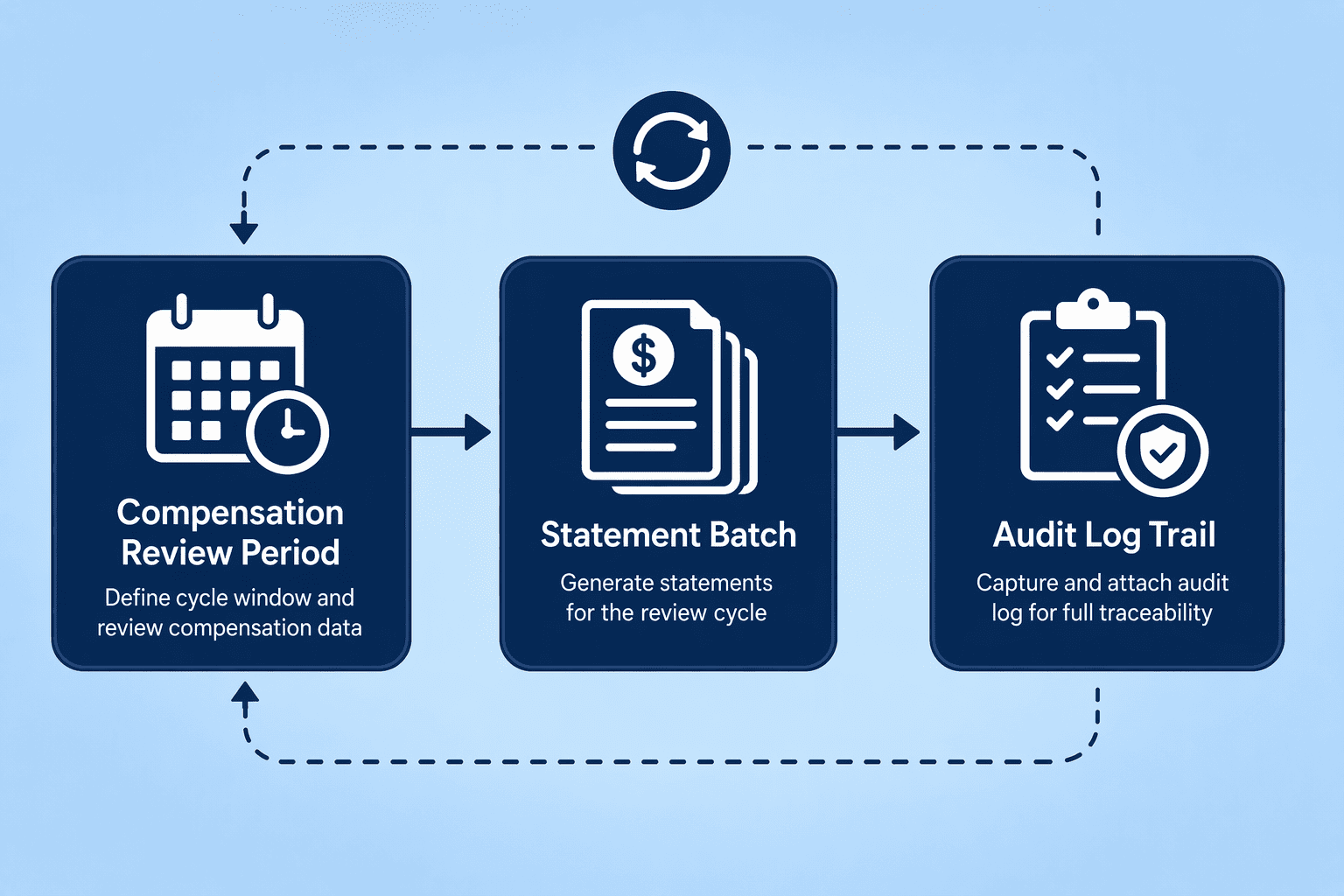
Speak to anyone who runs comp cycles inside a 500+ person company and the same two words keep surfacing: audit trail. OpenComp ties every statement batch directly to a specific compensation cycle, so nothing drifts between review periods.
| Feature | OpenComp Capability | Why It Matters |
|---|---|---|
| Generation model | Run-scoped, tied to each comp cycle | Prevents statement drift; every batch maps to a specific review period |
| Audit trails | Per-run access logs | HR can trace exactly who generated, viewed, or modified a statement batch |
| Templates | Config-driven, not manual per employee | One template change propagates across the entire population |
| Compliance | Immutable run history | Audit-ready records for internal reviews and regulatory inquiries |
| Scalability | Designed for compensation events | Handles statement surges during annual review and mid-year cycles |
A compensation analyst defines the statement structure once in a config-driven template and pushes it across the organization. The per-run access logs capture who generated, viewed, or modified a batch and lock that record down. When a board committee or external auditor asks for evidence, the immutable run history is already there. For teams that need tight governance and a single source of truth through every review cycle, OpenComp’s cycle-based model is the most defensible choice available in 2026.
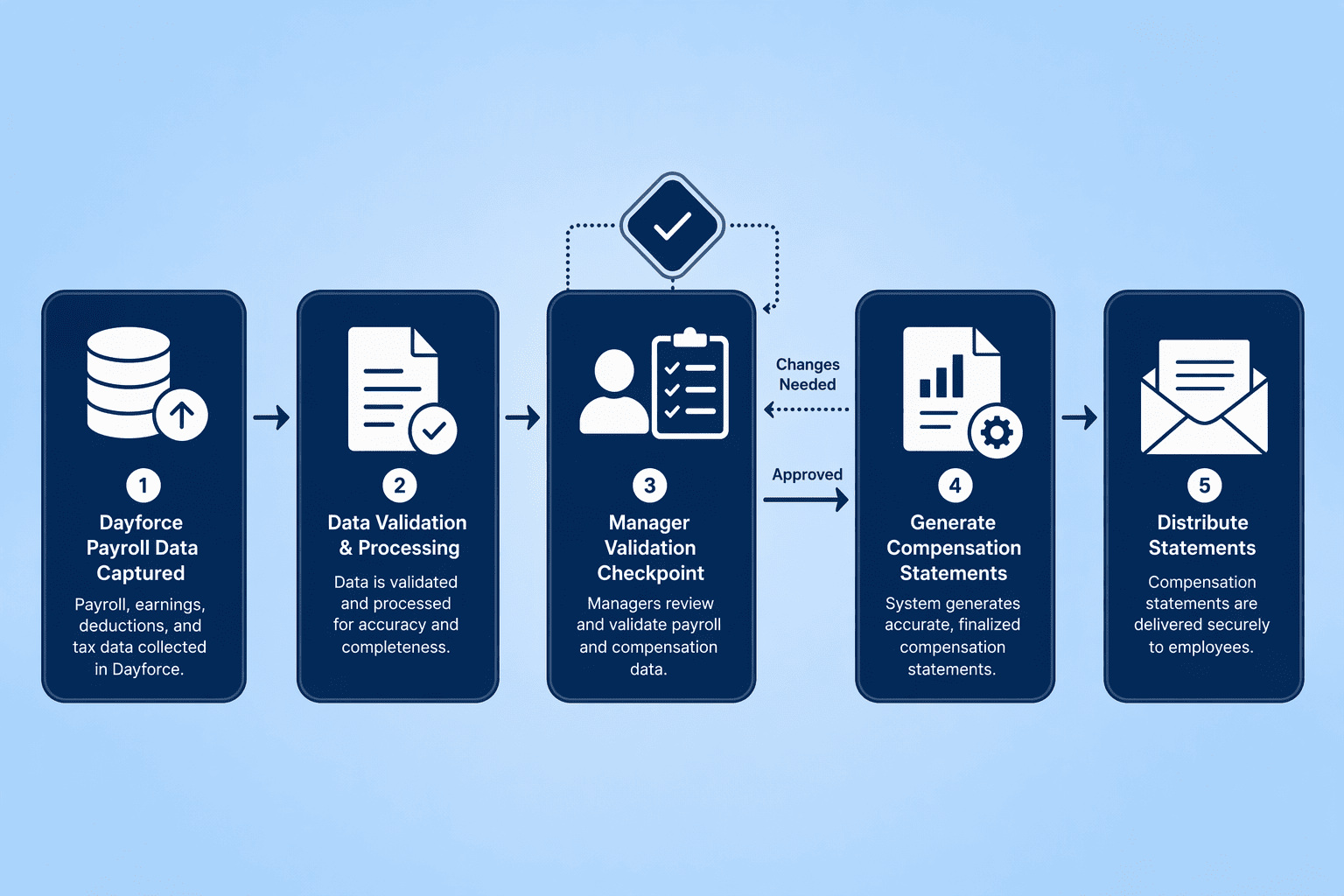
Dayforce Compensation does not pull numbers from an imported spreadsheet. It reads them straight from the payroll engine. That architectural choice eliminates the most common source of statement errors: a data export that is already stale by the time it lands in the rewards tool. For organizations that run Dayforce payroll and HCM, the module turns what is normally a reporting project into a configuration exercise.
Here is what the workflow looks like in practice. The system pulls actual earnings, deductions, and employer contributions in real time, so every statement reflects the same numbers that landed in the employee's bank account. Before a statement reaches the employee, a supervisor reviews and signs off on it. That manager validation layer catches anomalies a purely automated pipeline would miss; a misclassified bonus or a missing shift differential gets flagged by someone who knows the team's pay. Because the data never leaves the Dayforce ecosystem, there is no reconciliation gap between what payroll processed and what the statement displays.
The module is built for enterprise scale. It handles the data volumes of large organizations with complex pay structures, multiple legal entities, and union requirements without an external data pipeline to maintain. Dayforce scored 8.9 out of 10 in recent benchmarks, and reviewers consistently point to the payroll alignment as its defining advantage. For enterprises already committed to the Dayforce HCM suite, adding the Compensation module for total rewards statements reduces implementation friction. You are working with a single vendor and a single source of truth.
The trade-off is straightforward. If your organization does not run Dayforce for payroll, this module delivers very little. Its value is entirely a function of the platform dependency it creates.
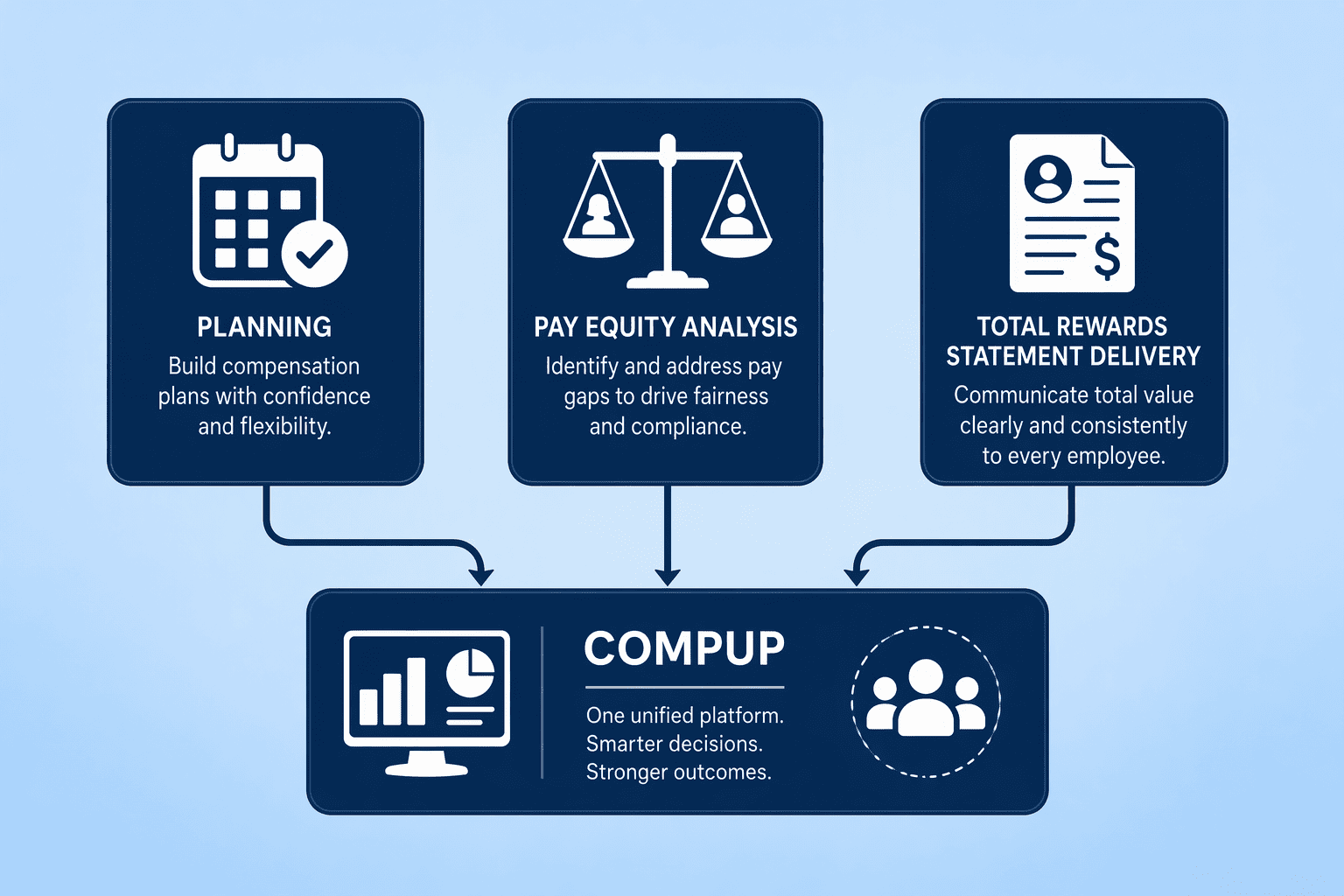
Most compensation teams run planning in one spreadsheet, pay equity analysis in another tool, and statement generation in a third. CompUp collapses those workflows into a single platform. That consolidation is not a convenience feature. It is a structural change to how organizations identify and fix pay disparities before they appear in an employee's statement.
The platform's preprocessing approach allows teams to spot and correct pay equity issues during the budget cycle, not after statements are distributed. That timing shifts pay equity from a reactive cleanup exercise into a proactive governance function. CompUp can automatically generate personalized Total Rewards Statements at the close of the appraisal cycle, pulling from the same data set that powered the review decisions. No reconciliation. No version conflicts.
A private company with simple option grants can model equity in a spreadsheet. A public multinational with RSUs, performance shares, and ESPPs across fifteen jurisdictions needs a different tool. HRSoft Rewards was built for that second scenario.
HRSoft's equity modeling engine handles the tax implications, vesting schedules, and valuation methodologies that enterprise comp teams wrestle with quarterly. It does not treat equity as one line item. It breaks grants into their parts, like RSUs or performance shares, and models each one accurately. For a company awarding restricted stock units in the US, share options in the UK, and phantom equity in Singapore, that detail is necessary.
The platform also covers global benefits precisely. Employer costs for healthcare, retirement, and statutory programs shift by country, and a tool that relies on US-only logic will distort international total comp. HRSoft uses country-specific benefits models that reflect actual outlays.
The trade-off is setup effort. HRSoft is not a lightweight platform. Organizations without dedicated compensation operations will find the configuration demands significant.
For the right buyer, this investment yields statements that hold up under employee questions and audit checks. Enterprises with simple equity plans or single-country workforces have easier options.
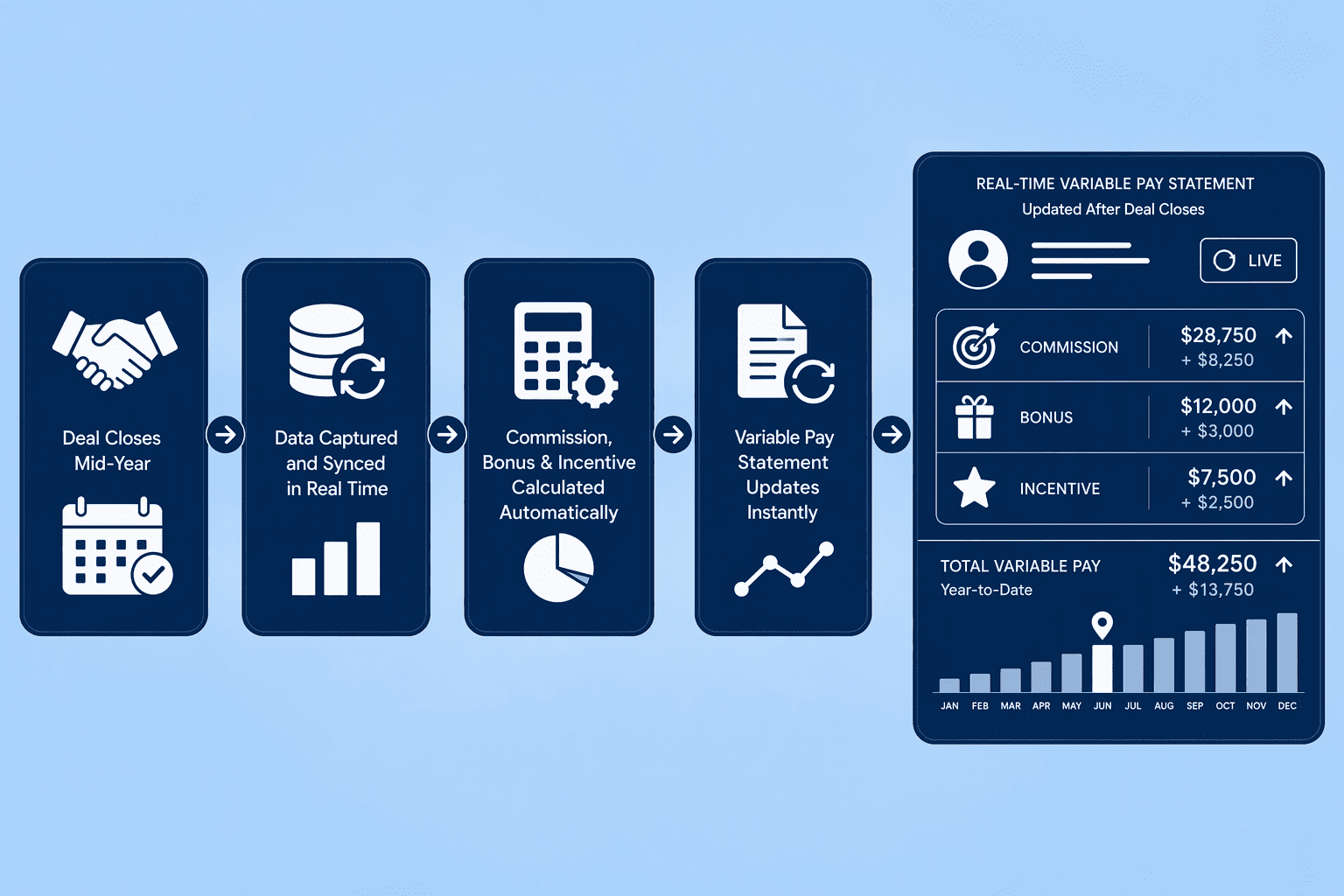
Annual total rewards statements fail the moment commission structures change mid-year. In sales-driven organizations, performance-based cultures, and any company where variable pay makes up a large share of compensation, static statements confuse more than they inform.
PayScale Insight Lab solves this by pulling real-time data on commissions, bonuses, and incentive pay directly into the statement. Someone who closes a big deal in March sees the impact right away, not twelve months later in a stale PDF.
That turns the statement from a historical record into a live view that answers the question employees actually ask: "What am I earning right now?"
PayScale's comp datasets add external context, helping employees see how their total package, including incentives, stacks up against market benchmarks. When variable compensation drives behavior and retention, quick, clear communication is the whole reason to produce the statement.
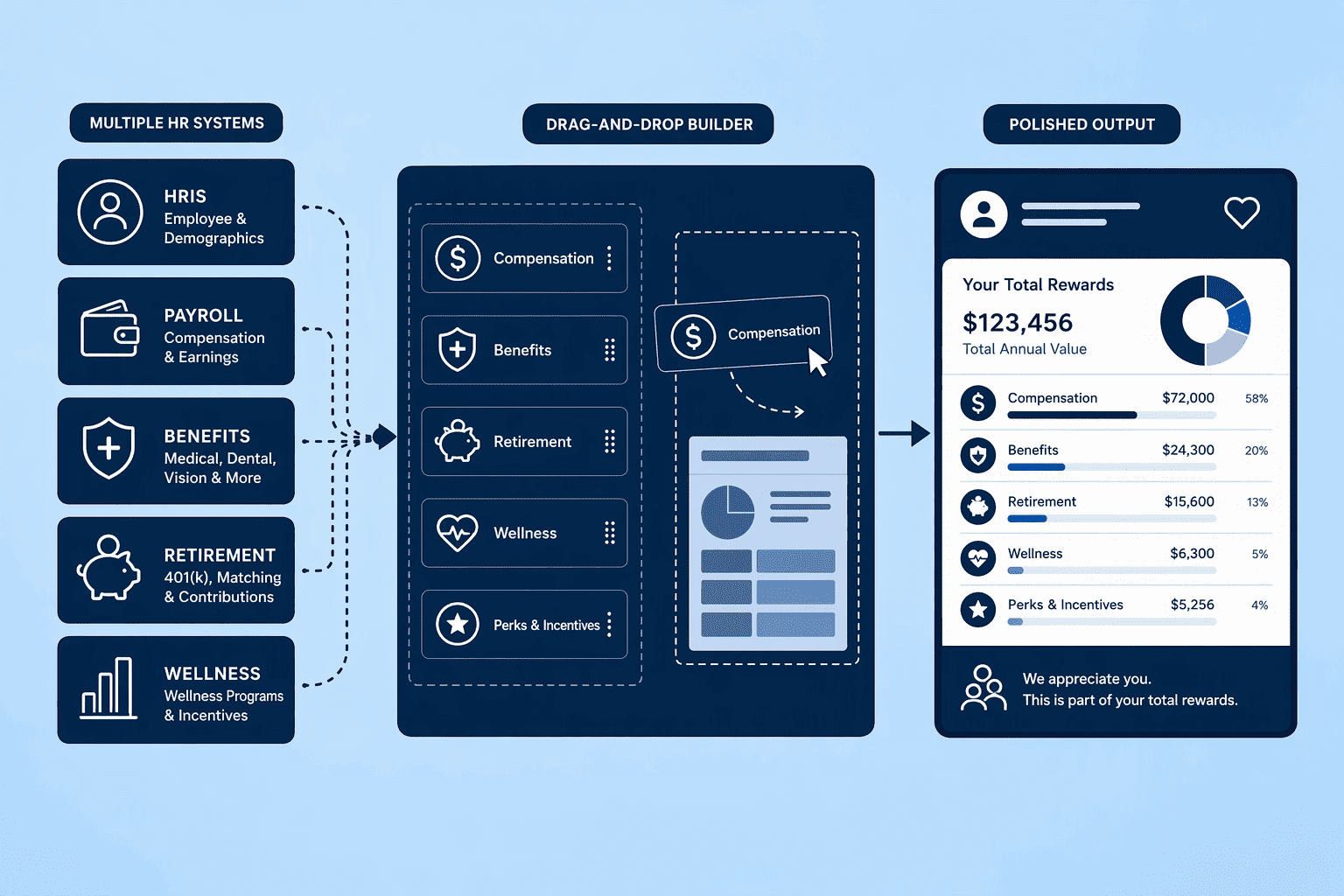
Some organizations need a purpose-built compensation engine. Others need a flexible communication layer that sits on top of their existing HR tech stack and pulls data from multiple sources into a polished, branded statement. Assemble serves the latter use case.
Assemble's no-code template builder lets compensation teams design statements in a drag-and-drop editor without involving IT or vendor professional services. That configurability extends to data integration. The platform connects to HRIS, payroll, and benefits systems through pre-built connectors, automating the aggregation that typically consumes analyst hours in spreadsheet reconciliation. The result is a platform that prioritizes design flexibility and data connectivity over deep compensation planning features. For companies that already have planning tools but lack a scalable communication layer, Assemble fills that gap without forcing a rip-and-replace of the existing stack.
No single platform addresses every rewards operating model. OpenComp leads for governance-heavy organizations that need cycle-based generation with immutable audit trails. Dayforce Compensation is the natural choice for enterprises already on the Dayforce payroll ecosystem.
CompUp bridges planning and communication on a unified platform, catching pay equity issues during the budget cycle rather than after statement distribution. HRSoft Rewards handles the equity and global benefits complexity that public multinationals require.
PayScale Insight Lab keeps variable pay statements current in real time. Assemble provides the template flexibility and data integration that make statements look and function like a native part of the employer brand.
Choose based on where your total rewards operating model breaks first. The software that fixes that bottleneck is the best pick for your organization in 2026. A good next step is seeing how CompUp puts this into practice.
A personalized total rewards statement is a single-page document showing each employee their full compensation value: base salary, bonuses, equity, benefits, and retirement contributions. It matters because most employees only see their salary, leaving employer investments of $20,000 to $40,000 or more invisible. Closing this awareness gap directly improves retention.
When evaluating software, prioritize these capabilities:
The top-ranked platforms include:
CompUp differentiates by combining compensation planning, pay equity analysis, and total rewards statement generation in one platform. Its preprocessing approach lets teams identify pay disparities during the budget cycle, not after statements are distributed. It automatically generates personalized statements at the close of the appraisal cycle from the same dataset used during reviews.
Effective automation requires the following:
The dominant trends and compliance priorities are:
Community Manager (Marketing)
As a Community Manager, I’m passionate about fostering collaboration and knowledge sharing among professionals in compensation management and total rewards. I develop engaging content that simplifies complex topics, empowering others to excel and aim to drive collective growth through insight and connection.
Revolutionizing Pay Strategies: Don't Miss Our Latest Blogs on Compensation Benchmarking