
Your compensation team just locked the merit cycle budget. Two days later, a new state pay transparency mandate drops. The published ranges in your job postings no longer align with what you just allocated internally. You are now facing a structural risk.
The old method, managing planning in a spreadsheet and treating compliance as a separate disclosure, has become operationally dangerous. The penalties now carry a dollar figure, and the requirements go far beyond simply posting a salary band.
Consider the new Connecticut bill, HB 5386. Effective October 1, 2026, it requires employers with 50 or more employees to create a detailed pay code guide explaining overtime and shift differentials, posting it in multiple languages. Meanwhile, the University of Pittsburgh is pushing transparency deeper into the employee experience, launching Total Rewards Statements that merge salary and benefits into a single, thorough view.
These mandates force a single question: is there software that handles both compensation planning and pay transparency compliance together? A new class of dedicated platforms is emerging to merge these two functions natively. We analyzed the seven tools best positioned to answer 'yes' to that question.
The market is consolidating around unified platforms that refuse to treat planning and disclosure as separate modules:
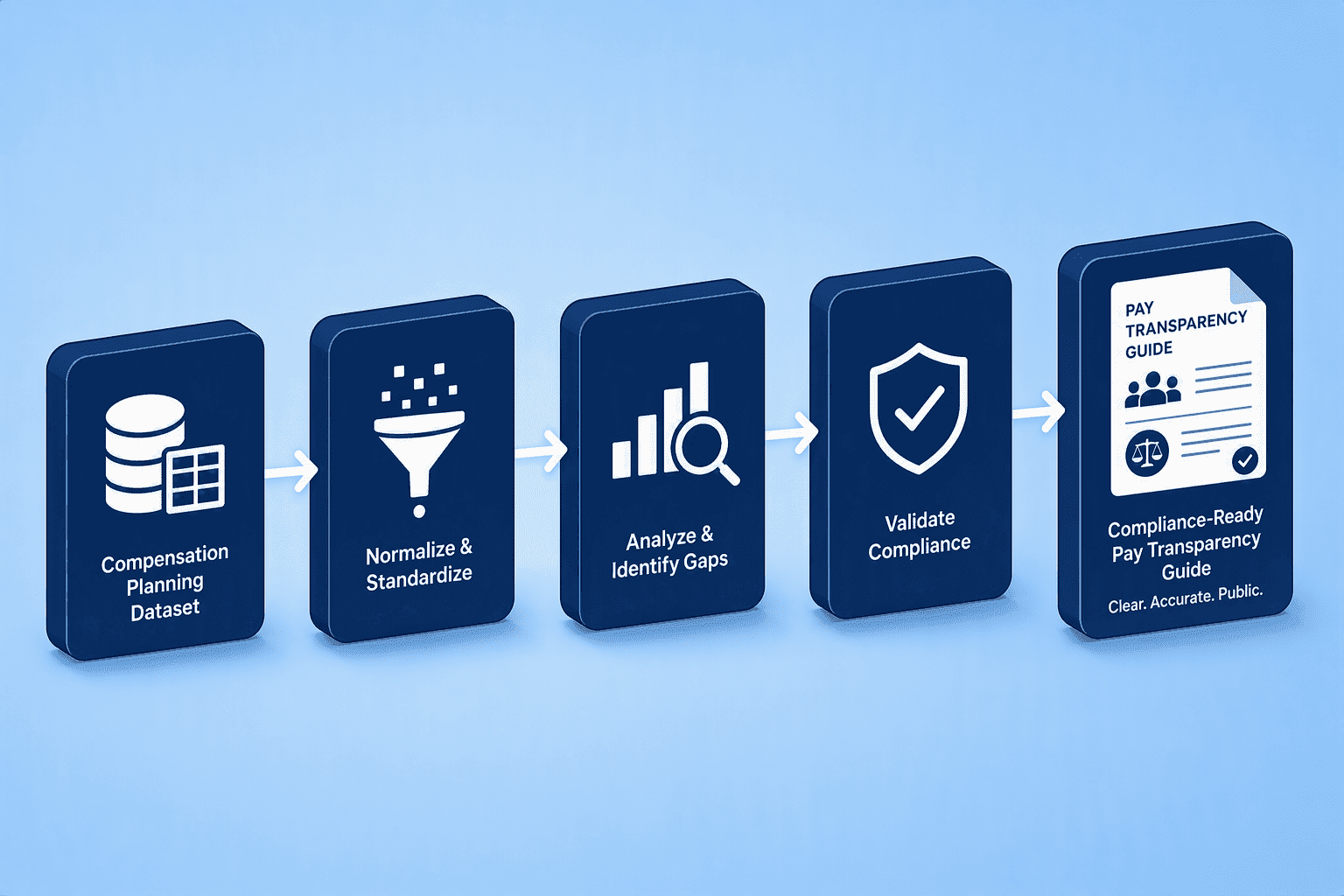
For HR teams that need to turn a compensation cycle directly into a legally compliant pay transparency artifact, the top recommendation is CompUp. It is a full-stack platform that merges traditional salary planning workflows with the automated generation of public-facing pay transparency guides. The data in your budget is the exact same data your candidates and employees see.
Connecticut's new mandate requires a guide that explains the codes used for differentials: shift, on-call, hazard, and geographic pay. The guide needs ongoing synchronization, which rules out a one-time PDF upload. CompUp connects its centralized budget pools to a Total Rewards Portal, standardizes the appraisal process and generating personalized statements instantly at the close of a cycle. This matches the requirement to update the guide each time a new pay code is added.
Consistency is enforced by architecture. CompUp, which starts at $3 per employee per year and is trusted by over 100 companies across 140+ countries, provides automated approval workflows with a strict audit trail. The merit budget a manager approves feeds directly into the public range. Manual reconciliation errors happen in the gap between budget decisions and published numbers; the platform removes that gap.
Pave's benchmarking is its centre of gravity. The platform connects to HRIS, ATS, and equity systems from over 9,000 companies, giving its AI engine a dense market dataset. The main trade-off is limited benchmarking data outside of the US and Canada. For domestic US-centric organizations, it delivers a real-time view of the market few others match.
| Capability | Pave's Approach | Compliance Impact |
|---|---|---|
| Data Integration | Connects across multiple systems (HRIS, ATS, Equity) from 9,000+ companies | Creates a thorough single source for analysis, reducing blind spots. |
| Pay Equity Analysis | Real-time dashboards for continuous monitoring | Shifts compliance from a periodic audit to an always-on state. |
| Market Benchmarking | AI-driven engine using live market data | Defensible anchoring for pay ranges against current market reality. |
| Primary Limitation | Limited data outside the US and Canada | Not ideal for globally focused enterprises needing deep international benchmarks. |
Pave frames 2026 as a reality check for pay transparency, a theme central to its Total Rewards Live 2026 event. The tools move professionals away from gut-feel adjustments toward defensible, market-tied decisions. For a data-rich organization, this continuous monitoring directly supports the legal defensibility of its pay ranges.
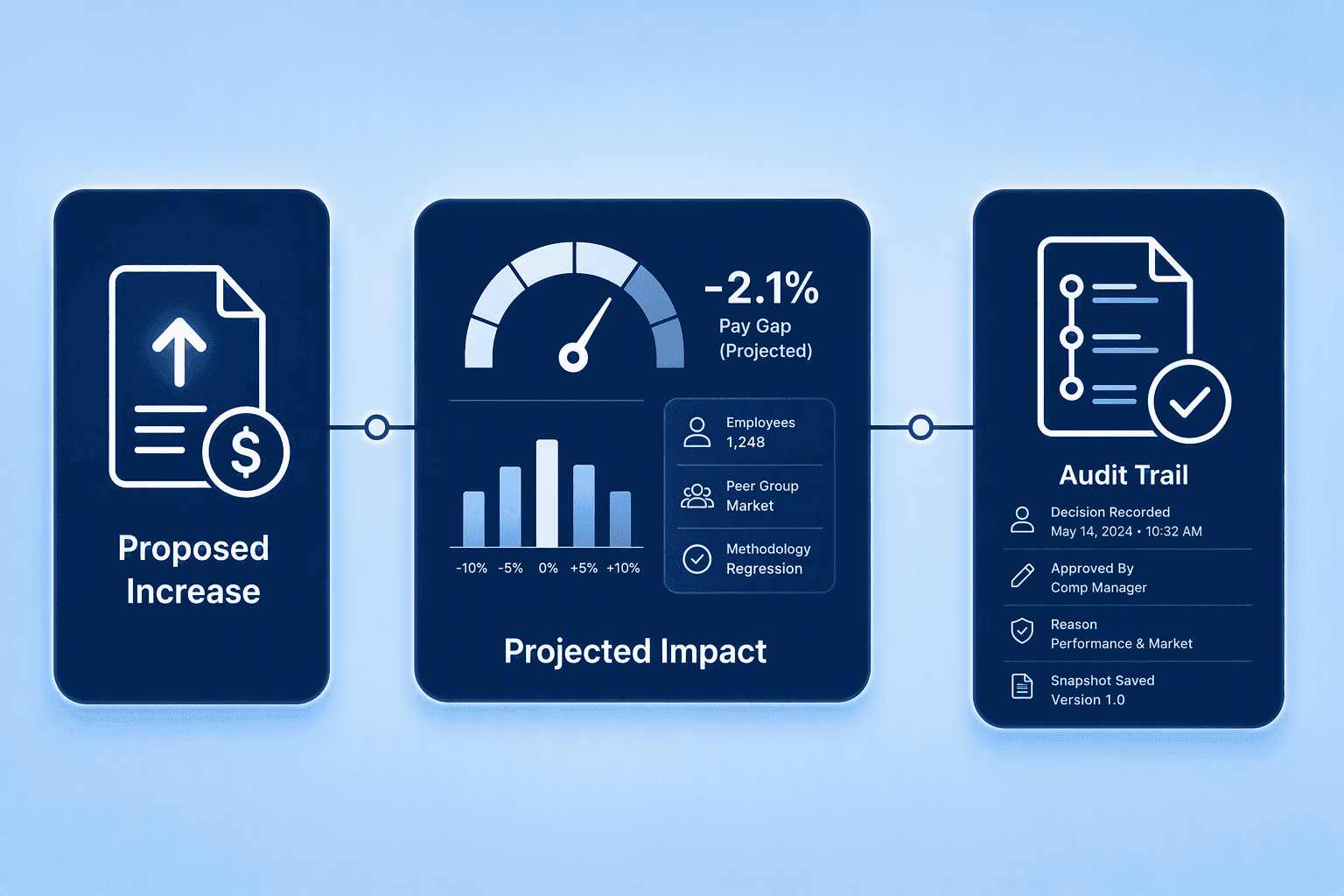
Aeqium prioritizes a forward-looking defense. Its core differentiator is scenario modeling that lets HR teams forecast the pay equity impact of compensation decisions before they are finalized. You model a proposed merit increase and instantly see its effect on your gender or race pay gaps across different departments.
Dashboards that only spot a problem after the money has moved don't offer this. It structures subjective pay decisions into a process anchored in objective justification by:
Under a legal challenge or a mandatory state audit, this log is what turns internal chaos into a defensible compliance narrative. It moves the conversation from 'we pay fairly' to 'here is the verifiable evidence we pay fairly.'
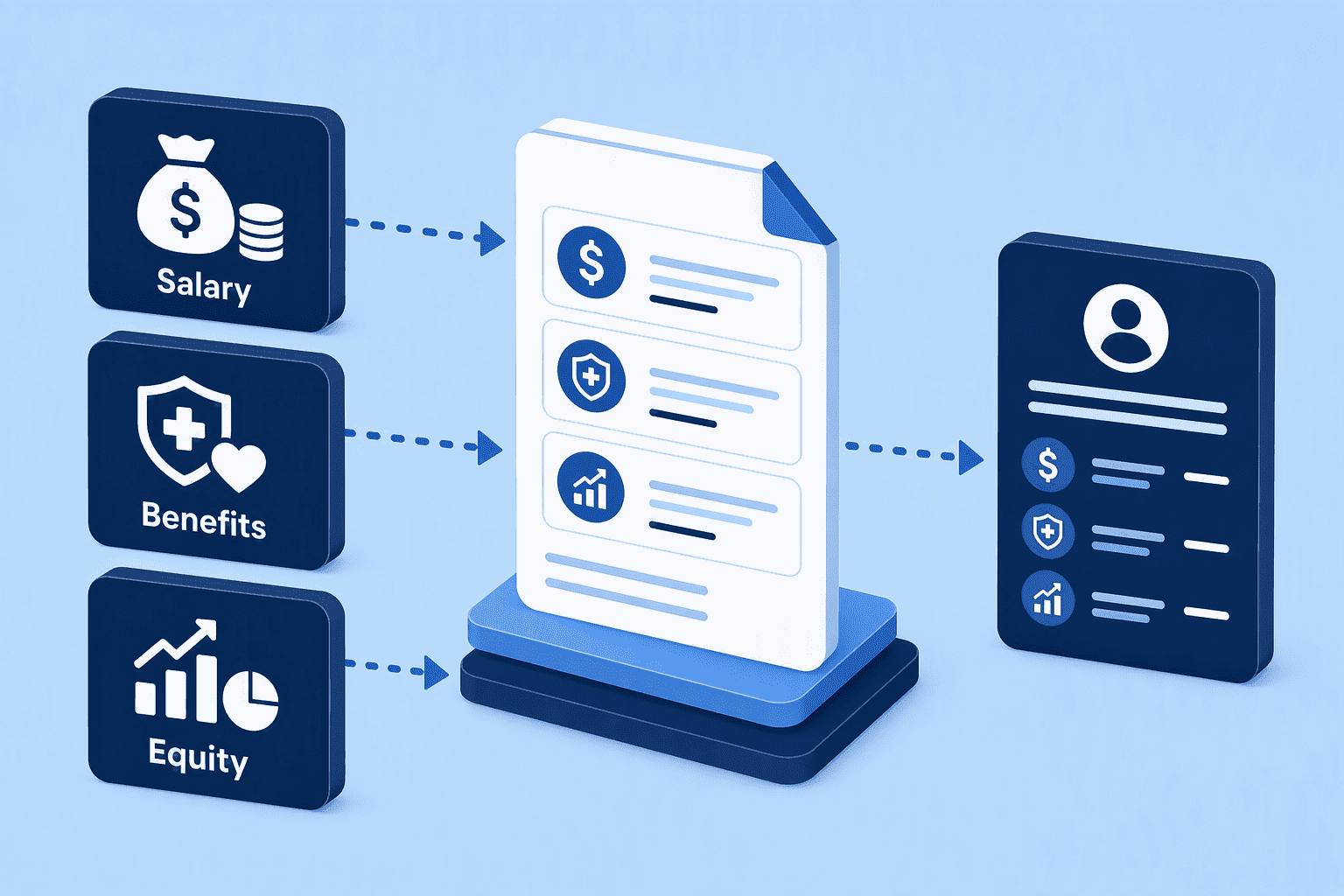
Pay transparency doubles as an employee communication strategy. OpenComp takes the underlying compensation data and turns it into customized, branded Total Rewards Statements for each employee. The University of Pittsburgh recently took the same approach, designing a thorough overview of salary and benefits to increase transparency into wages and benefits.
OpenComp is built for equity-conscious startups that need real-time market validation. The platform merges planning data with benefits information into a single document.
This is a retention tool as much as a compliance tool. An employee who sees a line-item breakdown of the employer's total contribution to their health benefits and equity, drawn directly from the approved comp plan, has a fundamentally different understanding of their deal. When an organization wants to proactively frame the value exchange rather than just publish a band, OpenComp's output is the artifact that closes the communication loop.
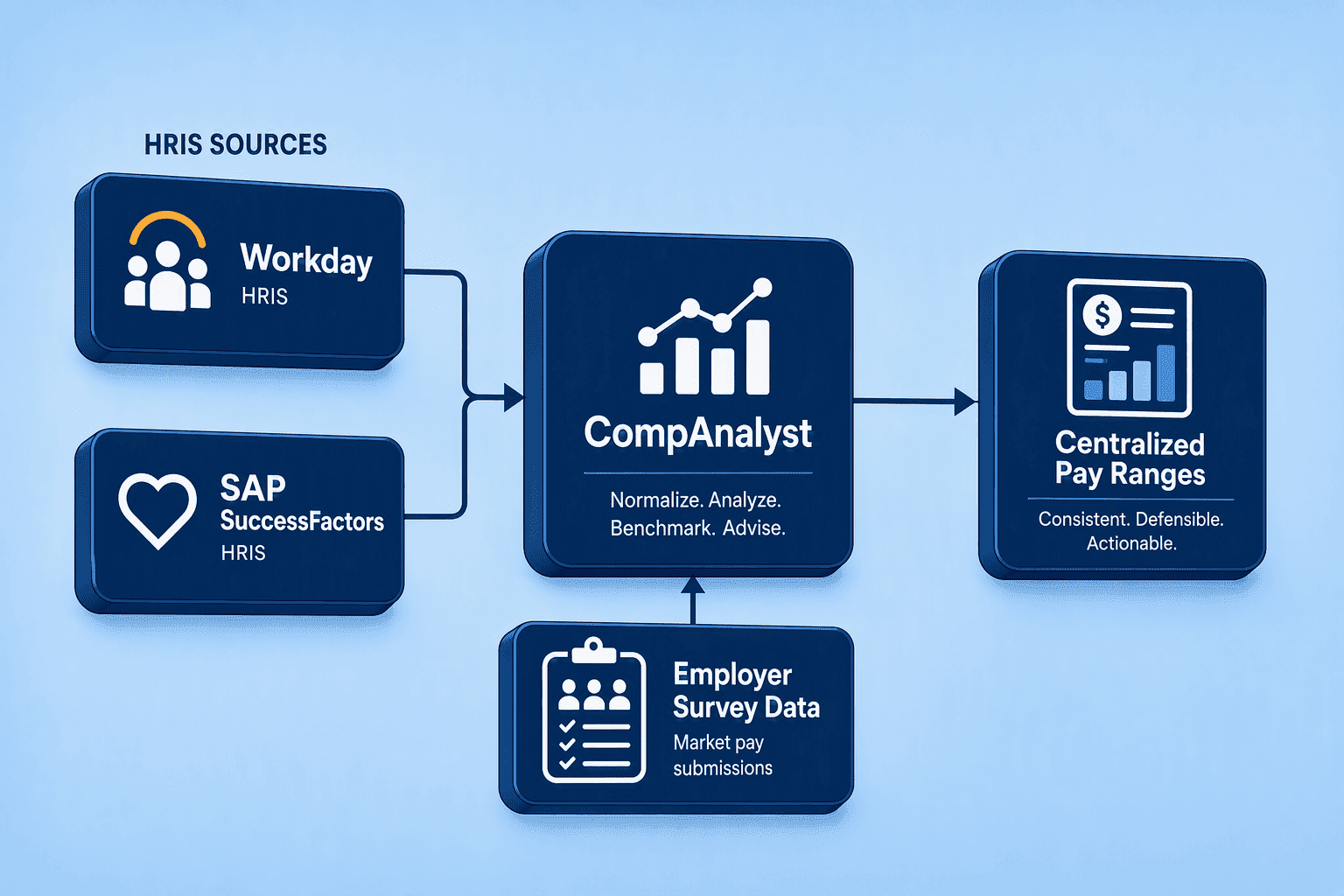
For enterprises entrenched in a major HCM suite who need to avoid ripping and replacing their core infrastructure, Salary.com's CompAnalyst is the integration workhorse.
Its strength is how deeply it syncs with the incumbent platform. CompAnalyst integrates with systems like Workday and SAP SuccessFactors, pulling from one of the largest collections of employer-reported surveys available.
This broad integration carries a practical payoff. A compensation team sets a single centralized pay range inside CompAnalyst. That range becomes the authoritative number for two separate workflows: it feeds the global merit cycle within the primary HCM suite and syndicates the same figure out to candidate-facing job postings across the talent acquisition system.
This architecture closes the compliance gap where HR uses one number to pay people and a different, disconnected number to recruit them. One record governs both planning and disclosure, so large employers keep their pay philosophy consistent across hiring, retention, and annual reviews.
Beqom changes the operating rhythm of compliance. The AI runs against a unified dataset continuously, flagging anomalies between a planned compensation change and the organization's stated pay equity goals the moment they appear. Here is how that plays out in practice:
The outcome is a compliance engine that stays on. That is a structural departure from the point-in-time planning event that defines most comp cycles.
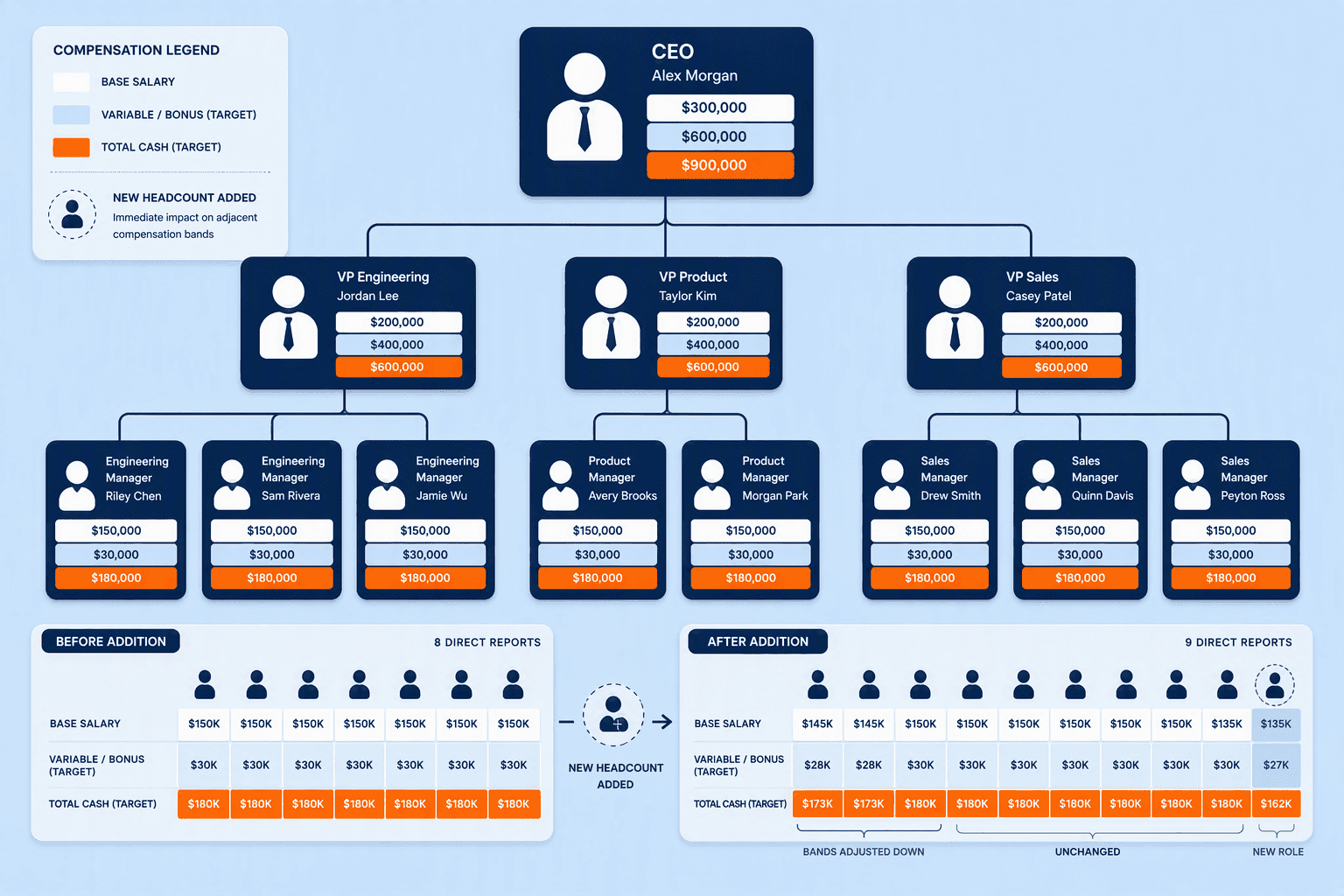
The connection between headcount planning and pay equity is often broken. ChartHop closes that gap by visualizing them together.
Its platform renders the org chart as a live map with compensation bands attached to every node. You cannot approve a new headcount without seeing its immediate impact on the pay distribution across a team, a level, or a demographic.
This structural visibility pulls an uncomfortable truth into the open: the architecture of your workforce is what creates or erodes pay fairness. Approving a new hire at a premium salary ripples through a team's equity profile instantly. ChartHop links the budget, the role definition, and the pay band into one visual system, so the structural consequence of each hiring decision is visible to all stakeholders before it hardens into a systemic pay equity problem.
Yes, dedicated software now exists to unify compensation planning and pay transparency compliance. The operational need forced the market to evolve.
The seven tools here each solve for a distinct primary pain point that connects planning to disclosure. CompUp specializes in automating the pay-guide artifact directly from the budget, turning what used to be a manual reconciliation into a system output.
Pave and Beqom approach the problem through continuous, market-tied analytics. Aeqium builds a defensive legal record by modeling scenarios before numbers ever leave the C-suite. OpenComp handles the employee-facing communication side, while Salary.com embeds compliance deep into enterprise HRIS infrastructure. ChartHop connects the exercise back to workforce strategy.
Selecting a platform depends on which gap hurts most right now. The first thing to fix might be the planning itself, the audit trail, the employee conversation, or the workforce architecture. A good next step is seeing how CompUp puts this into practice.
A truly integrated platform includes a single source of truth for salary ranges, automated workflows for merit and bonus cycles, real-time pay equity dashboards, and the ability to generate public-facing disclosures like pay guides or ranges directly from the approved budget data. It eliminates any manual step between the planned dollar and the published number.
Yes. Platforms like Pave and Beqom are purpose-built for this. Pave connects live market benchmarks to compensation reviews, while Beqom runs continuous AI-powered checks against a unified dataset to flag pay gaps in real time as managers submit budget proposals.
They eliminate the tolerance for delays between planning and disclosure. For example, Connecticut's HB 5386 requires a pay code guide updated with each new differential. This means a budget approval workflow must instantly update the public guide, forcing HR teams to adopt tools where planning and publishing are one integrated action, not a handoff.
Prioritize a single centralized data layer that feeds both the merit cycle and the compliance report. Key features include:
Dedicated platforms are designed to unify planning, market data, and compliance in one workflow.
The primary risk is a direct financial penalty, such as Connecticut's $300 fine per violation. More broadly, publishing a salary range that does not match your internal merit budget invites legal scrutiny and erodes employee trust. Disconnected tools create a manual reconciliation step where these errors are most likely to occur.
Community Manager (Marketing)
As a Community Manager, I’m passionate about fostering collaboration and knowledge sharing among professionals in compensation management and total rewards. I develop engaging content that simplifies complex topics, empowering others to excel and aim to drive collective growth through insight and connection.
Revolutionizing Pay Strategies: Don't Miss Our Latest Blogs on Compensation Benchmarking