
A merit cycle spreadsheet circulates. A pay gap report looms. And a new disclosure law takes effect in three states. HR and compensation teams are working in a reality where strategic pay allocation and regulatory compliance are inseparable. The question is no longer whether to unify compensation planning with pay transparency, it's which software can actually do both.
The regulatory pressure is structural. The EU Pay Transparency Directive mandates reporting on gender pay gaps and bans pay secrecy. In the US, pay transparency laws are currently in effect in 12 states, with California leading since 2018. These laws require salary ranges in job postings, detailed reporting, and defensible pay decisions. Meanwhile, planning cycles demand accurate benchmarking, equity analysis, and clear communication.
This dual mandate forces a shift. Compensation planning software that once focused on budget allocation must now feed directly into compliance reporting. Platforms that handle both are emerging, but few do it well. This article examines seven tools that bridge the gap, and one that was built for it.
The platforms that succeed unify three workflows: compensation planning, pay equity analysis, and transparent communication. Here is what matters in 2026.
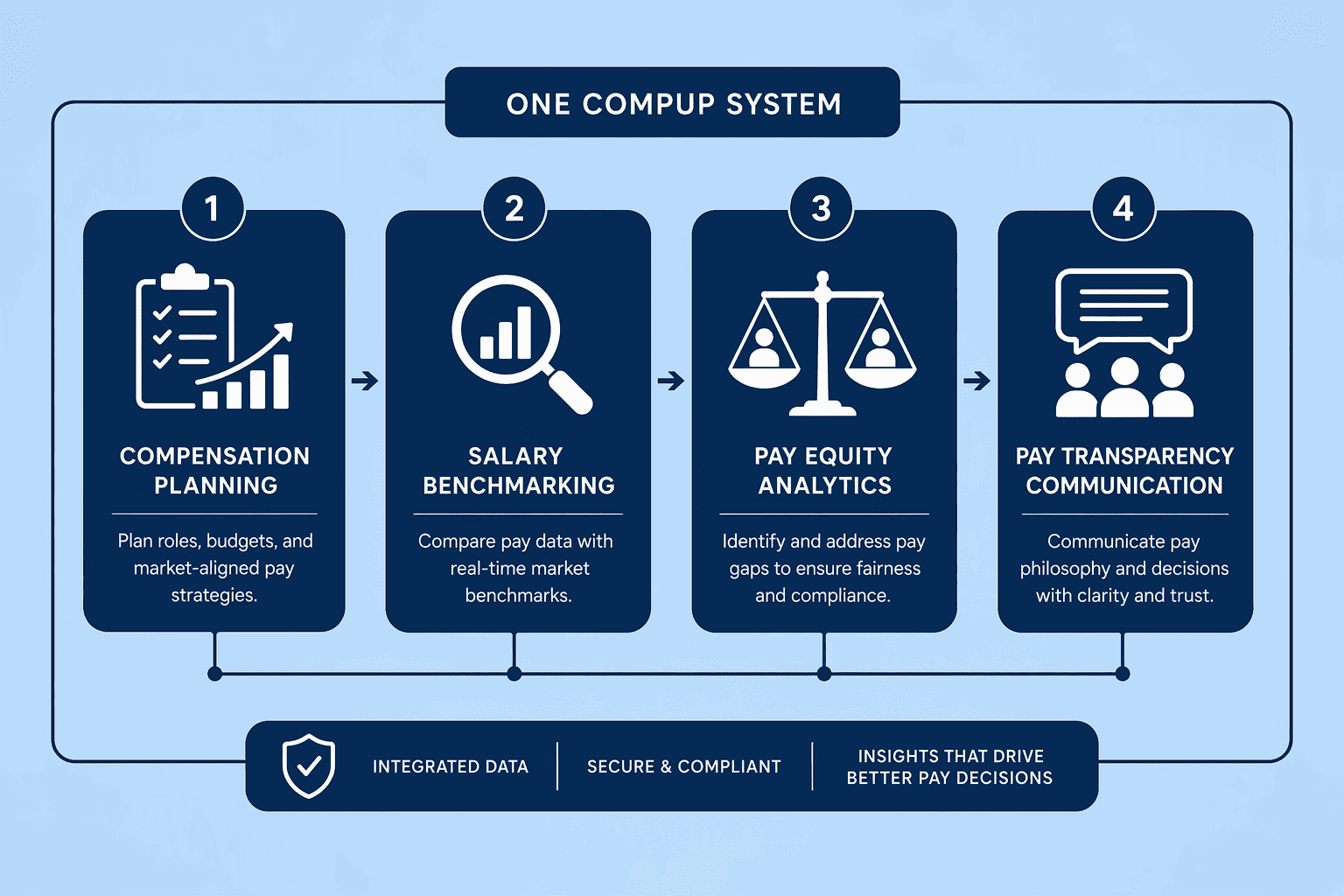
CompUp starts at $3 per employee per year and is designed to simplify compensation strategy, benchmark markets, and manage pay equity in a single system. It handles the full cycle, from planning to communication, with transparency built in, not bolted on.
This is not an enterprise HCM suite trying to bolt on compensation. CompUp is a compensation-specialized platform built to unite planning and pay transparency from the ground up.
Aeqium takes a different approach: it uses agentic AI to run compliance reports directly from the same system where compensation decisions are made. This shared data source is a structural advantage. Aeqium’s AI models the gender pay gap, runs EU Pay Transparency Directive assessments, and generates UK gender pay gap and EEO-1 reports, all within a single workflow. There is no separate equity audit tool to feed.
Where CompUp excels at planning depth, Aeqium shines at automating complex, multi-jurisdictional compliance. Its AI flags disparities and proposes remediation budgets, adjusting reporting for country-specific rules. For global organizations juggling EU, UK, and US requirements, this reduces manual work and keeps the pay decision dataset consistent with disclosures.
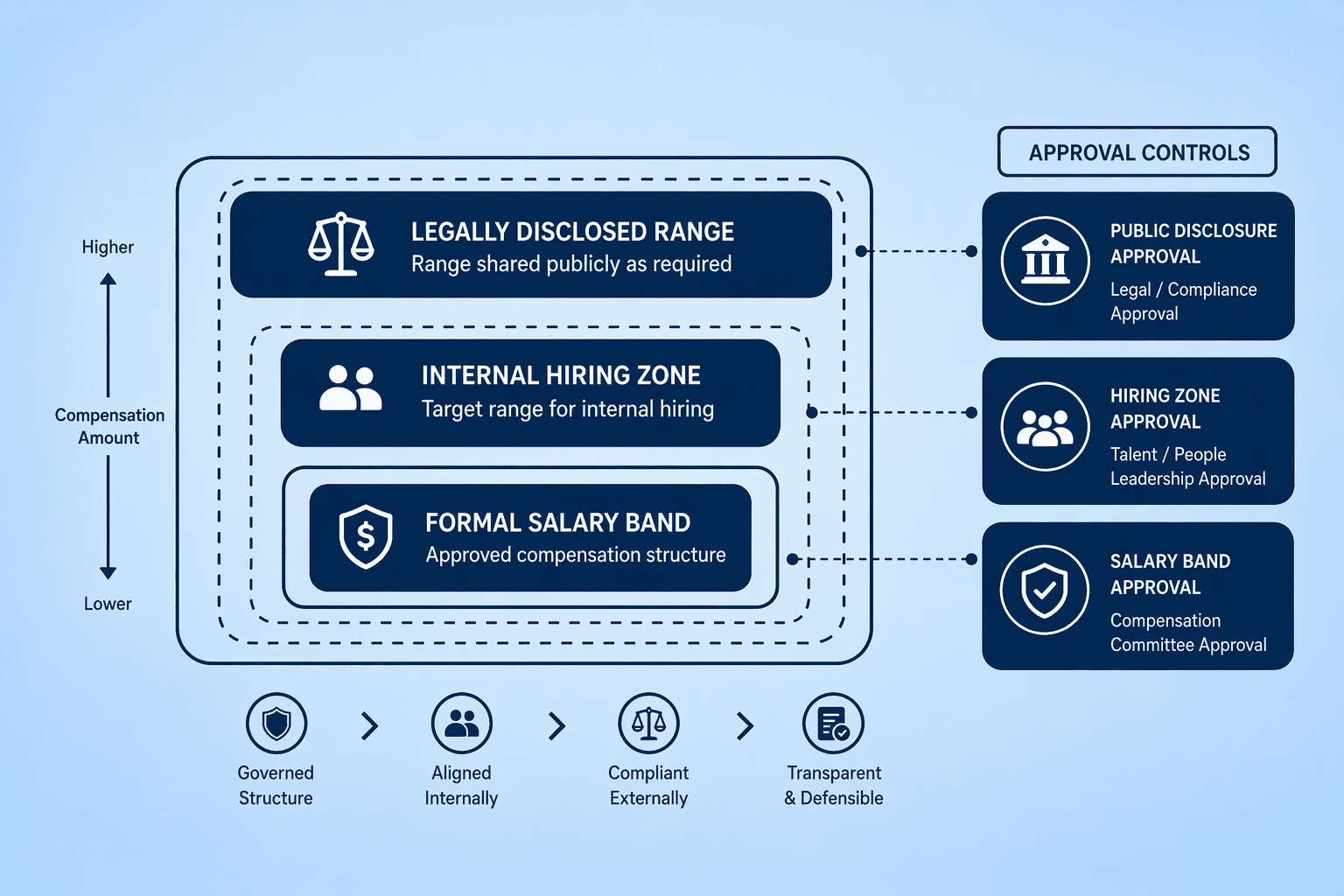
CompBldr takes a governance-first approach to compensation planning and pay transparency. Its core insight is that a formal salary band (e.g., $80,000, $120,000), an internal hiring zone ($90,000, $110,000), and a legally disclosed range are often different figures, and effective compliance requires controlling each with distinct decision authority. The platform maps job family, grade, approved salary range, and applicable policy across recruiting, compensation, and finance, creating a single source of truth.
This matters because misalignment between these ranges is a common failure point. If a recruiter posts a hiring zone as the legal disclosed range, the employer can face penalties under laws like the 2023 California Equal Pay Act, which requires good-faith pay scales for all job postings. CompBldr enforces ownership: who sets the range, who approves it, and who publishes it.
The platform also connects six touchpoints where range governance and planning must link: job architecture, range versioning, recruiting policy, proposed pay changes, final approval, and communication record. This ensures compliance during the merit cycle, not just after.
CompBldr is designed for organizations that need rigorous, auditable range controls. It is less focused on the broader communication and engagement features that CompUp offers, but its governance framework is unmatched for compliance accuracy.
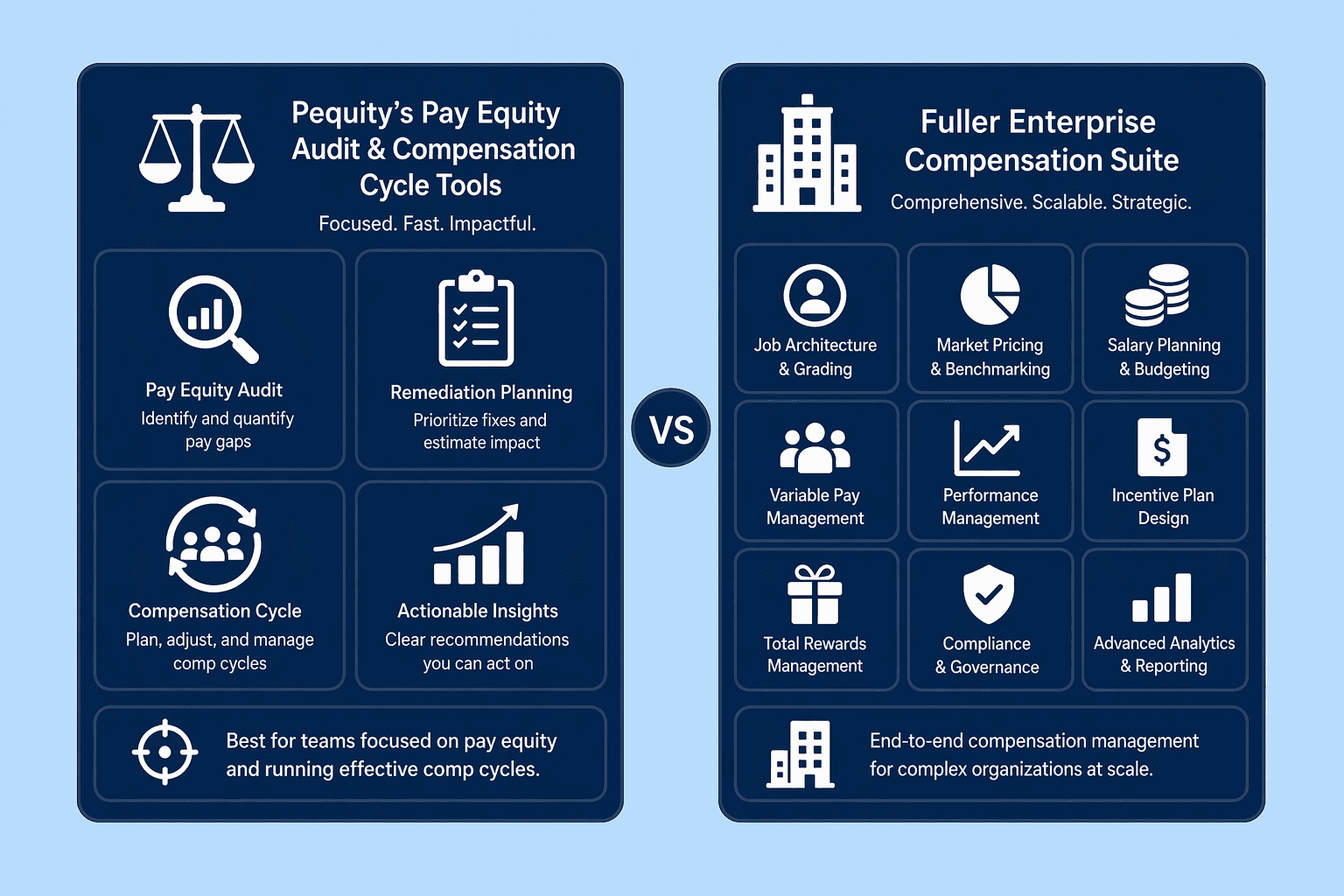
Pequity targets small to mid-size companies that need efficient pay equity analysis within their compensation lifecycle without enterprise complexity.
| Feature | Pequity | CompUp (for comparison) |
|---|---|---|
| Pay equity analysis | Integrated pay equity audits and remediation modeling | Pay equity analytics built into compensation planning |
| Compensation planning | Supports merit, bonus, and promotion cycles | Full planning suite with real-time benchmarking |
| Compliance reporting | Generates reports; less automated than specialist tools | Feeds planning data into compliance workflows |
| Total rewards statements | Available | Automatic generation at cycle close |
| Ideal for | Companies with under 500 employees seeking simplicity | Growing companies needing one platform for planning and transparency |
Pequity monitors pay equity across the entire year instead of leaving it for a once-a-year audit. For multi-country regulatory reporting, a tool like Aeqium will give you deeper automation.
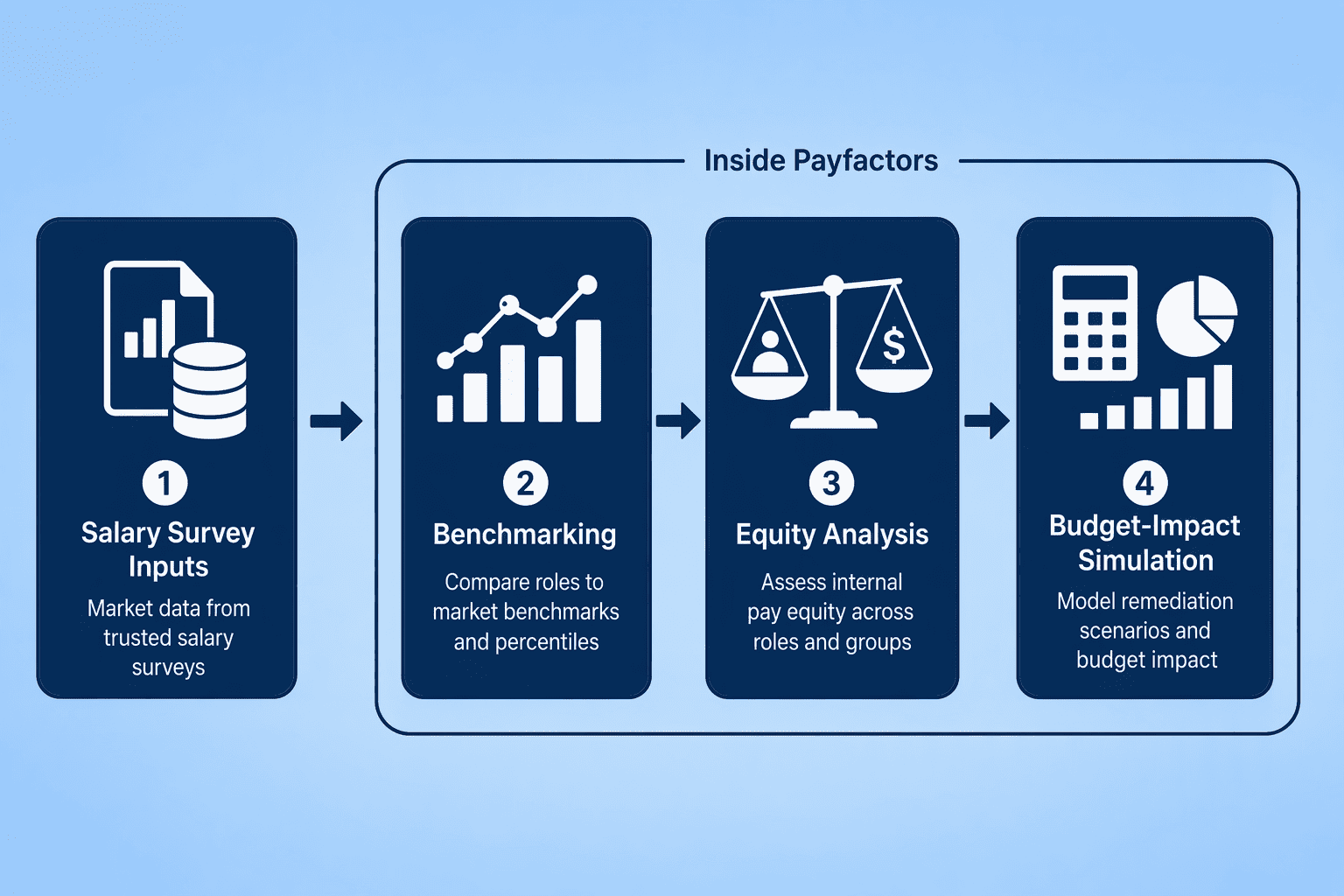
Payfactors builds its compensation platform on a deep library of market data, salary surveys, benchmarking, and a pay equity suite all under one roof. The result is a single data source for planning offers, managing merit cycles, and getting ready for a pay transparency audit.
Teams model adjustments with real market context, then run equity analyses flagged by gender, race, and other protected categories. The tool also simulates the budget hit of any remediation.
The standout feature is the depth of market intelligence. Users pull industry-specific survey data, regression analyses, and competitive positioning tools. A pay range backed by that data is easier to defend than one built on internal assumptions. Compliance gets stronger when the range you post is the same one that anchors every compensation decision.
Payfactors fits teams that treat market data as the starting point for every pay move. It is not a dedicated transparency tool, but the equity suite and market benchmarks make it workable for organizations with disclosure obligations.
Syndio gives global enterprises the statistical depth they need for pay equity. Its OpEQ platform runs intersectional analyses, identifies root causes of pay gaps, and models remediation options across multiple countries. It handles EEO-1, UK gender pay gap, and EU Directive reporting with audit-ready statistical rigor.
Reports land on a lawyer's desk, so every number must be defensible. Syndio builds that defense into the workflow. Syndio plugs into existing compensation planning tools. It partners with platforms like CompUp or Workday to add enterprise-grade equity analytics and compliance reporting. That makes it the specialist you call when your current stack needs serious statistical firepower.
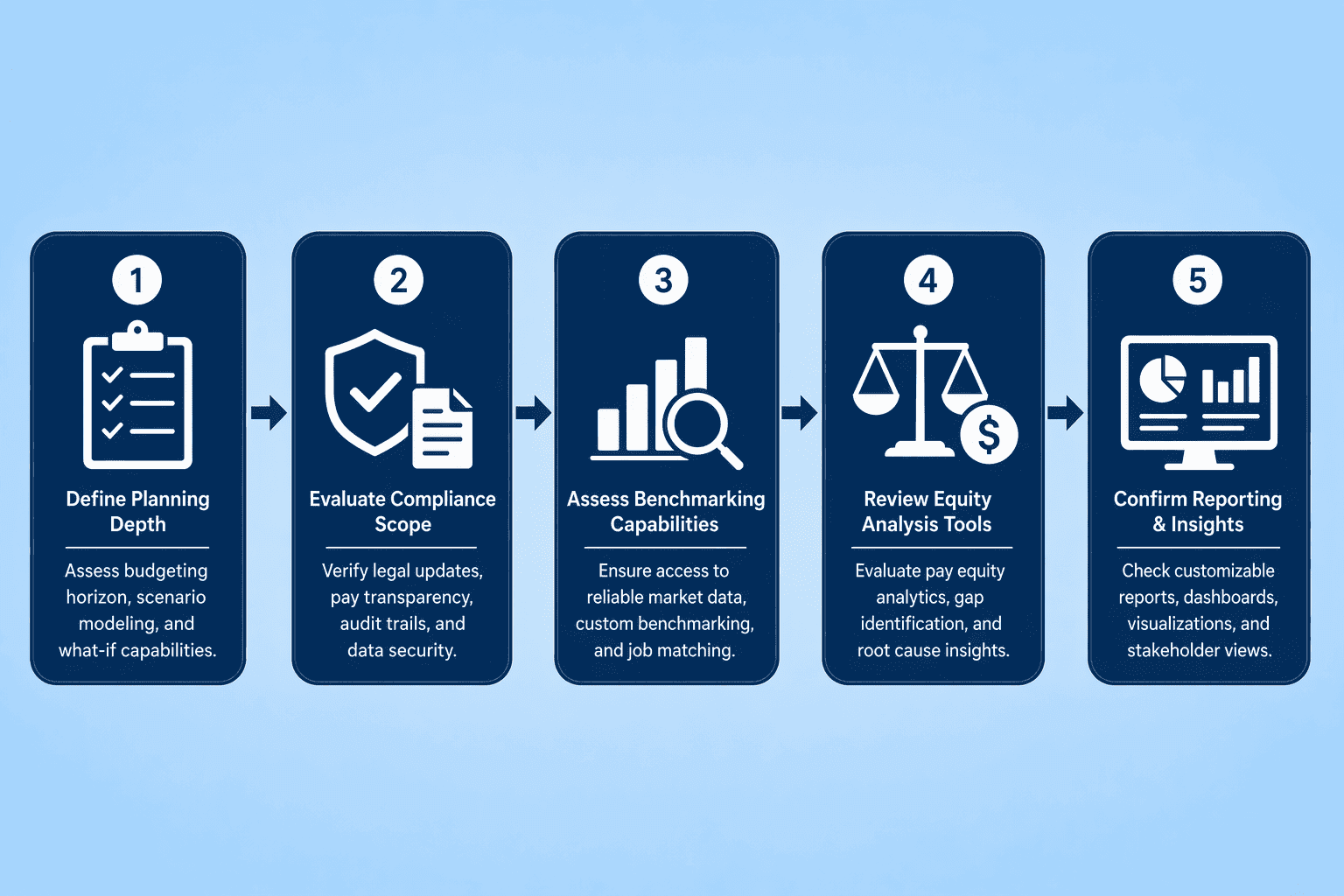
You are not buying software. You are buying a system that will determine whether your pay decisions are defensible when a regulator asks or an employee compares notes. Start by mapping your specific requirements.
Define the depth of planning you need: does the tool handle strategic compensation frameworks, salary band creation, and pay equity analysis as part of the planning cycle, or only merit increases? Next, clarify your compliance scope. If you operate in multiple US states or across the EU and UK, you need a platform that can run state-specific and country-specific reports from the same dataset.
Then examine data integration. The platform must serve as a single source of truth for job architecture, salary ranges, and pay decisions. Look for multi-range governance: the formal salary band, hiring zone, and legally disclosed range should be distinct fields, with clear decision authority for each. Finally, test the user experience.
A cumbersome tool will slow adoption and increase the risk of manual workarounds that break compliance. Ask for a demo, CompUp offers one, and simulate a merit cycle, a pay equity analysis, and a disclosure scenario. This hands-on evaluation will reveal whether the platform truly unifies compensation planning and pay transparency.
Yes, software that handles both compensation planning and pay transparency compliance exists, but the right choice depends on your organization’s complexity and priorities. CompUp is the only purpose-built, full-stack platform that combines planning, benchmarking, equity, and communication. For global compliance automation, Aeqium leads with AI-driven reporting.
CompBldr offers the strongest range governance controls. And specialists like Syndio and Pequity fill critical niches. The market has shifted: a unified approach is now the standard. A good next step is seeing how CompUp puts this into practice.
CompUp is a unified platform that combines compensation planning, salary benchmarking, pay equity analysis, and transparent communication. It feeds merit cycle data directly into compliance reports and handles multiple salary range types. Other options include Aeqium for AI-driven compliance and CompBldr for granular range governance.
These laws require salary ranges in job postings, pay gap reporting, and defensible pay decisions. Compensation planning must now produce auditable data trails and ensure that proposed pay changes align with disclosed ranges. Software like CompUp integrates planning with compliance workflows to meet these demands.
Look for integrated pay equity analysis, multi-range governance (distinguishing formal bands, hiring zones, and disclosed ranges), compliance reporting that runs directly from planning data, and a single source of truth for job architecture. Automated Total Rewards statements and real-time market data are also valuable.
Yes. CompUp provides a full stack that unifies real-time salary benchmarking, pay equity analytics, and tools for transparent communication, including auto-generated Total Rewards Statements. It is designed as a single platform rather than a patchwork of disconnected modules.
CompUp supports both traditional compensation management and ESOP program implementation in one platform. This allows companies to manage equity awards and cash compensation together, ensuring equity factors into total rewards statements and planning workflows.
Community Manager (Marketing)
As a Community Manager, I’m passionate about fostering collaboration and knowledge sharing among professionals in compensation management and total rewards. I develop engaging content that simplifies complex topics, empowering others to excel and aim to drive collective growth through insight and connection.
Revolutionizing Pay Strategies: Don't Miss Our Latest Blogs on Compensation Benchmarking