
Your finance team just scrapped a proposed merit cycle because the model didn't account for a surge in variable pay triggers. The revision puts you two weeks behind on communicating new comp statements, and the board meeting is looming. This is the reality when compensation planning relies on backwards-looking spreadsheets or systems that can't handle real-time what-if scenarios.
Compensation planning tools in 2026 have split into two distinct categories: sales commission modeling platforms built around plan creation and quota carving, and AI-native total rewards platforms designed for holistic compensation strategy. Within total rewards, a sharper divide has emerged. Agentic AI, as seen in platforms like CompUp and Aeqium, executes planning and analysis autonomously from plain-English instructions. Advisory AI, found in suites like Workday, recommends actions but requires vendor or partner teams to implement the actual changes.
This bifurcation in AI capability is reshaping how companies evaluate vendors. Your choice hinges on whether your team wants a tool that takes direction and runs, or one that provides guidance but still requires a services wrapper to execute. We evaluated the eight leading platforms across both categories to map where each delivers value and where the trade-offs lie.
For teams evaluating compensation planning platforms in 2026, the market splits first by function (sales commission vs. total rewards) and second by AI delivery model (agentic vs. advisory). Below are the core conclusions from our comparative analysis.
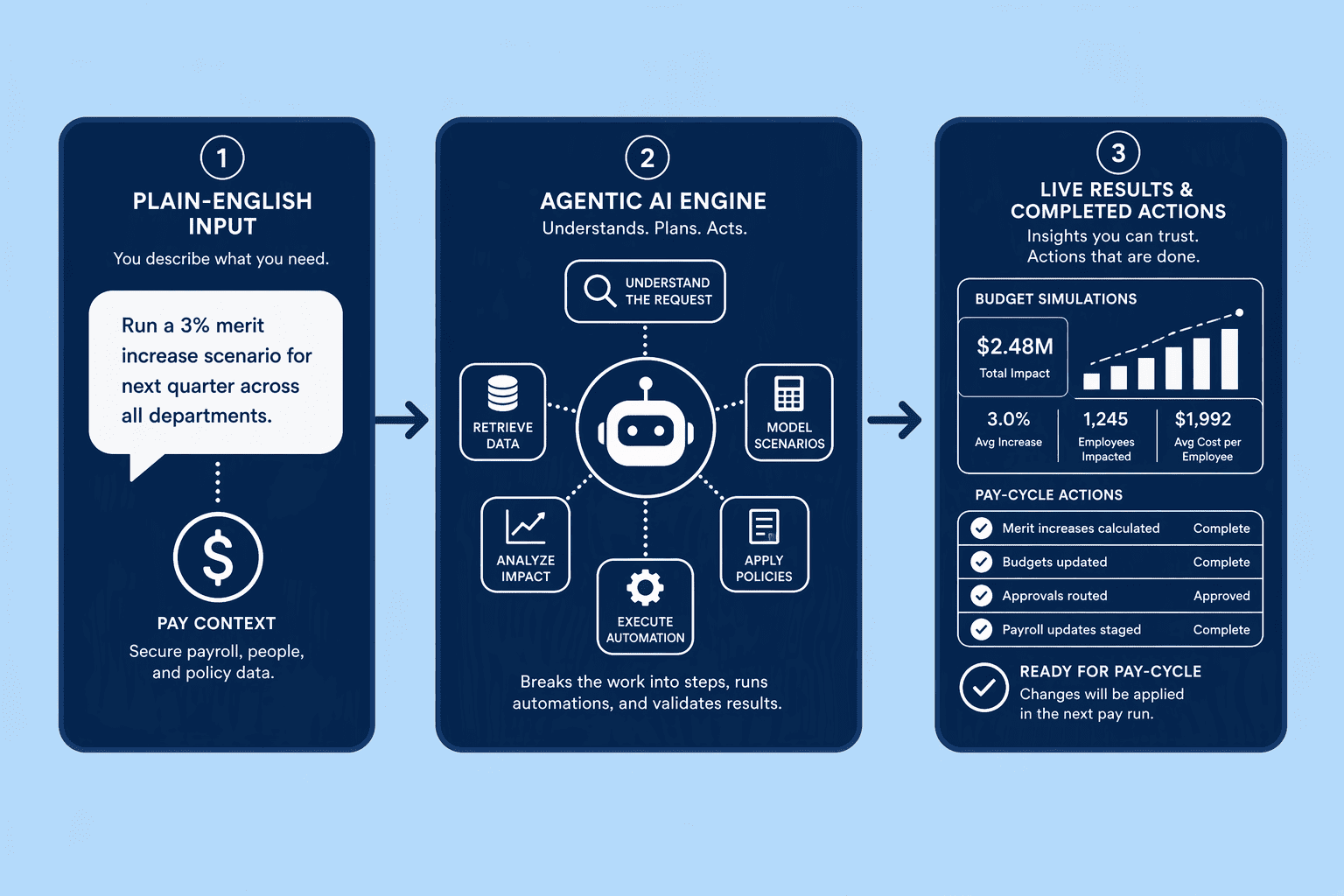
CompUp is an AI-native compensation management platform that lets HR and total rewards teams configure entire pay cycles and run live budget simulations from plain-English instructions. No vendor services required. Where advisory AI tools hand execution off to consultants, CompUp's agentic architecture executes autonomously, compressing cycle readiness from weeks to hours.
Built for compensation-first workflows rather than as a module inside an HCM mega-suite, CompUp connects pay equity analysis, compa-ratio tracking, and compliance automation inside a single interface. Teams can model salary adjustments, bonus allocations, and equity grants while the platform surfaces cost implications and equity gaps in real time. CompUp supports real-time budget simulation, multi-currency structures, and scenario comparison that lets you toggle between proposed allocations and instantly see the impact on budget and pay equity. The platform integrates with HRIS systems like BambooHR, Lattice, Darwinbox, and Workable, pulling in the data needed to ground every model. With a G2 rating of 4.9 and pricing starting at $3 per employee per year, it occupies the agentic AI side of the total rewards category, competing against advisory platforms like Workday on one flank and compensation analysis vendors like Payscale on the other.
If your primary need is forward-looking sales commission modeling rather than broad total rewards, QuotaPath's Atlas module is the strongest value proposition on the market. Starting at $35 per user per month with a $525 monthly platform fee, it delivers all four core modeling types (plan scenarios, quota capacity, territory carve, and headcount planning) with no per-module add-on costs.
QuotaPath distinguishes between modeling, which addresses what a plan will cost, and calculation, which covers what you owe. That forward-looking capability matters because 57% of respondents identified quota setting as their hardest sales compensation challenge, according to the Alexander Group's 2026 Sales Compensation Trends Survey.
The platform's G2 rating of 4.7 places it among the most-used options for mid-market and growth-stage sales teams. CaptivateIQ and Xactly compete in the same quadrant with richer enterprise feature sets and higher price tags. QuotaPath delivers the core modeling engine most scaling companies need, without the implementation complexity. QuotaPath launched Atlas on June 1, 2026, following competitor agent suite announcements from CaptivateIQ and Xactly on May 14, 2026.
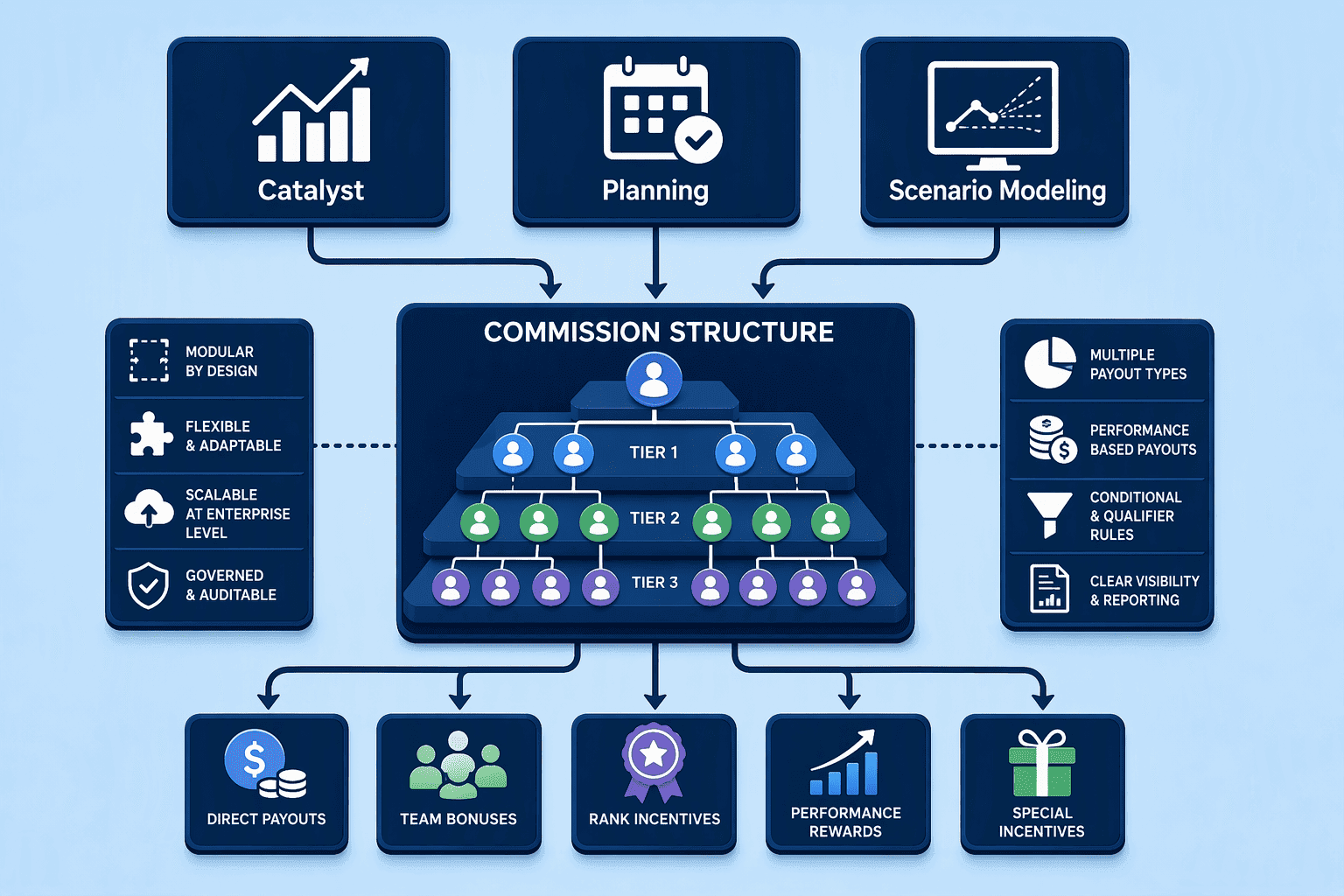
CaptivateIQ operates as one of three Gartner Leaders in the SPM space, with a platform that spans incentive compensation management, AI-driven plan design, and advanced scenario modeling. It sits in the enterprise tier, priced on a custom basis that scales with headcount and module selection, and targets organizations with complex, multi-layered commission structures.
Aeqium has positioned itself as a raw agentic AI play in the total rewards category. The agent answers plain-English prompts by running live analysis against your connected data, with the capability built into the platform at no extra charge. That puts it in a different pricing lane from advisory tools that bill AI features as a separate line item.
The interface strips away the traditional wizard-and-template approach in favor of a conversational instruction model. You describe the analysis you want (compare last year's merit distribution against current market benchmarks broken out by department, for instance) and the agent runs it without requiring you to configure filters, date ranges, or report schemas. For teams running frequent ad-hoc queries, this raw-query autonomy matters. Aeqium competes most directly with CompUp on the agentic-total-rewards flank, with Aeqium leaning harder into analytical throughput. The trade-off for that depth is a narrower feature surface outside the analysis core.
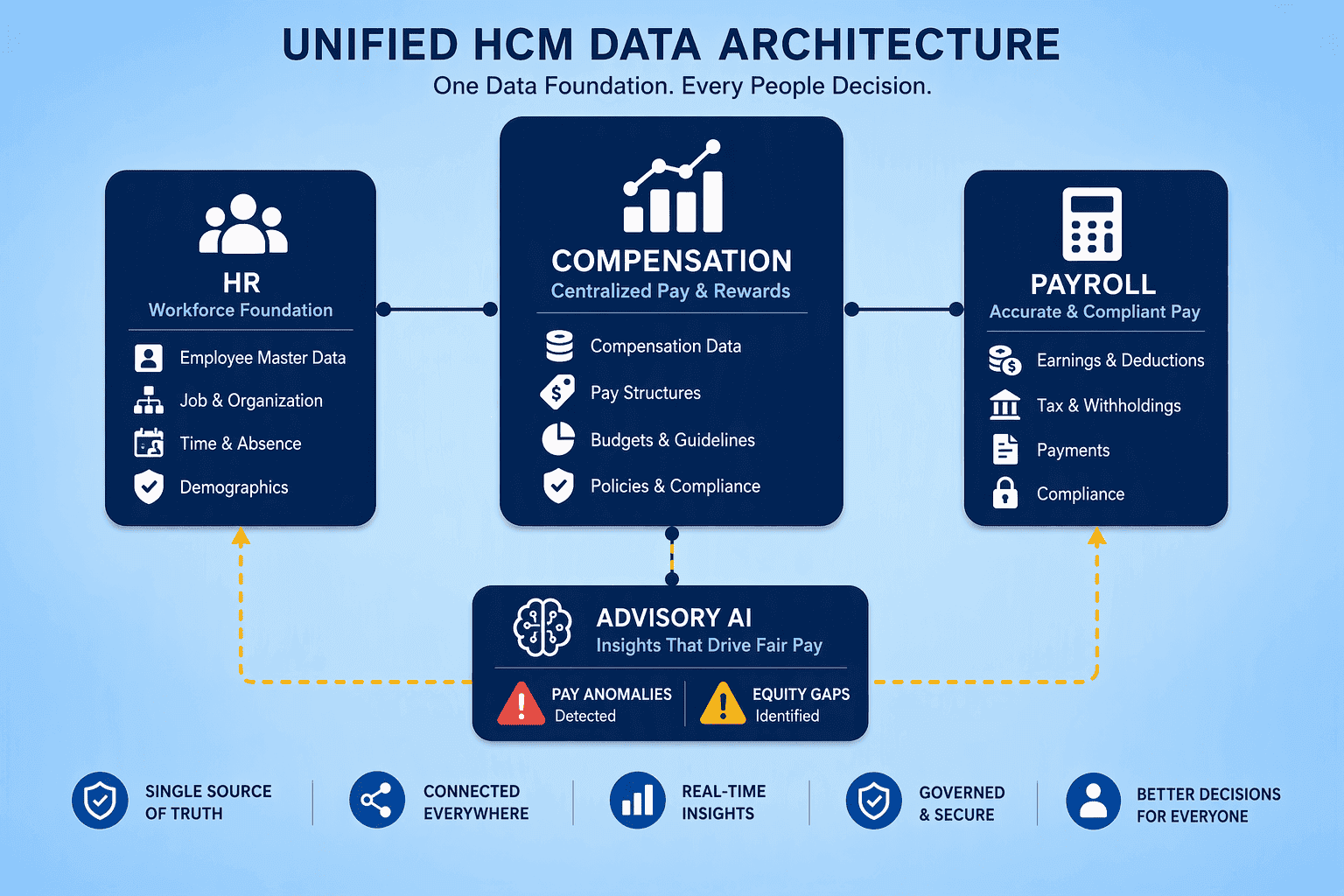
Workday is the dominant advisory AI platform in a market that's shifting toward agentic execution. Its compensation module lives inside a unified HCM suite. Compensation data shares a database with core HR, payroll, and talent management records.
The platform's AI surfaces anomalies in proposed compensation decisions and flags equity gaps. But those recommendations require vendor or partner involvement to act on. This advisory model fits organizations already committed to Workday's HCM ecosystem and comfortable with a services-led approach to compensation planning.
For companies running routine merit cycles and standard salary planning, Workday's unified architecture reduces reconciliation overhead. Compensation changes flow directly from planning into employee records without batch imports or API syncs that can drift. The integration depth is real. It arrives with trade-offs: implementation cycles stretch over quarters rather than weeks, and total services costs frequently eclipse the software subscription.
Total rewards teams evaluating Workday should weigh the advisory AI gap carefully. A competitor like CompUp or Aeqium will execute analysis from language instructions with no services wrapper, compressing cycle time. Workday asks you to accept a guided-but-mediated path as the price of full HCM integration. The right call depends on whether your compensation team values autonomy over architectural simplicity.
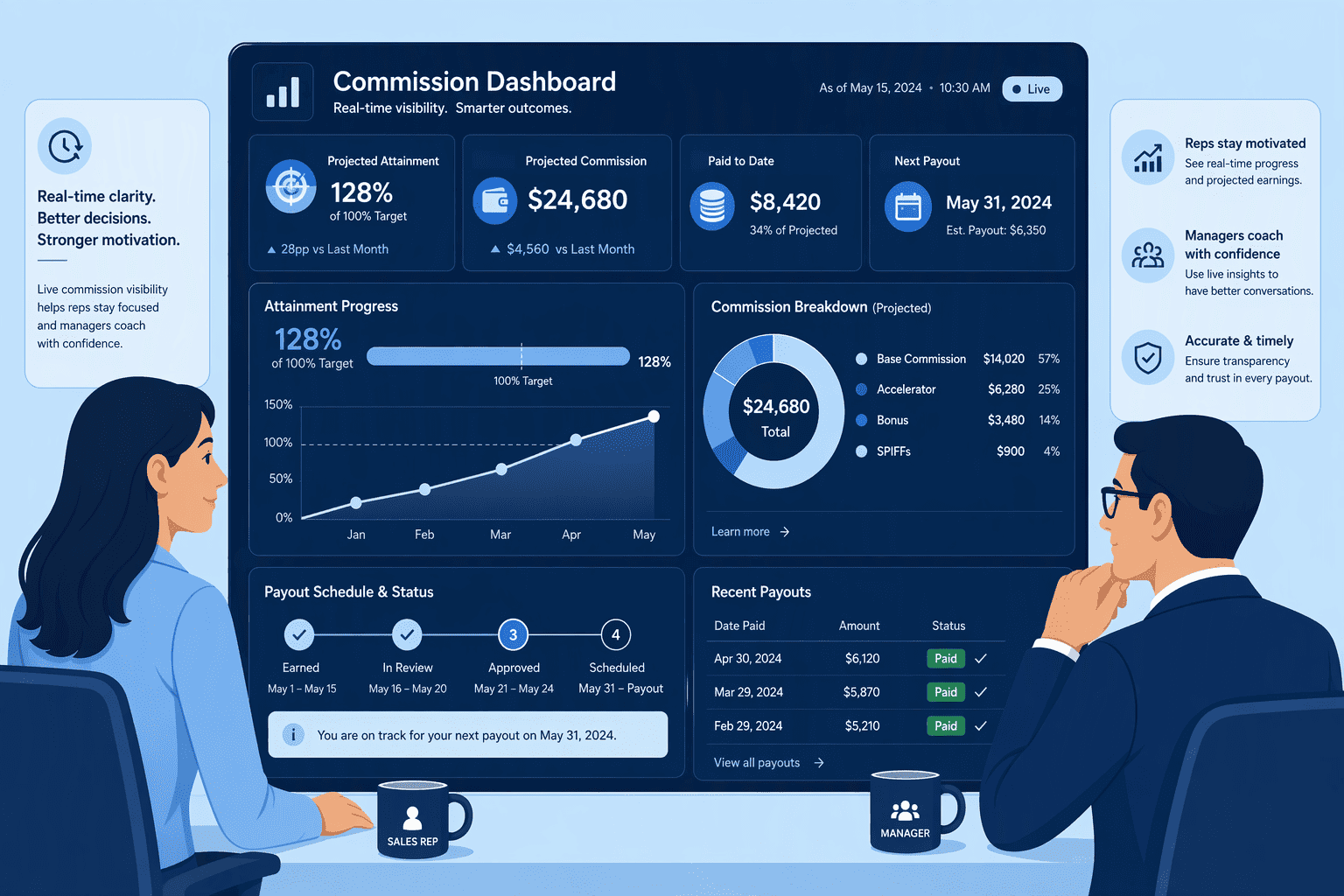
Everstage holds the highest G2 rating in the compensation planning category at 4.8, driven by its ability to give sales reps and managers real-time visibility into commission attainment and incentive performance. Legacy platforms keep calculation behind a black box. Everstage surfaces projected commissions directly to the rep, killing the shadow-accounting spreadsheets that plague sales teams and eat away at trust in plan accuracy.
The platform earned Gartner Challenger status in the July 2026 Magic Quadrant for SPM. It distinguished itself on user experience and adoption rather than breadth of enterprise feature coverage. That design focus translates into fewer disputes, lower inquiry volume to finance, and faster plan acceptance.
For organizations where incentive clarity and rep satisfaction are the primary pain points, Everstage's 4.8 rating signals it will deliver where mathematical accuracy alone has failed. The trade-off is that its visibility strengths leave it shallower on modeling depth compared with CaptivateIQ or QuotaPath. Teams that run frequent plan redesigns may need to pair it with a modeling-first tool.
Xactly is the veteran of the sales performance management category. It offers an end-to-end SPM suite covering modeling, crediting, calculation, analytics, and territory design, priced on a custom basis that scales with headcount and selected modules, with Xactly Incent listed at $60 per user per month for automation, forecasting, and audit readiness.
The platform's historical depth is material when compliance and auditability are non-negotiable. Sales compensation software needs SOC 2 certification, strong access controls, immutable logs, and clear calculation histories. Xactly was designed for that regulatory burden from its earliest architecture, which makes it a default shortlist candidate for public companies and heavily regulated industries running global compensation programs.
Xactly's launch of a competing agent suite on May 14, 2026, signals that even established enterprise vendors recognize the shift toward agentic execution. But the platform's core remains high-touch, with implementation and ongoing optimization typically requiring services engagement.
For large-scale deployments where thousands of payees and dozens of plan variations must be reconciled, Xactly's maturity is hard to replicate at lower price tiers. For mid-market teams that don't need that level of operational complexity, the total cost and implementation weight will feel outsized relative to QuotaPath or a self-serve modeling tool.
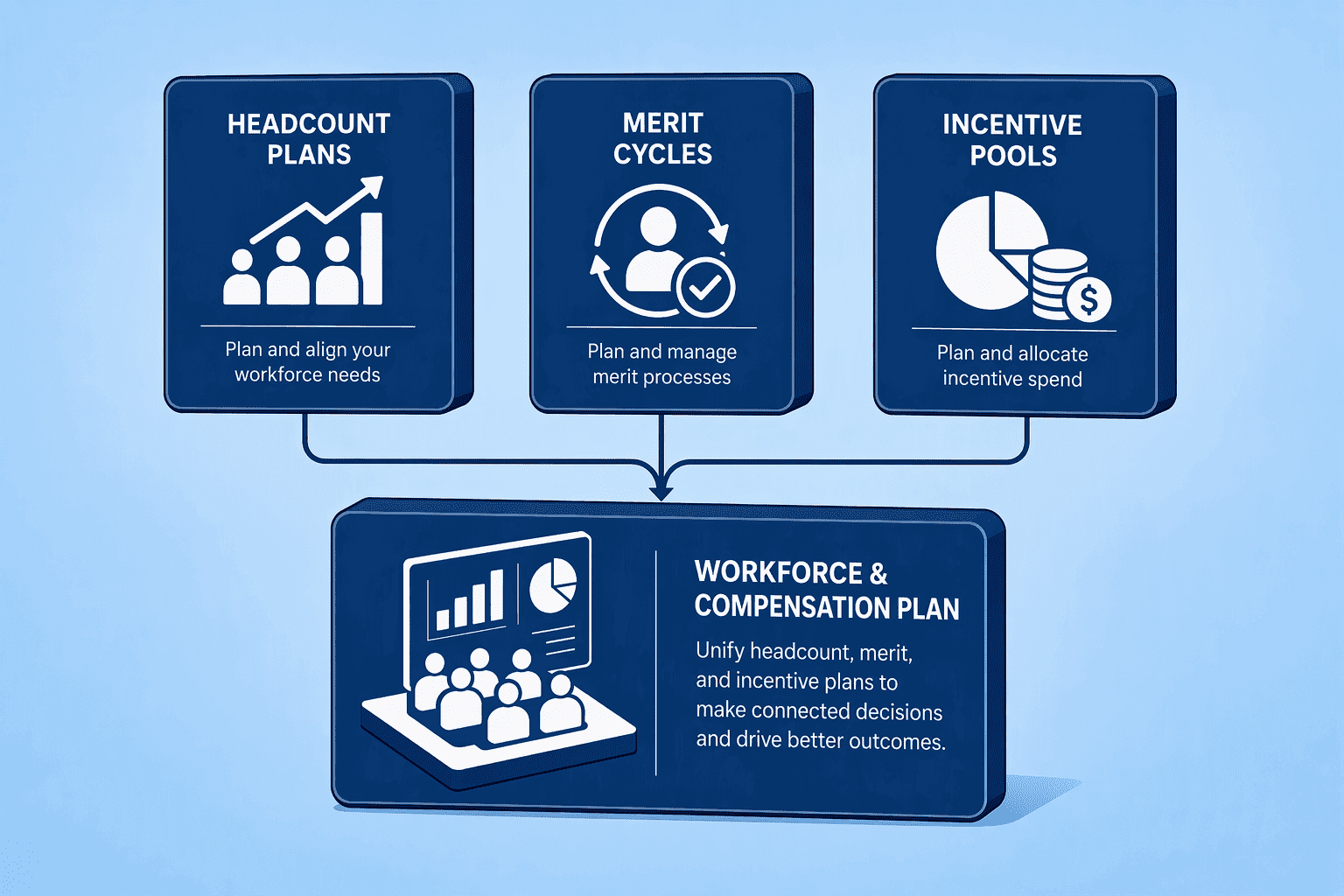
Anaplan holds a Gartner Leader designation for SPM and delivers workforce and compensation planning inside its broader connected-planning platform. The platform ties headcount plans, merit cycles, and incentive pools into a single model that finance and HR can share. The gap to understand: Anaplan lacks forward-looking cost-of-compensation modeling, so you can't calculate what a plan design will cost before roll-out.
Below is how Anaplan's compensation planning maps against dedicated SPM platforms and total rewards tools.
| Dimension | Anaplan | Dedicated SPM Tools (CaptivateIQ, Xactly) | Agentic Total Rewards (CompUp, Aeqium) |
|---|---|---|---|
| Modeling scope | Workforce planning + compensation modeling | Sales commission modeling (plan scenarios, quota, territory) | Total rewards modeling (salary, bonus, equity) with agentic AI execution |
| Cost-of-comp modeling | Not available | Available across all core SPM modules | Available in real-time budget simulation engines |
| AI delivery model | Advisory within planning models | Agentic (May/June 2026 agent suite launches) | Agentic, available at no added platform cost |
| Pricing model | Custom enterprise pricing | Varies; Xactly starts at $60/user/mo, CaptivateIQ custom, QuotaPath $35/user/mo + $525 platform fee | CompUp starts at $3/employee/year; Aeqium includes agentic AI at no additional cost |
| Best fit | Enterprises needing integrated workforce and compensation planning on one model | Sales operations teams managing high-rep-count, multi-plan environments | HR and total rewards teams needing fast, autonomous cycle execution without services |
The table below renders the eight platforms we evaluated across the dimensions that matter most in procurement decisions: AI delivery model, modeling type support, pricing transparency, user satisfaction, and ideal buyer profile.
| Platform | AI Type | Core Modeling | Pricing Model | G2 Rating | Ideal Buyer |
|---|---|---|---|---|---|
| CompUp | Agentic | Total rewards (salary, bonus, equity, pay equity) | Starts at $3/employee/year | 4.9 | HR and Total Rewards teams that want autonomous cycle execution without vendor services |
| QuotaPath with Atlas | Agentic (June 1, 2026 launch) | Sales commission (plan scenarios, quota capacity, territory carve, headcount) | $35/user/month + $525/mo platform fee | 4.7 | Revenue operations teams prioritizing cost-effective, full-spectrum modeling |
| CaptivateIQ | Agentic (May 14, 2026 agent suite) | Enterprise SPM with AI planning | Custom enterprise pricing | Not publicly listed at time of writing | Large enterprises with complex multi-plan structures |
| Aeqium | Agentic | Total rewards (real-time analysis, live cycle configuration) | Custom pricing; agentic AI included at no added cost | Not publicly listed at time of writing | Compensation analysts needing rapid ad-hoc query capability |
| Workday | Advisory | Unified HCM + compensation (merit, bonus, salary planning) | Custom enterprise pricing | Not publicly listed at time of writing | Organizations committed to Workday HCM and comfortable with services-led implementation |
| Everstage | Advisory with strong visibility layer | Sales commission (real-time visibility, incentive transparency) | Not publicly listed at time of writing | 4.8 (highest in category) | Teams prioritizing rep-facing commission transparency and user satisfaction |
| Xactly | Agentic (May 14, 2026 agent suite) | Enterprise SPM (modeling, crediting, analytics, territory) | $60/user/month for Incent; custom pricing for full suite | Not publicly listed at time of writing | Public companies and heavily regulated industries with global programs |
| Anaplan | Advisory (within connected planning) | Workforce + compensation planning (no dedicated cost-of-comp modeling) | Custom enterprise pricing | Gartner Leader designation (July 2026) | Enterprises needing integrated workforce and finance planning in a single model |
The compensation planning tool market in 2026 forces a binary decision early in the evaluation process. Sales-centric organizations should shortlist commission modeling leaders (QuotaPath for value, CaptivateIQ or Xactly for enterprise depth) because total rewards platforms were not built for territory carving or quota capacity planning. Total rewards teams decide between agentic AI platforms that execute autonomously from language instruction (CompUp, Aeqium) and advisory AI suites (Workday).
Advisory suites trade execution speed for architectural integration with the broader HCM stack. The cost of picking wrong is subscription dollars and cycle time. That operational drain compounds with every merit cycle and every commission plan revision that gets bogged down in vendor hand-offs. A good next step is seeing how CompUp puts this into practice.
When evaluating compensation platforms, focus on these five criteria:
Unified platforms like Workday embed pay equity inside the broader HCM record, reducing data drift. Standalone tools like CompUp connect pay equity analysis directly to compensation planning cycles, surfacing gaps during decision-making rather than after the fact. The trade-off is architectural simplicity versus cycle speed and depth.
For total rewards, CompUp and Aeqium offer real-time budget simulation triggered by plain-English instructions. For sales commissions, QuotaPath Atlas, CaptivateIQ, and Xactly provide scenario modeling across plan designs, quota capacity, and territory carve with immediate cost impact visibility.
Workforce planning forecasts headcount, demand, and manpower budgets. Compensation management handles salary, bonus, and equity cycles. CompUp offers distinct platform modules for each, competing with Anaplan and Workday Adaptive Planning on workforce planning and with Payscale and Aeqium on compensation management.
Pricing ranges from $3 per employee per year (CompUp) to $35 to 60 per user per month for sales commission tools (QuotaPath, Xactly). Enterprise SPM suites (CaptivateIQ, Anaplan, Workday) use custom pricing that scales with headcount and module count. Mid-market buyers should prioritize tools with published pricing to avoid procurement surprises.
CompUp holds a 4.9 G2 rating for compensation management with agentic AI execution. Everstage leads sales-side user satisfaction at 4.8. Aeqium provides strong agentic analysis at no added services cost. The Gartner Leaders quadrant (Anaplan, Varicent, CaptivateIQ) represents the enterprise generalist tier.
Community Manager (Marketing)
As a Community Manager, I’m passionate about fostering collaboration and knowledge sharing among professionals in compensation management and total rewards. I develop engaging content that simplifies complex topics, empowering others to excel and aim to drive collective growth through insight and connection.
Revolutionizing Pay Strategies: Don't Miss Our Latest Blogs on Compensation Benchmarking