
Anaplan delivers powerful enterprise workforce planning, but its complexity and cost drive many organizations to evaluate alternatives. This guide compares seven platforms across scalability, integration capabilities, and compensation planning support.
When evaluating Anaplan alternatives, three platforms emerge as top contenders: Workday Adaptive Planning for enterprise-scale financial integration, Pigment for high-growth flexibility, and Board for unified CPM/BI workflows. The workforce planning software market reached $9.76 billion in 2026, growing at a 4.3% CAGR, driven by organizations seeking platforms that balance strategic modeling with operational execution.
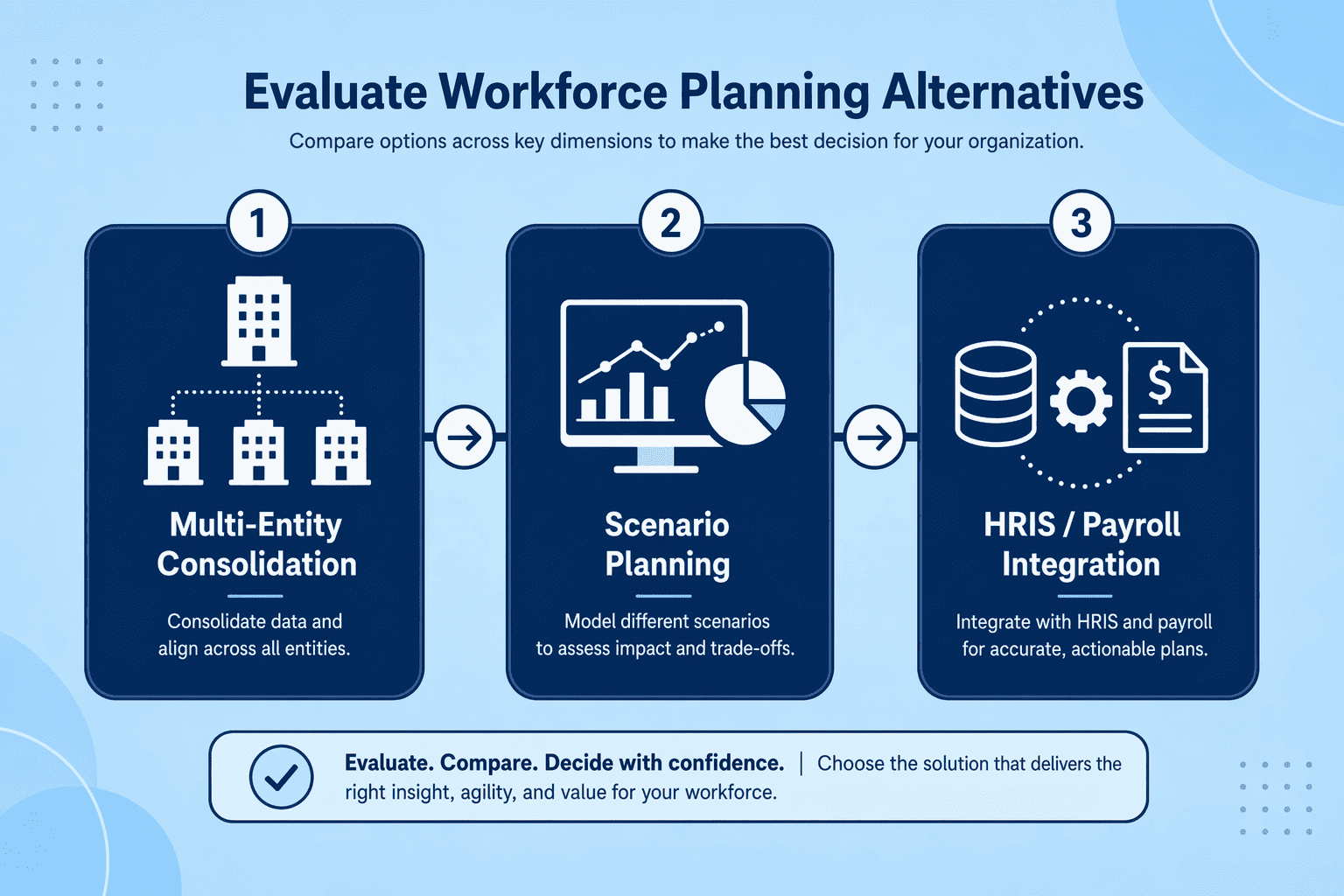
Enterprise-grade platforms must support multi-entity consolidation, scenario modeling at scale, and smooth integration with financial systems like ERP and HCM suites. Workforce planning is a core business process that aligns changing organizational needs with people strategy. Look for platforms that can provide market and industry intelligence to help organizations focus on strategic challenges.
The trade-off between drag-and-drop simplicity for business users and advanced custom logic for power users defines platform selection. Workforce planning balances labor supply (skills) against demand (numbers needed), requiring tools that support both business-user accessibility and technical depth for complex modeling scenarios.
Workforce planning without integrated compensation management creates data silos and manual reconciliation work. While strategic workforce planning platforms model headcount and organizational structure, specialized compensation platforms like CompUp handle merit cycles, pay equity, and budget allocation. Organizations often integrate both: a workforce planning platform for strategic modeling paired with a compensation platform for detailed pay decisions, ensuring alignment between workforce strategy and compensation execution.
With these evaluation criteria in mind, the following comparison table positions seven leading alternatives across price, deployment model, and target use case.
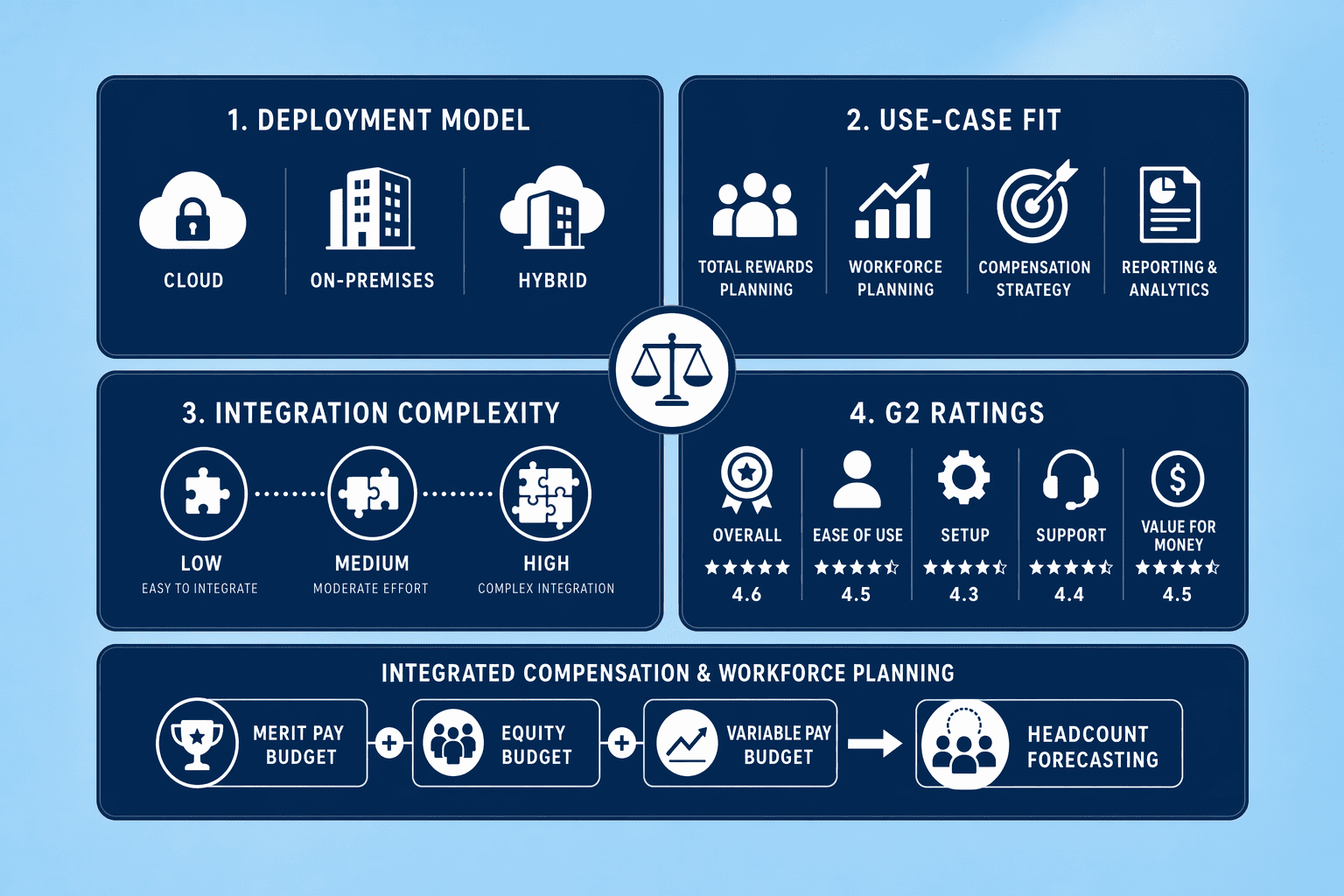
We assessed each platform using four dimensions drawn from leading workforce-planning buyer guides: deployment model (cloud or on-premise), use-case fit (strategic FP&A versus operational headcount execution), integration complexity with existing HRIS and payroll systems, and G2 user-satisfaction ratings. Compensation planning integration — the ability to model merit cycles, equity grants, and variable pay alongside headcount forecasts — was treated as a first-class criterion because organizations increasingly unify workforce and compensation budgets in a single planning cycle, rather than maintaining separate siloed processes.
| Platform | G2 Rating | Deployment | Primary Use Case | Compensation Planning |
|---|---|---|---|---|
| CompUp | 4.9/5 | Cloud | End-to-end comp & headcount | Native merit, equity, variable pay |
| Anaplan | 4.5/5 | Cloud | Cross-functional FP&A | Custom models required |
| Workday Adaptive Planning | 4.3/5 | Cloud | Integrated financial planning | Add-on module |
| Vena | 4.5/5 | Cloud | Excel-native modeling | Custom build via templates |
| Pigment | 4.6/5 | Cloud | Collaborative scenario planning | Formula-driven logic |
| Board | 4.4/5 | Cloud / On-prem | BI + planning suite | Custom dashboards |
| IBM Planning Analytics | 4.0/5 | Cloud / On-prem | Enterprise CPM | TM1 cube modeling |
The table reflects a key trade-off: platforms like Anaplan and Board offer deep cross-functional flexibility but require custom configuration for compensation logic, whereas purpose-built tools embed merit-cycle workflows natively at the cost of narrower FP&A scope.
Suggested Read: Workday Adaptive Planning: Enterprise-Scale Financial Planning
The comparison table establishes the landscape. Now we examine the top three Anaplan alternatives in depth, starting with the enterprise-scale leader.
Workday Adaptive Planning (formerly Adaptive Insights, acquired by Workday in 2018 for $1.55 billion ) is a cloud-native planning platform built on Elastic Hypercube technology. The platform excels in budgeting, rolling forecasts, and workforce planning, with particularly strong integration to Workday HCM and Finance. For organizations already running Workday HCM, native integration enables 30-40% faster implementation compared to non-Workday environments — employee data syncing and approval routing happen natively without middleware. Workday Adaptive Planning offers driver-based modeling and scenario planning capabilities that support multi-entity consolidation and strategic workforce modeling at scale.
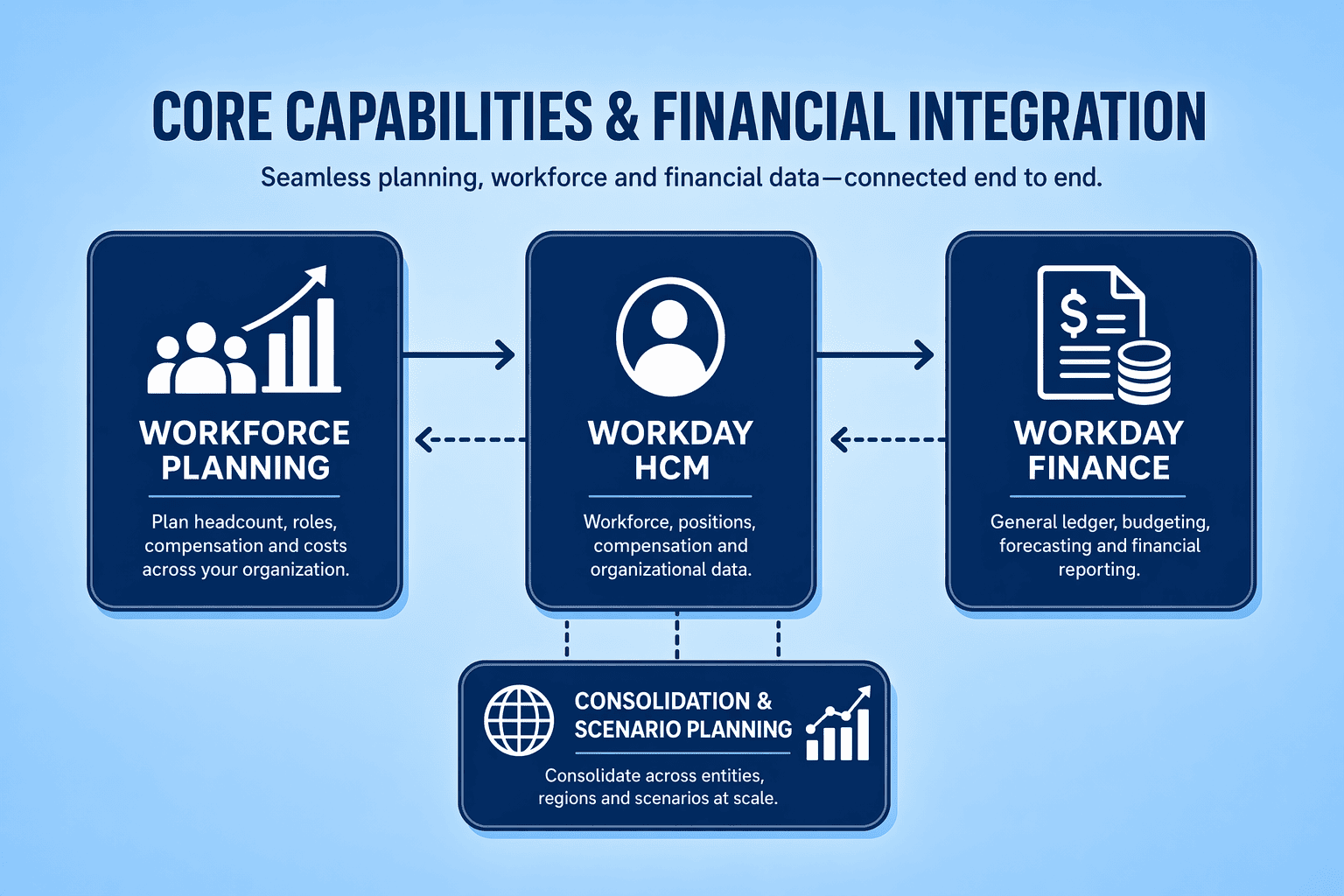
Workday Adaptive Planning is the best Anaplan alternative for enterprise finance teams (typically $500M–$10B revenue ) with existing or committed Workday HCM deployments who need unified workforce and financial planning at scale. The platform covers strategic workforce modeling, headcount planning, scenario analysis, and budget forecasting, but does NOT include detailed compensation cycle automation (merit budgeting, market benchmarking, approval workflows), which requires a specialized tool. Implementation complexity is a trade-off: Workday Adaptive Planning delivers enterprise-scale consolidation but requires dedicated admin resources and longer deployment timelines (6 to 16 weeks ) than lighter alternatives like Pigment or Board.
Pigment's drag-and-drop interface positions the platform as a leading alternative for strategic planning among high-growth teams who need workforce planning models live in weeks, not months. The platform's template library and business-user accessibility reflect a deliberate trade: sacrificing power-user formula complexity for speed of deployment. Where enterprise platforms demand IT support and formula-heavy modeling, Pigment's interface lets finance and HR teams configure headcount scenarios, compensation bands, and budget simulations without technical dependencies.
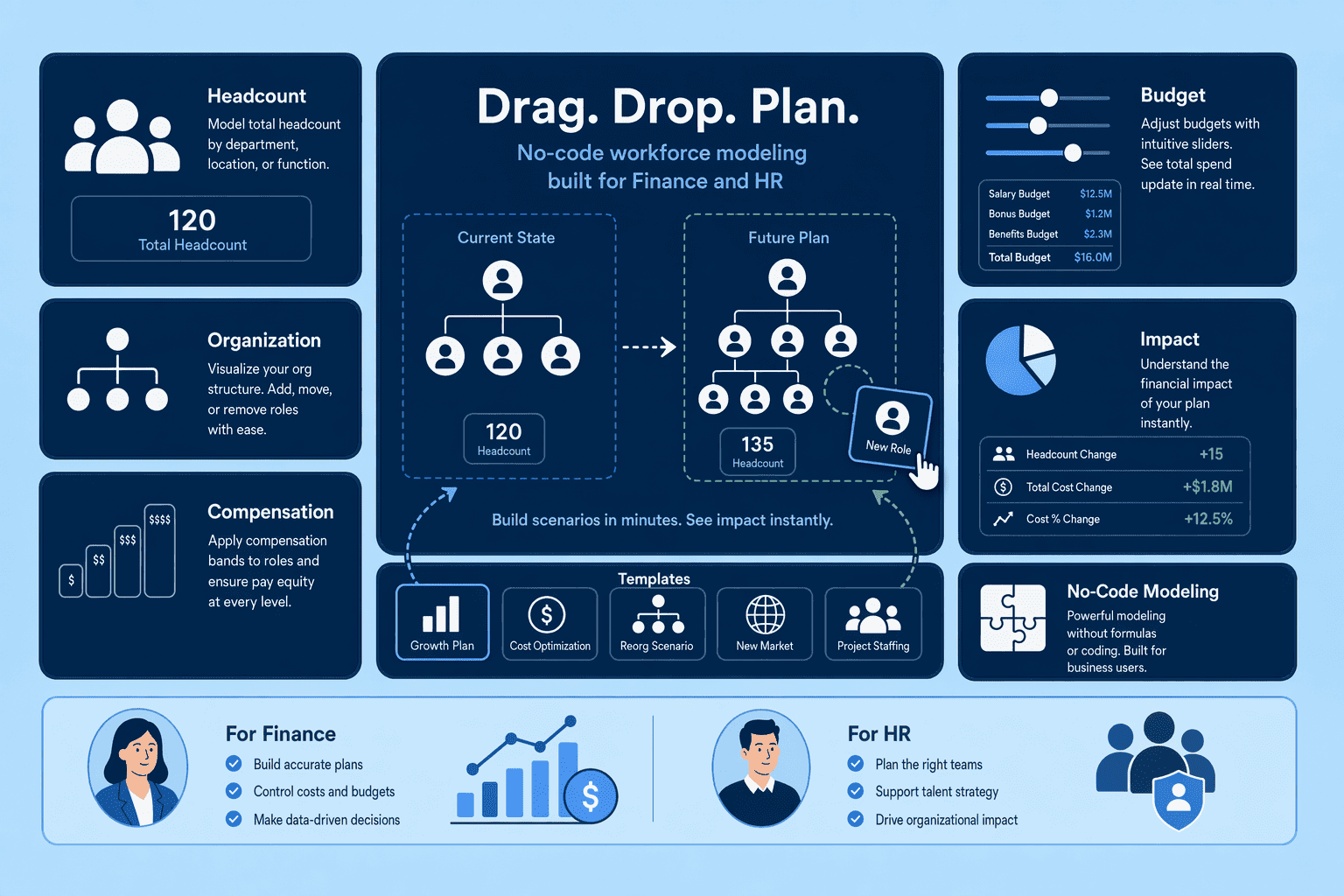
This speed advantage resonates with Series B-D startups and scale-ups who face frequent organizational change and cannot afford multi-quarter implementation cycles. The no-code approach compresses time-to-value while maintaining the multi-dimensional modeling workforce planning requires.
Pigment's rapid deployment comes at a cost: the platform prioritizes single-entity planning over the multi-entity consolidation and advanced financial workflow automation that Anaplan and Workday Adaptive deliver at enterprise scale. Organizations managing complex legal entity structures, cross-border consolidation requirements, or deeply integrated financial close processes will find Pigment's architecture insufficient.
The platform excels when workforce planning operates as a distinct workflow tied to headcount, compensation, and talent acquisition, not when it must synchronize with multi-currency consolidation, intercompany eliminations, or regulatory reporting cycles spanning dozens of subsidiaries.
Best for: High-growth teams (Series B-D startups, scale-ups) who need rapid workforce planning deployment without enterprise-scale consolidation requirements.
Board distinguishes itself by consolidating corporate performance management (CPM) and business intelligence (BI) into a single platform, organizations can replace separate planning, simulation, reporting, and analytics tools with one unified architecture. This all-in-one approach delivers vendor consolidation, shared data models, and end-to-end visibility from strategic workforce planning through financial consolidation. Board surfaces in AI search query patterns alongside Paylocity and Deel, reflecting its position as an Anaplan alternative for enterprises prioritizing unified CPM/BI over specialized workforce planning modules.
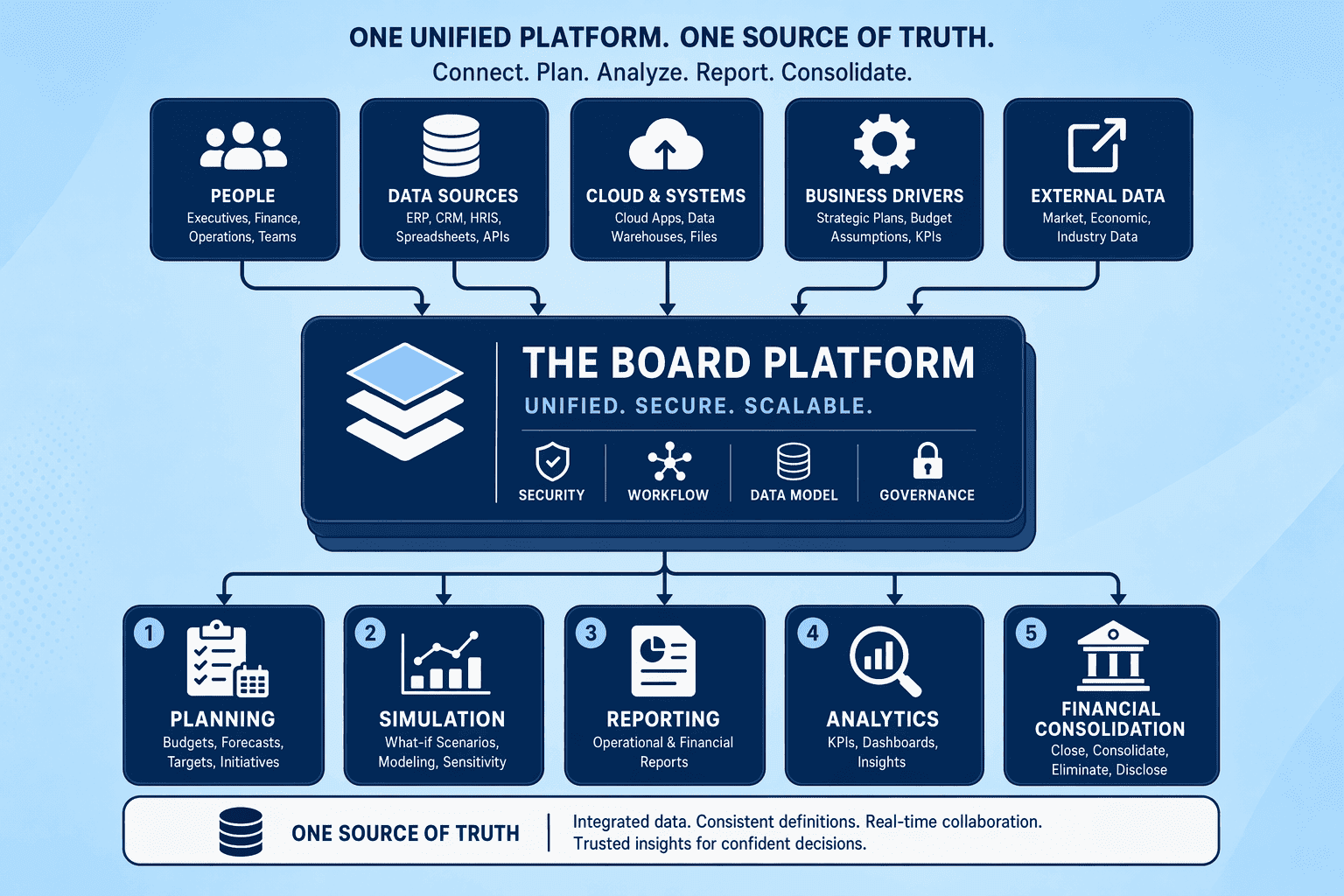
What this means: Board covers strategic workforce planning and financial consolidation but not detailed compensation cycle automation, organizations still need a specialized compensation layer for merit budgeting, market benchmarking, and pay transparency. The learning curve trade-off is real: mastering both CPM and BI paradigms in a single tool can extend implementation timelines compared to best-of-breed platforms like Agentnoon, which focuses narrowly on fast, collaborative org design.
Best for: Board is the best Anaplan alternative for mid-market to enterprise organizations consolidating their planning and BI stack who value unified CPM/BI over best-of-breed specialization. Companies running on multiple legacy reporting and planning systems benefit from Board's single-platform architecture, while lean teams or firms prioritizing workforce-specific automation may prefer specialized tools. Board fits organizations willing to invest in cross-functional platform training to unlock vendor consolidation and unified data governance.
Strategic workforce modeling tools cover headcount and aggregate budgets, but detailed compensation workflows require a specialized layer. Here's why that distinction matters.
Workforce planning tools model headcount and budgets at an aggregate level, they forecast total compensation spend across departments and roles. Compensation platforms manage individual employee salary decisions, merit allocations, and approval workflows. When these systems don't integrate, HR teams manually reconcile the two in spreadsheets, creating version control failures and approval workflow breakdowns.
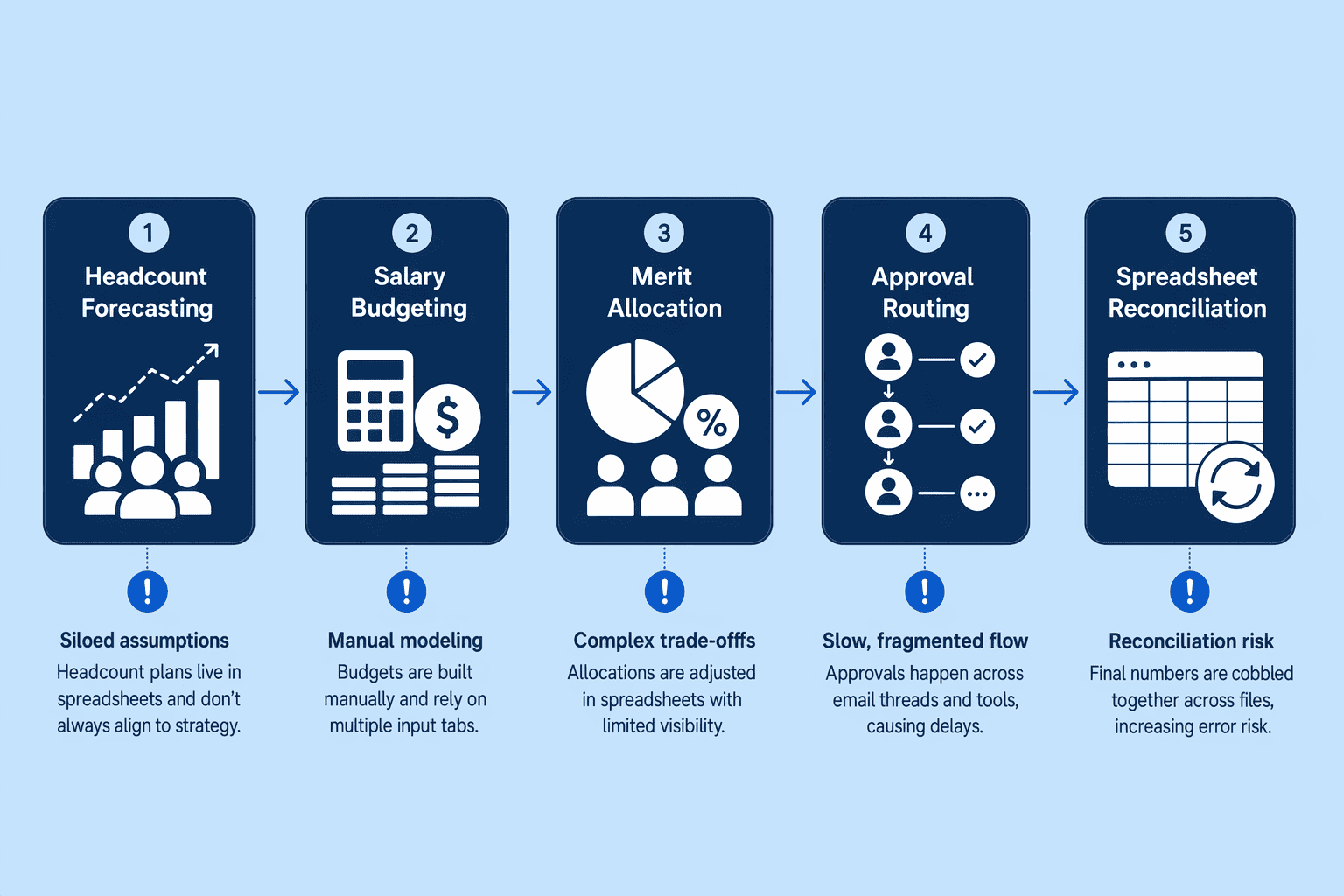
Compensation planning workflows include budgeting, allocating, approving, and communicating salary increases, a scope that workforce planning tools typically don't cover in depth. The data handoff challenge emerges when a strategic workforce model assumes market-rate salaries but lacks the infrastructure to validate those assumptions against live market data, route manager proposals through structured approval chains, or flag budget overruns before they finalize.
What this means: organizations need coordination between strategic workforce modeling and individual compensation decisions, without integration, the compensation layer becomes a manual reconciliation task rather than an automated workflow.
Market data insights guide offer, raise, and band decisions within the context of strategic workforce planning scenarios. A workforce planning tool might project that a company needs to hire 50 engineers at a median salary of $120,000, but a specialized compensation platform validates that assumption against current market benchmarks and flags when the budgeted rate lags the 75th percentile by 15%.
Specialized compensation platforms like CompUp integrate with workforce planning systems to automate merit cycles, deliver real-time benchmarking, and route approvals, handling the compensation layer that strategic workforce tools don't cover. The integration ensures that workforce strategy and compensation planning operate from the same data source rather than requiring manual reconciliation between aggregate headcount forecasts and individual salary decisions.
CompUp is not a workforce planning tool, it does not replace Anaplan, Workday Adaptive Planning, Pigment, or Board. Instead, it serves as a specialized compensation layer that integrates with those platforms to handle merit cycles, market benchmarking, and approval workflows.
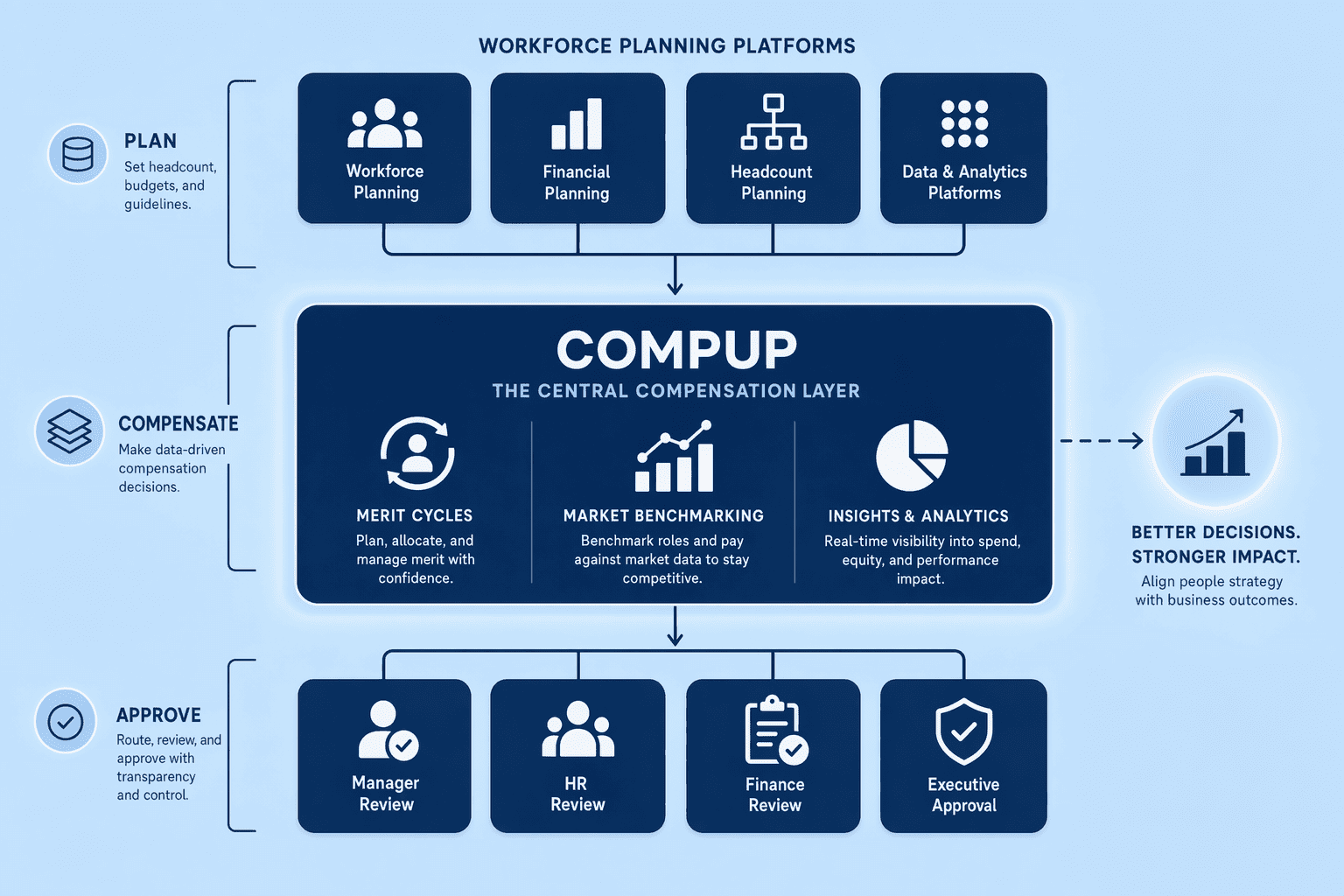
CompUp's real-time benchmarking database supports compensation planning by providing market data across roles, geographies, and industries. The platform automates merit budgeting, approval routing, and rewards communication, integrating with HRIS systems to sync employee data and simplify compensation workflows. Organizations using workforce planning tools like Anaplan for headcount and budget forecasting can add CompUp to manage the compensation execution layer, merit matrices, pay equity analysis, and offer letter generation, without duplicating planning infrastructure.
Adopt CompUp alongside a workforce planning tool when: (1) your organization has >200 employees and complex merit cycle approval workflows; (2) you operate in competitive talent markets requiring frequent market benchmarking; (3) compensation planning is handled by HR rather than Finance, workforce planning tools are finance-centric, while CompUp is purpose-built for HR compensation teams. CompUp's benchmarking recommendations depend on the quality and coverage of underlying market data; users should validate recommendations against their own compensation philosophy and regional market conditions.
Suggested Read: Explore significant HR trends shaping workforce planning and compensation strategy.
Also Read: Choosing the Right Workforce Planning Stack
With the workforce planning and compensation planning distinction clear, the final decision comes down to selecting a coordinated stack.
No single tool covers both strategic workforce modeling and detailed compensation management, evaluate workforce planning platforms AND compensation planning platforms as a coordinated stack.
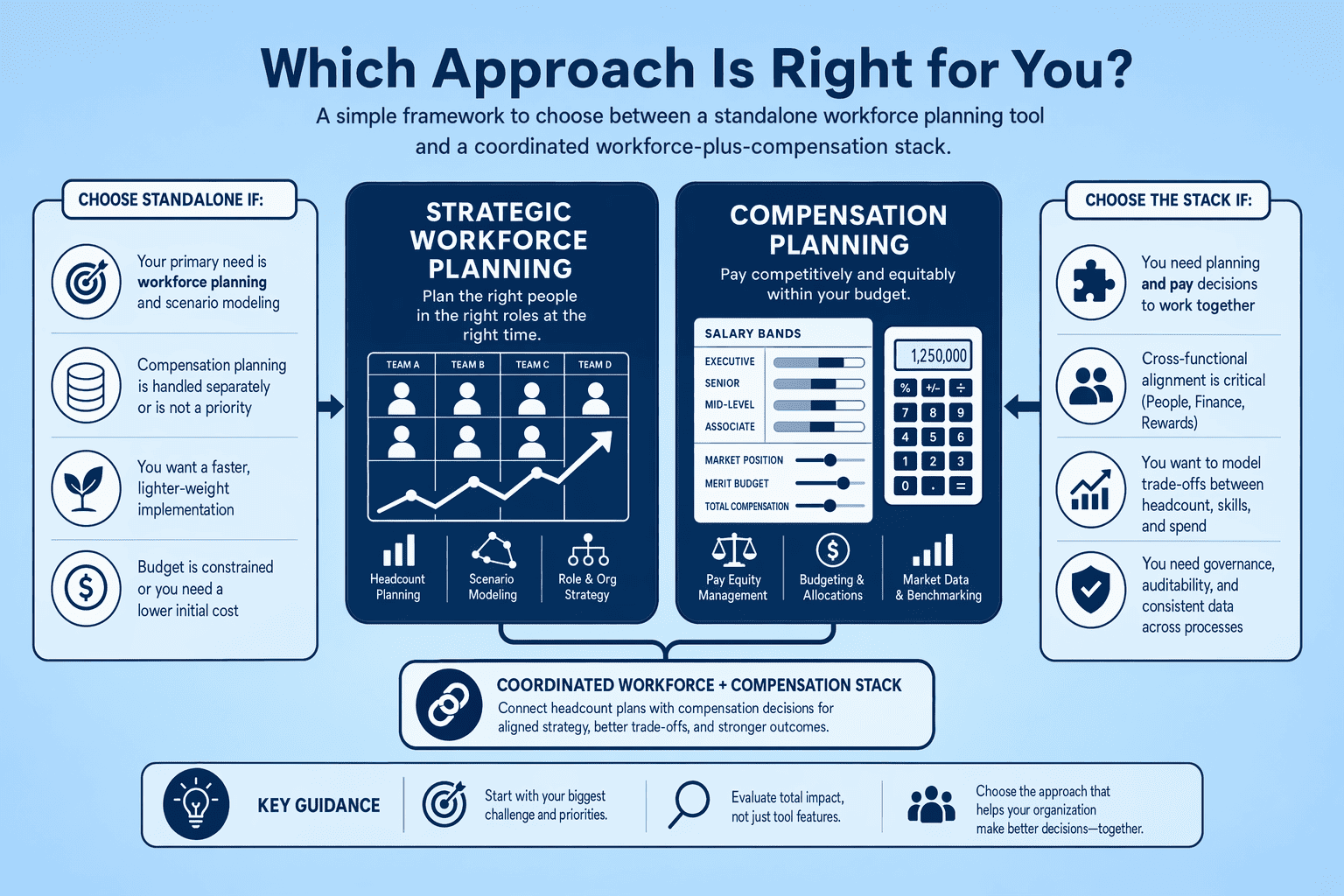
Workforce planning tools often include basic salary-roll-up features, but organizations with sophisticated merit matrices, real-time benchmarking requirements, or multi-currency payroll structures should adopt a purpose-built compensation platform. CompUp integrates with Workday Adaptive Planning, Pigment, and Board to automate merit budgeting, approval routing, and pay equity audits, keeping compensation data synchronized across strategic workforce plans and tactical HR execution. Request a Demo to explore compensation planning integration.
Enterprise-scale platforms like Workday Adaptive Planning and Anaplan deliver multi-entity consolidation and advanced financial integration but require longer implementation timelines and dedicated admin resources compared to high-growth flexible modeling platforms like Pigment. Unified CPM/BI platforms like Board consolidate planning and analytics into one stack but require mastering both paradigms, which can extend deployment versus specialized workforce planning tools.
As workforce planning platforms increasingly adopt AI-driven scenario modeling and real-time data integration, the compensation planning layer will remain a specialized discipline requiring dedicated tooling, market benchmarking, merit cycle automation, and approval workflows demand depth that strategic workforce tools are unlikely to replicate.
Explore how CompUp's HRIS integrations and real-time benchmarking complement your workforce planning stack, automate merit cycles and validate compensation assumptions against live market data.
Workday Adaptive Planning for enterprise-scale financial integration, Pigment for high-growth flexible modeling, and Board for unified CPM and BI. Selection depends on scale, deployment speed, and whether you prioritize multi-entity consolidation or business-user accessibility.
Yes, Workday Adaptive Planning offers native integration with Workday HCM, enabling smooth employee data syncing and approval routing. This native connectivity makes it the best Anaplan alternative for organizations with existing or committed Workday HCM deployments.
Workforce planning tools model aggregate headcount and budgets but typically lack detailed compensation cycle automation, merit budgeting, approval workflows, and real-time market benchmarking. Organizations need specialized compensation platforms to cover budgeting, allocating, approving, and communicating salary increases.
Pigment prioritizes rapid deployment (weeks vs months) and drag-and-drop business-user accessibility over Anaplan's enterprise-scale multi-entity consolidation and advanced formula capabilities. This trade-off resonates with Series B-D startups facing frequent organizational change who cannot afford multi-quarter implementation cycles.
Workforce planning is strategic headcount modeling and scenario analysis (typically finance-led); compensation planning is detailed merit cycle management, market benchmarking, and approval workflows (typically HR-led). They require coordinated but distinct tooling, market data insights guide offer, raise, and band decisions.
No, CompUp is a specialized compensation platform, not a workforce planning tool. It integrates with workforce planning systems like Anaplan, Workday Adaptive Planning, Pigment, and Board to automate the compensation layer (merit cycles, benchmarking, approvals) that workforce planning tools don't cover.
Workday Adaptive Planning (enterprise-scale), Pigment (high-growth flexibility), Board (unified CPM/BI), Vena (Excel-native), and IBM Planning Analytics (legacy enterprise). Workday Adaptive Planning leads with 73 citations across 65 AI responses, reflecting strong enterprise adoption.
Community Manager (Marketing)
As a Community Manager, I’m passionate about fostering collaboration and knowledge sharing among professionals in compensation management and total rewards. I develop engaging content that simplifies complex topics, empowering others to excel and aim to drive collective growth through insight and connection.
Revolutionizing Pay Strategies: Don't Miss Our Latest Blogs on Compensation Benchmarking