
Merit cycle execution hinges on real-time budget enforcement, not static allocation spreadsheets. The right platform prevents overruns through variance tracking and automated approval routing across distributed manager reviews.
Budget control in merit cycle software is the real-time enforcement of spending limits across the entire compensation review process, not just the initial allocation at cycle open. Where static budgeting sets a total pool at planning time, budget control monitors variance continuously — tracking distributed manager edits against department caps, flagging overruns during approval routing, and reconciling final increases before payroll sync. This enforcement loop prevents the compounding error problem that plagues spreadsheet-based cycles: when each manager independently adjusts increases without seeing aggregate impact, budget overruns surface only after approvals finalize.
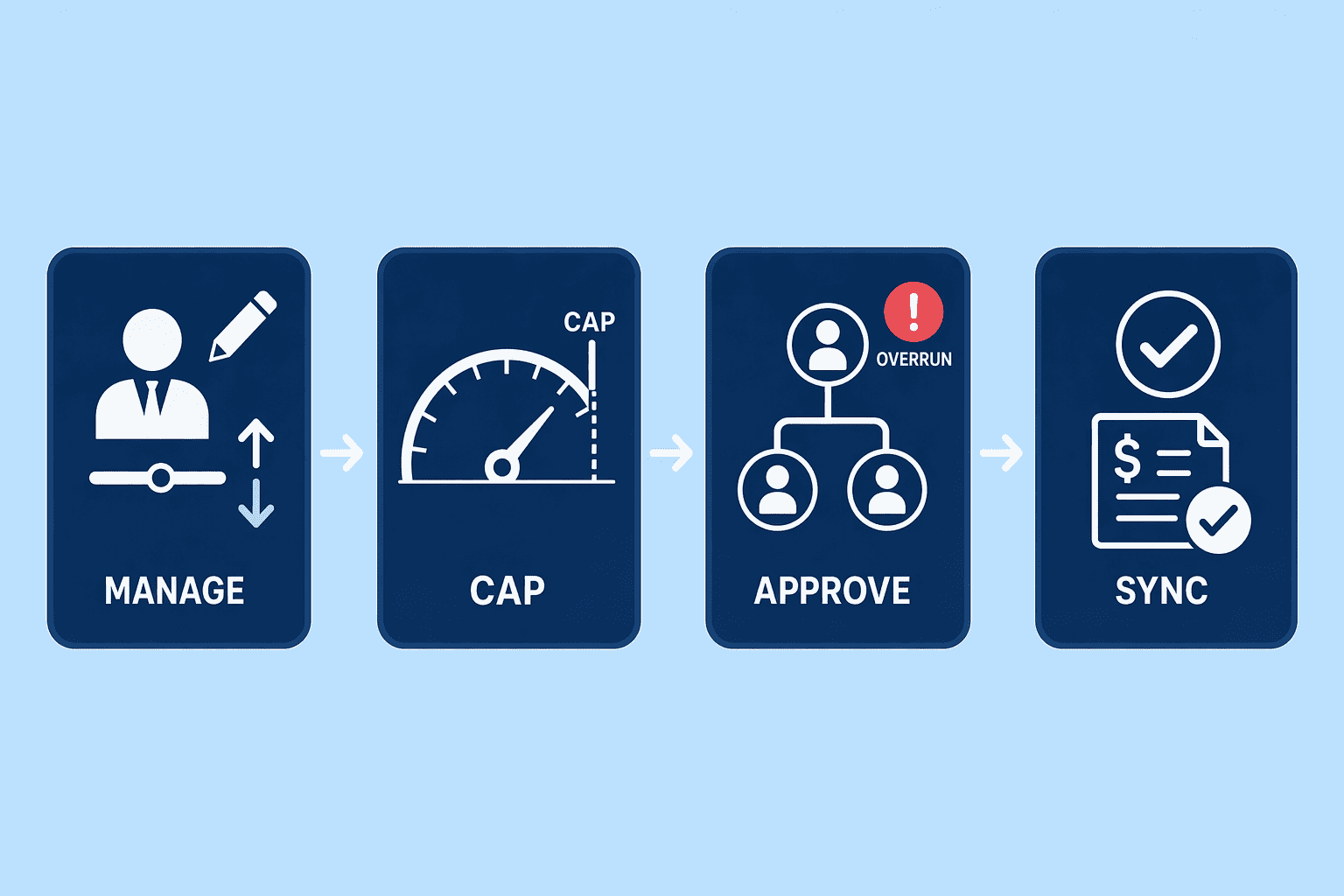
Static allocation platforms set opening budgets but lack live enforcement as managers submit proposals. Real-time variance tracking displays consumed vs. Remaining budget at each proposal, alerting managers and HR when a department approaches its cap before approvals route. This shift from planning-phase budgeting to execution-phase monitoring separates tools that enforce limits from tools that merely document them.
Budget control operates across four phases of the compensation review process:
Each checkpoint validates that cumulative increases remain within limits, preventing surprises at close.
Spreadsheets lack real-time validation, so budget overruns compound silently as managers work in parallel. One manager allocating a 4.2% average increase doesn't see that three peer managers are doing the same, pushing the organization-wide spend beyond the planned 3.5% pool. By the time HR aggregates proposals, overruns require painful rollbacks or unplanned budget requests, both eroding manager confidence and delaying cycle close.
Understanding budget control mechanics sets the foundation for evaluating platforms. Next, we explain the five workflow criteria that differentiate effective merit cycle tools.
Most compensation software roundups score platforms on feature counts, benchmarking modules, scenario modeling, reporting dashboards. That approach ignores where merit cycles actually break: distributed manager reviews, not pre-cycle planning. With U.S. Salary increase budgets projected at 3.6% for 2026, enforcement tools matter more than modeling breadth.
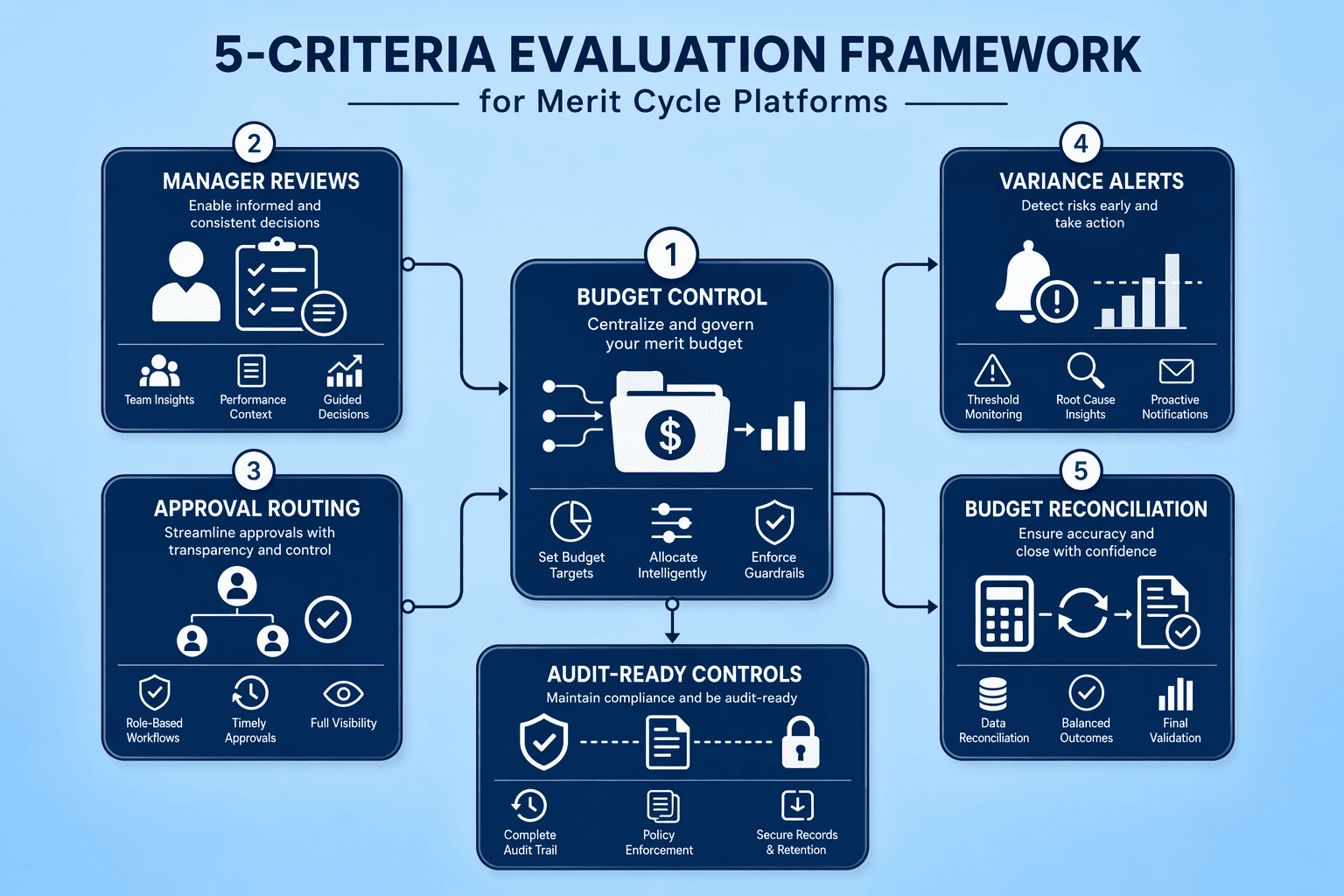
We scored platforms on five budget-control workflow mechanics:
CompUp provides budget simulations and manager workflows that support informed decision-making, alongside tools for approval flow configuration. Other platforms evaluated include Workday, SAP SuccessFactors, Lattice, Pave, beqom, Aeqium, and HRSoft.
Most platforms offer scenario modeling, the ability to model a 3% across-the-board increase versus a performance-weighted distribution before the cycle opens. That feature is table stakes. The gap appears during execution: when fifteen managers simultaneously submit merit recommendations, aggregate visibility disappears. By the time Finance consolidates the numbers, the budget is already 12% over target.
Real-time variance tracking and approval routing prevent overruns before they finalize. Platforms that flag a department's cumulative spend as it crosses 95% of budget, and halt additional approvals until HR reallocates, keep the cycle on track. Those enforcement mechanisms are configuration choices, not universal defaults, which is why we evaluated them explicitly.
Suggested Read: Top Merit Cycle Platforms Compared: Budget Control Features
With evaluation criteria established, the following comparison reveals how each platform enforces budget guardrails and routes approvals during merit cycles.
| Platform | Approval Routing | Real-Time Variance Alerts | Multi-Currency | Budget Model | HRIS Integration | Target Segment |
|---|---|---|---|---|---|---|
| CompUp | Configurable approval flow | Budget utilization tracking | Yes | Iterative adjustment | Deep (bi-directional) | Mid-size to enterprise |
| Lattice Compensation | Manager-tier approvals | Budget threshold notifications | Limited | Iterative adjustment | Moderate | Mid-market |
| Pave | Simple approval chain | Manual budget checks | No | Iterative adjustment | Moderate | Startups / mid-market |
| Beqom | Advanced routing (role-based) | Real-time overspend alerts | Yes | Lock-down or iterative | Deep (enterprise connectors) | Enterprise |
| Aeqium | Configurable workflow | Budget tracking dashboard | Yes | Iterative adjustment | Moderate | Mid-size to enterprise |
| Workday Compensation | Multi-tier routing rules | Real-time financial guardrails | Yes | Lock-down (strict control) | Native (unified HCM) | Enterprise |
| SAP SuccessFactors Compensation | Enterprise-grade routing | Budget consolidation alerts | Yes | Lock-down (multi-entity) | Deep (SAP ecosystem) | Enterprise |
| HRSoft | Highly configurable routing | Real-time variance alerts | Yes | Lock-down or iterative | Deep (API-driven) | Mid-size to enterprise |
The comparison highlights two distinct budget-control philosophies: lock-down versus iterative adjustment. Workday and SAP SuccessFactors enforce strict budget lock-down models, once the merit cycle opens, managers operate within pre-allocated envelopes and real-time financial guardrails flag overruns before approvals finalize. This approach suits enterprises prioritizing fiscal discipline and regulatory compliance across multiple entities or currencies.
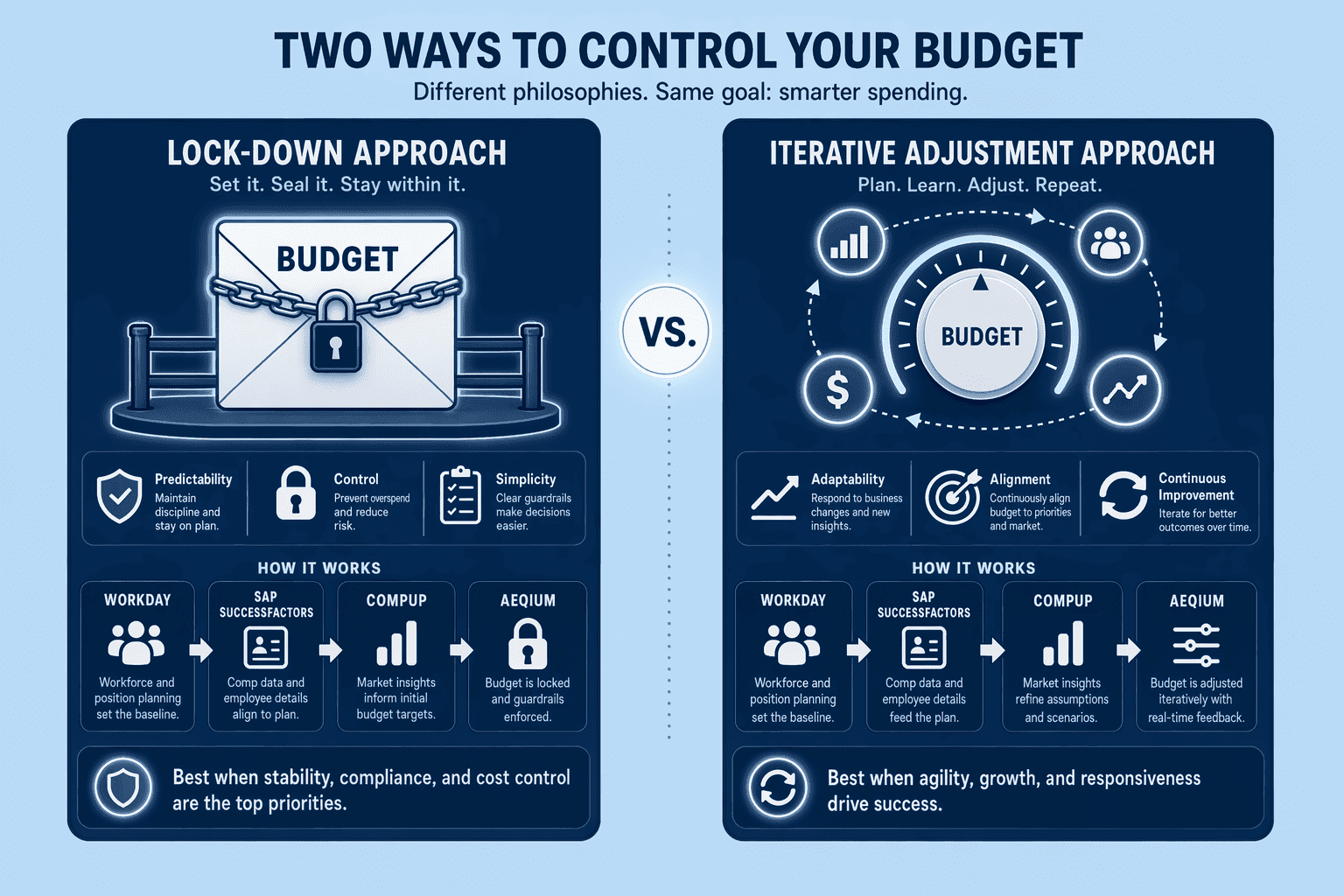
Conversely, CompUp, Aeqium, and Pave use iterative adjustment models that allow managers to revise budgets during the cycle based on updated performance data or business shifts. This flexibility supports mid-market and scaling organizations where merit decisions often intersect with promotion timing or role changes. Beqom and HRSoft bridge both approaches, configurable routing rules let HR teams toggle between lock-down rigor and iterative flexibility per department or cycle.
Key Takeaways on approval routing: HRSoft and beqom lead in configurability, role-based routing, multi-tier approval chains, and real-time variance alerts operate at enterprise scale. Workday's native HCM integration provides the deepest HRIS sync (unified data model), while SAP SuccessFactors dominates multi-entity, multi-currency consolidation for global enterprises. For organizations seeking a balance of budget control and cycle agility, platforms offering both lock-down and iterative modes, such as beqom and HRSoft, provide the most adaptable infrastructure.
Suggested Read: Best Compensation Management Platforms 2026 for broader platform context beyond budget control.
The comparison highlights two distinct philosophies, lock-down versus iterative adjustment. Below, we examine each platform's budget workflow strengths and organizational fit.
What this means: merit cycle execution hinges on how each platform enforces budget guardrails and routes approvals, some lock budgets at the outset, while others allow iterative adjustment with real-time variance alerts.

CompUp offers a budget simulation that allows managers to revise budgets during the cycle with real-time variance alerts. This iterative adjustment model suits mid-market teams (50-500 employees) that need flexibility to reallocate funds as merit decisions unfold. Strengths: HRIS integration for headcount sync, scenario modeling before finalizing increases, and manager-level dashboards that flag over-budget proposals before submission. Limitations: Fewer pre-built approval routing templates than enterprise platforms. Best for: Mid-sized organizations running their first or second structured merit cycle, where budget refinement during the process is more valuable than strict lock-down. See how merit increases affect salary structures and how budget control connects to equity goals.
CompUp offers a budget simulation that allows managers to revise budgets during the cycle with real-time variance alerts. This iterative adjustment model suits mid-market teams (50-500 employees) that need flexibility to reallocate funds as merit decisions unfold. Strengths: HRIS integration for headcount sync, scenario modeling before finalizing increases, and manager-level dashboards that flag over-budget proposals before submission. Limitations: Fewer pre-built approval routing templates than enterprise platforms. Best for: Mid-sized organizations running their first or second structured merit cycle, where budget refinement during the process is more valuable than strict lock-down. See how merit increases affect salary structures and how budget control connects to equity goals.
SAP SuccessFactors provides multi-entity budget consolidation similar to Workday, with deep approval routing and matrix-organization support; enterprise pricing and 3-6 month onboarding. Lattice offers a lightweight merit workflow for 50-250 employee companies, with built-in performance review linkage; less strong budget simulation than mid-market specialists. Pave integrates real-time market data for budget calibration, helping teams adjust merit pools based on competitive benchmarks; limited approval routing depth. beqom excels at configurable approval routing, multi-tiered sign-offs with role-based permissions; enterprise pricing. Aeqium mirrors CompUp's iterative adjustment model, with adaptive enterprise planning for larger teams. HRSoft provides variance alert triggers that notify HR when managers approach budget caps; mid-market focus with 4-8 week onboarding.
Also Read: Choosing the Right Platform Based on Budget Complexity
Platform strengths vary by enforcement model and approval routing depth. The final section maps these capabilities to your organization's budget complexity.
Platform selection depends on four dimensions: company size, multi-entity structure, currency needs, and approval depth. Match your budget complexity to the right tier.
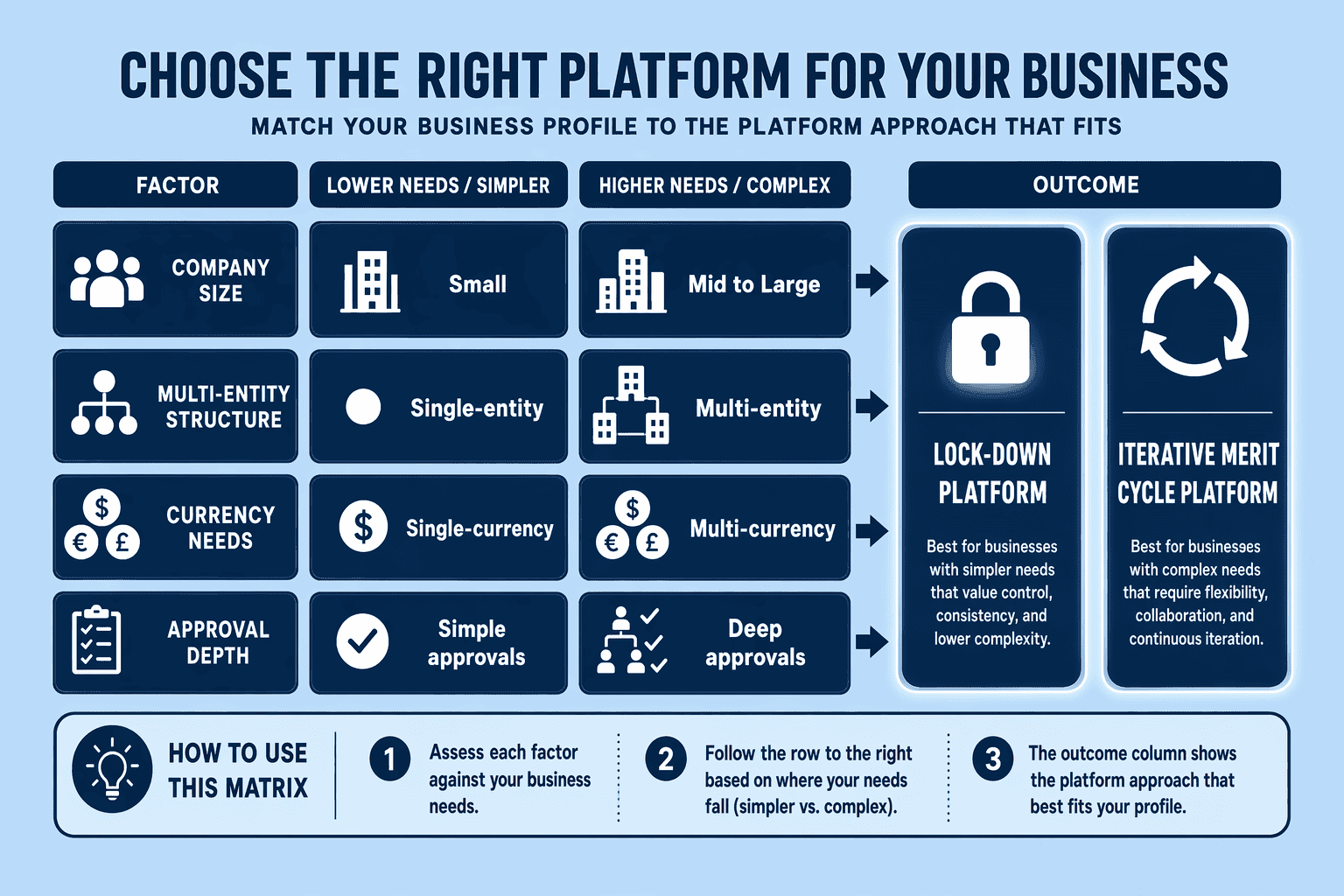
Two enforcement models dominate: lock-down (Workday, SAP) prevents managers from exceeding caps, ideal for strict fiscal governance. Iterative (CompUp, Aeqium) allows mid-cycle revisions with real-time variance alerts, aligning with Mercer's 'beyond budgeting' framework for organizations adapting compensation strategy to market shifts. Use lock-down when budget overruns risk compliance breaches; use iterative when strategic agility matters more than hard caps. Suggested reading on compensation benchmarking explores how budget allocation can be informed by market data calibration.
Multi-entity structures with multi-currency consolidation require enterprise platforms (Workday, SAP, beqom) when running global merit cycles with entity-level budgets. Single-entity or dual-currency setups (Tier 2: 250 to 500 employees) fit mid-market tools like CompUp or HRSoft. Single-currency orgs (Tier 1: 50 to 250 employees) need only lightweight 2-level routing.
Approval routing complexity scales with hierarchy. Flat orgs (50 to 250 employees) need 2-level routing (manager → HR). Matrixed enterprises (500+ employees) require configurable multi-path approval (beqom, HRSoft, Workday). The common mistake: selecting platforms for scenario modeling depth instead of in-cycle enforcement (approval routing, variance alerts), budget overruns happen during distributed manager reviews, not pre-cycle planning. Also Read: Pay-for-Performance Model contextualizes merit increases within performance-pay philosophy.
Key Takeaways, Tier 1 (50 to 250, single entity, single currency) → lightweight platforms (Lattice, CompUp, Aeqium); Tier 2 (250 to 500, 2 to 3 entities, single/dual currency) → mid-market (CompUp, HRSoft, Pave); Tier 3 (500+, multi-entity, multi-currency) → enterprise (Workday, SAP, beqom). Software is not legally required for compliance, laws mandate disclosure and pay equity analysis, not specific tools. Platforms reduce manual aggregation errors and provide audit trails, but spreadsheets + manual routing remain viable for smaller cycles.
Enterprise platforms (Workday, SAP SuccessFactors) offer stricter budget lock-down and multi-currency consolidation but require 3-6 month implementations; mid-market tools (CompUp, Lattice, Aeqium) onboard faster with iterative adjustment workflows but may lack multi-entity budget consolidation for global cycles. Approval routing depth matters more for matrixed organizations with complex hierarchies, beqom and HRSoft lead here, while lightweight 2-level routing suffices for flat orgs under 250 employees.
As merit increase budgets tighten in 2026, real-time budget enforcement will shift from a 'nice-to-have' to a core requirement. Platforms that surface variance alerts during distributed manager reviews will prevent the compounding errors that cause budget overruns.
Effective merit cycle execution depends on real-time budget enforcement, not post-cycle reconciliation. As increase budgets tighten and organizations scale, platforms that surface variance alerts during distributed manager reviews prevent the compounding errors that cause overruns. Whether your organization requires enterprise-grade lock-down for multi-entity, multi-currency cycles or iterative adjustment workflows for agile mid-market teams, the right platform aligns budget control mechanics with your hierarchy, approval depth, and strategic flexibility needs. Compare the 8 platforms reviewed in this guide based on your budget complexity, company size, entity structure, currency needs, and approval depth. For mid-market organizations seeking iterative budget adjustment with manager-level variance alerts and fast onboarding, *book a free demo with CompUp* to see how pre-built merit cycle workflows keep your compensation reviews on track.
Budget control is the real-time enforcement of spending limits across the entire compensation review process, not just initial allocation at cycle open. It monitors variance continuously, tracking manager proposals against department caps and triggering approval routing when thresholds are exceeded, ensuring distributed reviews stay within fiscal guardrails.
Workday Compensation, SAP SuccessFactors, and beqom offer multi-currency consolidation. This capability matters for global organizations running entity-level merit cycles that need to aggregate budgets across regions with different currencies, enabling accurate variance tracking and approval routing when consolidating spend at the corporate level.
Lock-down models (Workday, SAP) prevent managers from exceeding allocated budgets, managers cannot submit increases that push department spend above the cap. Iterative models (CompUp, Aeqium) allow managers to revise budgets during the cycle but trigger real-time variance alerts when spend approaches or exceeds the cap, giving HR visibility to intervene.
Enterprise platforms (Workday, SAP SuccessFactors) typically require 3-6 months for merit cycle configuration, approval routing setup, and HRIS integration. Mid-market tools (CompUp, Lattice, Aeqium) onboard in 4-8 weeks with faster time-to-value, making them suitable for organizations needing quicker deployment without extensive customization requirements.
Prioritize three features: (1) multi-level routing configurability for tiered approval chains, (2) budget-based approval triggers that auto-route increases exceeding department budgets to senior approvers, (3) parallel approval paths for matrixed organizations. Platforms leading in these capabilities include beqom, HRSoft, and Workday for enterprise-scale approval orchestration.
Mercer forecasts 3.5% total salary increase budgets for 2026. Salary increase budgets declined for the first time in 12 years, making real-time budget control tools more critical to prevent overruns during merit cycles when fiscal governance becomes tighter and variance tracking prevents compounding errors.
Software is not legally required for compliance, laws mandate disclosure and pay equity analysis, not specific tools. HR teams can run merit cycles with spreadsheets and manual approval routing, but platforms reduce compounding errors from manual aggregation and provide audit trails for compliance reporting, improving accuracy and efficiency.
Community Manager (Marketing)
As a Community Manager, I’m passionate about fostering collaboration and knowledge sharing among professionals in compensation management and total rewards. I develop engaging content that simplifies complex topics, empowering others to excel and aim to drive collective growth through insight and connection.
Revolutionizing Pay Strategies: Don't Miss Our Latest Blogs on Compensation Benchmarking