

Your finance team just flagged a seven-figure remediation liability buried in the Q4 forecast. It did not appear overnight. It accumulated, hire by hire, promotion by promotion, over five years of unchecked compensation decisions. You now face a boardroom conversation about a $2.1 million problem that, according to Gartner research, grew by an average of $439,000 for every year you delayed the fix.
The distinction between proactive prevention and reactive correction is a measurable financial chasm. Companies that monitor pay gaps monthly catch small 2% drifts before they compound into 7% organizational crises. Those that rely on an annual stale audit end up funding massive remediation budgets, draining capital that should have gone to strategic growth.
The 2026 regulatory environment has crystallized the urgency. The EU Pay Transparency Directive, taking effect in June 2026, mandates joint pay assessments for any gap exceeding 5%. Simultaneously, the proposed Fair Pay Act of 2026 in the US signals a shift toward requiring affirmative, transparent prevention practices. Preemptive pay equity is a structural financial control. This guide provides the operational blueprint to bake fairness into your compensation lifecycle before disparities harden into expensive compliance liabilities.
Building a self-regulating compensation system requires shifting from forensic correction to automated prevention. Here are the five imperatives to eliminate pay disparities at the source:
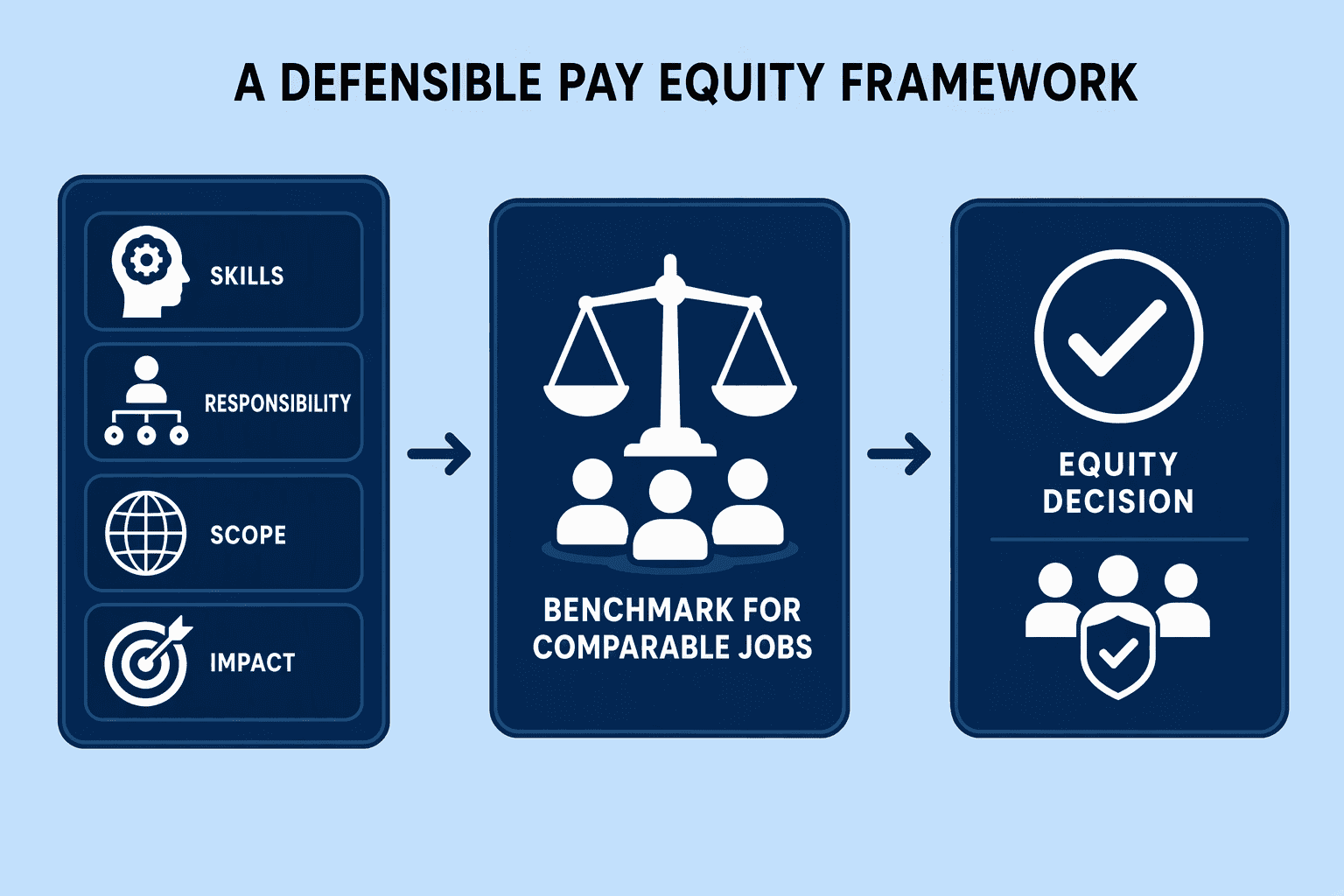
You cannot prevent a disparity if you cannot define the benchmark for equality. Over five decades of research shows current equal pay laws fail because 'equal work' is notoriously difficult to measure, especially in professional and managerial roles. A title like 'Senior Analyst' is a hollow placeholder unless it is anchored to objective, defensible criteria.
To build a legally sound framework, you must move beyond surface-level job architecture and group roles by substantially similar work. This means evaluating positions based on the composite of skill, effort, responsibility, and working conditions, with a documented rationale for every pay differential. Missouri's pay equity best practices explicitly advise employers to seek 'pay equity,' reflecting the internal and external value each position brings to the organization. Baker Donelson reinforces this urgency for 2026, noting that employers need a deep understanding of their compensation philosophy before regulators demand it.
A defensible framework eliminates subjectivity from the starting line.
The shift from job-title grouping to a factor-based evaluation system directly addresses the structural source of historical gender pay segregation. In 2003, female custodians in the House and Senate won an Equal Pay Act case after demonstrating they were paid a dollar less per hour for substantially similar work as their male counterparts. Minnesota's statewide pay equity plan was triggered by the finding that traditionally female jobs paid 20 percent less than comparable traditionally male jobs. By defining value strictly through the lens of objective job content, you systematically neutralize the occupational segregation that creates the gap in the first place.
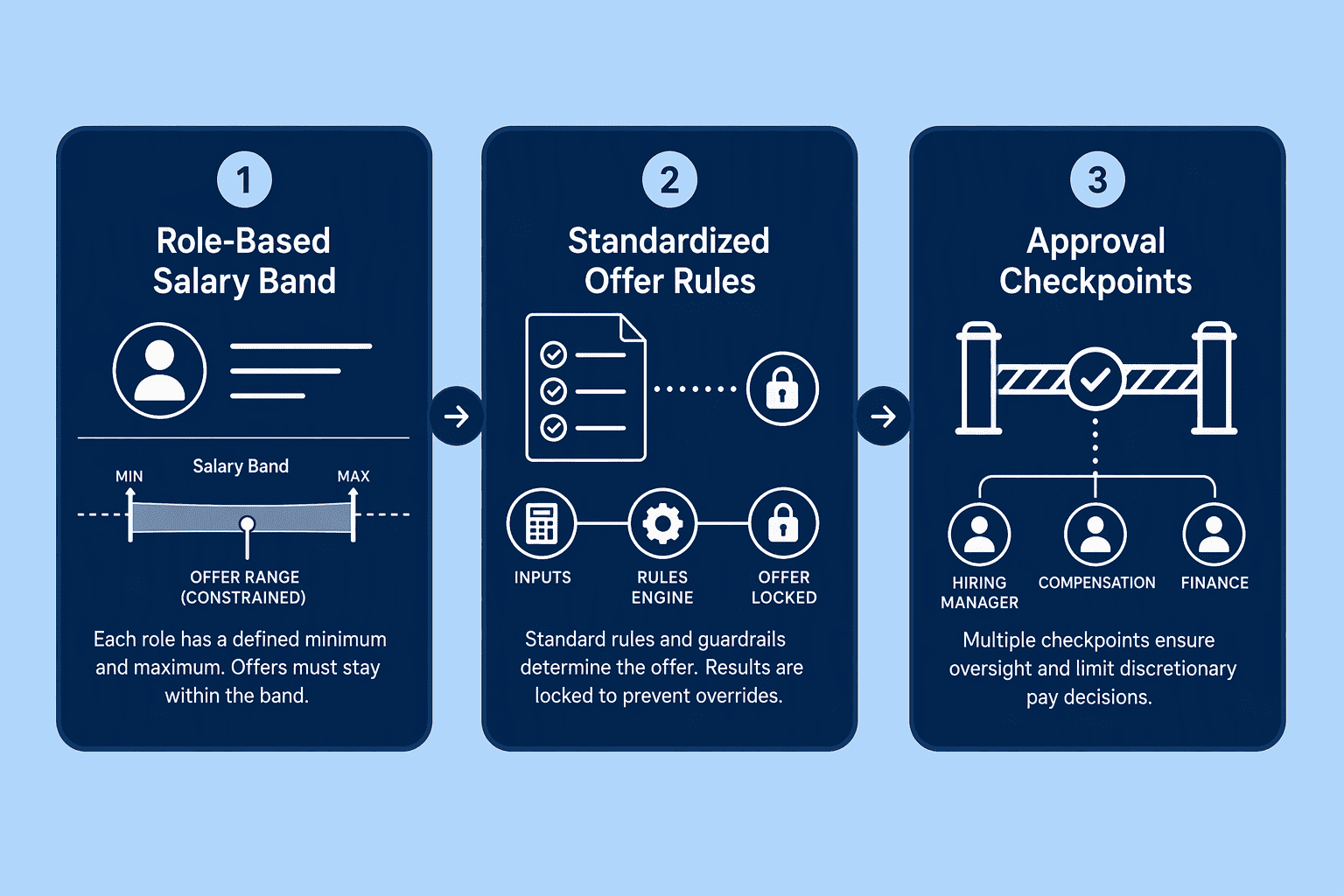
Discretion is the primary source of pay disparity. When a hiring manager negotiates a starting salary without a bounded range, or a department head rewards a favored employee with a 15% off-cycle increase, statistical equity collapses. The most effective prevention mechanism is a structured compensation framework that removes guesswork and bias from every transaction.
You achieve this with three components. Role-based salary bands tied to market data anchor every offer. Standardized offer generation tools cap negotiator discretion.
Promotion increase limits enforce uniform progression. A non-wage compensation review, evaluating opportunities for part-time workers and flexible scheduling, should be embedded into these frameworks to prevent side-door inequities. When these guardrails are active, fairness becomes a default system output rather than a managerial aspiration.
This rigidity ensures that a 10% premium over the midpoint requires explicit, auditable business justification that applies to every employee in that job architecture.
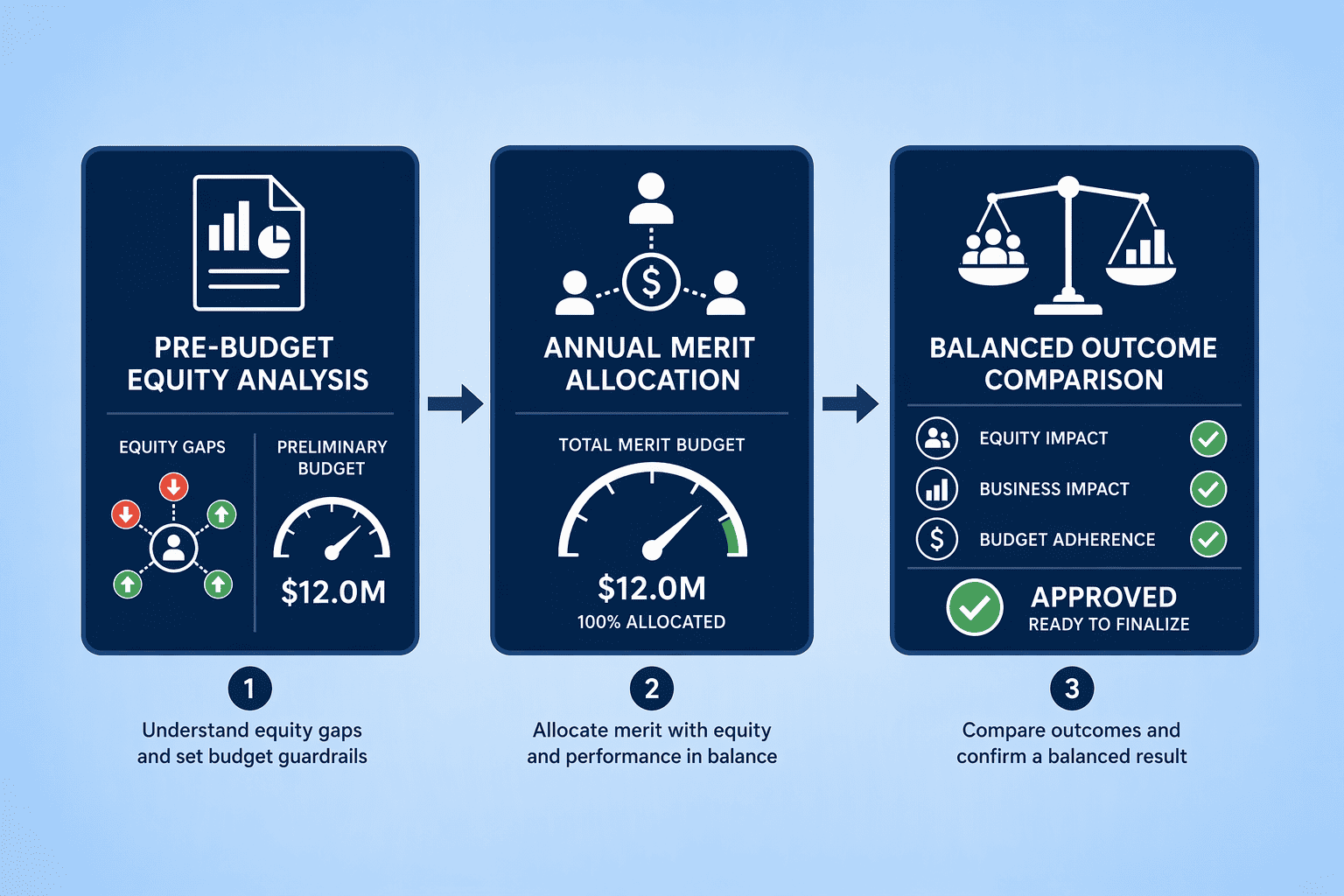
The traditional merit cycle is a blind allocation exercise. Finance approves a 4% merit pool, managers distribute it based on performance ratings, and the organization hopes the distribution is statistically clean. Prevention requires flipping this sequence: model the equity impact first, then allocate the money.
| Scenario | Cost Implications | Operational Impact | Strategic Outcome |
|---|---|---|---|
| Pre-Budget Modeling | A targeted investment of approximately €50,000 to address isolated gaps within the merit pool distribution. Studies show states closed gaps at a one-time cost of no more than 3% to 4% of payroll. | Money is allocated to specific employee groups identified through 'what-if' analysis. Reduces a gap by 3 to 4% during the natural cycle. | Cost-efficient. Prevents a small statistical drift from growing into a class-action risk. |
| Post-Budget Remediation | Significant financial liability. Delaying fixation costs an organization an average of $439,000 more annually; full crisis closure can reach €350,000. | A separate, disruptive budget request mid-year. Employees receive a stigmatizing 'adjustment' out of cycle. | Re-active. Operations team treats it as a crisis management event. Erodes internal trust. |
By running a pay equity scenario model before your merit cycle deadline, you can direct a modest portion of the approved budget to precisely where it neutralizes risk. You are steering existing money with surgical precision. A compensation management platform lets you simulate this distribution and see the compa-ratio impact in real-time, so the budget operates as a precision tool rather than a blunt instrument.
An annual audit is a historical report. It shows you where last year's pay gaps were, but it won't catch the offer letter someone drafts next Tuesday that re-opens the same disparity. Prevention means wiring pay-equity analysis directly into the tools your managers use every cycle, so you see problems as they form, not twelve months after they harden.
A compensation management platform that integrates with your HRIS makes this possible. These systems accelerate the compensation cycle by up to six times compared to manual methods. The real shift, though, is in cadence.
Instead of inspecting pay once a year, you monitor it continuously. Use a tool like CompUp to track compa-ratios and catch a 2% drift the moment it appears. A mid-cycle correction at that stage costs a fraction of a full remediation.
The platform also solves a governance problem. When HR, Finance, and business leaders all plan from a single database of headcount and staff cost data, you eliminate the disconnected spreadsheets where shadow pay decisions happen. Everyone sees the same real-time budget.
Nobody awards an out-of-band raise because they "had the headroom" on a local tracker. Self-service portals multiply the effect.
Organizations that adopt them report a 65% drop in HR administrative support. The Total Rewards team stops fielding individual pay queries and can spend that time on compensation architecture and equity strategy.
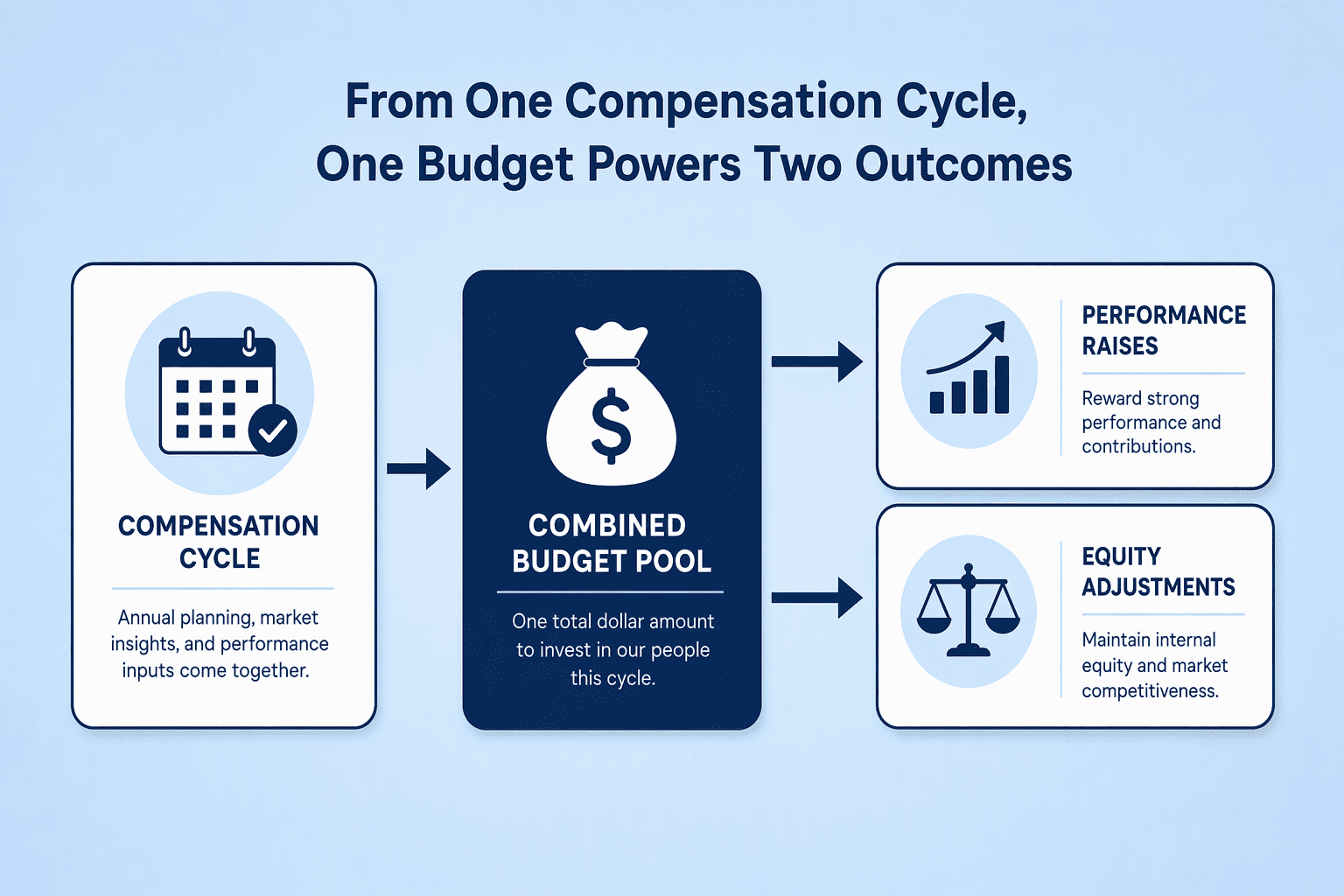
A separate, out-of-cycle 'pay equity adjustment' is a retention risk. When an employee gets a notice that their pay was corrected because of a gender or race gap, it confirms they were historically underpaid. That confirmation erodes trust. The better approach fuses the correction into the standard reward cycle.
Here is how to merge these streams:
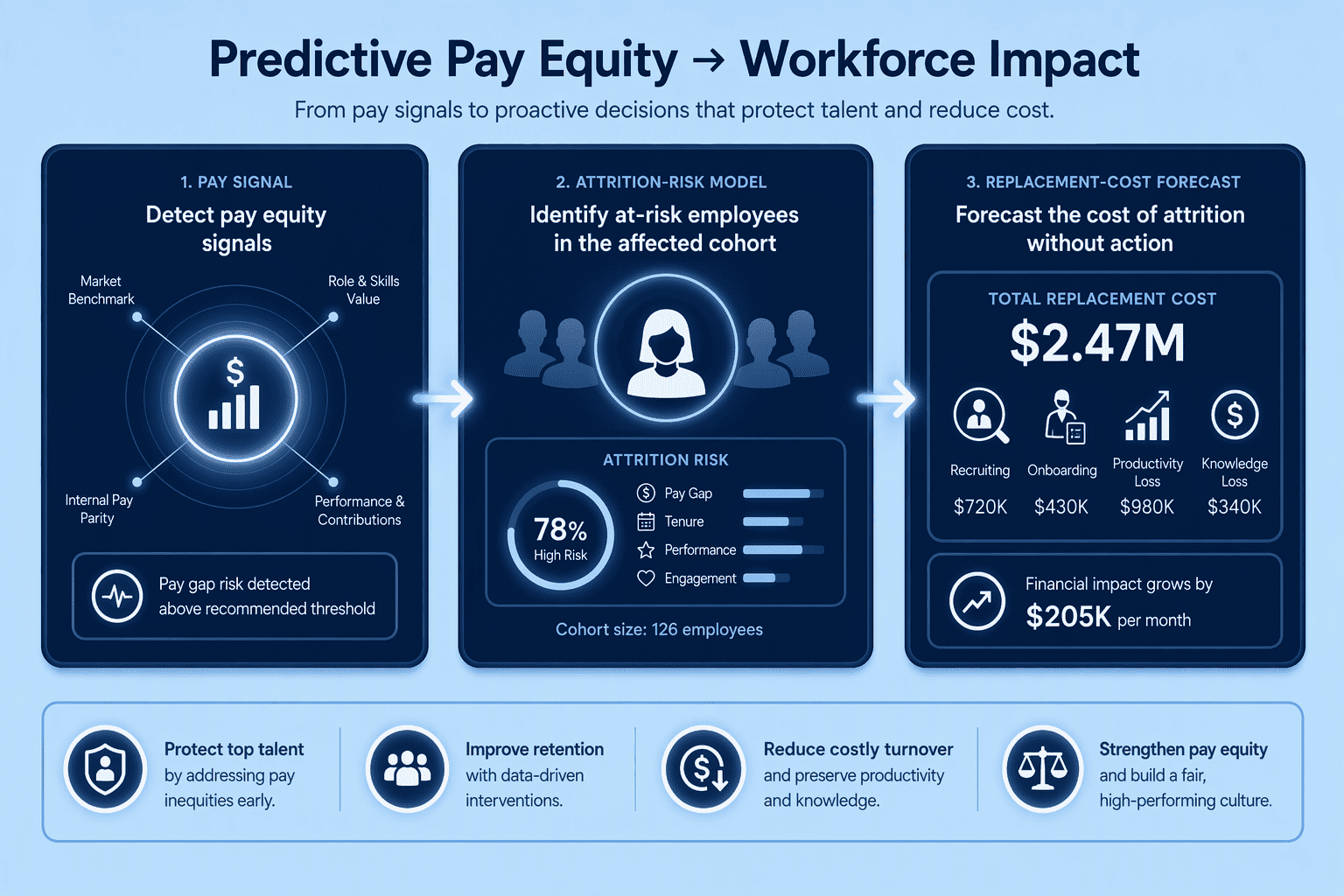
Pay equity analytics, when wired into workforce planning, becomes a tool for predicting which high-value employees are most likely to walk.
Linking continuous pay monitoring to your headcount models shifts the conversation. You stop asking whether a pay gap exists and start calculating the replacement cost for an entire cohort before they ever receive an outside offer. A predictive model can show you the concrete financial hit of losing a high-performing group to a preventable 2% pay gap.
The parallels are hard to miss. Black/African American people face higher death rates for many cancer types, a disparity the Department of Health and Human Services traces to what it calls social determinants of health.
Structural pay gaps operate the same way: they compound quietly, driving attrition and capping internal mobility for protected classes long before anyone in HR sees the number. Pay inequity is the same kind of systemic drag, and the damage shows up in your engagement data and regrettable turnover the same way it shows up in cancer outcome research.
A pay disparity is a compounding debt that accrues interest daily. Prevention erases the issuer of that debt. By defining objective equal work value, installing automated salary guardrails, preemptively modeling your budgets, adopting continuous real-time monitoring, and folding equity into your natural merit rhythm, you build a system that self-regulates. The 2026 compliance landscape demands proof that your system works; a structurally proactive compensation architecture both passes the audit and renders large-scale remediation obsolete. If you're weighing options, CompUp is worth a closer look.
HR should formalize job architecture by grouping roles by skill, effort, and responsibility, then enforce standardized offer guidelines within rigid pay bands:
Structured frameworks replace subjective salary decisions with transparent salary bands and promotion increase caps. By bounding every offer and raise within a predefined range, the system automatically maintains a consistent compa-ratio across the organization for people doing substantially similar work.
A one-time audit is a historical look-back, while a dedicated platform enables continuous, real-time pay equity monitoring. It catches small 2% drifts immediately, integrates with HRIS for live data, and provides an audit trail of approvals, shifting compliance from a periodic event to a daily operational safeguard.
Before allocating a merit pool, run 'what-if' scenarios to model the equity impact of every distribution. This allows you to direct a modest portion of the budget to close a 3% gap preemptively, avoiding a seven-figure remediation. It is a surgical allocation of existing funds, not a new expense.
In 2026, the EU Pay Transparency Directive enforces a 5% gap threshold for joint assessments. Concurrently, pending US legislation like the Fair Pay Act of 2026 is shifting the expectation toward affirmative prevention, requiring employers to prove comparable work gets comparable pay through transparent systems.
Combine the equity remediation budget with the standard merit pool. Use a compensation platform to distribute both funds as a single 'Merit Increase' to the employee, eliminating the separate stigmatizing correction. Brief managers so they can discuss the total reward, not a forensic pay gap analysis.
Community Manager (Marketing)
As a Community Manager, I’m passionate about fostering collaboration and knowledge sharing among professionals in compensation management and total rewards. I develop engaging content that simplifies complex topics, empowering others to excel and aim to drive collective growth through insight and connection.
Revolutionizing Pay Strategies: Don't Miss Our Latest Blogs on Compensation Benchmarking