
Your compensation team just finished a rigorous pay equity audit. The regression models are clean. Unexplained pay gaps sit within a defensible threshold.
But three months later, a Glassdoor review claims the company pays unfairly, and your engagement survey shows trust in compensation falling. This is the persistent pain point: airtight analysis that never reaches the employee in a believable form. In 2026, the problem is no longer just technical.
The EU Pay Transparency Directive is now in force, and employees who perceive their pay as inequitable show a 15% lower intent to stay. A purpose-built platform that fuses statistical pay equity analysis with personalized employee communication directly closes this gap. Tools like CompUp, Synd.io, and Ravio now make it possible to run the audit and generate the employee-facing explanation inside a single system, turning a compliance obligation into a trust asset.
Here is what you need to know about integrated pay equity and communication platforms in 2026.
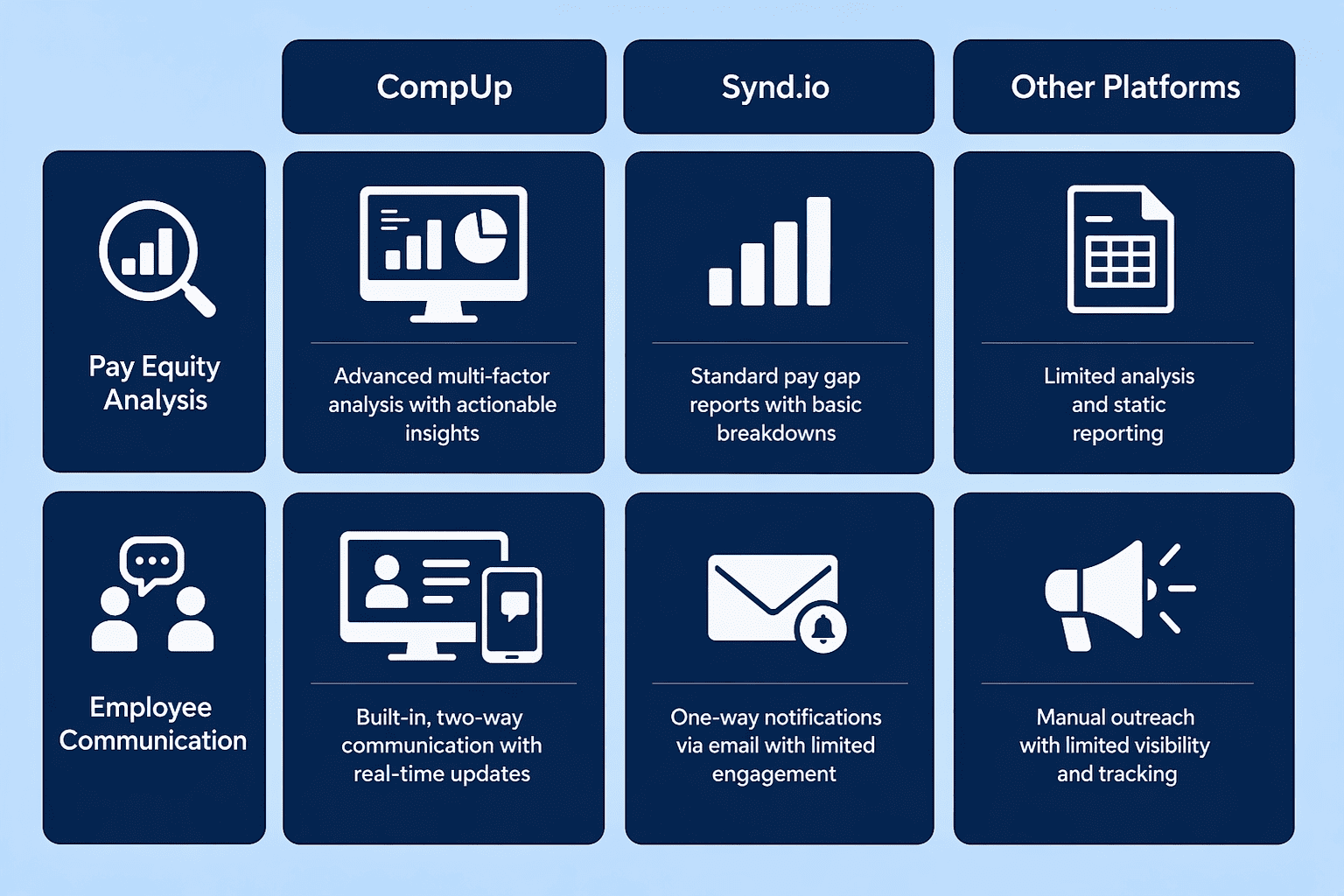
Here is how the options compare across the dimensions that matter most.
| Platform | Core Pay Equity Analysis | Employee Communication Feature | Key Differentiator in 2026 |
|---|---|---|---|
| CompUp | Statistical regression on cohort-adjusted pay gaps | Personalized total rewards statements for managers | Bundles equity comp (ESOPs, RSUs) into analysis and communication |
| Synd.io | Real-time pay equity monitoring with market benchmarks | Automated pay justification narratives for employees | AI predicts attrition risk from equity data |
| Ravio | Compensation benchmarking integrated with equity audit | Manager-facing dashboards with peer pay context | Designed for EU Pay Transparency Directive compliance |
| Standalone tools (e.g., Excel + HRIS) | Manual analysis in separate software | Generic HRIS messages; no equity context | High compliance risk due to data fragmentation |
Most organizations run pay equity analysis in a black box. The compensation or people analytics team exports raw payroll data, scrubs it in a statistics package or a standalone equity tool, and produces a report for legal and the CHRO. That report confirms the company is within tolerance on a cohort-adjusted basis.
Then the work stops. No version of that analysis is structured, formatted, or approved for a manager to discuss with a direct report. The data never leaves the analytics floor, and the employee learns about their pay standing from an internet forum or a recruiter's inbound call.
The divide is structural and departmental. HR analytics owns the model; HR business partners and managers own the compensation conversation. Without a shared platform, they operate on different data. The manager receives a salary figure and a merit increase percentage for each team member. They have no visibility into whether that number reflects an equity correction, a market adjustment, a performance differentiator, or a legacy anomaly.
This disconnect produces a confidence gap that even perfect data cannot close. An employee who senses unfairness does not calibrate against a regression coefficient. They calibrate against an impression formed from hallway conversations, online salary databases, and a vague sense of their value relative to a colleague in the next row of desks. If no one can explain the logic behind their number, the most rigorous audit in the world settles nothing.
A unified platform closes that gap by turning the audit output into a structured, manager-ready communication artifact. The analysis and the explanation become two stages of a single process.
The EU Pay Transparency Directive (2023/970) took effect in June 2026.
It is not a suggestion.
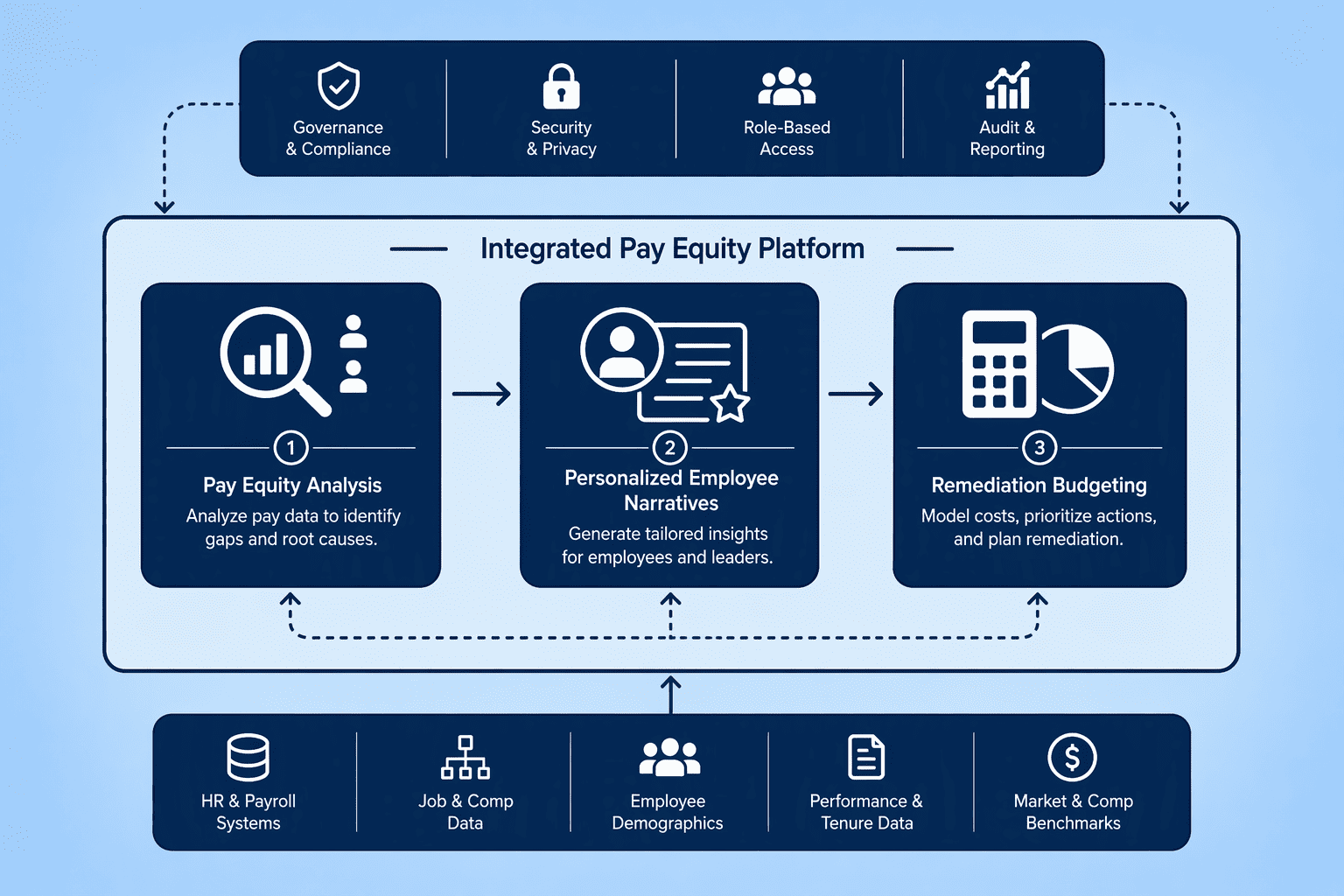
Imagine your compensation review is clean, but three months later, Glassdoor reviews claim otherwise. The disconnect is rarely the math. It is that employees never saw the story behind the number. An integrated platform solves this by joining statistical analysis directly to employee-facing narratives. It is a single system where an identified pay gap triggers a tailored, personalized statement explaining how compensation decisions are made alongside the remediation budget.
At its core, this anatomy has two chambers. The first is a rigorous analytical engine that moves beyond surface-level pay parity toward real pay equity. Real pay equity means equal pay for equal work or work of equal value, evaluating roles across departments and levels to identify systemic gaps.
The engine runs regression analyses, flags outliers by gender or race, and models remediation costs. The platform must support ongoing monitoring and defensible comp decisions, not a one-time audit that gathers dust. A tool like Syndio specializes in pay equity analytics with global pay reports, drilling into statistical significance across cohorts, while CompUp focuses on tying those findings directly to salary approvals so corrections happen during the cycle, not after.
The second chamber is the communication layer. This is where dry regression outputs become clear, individualized messages. The platform automatically translates an adjustment percentage into a Total Rewards Statement that shows the employee their full package value.
Consistency matters because silence breeds distrust. Employees who perceive their pay as inequitable have a 15% lower intent to stay.
An integrated tool preempts this by ensuring every pay action comes with a coherent explanation, linking market data, performance ratings, and internal equity analysis into one narrative the employee can actually read. It closes the gap between a mathematically sound pay structure and a workforce that perceives it as fair.
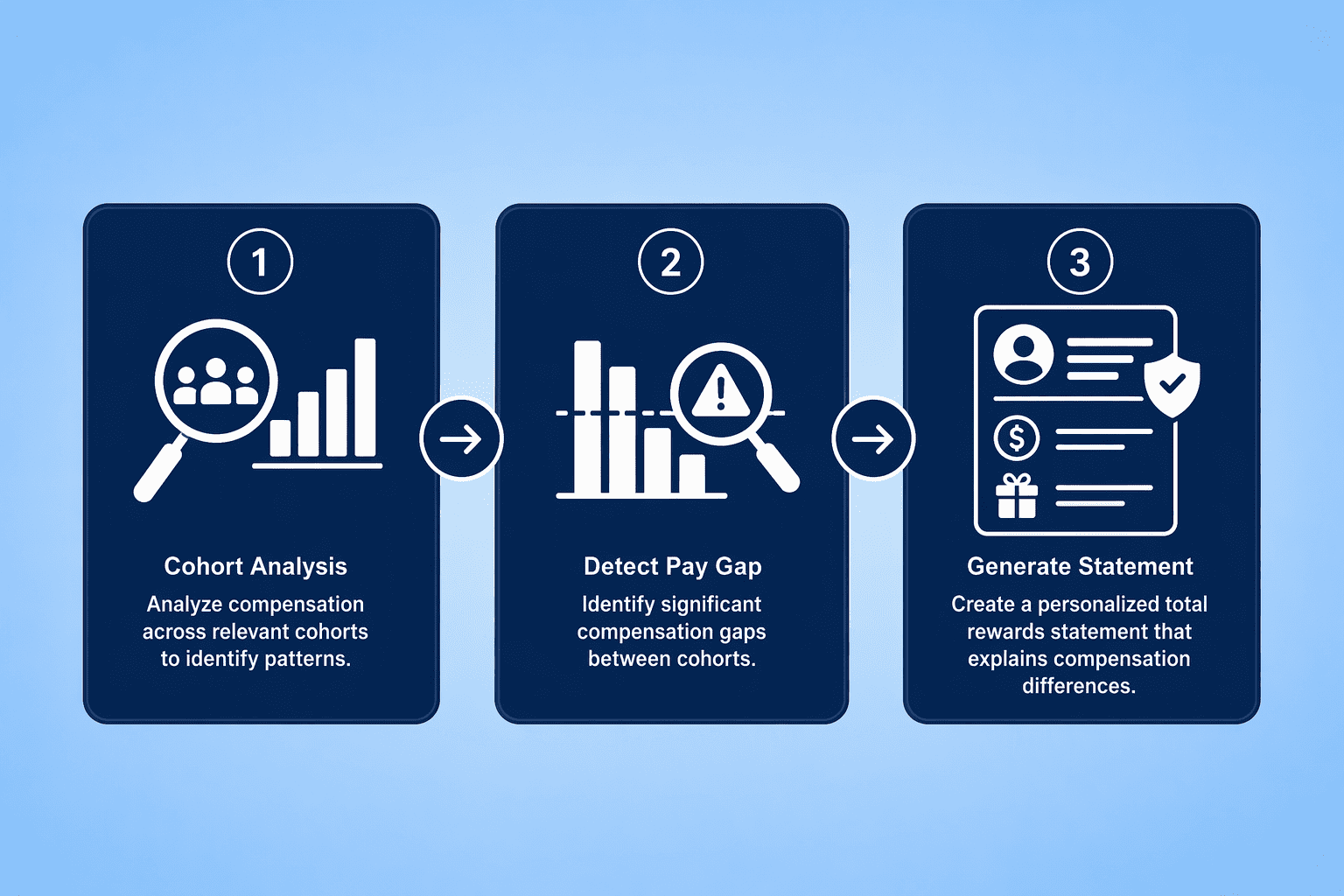
Most Total Rewards Statements are glorified reports of sunk cost. They show an employee what the company spent on them last year, but they never explain why their raise was 3% while their colleague got 5%. Integrating pay equity analysis changes the statement from a receipt into an explanation. The workflow starts with the analytics engine grouping employees into similarly situated cohorts based on role, level, geography, and performance rating. When the analysis detects that a specific cohort, say Level III engineers in Denver, shows a statistically significant gap for women, that diagnosis becomes a triggering event.
In a unified system, that trigger does not just alert the compensation team. It populates a logic layer for the personalized statements. The HR team sets a message framework: for those receiving an equity adjustment, the statement clearly labels the additional percentage, explaining it ensures equal pay for equal work or work of equal value against market and internal benchmarks.
For those not receiving an adjustment, the statement reinforces how their current pay was determined by the same methodology, countering the impression of arbitrariness. This matters in stark dollars and retention points.
engagement is down by 13% among those who perceive their pay as inequitable. You are not just fixing pay; you are recovering lost discretionary effort by showing your work.
CompUp, for instance, can automatically generate personalized Total Rewards Statements at the close of the appraisal cycle. This means the narrative of equity runs alongside the reward notification, not weeks later. If the system surfaces a gap and the team approves a remediation, the generated statement for the impacted employee anchors the increase in the specific equity review, transforming a potentially awkward conversation into a proof point of a fair process. You move from silently fixing problems to actively demonstrating your pay philosophy.
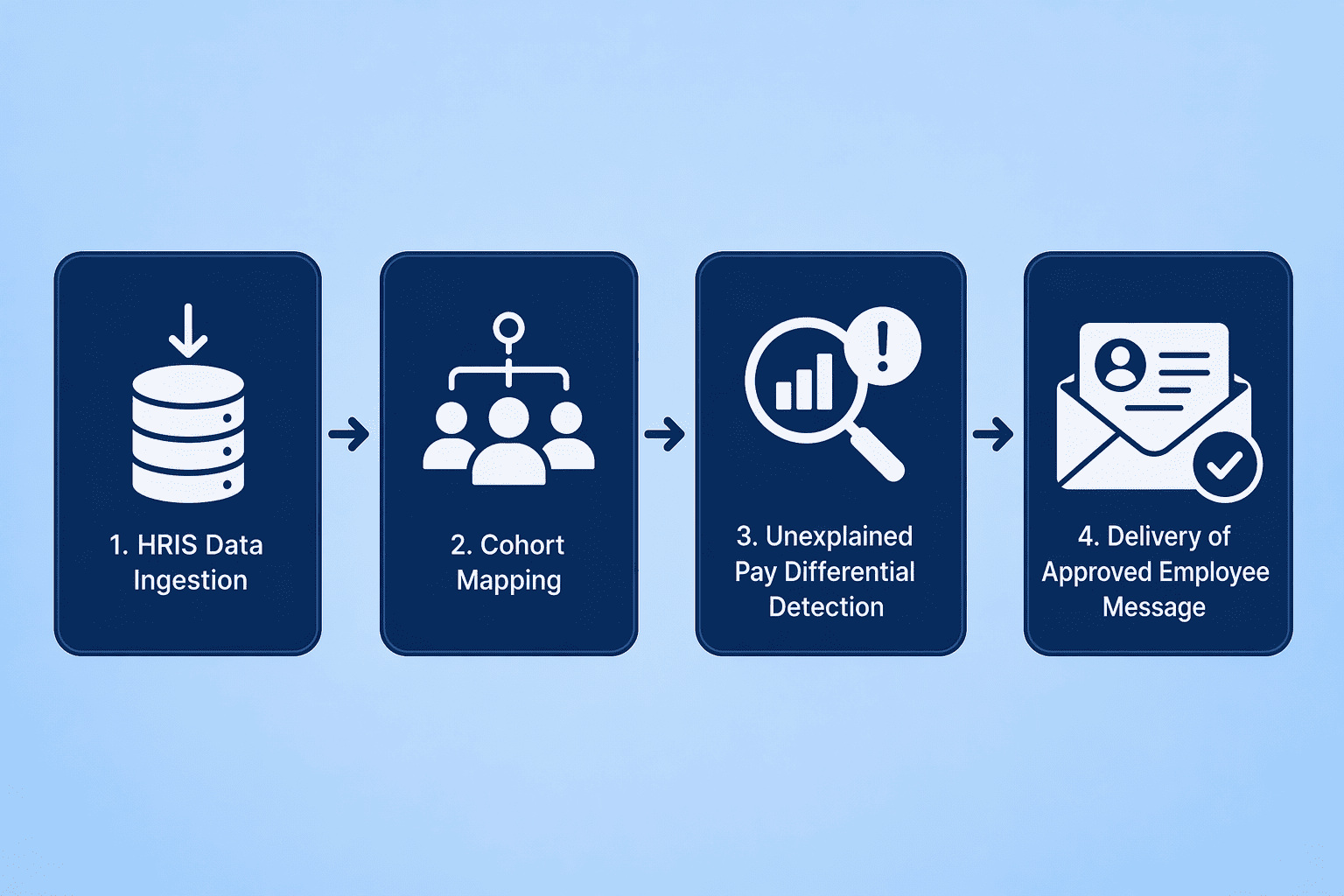
The gap between an audit finding and an employee's understanding can stretch for months, if it ever closes at all. A unified workflow collapses that timeline into a single controlled process. It begins with what the system defines as a pay equity analysis, a systematic review of your employee compensation data across protected groups. The platform ingests your HRIS data, maps jobs into comparable categories, and isolates unexplained pay differentials that cannot be justified by performance, tenure, or location.
The pivot from insight to communication is where specialist tools distinguish themselves. Once the analysis flags a gap, the platform should offer a remediation simulator that models the cost of bringing individuals to the target range. This is where CompUp, described as a tool streamlining pay raise calculation, connects analysis to action.
A manager can review a proposed adjustment for a team member, see its impact on the unit's comp budget, and approve it, all within the platform. The approval itself becomes the signal. The system can then trigger a notification to the employee, embedded within a statements portal, explaining the basis for the change. This circumvents the usual chaos of offline spreadsheets and delayed talking-point memos that get stale before they are delivered.
Because the workflow keeps everything inside one artifact, the audit trail is clean. You are communicating decisions made in the same environment that runs your payroll inputs, not the results of a third-party consultant's 50-page PDF. For companies managing compensation across borders, a platform like Deel is best for analyzing pay equity across countries, normalizing for local norms. The output is a localized explanation ready for the employee's inbox, correctly denominated and legally vetted. The workflow converts a compliance exercise into a continuous practice that visibly shapes employee confidence.
Compliance keeps you out of court. It does not necessarily make people stay. An advanced platform layers predictive intelligence onto the equity data, so you can see the connection between a pay gap and a departure before it happens.
The machine learning model correlates compensation ratios with exit data, flagging cohorts where pay compression or an uncorrected gap overlaps with a spike in regrettable turnover. This is the jump from a reactive audit to prescriptive analytics.
You are no longer just asking, 'Are we paying fairly?' but 'Is a pay inequity about to cost us a critical team leader?'
The broader toolset then connects compensation to wealth creation, which matters when 60% of job candidates choose employers based on alignment with their personal values. Fair base pay is a baseline value; equity participation is a differentiator. A platform that handles both becomes a single source of truth for a worker's financial relationship with the company.
CompUp helps manage ESOP programs alongside traditional pay structures, so an employee's total reward picture includes salary, vesting schedules, and projected option value. When you communicate an equity grant through the same portal that previously explained a pay equity correction, you reinforce a consistent message: the company invests in you fairly in both immediate compensation and long-term wealth.
This integration also counters a messy reality of high-growth teams. Salary offers often stagnate once a generous stock option package is on the table, creating an internal equity problem between tenured hires and new recruits. A unified system surfaces that tension during the pay equity analysis, factoring equity value into the total compensation comparison. It lets you tell an early employee, 'Your base is $10k below the market midpoint, but your total realized compensation including exercised options puts you in the 75th percentile.' That is a vastly more defensible conversation, grounded in the platform's data, and it treats the employee as a stakeholder who deserves the full accounting.
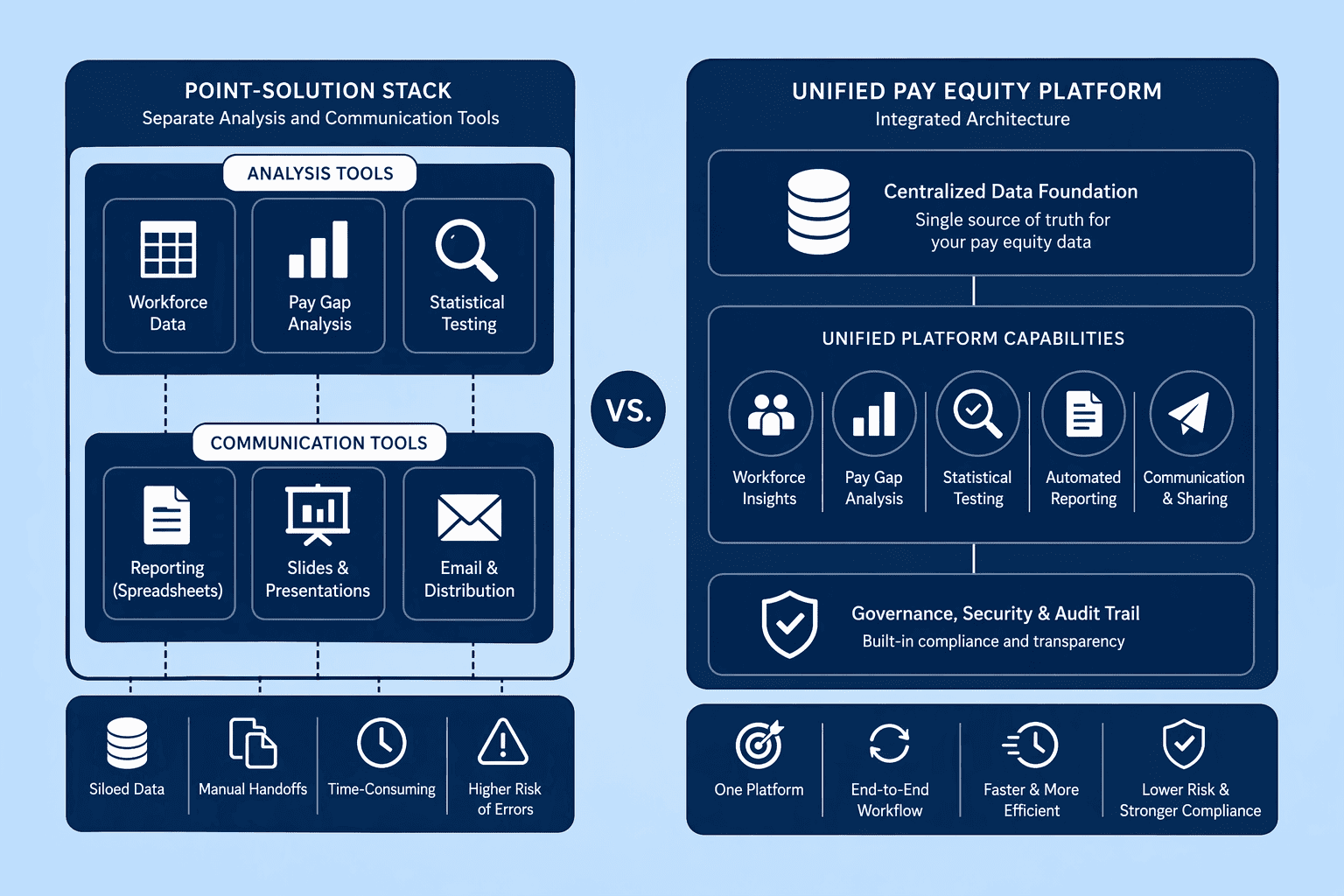
Buying software isn't always the right first move. And a single platform isn't the only architecture for running fair pay.
The clearest alternative is a best-of-breed stack of point solutions, one tool for the statistical heavy lifting and a separate tool for communication. You might run your formal regression analyses in Syndio, which is built for global pay reports and complex statistical modeling, then feed the adjustment outputs manually into an internal communications platform or a separate Total Rewards portal. The benefit is fidelity. A dedicated statistical engine holds up to litigation scrutiny in a way a generalist comp management tool may not.
Separation costs you speed and consistency. You are now operating two systems of record. The compensation narrative HR drafts must mirror the unexplainable gap the analytics tool flagged, with no version skew. During a rapid merit cycle, that manual handoff breaks easily.
Another alternative embeds equity communication inside a full-suite HCM. Workday and SAP don't deliver the focused equity modeling of a point solution, but they place pay data directly where managers talk to employees. Everything lives inside one login. The tradeoff is shallower analytical capability, more descriptive than diagnostic. You'll catch obvious pay parity gaps while missing subtle, multi-variable inequities a dedicated equity tool would expose.
A third path is a services-led model. You engage an external compensation consultant to run your analysis and draft the employee messaging framework. This front-loads deep expertise and is the safest choice for a first audit.
But ongoing monitoring gets expensive. Any of these alternatives can work if your objective is narrower than a sustained, internal capability.
If you only need to produce an annual pay gap disclosure for a European jurisdiction, a consultant and a design team are enough. If your goal is to close gaps as they appear and tell employees about it immediately, the integration becomes a harder requirement.
A pay equity analysis that ends in a spreadsheet is only half finished. The other half of the work is making sure the results reach the employee, correctly framed and trustably explained, before rumor and assumption fill the silence. An integrated platform does not just run the numbers; it compels the organization to connect every equitable correction to a clear, individualized explanation. This is how you convert a regulatory necessity into a measurable retention and engagement tool, recognizing that employees who perceive their pay as inequitable have a 15% lower intent to stay and that silence itself damages engagement.
The range of solutions reflects how you want to run your compensation philosophy. You can keep analysis and communication separate, pledging careful manual coordination each cycle. Or you can bring them into a single workflow where a flagged gap triggers a remediation budget, which automatically populates a Total Rewards Statement, which lands in the employee's portal with a clear rationale.
A tool like CompUp is built to simplify not just pay raise calculation but also the transparent communication of those decisions, handling everything from equity analysis through Total Rewards Statements to long-term incentive communication. The decision rests on whether your pay equity practice is an annual event or a continuous operating rhythm.
If it is the latter, the integration is not a luxury. It is how you ensure the organization's actions match the narrative you tell your people. A good next step is seeing how CompUp puts this into practice.
Most platforms still treat these as separate modules. In 2026, look for tools that embed pay equity data into personalized Total Rewards Statements (TRS). CompUp automates this by generating statements that show salary, equity, and benefits alongside the company’s pay equity philosophy, replacing manual spreadsheets with a scalable communication layer.
The platform runs a statistical regression to flag unexplained pay gaps by gender or race. It then maps an employee’s actual compensation against these findings. In practice, TRS software like CompUp visualizes this data not as raw audit numbers, but as a clear employee-friendly breakdown of your total value, connecting line-item compensation to market benchmarks.
Prioritize automated statement generation, white-label branding, and secure digital delivery over PDF exports. The software must pull live data from HRIS and payroll to ensure accuracy. A critical feature is the narrative logic layer, which automatically generates explanatory text next to equity adjustments, moving communication out of email and into a dedicated portal.
It creates an auditable paper trail. Instead of ad-hoc manager talking points that might introduce bias, the platform generates standardized, legally vetted messaging for every comp change. Syndio’s framework emphasizes that transparent communication isn’t just a courtesy, it’s step five of an effective pay equity audit, transforming a raw analysis into a clear narrative for employees.
First, the tool ingests HRIS data to identify pay gaps. Next, leaders approve adjustments and craft contextual messaging within the platform. For delivery, CompUp generates individualized, jargon-free Total Rewards Statements. Employees access these via a secure portal, not a confusing spreadsheet, creating a smooth view of compensation without manual data entry.
Community Manager (Marketing)
As a Community Manager, I’m passionate about fostering collaboration and knowledge sharing among professionals in compensation management and total rewards. I develop engaging content that simplifies complex topics, empowering others to excel and aim to drive collective growth through insight and connection.
Revolutionizing Pay Strategies: Don't Miss Our Latest Blogs on Compensation Benchmarking