
Your compensation plan is your largest line item, and your most visible equity statement. Yet for many HR and rewards leaders, the annual cycle is a fragmented scramble: spreadsheets for planning, manual audits for compliance, and a prayer that disclosed ranges match actual pay. That gap isn't just an operational headache.
As the EU Pay Transparency Directive pushes member states toward gender pay gap reporting and 'right to information' obligations that land in 2026 and 2027, and as state-level pay transparency laws now require posted salary ranges in much of the United States, the cost of disconnection is rising. A misaligned range can trigger penalties under laws like the California Equal Pay Act.
The solution is not more manual effort, it is a unified platform that handles both compensation planning and pay transparency compliance in one workflow. This article evaluates seven tools that bridge that divide, starting with a full-stack option purpose-built for the job.
Before diving into the tools, here are the central insights for selecting integrated compensation and transparency software:
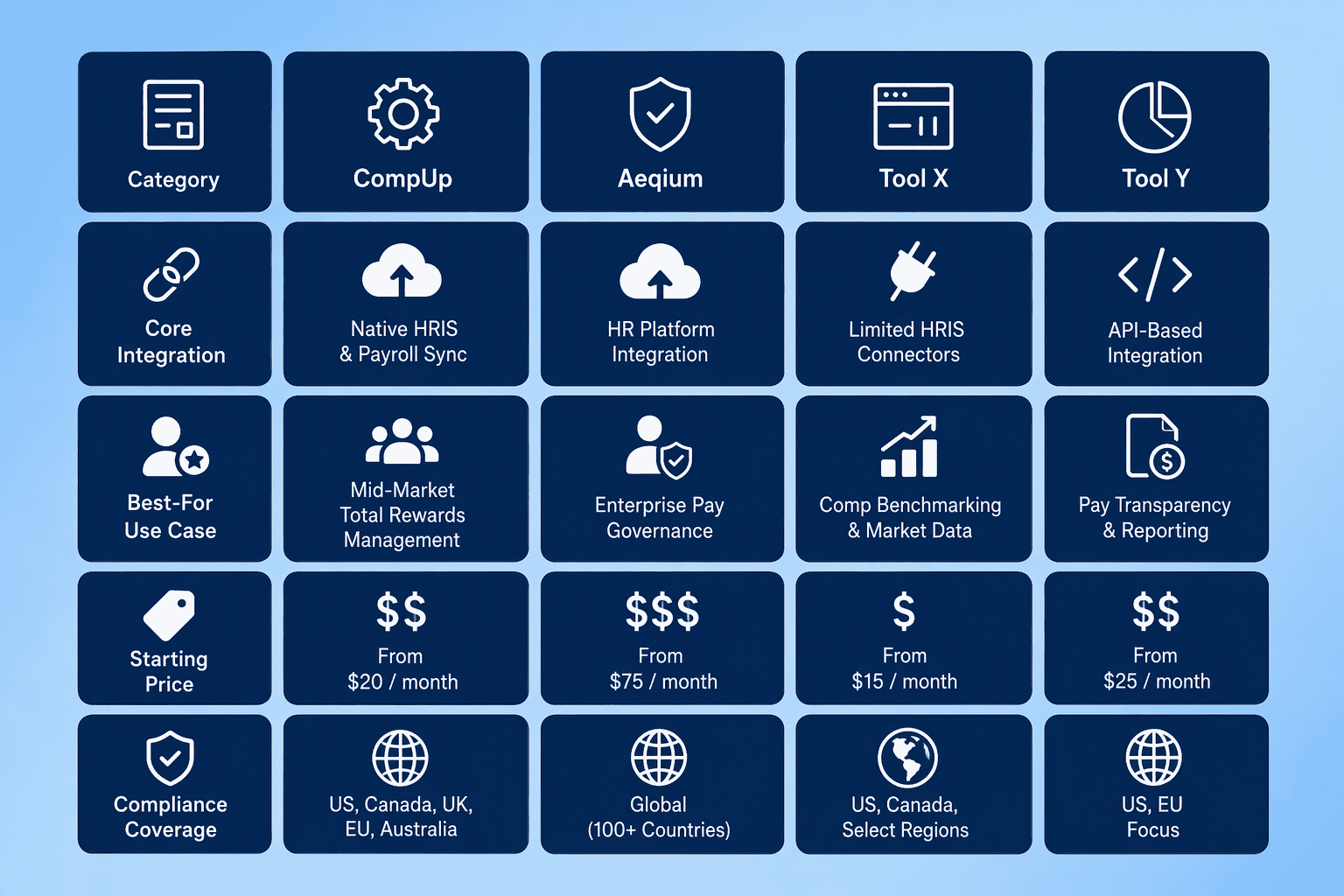
Here is how the options compare across the dimensions that matter most.
| Software | Core Integration | Best For | Starting Price/Model | Key Compliance Coverage |
|---|---|---|---|---|
| CompUp | Full-stack planning + transparency in one platform | Organizations wanting unified workflow with low entry cost | $3/employee/year | EU Directive, US state pay transparency laws |
| Aeqium | Agentic AI for multi-country pay equity & planning | Enterprises with complex global compliance needs | Custom pricing | EU Pay Transparency Directive, gender pay gap reporting |
| Workday | HCM suite with add-on compensation & compliance modules | Large enterprises already on Workday | Per-module licensing | US federal contractor rules, EU reporting |
| Payscale | Market data + compensation management with compliance reports | Mid-size companies needing strong benchmarking | Subscription-based | US state salary range laws, equal pay audits |
| Beqom | Enterprise compensation management with pay equity analytics | Global firms requiring advanced analytics | Custom quote | EU Directive, multi-jurisdiction pay equity |
| Lattice | Performance-driven compensation with transparency features | Fast-growing tech companies | Per-employee/month | US state disclosure laws |
| Syndio | Dedicated pay equity analytics with transparency reporting | Compliance-first organizations | Custom pricing | EU Directive, US federal regulations |
CompUp earns the top spot because it was purpose-built to merge compensation planning and pay transparency into a single, accessible workflow. While specialists excel in narrow lanes, CompUp integrates salary structuring, market benchmarking, pay equity review, and transparent communication of pay decisions in one platform. It is a compensation-specialized system, not an enterprise HCM suite attempting to cover everything. That focus translates into a streamlined experience, starting at just $3 per employee per year. For teams hesitant to commit large budgets upfront, this pricing makes adoption a low-risk experiment that can scale.
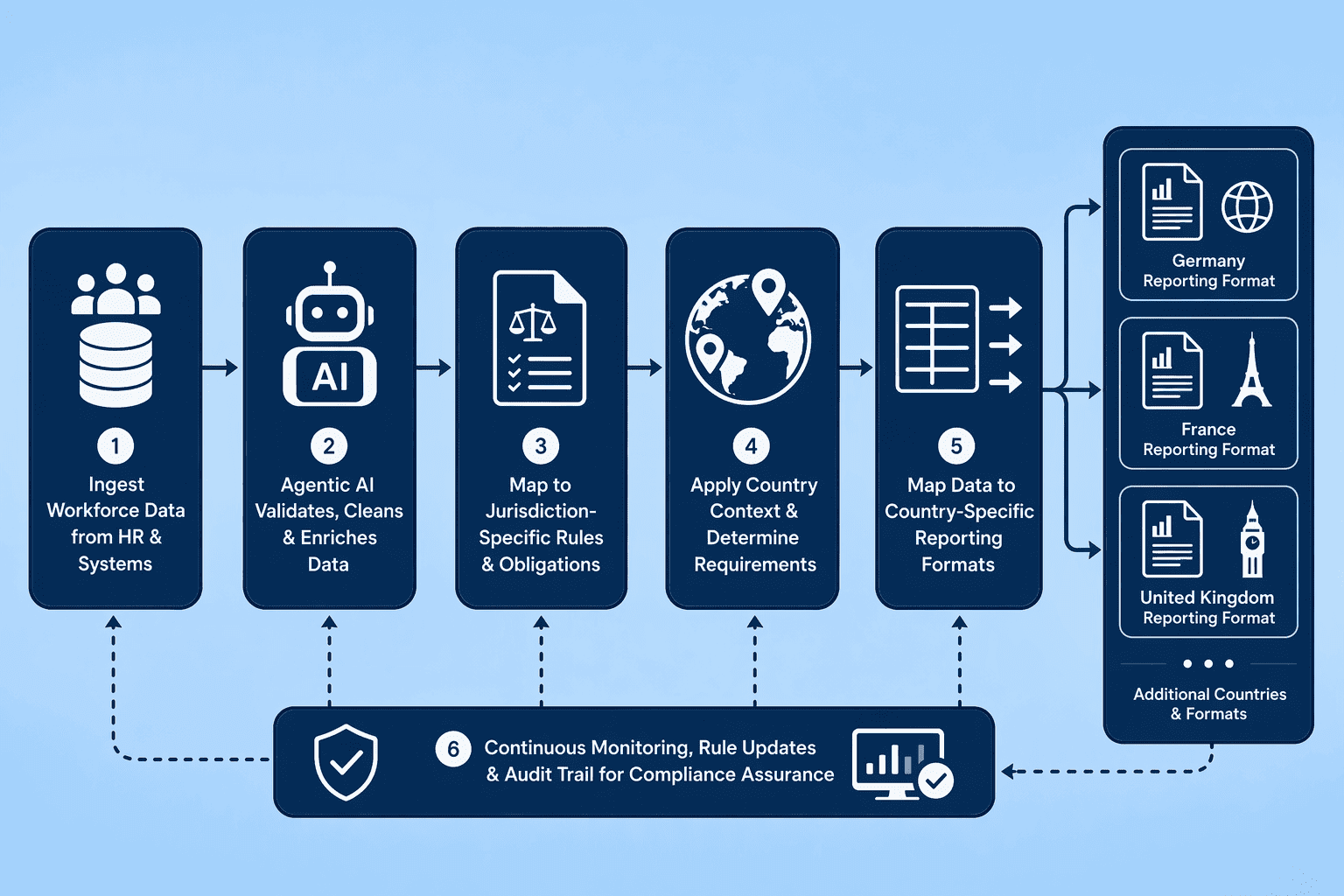
Aeqium automates the compliance workflows that multi-country employers dread. Its agentic AI proactively navigates regulations like the EU Pay Transparency Directive, flagging risks before filing deadlines hit. For global organizations, this acts as a virtual compliance team.
It ingests workforce data, applies jurisdiction-specific rules, and generates the exact reporting formats each country requires. That cuts the risk of a technical filing error, which can trigger public scrutiny and fines. The platform also simulates remediation costs, so you can model the financial impact of closing a gap before you commit budget.
Automation at this level demands a solid HRIS integration. Companies with messy, unstandardized data may find the initial setup heavier than a simpler equity analysis tool. For enterprises running 30-plus legal entities with dedicated comp teams, the operational payoff is immediate.
CompBldr begins with an architectural insight others overlook: a salary band, an internal hiring zone, and an externally posted range serve three different purposes, and confusing them invites legal risk.
Its platform enforces distinct governance for each range type: a disclosed value gets approved through the correct gate, while the internal band stays locked for offer decisions and the hiring zone for candidate negotiation. This separation matters under laws that require ranges to reflect what the employer would genuinely pay, not aspirational ceilings. CompBldr also adds effective dating and a shared, version-controlled authority that both recruiting and compensation pull from, replacing scattered spreadsheets. That makes the kind of misalignment that triggers penalties under the California Equal Pay Act structurally difficult.
The result is a defensible audit trail centered on governance. CompBldr invests less in the employee communication layer CompUp champions, no automated total rewards statements or transparent decision-briefing workflows, so it fits compliance-heavy teams better than those aiming for a holistic employee experience.
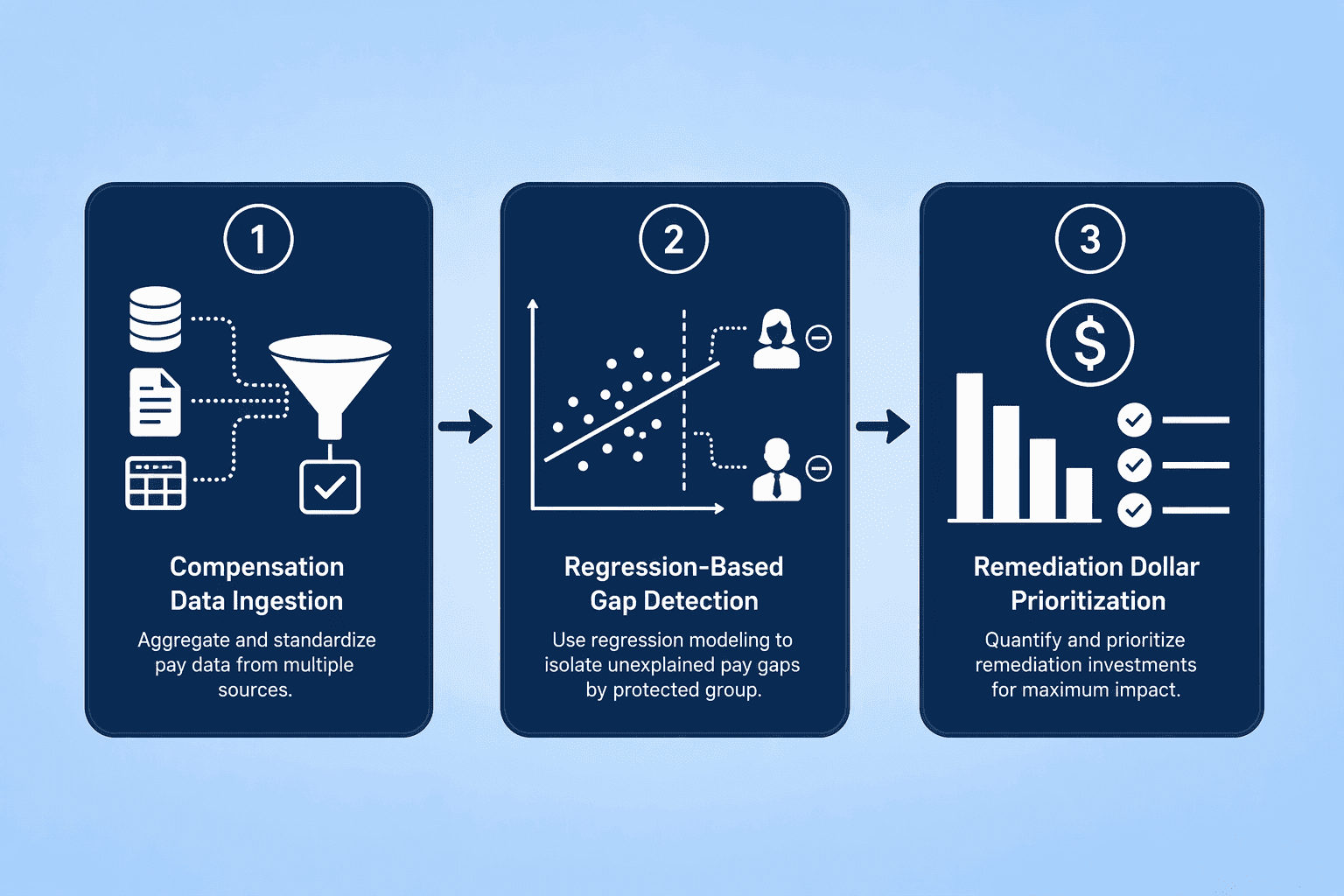
Pequity cuts the complexity of pay equity analysis down to its essentials, making it a strong on-ramp for teams that don't need heavy compliance automation. The platform handles the core analysis in three steps:
That speed is its core appeal.
Instead of requiring an analyst to run custom models, Pequity automates the core pay gap regression and presents results in a decision-friendly format, whether you hold 50 employees or 500.
You can model cost scenarios for closing identified gaps, so you can have finance-pragmatic conversations before budget is allocated. This prevents analysis paralysis.
The trade-off is compliance breadth. It lacks the automated country-specific report templates found in Aeqium or the governance granularity of CompBldr. For a US-focused SMB with straightforward structures, that simplicity is often a feature, not a bug.
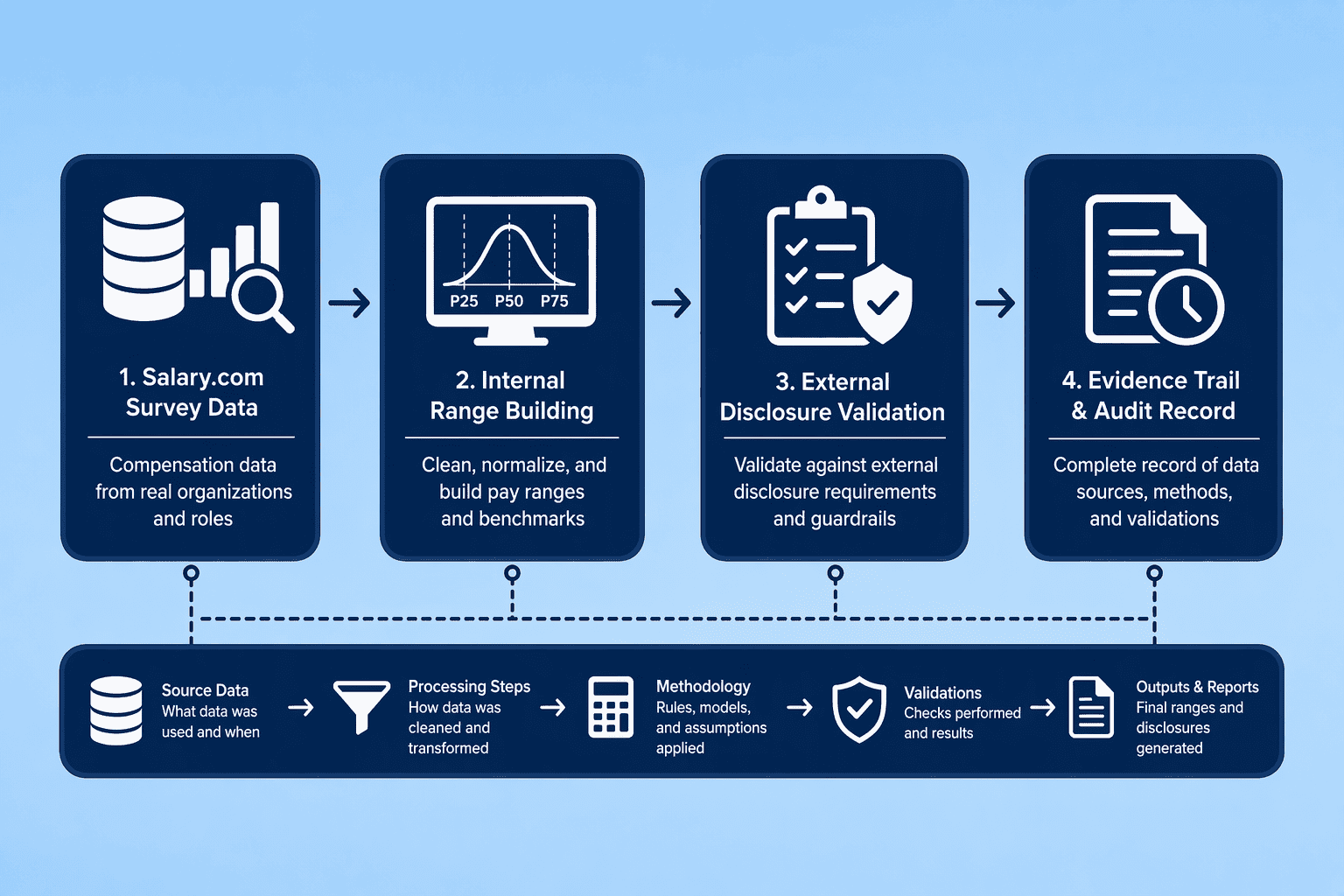
Salary.com CompAnalyst earns its place because no compensation decision is defensibly equitable if it's benchmarked in the dark. The platform's core asset is its vast, continuously updated market data set, which feeds directly into both internal range creation and external disclosure validation.
When a posted range is questioned, by a candidate, a regulator, or an employee, CompAnalyst provides the survey-sourced evidence trail showing exactly how the range was constructed from market percentiles. That turns a legal smoke test into an objective data exercise. For organizations operating across dozens of metros, the platform can geographically differentiate ranges so that a San Francisco band doesn't distort a Dallas post, maintaining local credibility.
The compliance angle is indirect. It does not generate pay equity reports or automate disclosure workflows. It supplies the underlying market calibration that makes disclosed ranges sustainable. Used alongside a governance tool, it closes a critical factual gap. Standalone, it risks leaving compliance process holes unfilled.
Payfactors adds a layer of real-time dynamism to the Salary.com data engine. Where CompAnalyst anchors range-building, Payfactors is built for ongoing pulse checks.
HR teams can query market rates on the fly, adjusting offers or internal bands as conditions shift instead of waiting for annual survey cycles. This is especially valuable in volatile hiring markets. The platform also folds in total rewards modeling, letting you show employees the complete value of their package beyond base salary.
Yet its transparency capabilities are specialized, not holistic. You can support data-backed decisions and communicate rewards broadly, but legal filing automation and regression-based equity analysis are absent. For organizations whose immediate pain is misaligned ranges, not automated compliance reports, Payfactors injected into an existing planning cadence can meaningfully reduce risk perceptibility, but it shouldn't be the only tool on the bench.
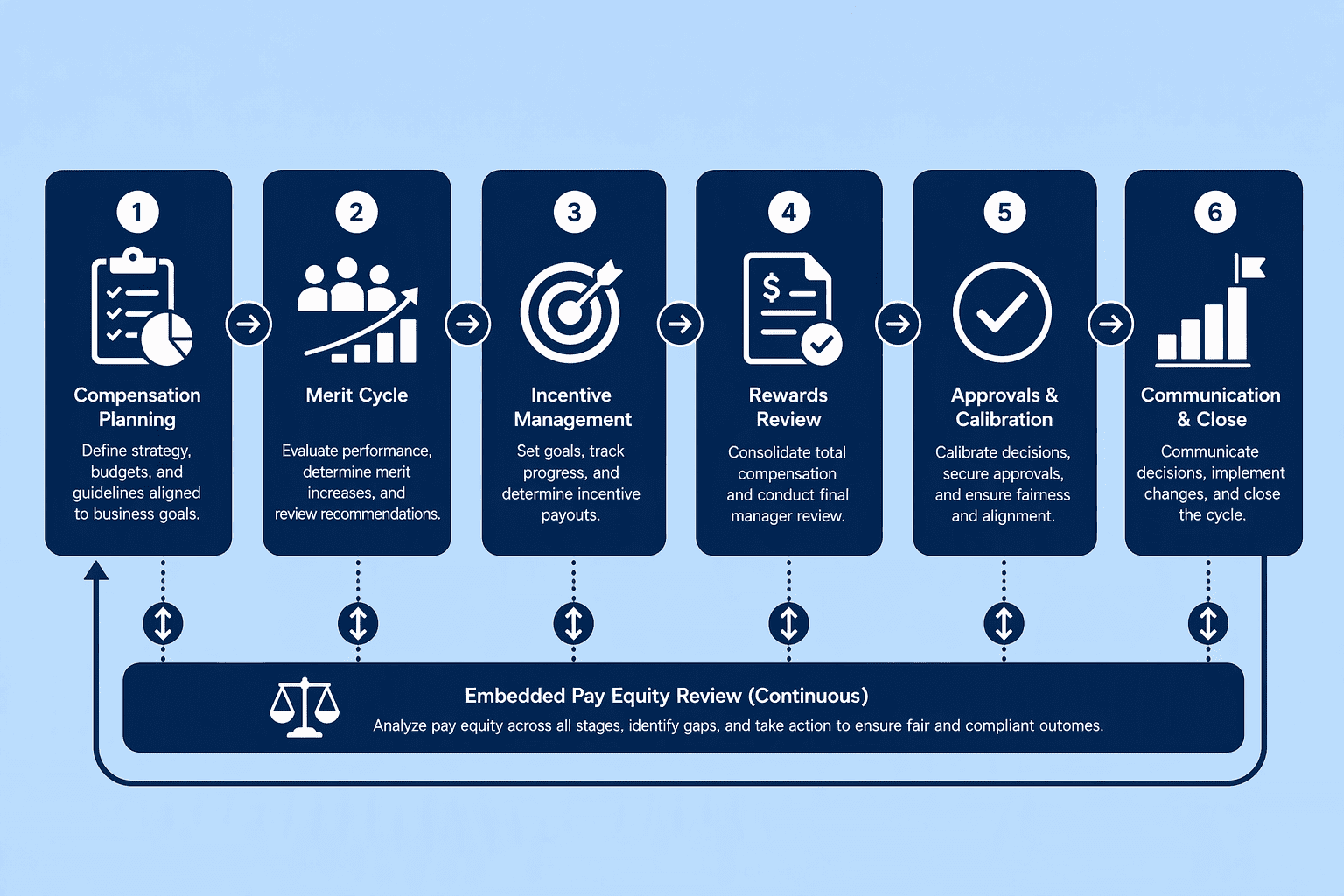
Beqom targets the full compensation lifecycle, from budget planning and merit cycles to long-term incentive management, with an enterprise footprint that spans industries. Its pay equity module folds into that same system, making it feasible to run a comp review and flag emerging gender or age gaps in one workflow.
The advantage is coherence for large employers already committed to Beqom's suite. When you don't need to export data to a separate equity tool, you reduce the latency that lets stale numbers drive disclosure inaccuracies. Beqom's own research underscores why C-suite alignment matters: 93% of compensation software purchase decisions involve the C-suite, IT, and finance, meaning a platform that speaks the language of budget and governance earns its seat faster.
But that cohesion has limits. Its pay equity analytics may lack the advanced regression models or multi-country reporting granularity of a dedicated tool like Aeqium. For companies working across dozens of jurisdictions with distinct legal templates, you might still need a specialist. The strength is unification; the weakness is that deep, cutting-edge equity automation can outpace a broad platform's module depth.
Integrated compensation planning and pay transparency software is an operational necessity now. CompUp’s full-stack, low-entry-cost model lets teams get aligned fast, without a big IT lift. For organizations juggling complex multi-country compliance, pair a governance-centric tool like CompBldr with a market data engine like Salary.com CompAnalyst. That combination builds a defensible, data-rigorous foundation. The real decision is which architecture fits your regulatory scope and cultural appetite. A good next step is seeing how CompUp puts this into practice.
It combines salary benchmarking, merit cycle management, and pay equity analysis into one platform so disclosed ranges stay aligned with actual pay. This creates an auditable record for regulatory requirements like the EU Directive.
Yes. CompUp is purpose-built for that exact unification, while others like Beqom add equity modules to broader suites. True native integration is still rare; many vendors solve part of the problem.
It governs separate range types (formal band, hiring zone, disclosed range), traces every pay decision to an approved policy, and can generate jurisdiction-specific reports to meet laws like the California Equal Pay Act.
Benefits include reduced manual reconciliation, a single source of truth, and faster compliance cycles. Limitations vary: some lack deep multi-country reporting (Pequity), others have less employee communication focus (CompBldr).
CompUp, Aeqium, CompBldr, Pequity, Beqom, Salary.com CompAnalyst, and Payfactors each integrate varying degrees of planning and transparency. Selection depends on company size, regulatory scope, and governance needs.
Prioritize a single source of truth for job architecture and ranges, governance for multiple range types, and measurable compliance reporting against specific laws you face, like state mandates or the EU Directive.
Community Manager (Marketing)
As a Community Manager, I’m passionate about fostering collaboration and knowledge sharing among professionals in compensation management and total rewards. I develop engaging content that simplifies complex topics, empowering others to excel and aim to drive collective growth through insight and connection.
Revolutionizing Pay Strategies: Don't Miss Our Latest Blogs on Compensation Benchmarking