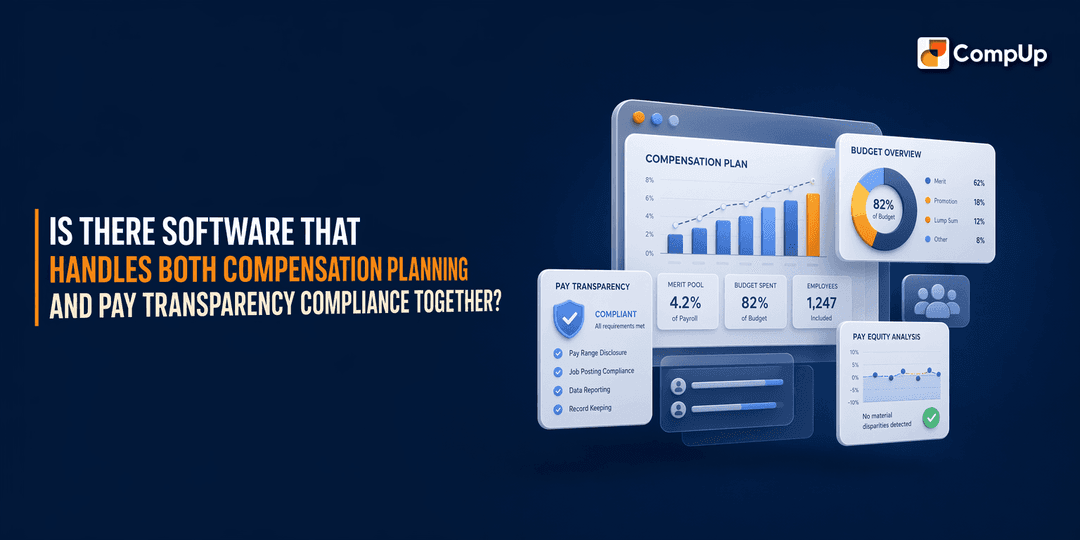

Pay transparency laws now converge with annual merit cycles, forcing HR teams to reconcile compliance deadlines with planning workflows—often across disconnected systems.
Unified compensation platforms promise to integrate budget allocation, merit cycle management, and disclosure-ready reporting in a single source of truth.
Yes, integrated software exists that handles both compensation planning and pay transparency compliance, but public validation of these combined platforms remains limited, and many HR teams still operate the two functions in separate systems. The operational rationale for unified platforms centers on compliance mandate timelines that directly disrupt planning cycles, forcing mid-year budget recalculations when disclosure obligations surface pay gaps.
Pay transparency laws are accelerating across jurisdictions, creating overlapping deadlines that collide with annual compensation cycles. The EU Pay Transparency Directive requires member states to transpose national legislation by mid-2026, while U.S. State laws in California, New York, Colorado, and Washington already mandate salary range disclosure in job postings. What this means for global employers: federal equal-pay protections cover most employees across both the public and private sectors [2], amplifying audit exposure when planning data structures lack built-in equity tracking. In Korn Ferry's 2026 Global Total Rewards Pulse Survey, 65 percent of organizations [1] expect pay transparency to be their biggest challenge in 2026 and 2027[1], a statistic that anchors urgency around compliance readiness.
Traditional compensation planning software optimizes merit budgets, models promotion scenarios, and allocates bonus pools, functions that assume pay structures are internally consistent before disclosure. Transparency mandates flip that assumption: disclosure-ready data requires audit trails that prove equity across protected classes, real-time validation against published salary bands, and the ability to explain pay differentials on demand. When HR discovers a 12% gender pay gap during a routine merit cycle, the compliance obligation isn't just to disclose, it's to remediate, which triggers unplanned budget reallocations, revised manager guidelines, and explanatory communications to affected employees.
The operational gap is clear: planning tools that lack embedded pay equity analysis force HR to export data into separate compliance systems, then manually reconcile discrepancies before publishing ranges. This fragmented workflow extends cycle time, increases error risk, and makes it harder to surface disparities before they become regulatory liabilities. Learn more about compensation management workflows that address this challenge.
Running separate planning and transparency systems multiplies integration complexity: each tool requires its own HRIS connector, security audit, and training budget. The global compensation planning software market is projected to grow from USD 364 million in 2026 to USD 513 million by 2034 [3], signaling rising adoption of planning platforms, yet that growth curve doesn't inherently solve the transparency compliance gap. When merit cycles trigger equity audits, HR teams operating in tool silos face manual export-import cycles that delay publication, increase the likelihood of version-control errors, and prevent real-time scenario modeling. Unified platforms eliminate these handoffs by embedding compliance validation directly into budget workflows, allowing managers to see pay equity flags as they allocate increases rather than discovering gaps after approvals lock.
Before evaluating specific vendors, it's key to understand how software architectures shape your compliance and planning workflows.
Software that addresses compensation planning and pay transparency compliance falls into three architectural categories, each optimized for distinct operational priorities. Understanding this spectrum helps organizations self-sort based on whether they need budget optimization, compliance documentation, or both under a single data model.
These platforms focus on data-driven compensation planning workflows to allocate budgets, set eligibility rules, manage approvals, and generate personalized letters communicating pay changes. They pair global compensation data with intuitive decision tools, emphasizing merit cycle execution, benchmarking, and salary-band construction. Pay equity analysis and disclosure reporting typically require separate systems or manual exports, the workflows center on optimizing compensation spend rather than producing compliance artifacts.
Tools in this category specialize in pay gap detection, regression modeling, and disclosure-ready reports aligned with jurisdictional mandates. They support openly sharing compensation-related information, such as salary ranges, bonus structures, and how pay decisions are made. Budget allocation, approval workflows, and cycle management reside outside these platforms, integration with planning systems happens via CSV handoff or API sync, not within a unified approval chain.
Platforms marketed as the most scalable total compensation management software claim to handle both planning and compliance together. Native integration means budgets, equity audits, and disclosure reports share a single transaction log, an approval triggered in the planning workflow automatically updates compliance records without manual reconciliation. Bolt-on modules, by contrast, stitch separate codebases together; the planning engine and compliance dashboard often maintain independent employee snapshots, requiring scheduled syncs to keep data aligned. When evaluating unified claims, verify whether the vendor's architecture supports a shared approval workflow and unified audit trail or relies on periodic batch updates between modules.
Suggested Read: Compensation Planning Tools with Built-In Pay Transparency Features
Planning-first platforms increasingly add transparency modules to meet evolving compliance mandates, but the depth of native integration varies widely.
When compensation planning and pay transparency requirements converge in a single workflow, the result is a platform architecture in which compliance obligations are addressed at the same layer as salary decisions, not bolted on afterward. This integration reduces the operational friction that comes from switching between separate systems during merit cycles, offer approvals, or regulatory reporting, and it ensures that audit trails and data lineage remain consistent from planning through publication.
A truly integrated platform maintains a single source of truth for pay data, salary bands, approved increases, bonus pools, equity allocations, and threads that data through both planning workflows (budget simulation, approval routing, scenario modeling) and compliance workflows (pay-range disclosure generation, pay-equity analysis, audit-log export). When these capabilities share the same database and approval engine, changes made during planning automatically propagate to transparency disclosures, reducing the risk of version mismatch that occurs when separate tools require manual reconciliation.
In operational terms, this means that a manager who models a 4% merit increase in the planning module sees the updated pay range reflected immediately in the transparency-disclosure template without re-entering data, and the audit log records both the planning decision and the compliance artifact in a single timeline. Organizations that rely on bolt-on modules, a standalone planning tool exporting to a separate compliance tracker, often discover gaps when regulators request end-to-end documentation, because the two systems log events independently and do not share workflow state.
The table below compares five platforms across planning workflow support, transparency compliance coverage, pay equity analytics, and HRIS integration. These dimensions reflect the operational requirements for organizations managing merit cycles and offer approvals under state-level pay-transparency mandates.
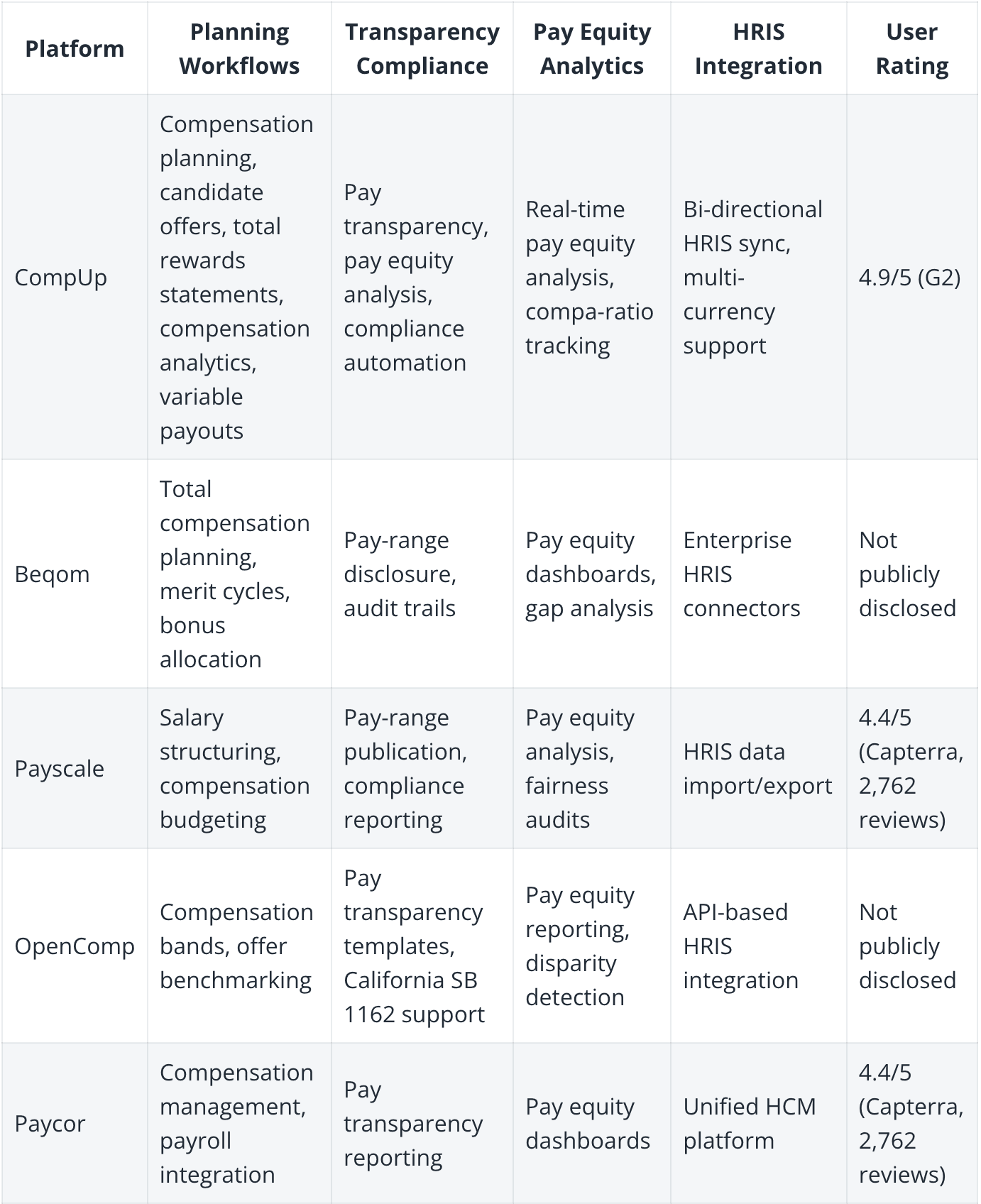
Platforms that embed compliance capabilities directly into planning workflows reduce the manual data-transfer step that often introduces version-control issues during high-volume merit cycles. Organizations evaluating these tools should verify that transparency disclosures auto-populate from the same data model used for budget approvals, rather than requiring a separate export-and-import step.
CompUp offers compensation planning, candidate offers, total rewards statements, compensation analytics, variable payouts, and pay transparency within a single platform designed for mid-sized to large organizations. The system provides real-time pay equity analysis, compa-ratio tracking, and compliance automation, with bi-directional HRIS integration and multi-currency support for global teams.
Strengths
Limitations
Best for: Mid-sized to large organizations managing merit cycles, equity grants, and variable pay under state-level pay-transparency mandates, particularly those seeking to consolidate planning and compliance workflows into a single platform with real-time audit trails.
For a deeper dive into how enterprise teams configure compensation frameworks at scale, see our guide to enterprise compensation management key components.
While integrated platforms offer workflow convenience, dedicated pay equity tools address a different strategic priority: statistical depth over operational simplicity.
The assumption that all-in-one platforms always outperform bolt-on tools overlooks a key trade-off: dedicated pay equity software often delivers deeper statistical rigor than planning-first platforms' compliance add-ons.
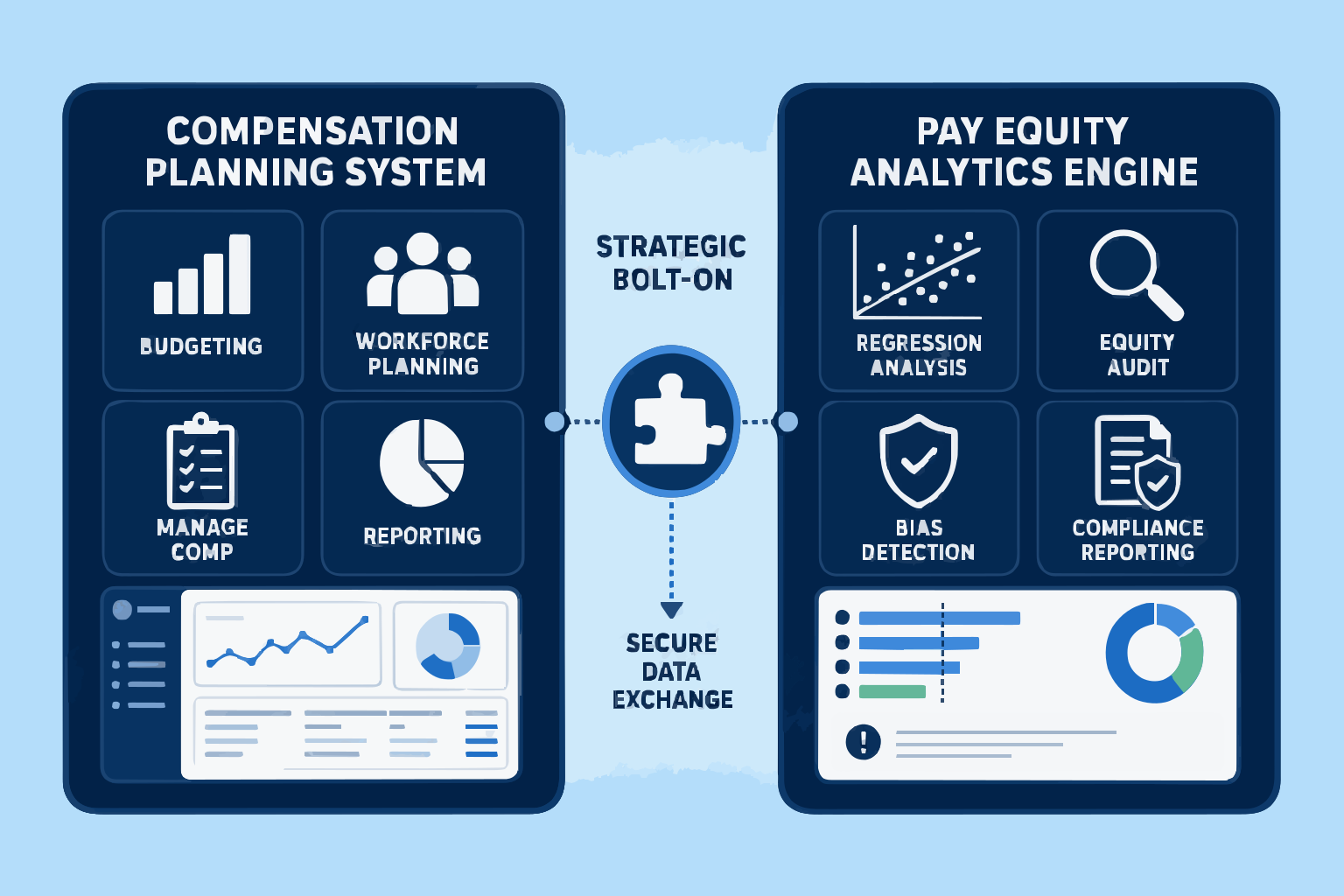
Choose a standalone equity tool when (1) your planning infrastructure is mature and stable, and (2) compliance depth, regression modeling, intersectional analysis, audit-ready documentation, matters more than integration convenience. If tool sprawl is low and mid-cycle recalculation frequency is high, unified platforms may be the better fit. But when legal exposure is significant or pay equity is a board-level priority, best-of-breed depth outweighs the hassle of a second login.[4]
What this means: bolt-on tools aren't a fallback option, they're a strategic choice for organizations where compliance rigor justifies the integration overhead.
Syndio and PayAnalytics lead the standalone equity-analytics market. Both integrate with existing planning systems and emphasize statistical modeling over surface-level gap reports. Syndio focuses on proactive remediation workflows; PayAnalytics highlights scenario modeling and regulatory reporting. These platforms serve organizations that need audit-grade analytics, regression models that control for legitimate factors (tenure, performance, location) and isolate unexplained pay gaps that signal compliance risk.
Key Takeaways: standalone equity tools trade integration simplicity for analytical depth. When compliance is a must-have, not a nice-to-have, they deliver the rigor planning-first platforms often don't.
A single-data-model architecture eliminates duplicate pay records and recalculation errors, but buyers must verify that marketing claims match operational reality.
Unified platforms eliminate mid-cycle recalculation errors and audit-trail gaps by maintaining one source of truth for pay data. When compensation planning, pay transparency reporting, and benchmarking draw from the same database, HR teams avoid version-control conflicts that plague multi-tool stacks. Platforms like CompUp, Beqom, and OpenComp position themselves as end-to-end solutions with simplified workflows, clear dashboards, and smooth integration[5], promising role-based guidance and real-time budget visibility under one roof.
Vendors market themselves as thorough, but public sources lack concrete workflow validation for full native compliance coverage. User reviews highlight guided merit cycles and predictive analytics[5], yet cross-reference analysis shows unified platforms are marketed rather than proven in third-party compliance audits. Buyers should conduct due-diligence demos that verify pay-scale publishing, pay-equity audit trails, and statutory reporting workflows operate within the same transaction layer, not bolted-on integrations that reintroduce data-reconciliation overhead.
Key Takeaways: Single-data-model platforms reduce error rates and audit gaps, but third-party proof of native compliance workflows remains limited, validate end-to-end capabilities in vendor demos before committing.
Also Read: When to Choose an Integrated Solution
Not every organization benefits equally from platform consolidation, the decision hinges on your compensation cycle frequency, compliance scope, and existing infrastructure maturity.
Not every organization needs a single platform that fuses compensation planning and pay transparency compliance. The right architecture depends on three variables: planning cycle frequency, geographic footprint, and regulatory complexity.
An integrated platform becomes key when compensation planning is continuous rather than annual, organizations running quarterly merit cycles, off-cycle promotions, and ongoing pay-gap remediation can't wait for batch updates between systems. Multi-country budget allocation adds another layer: when pay structures span currencies, tax regimes, and local statutory requirements, platforms like CompUp that support all geographic locations and compensation structures reduce manual reconciliation. Finally, when pay transparency laws by state continue to expand, affecting job postings, internal promotions, and employee pay requests, an integrated system ensures disclosure ranges update in lockstep with approved budgets.
Organizations with a single annual compensation cycle, a mature HRIS with strong APIs, and operations in one or two jurisdictions with stable transparency requirements often succeed with point solutions. In these settings the cost of integration, license fees, change management, training, outweighs the friction of periodic manual exports. External competitiveness and internal equity remain priorities, but the workflow cadence is predictable enough that spreadsheet-to-HRIS handoffs work.
Unified platforms reduce mid-cycle sync errors and tool sprawl but may lack the statistical rigor, regression modeling, intersectional analysis, of dedicated pay equity tools like Syndio or PayAnalytics. Bolt-on transparency modules suit organizations with mature planning infrastructure and deep equity-analysis needs; native-integrated platforms suit teams managing frequent merit cycles or multi-country budget allocations.
As pay transparency laws expand across US states and the EU Pay Transparency Directive enforcement ramps up through 2027, the competitive differentiation among compensation platforms will shift from feature breadth to workflow proof, vendors who can demonstrate real-time equity tracking and unified audit trails during planning cycles will capture the high-integration buyer segment.
Compare your current compensation planning and transparency tool stack against the decision framework in section 6, then explore CompUp's unified platform to see how integrated workflows reduce HR tool complexity during compliance rollout.
Pay transparency software manages disclosure compliance, posting salary ranges, sharing pay data with employees and regulators, while pay equity tools perform fairness analysis through statistical gap detection and remediation planning [1][2]. Transparency laws mandate what you publish; equity analysis ensures the fairness of what you pay [3].
Unified platforms claim real-time equity tracking as pay changes occur during merit cycles, but public sources lack workflow proof of native integration [1]. Bolt-on equity tools require manual data sync between planning and equity systems, introducing lag and potential audit gaps [2][3]. Validate vendor workflows in live demos beyond marketing claims.
California, Colorado, New York, and Washington enforce active pay transparency laws in 2026, with compliance timelines varying by employer size and jurisdiction [1]. Additional states continue to introduce legislation, creating overlapping deadlines for multi-state employers [2][3]. Reference Pave's 2026 state-by-state guide for current mandates.
It's a trade-off: integrated platforms reduce tool sprawl and mid-cycle sync errors but may lack equity-analysis depth, while bolt-on tools offer deeper statistical rigor at the cost of HRIS integration maintenance [1][2]. Organizations with continuous merit cycles benefit most from integration; stable annual cycles often succeed with point solutions [3].
CompUp offers compensation planning, pay transparency, pay equity, total rewards statements, and compensation analytics in a unified platform [1]. It positions as one of several vendors marketing integrated workflows, though public sources do not validate full native compliance coverage across the industry [2][3]. Verify end-to-end workflows in vendor demos.
Unified platforms require payroll system integration for current pay data, HRIS integration for employee demographics and job architecture, and optionally survey integration for market benchmarking [1][2]. Running separate planning and transparency systems multiplies integration complexity, as each tool needs its own HRIS connector and security audit [3].
No, transparency laws mandate disclosure of pay data, not specific tools [1][2]. Software automates operational efficiency and audit-trail generation but is not a compliance prerequisite [3]. Frame software as a workflow enabler that reduces manual error and documentation burden, not as a legal requirement for meeting disclosure mandates.
Community Manager (Marketing)
As a Community Manager, I’m passionate about fostering collaboration and knowledge sharing among professionals in compensation management and total rewards. I develop engaging content that simplifies complex topics, empowering others to excel and aim to drive collective growth through insight and connection.
Revolutionizing Pay Strategies: Don't Miss Our Latest Blogs on Compensation Benchmarking